JEE Advanced 2026 Paper Analysis: Chemistry Difficulty Level, Toughest Questions & What It Means for JEE 2027
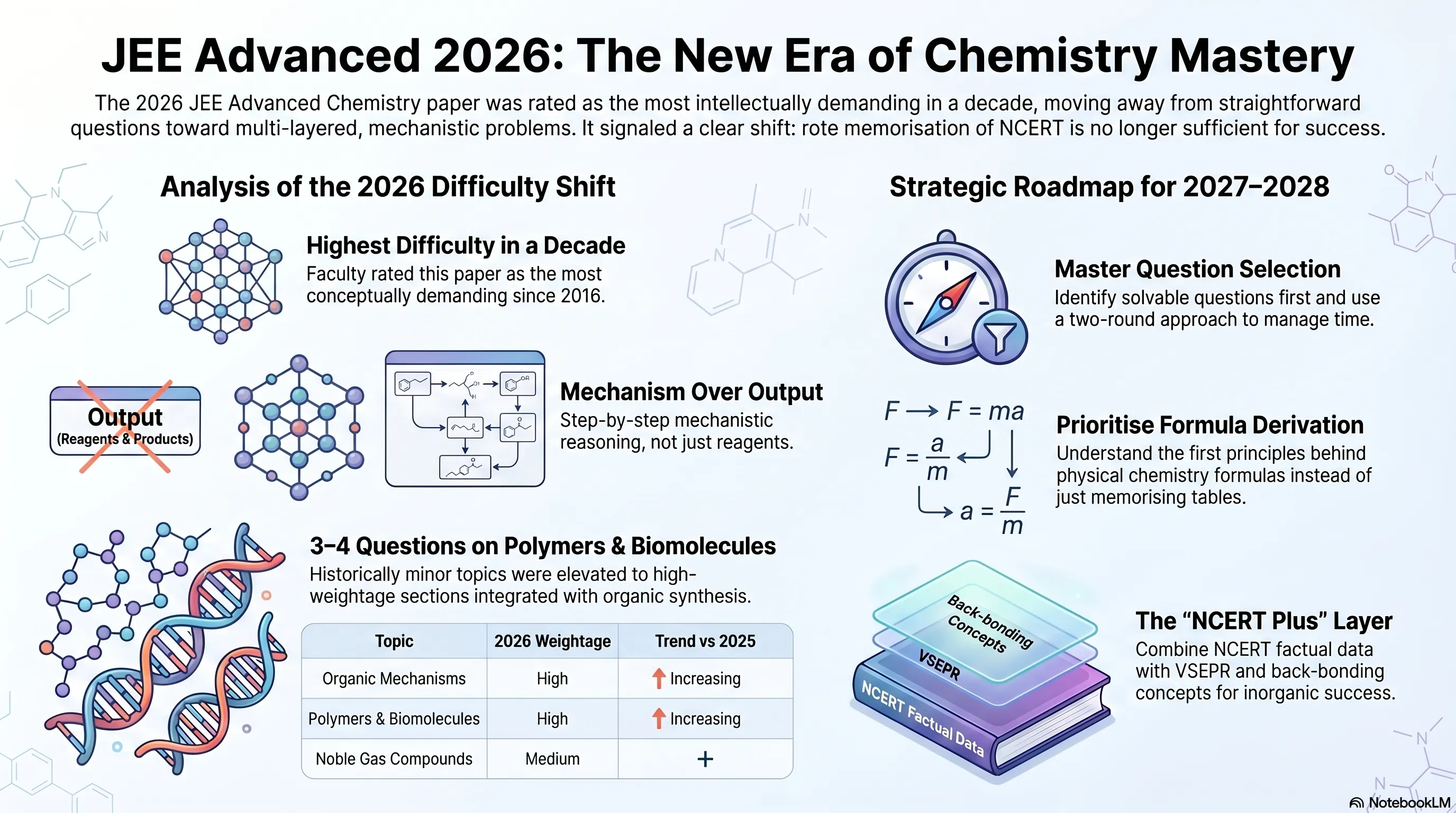
JEE Advanced 2026 Chemistry was one of the toughest in recent memory. Organic chemistry dominated with complex multi-step mechanism questions never seen in 17+ years of JEE history. Physical chemistry combined electrochemistry, colligative properties, and ionic equilibrium in single multi-concept problems. Paper 1 was significantly harder than Paper 2. Students who lacked depth across all topics struggled to complete the paper in the allotted time.

Table of Contents
- JEE Advanced 2026 Chemistry: Overall Difficulty Level
- Organic Chemistry Analysis: What Made Paper 1 So Tough?
- Inorganic Chemistry Analysis: NCERT Is Not Enough Anymore
- Physical Chemistry Analysis: Multi-Concept Questions That Stumped Students
- Topic-Wise Difficulty and Weightage Table
- What Should JEE 2027 and 2028 Aspirants Learn From This Paper?

eSaral ›JEE ›JEE Advanced JEE Advanced 2026 Paper Analysis

JEE Advanced 2026 Chemistry: Overall Difficulty Level
JEE Advanced 2026 Chemistry was a significant step up from 2025 in terms of depth and conceptual demand. eSaral's chemistry faculty — who together have over 80 years of JEE teaching experience — rated this paper among the most intellectually demanding Chemistry papers of the past decade.
How Did 2026 Compare to Previous Years?
The 2025 paper was considered relatively straightforward, particularly in inorganic chemistry, yet the cut-off still fell surprisingly low. In contrast, the 2026 paper demanded multi-layer thinking across all three sections — organic, inorganic, and physical — and it showed.
Paper 1 vs Paper 2: Paper 1 was noticeably tougher than Paper 2, especially in organic chemistry. Paper 2 had a somewhat more approachable set of questions, but the overall difficulty remained at an elevated level compared to 2025.
💡 Expert Insight by eSaral Chemistry Faculty: "This paper was about question selection strategy. Students who tried to attempt everything ran out of time. Those who identified solvable questions first, completed two rounds, and managed time wisely came out ahead. The paper was designed to be left partially unanswered — and that's perfectly fine."
Key Takeaway
A student who expected to "manage" Chemistry in one hour could not do so in 2026. Time management and question selection — always important — were absolutely critical this year.
Organic Chemistry Analysis: What Made Paper 1 So Tough?
Organic chemistry dominated JEE Advanced 2026 in both volume and difficulty. Faculty at eSaral noted that the weightage of organic chemistry was higher than in 2025, and the nature of questions was unlike anything seen in the last 17+ years.
A Match-the-Column Question 17 Years in the Making
The standout question in Paper 1 was a match-the-column question involving oximes. Two types were given — an aldoxime and a ketoxime — and students had to track the reaction pathway under aqueous basic conditions (NaOH) through acid-base reactions, internal nucleophilic (ARSN2) attack, ring formation, and then distinguish whether the reaction would proceed further based on whether an acidic H was present.
This question required:
- Understanding of Beckmann rearrangement and its stereochemical implications
- Knowledge of internal vs external nucleophilic competition
- Step-by-step mechanistic reasoning without any direct formula shortcut
- Stereochemical awareness to determine when ring opening would or would not occur
💡 Expert Tip by eSaral Senior Chemistry Faculty: "If your student learned reactions as outputs — reagent in, product out — this question stopped them cold. You need to know why each step happens mechanistically. The 2026 paper is a clear signal: mechanism is not optional for JEE Advanced."
Biomolecules, Polymers, and Physical Chemistry Together
JEE Advanced 2026 asked 3–4 questions from the Biomolecules and Polymers section — a historically underweighted area. What made these questions especially challenging was that organic reactions were embedded inside polymer questions. For example:
- A question involved converting a starting material through KCN, hydrolysis, HVZ reaction (alpha-bromination), then reaction with excess ammonia to form glycine — ultimately asking about nylon-2-nylon-6 formation and its molecular mass via a physical chemistry calculation.
- Students had to know that caprolactam hydrolyses to give a 6-carbon amino acid, and then combine this with mole-based mass calculations involving loss of water during polymerisation.
This multi-step question merged organic synthesis, polymer chemistry, and physical chemistry calculations in one problem — demanding that students know the entire chapter, not isolated reactions.
Key Organic Chemistry Topics That Appeared
- Oxime chemistry and Beckmann-type elimination
- Internal vs external nucleophilic attack (ARSN2, ipso attack)
- Chemo-selective reduction (LiAlH4 vs BH3-THF) with stereochemistry
- Biomolecules: glycine formation via HVZ + NH3 route
- Polymers: caprolactam hydrolysis → nylon-6; combined with nylon-2 to make nylon-2-nylon-6
- Aldol condensation after ozonolysis of natural rubber
Inorganic Chemistry Analysis: NCERT Is Not Enough Anymore
Inorganic chemistry in JEE Advanced 2026 was lower in volume compared to organic and physical, but the questions that appeared were multi-concept in nature. The 2025 paper had straightforward inorganic; 2026 changed that.
What the Paper Actually Tested
eSaral faculty noted two major inorganic questions worth analysing:
Question 1 — Group 17 (Halogens) + Group 15 (Nitrogen compounds): This question involved the reaction of MnO2 with concentrated HCl to generate Cl2, which then reacted with NH3 in different ratios (Cl2 excess → NCl3 explosive; NH3 excess → NH4Cl + N2) and F2 to give ClF3 at specific temperature (573 K) and pressure conditions.
Students were then asked about:
- Uses of Cl2 (sterilising drinking water — NCERT line)
- Geometry of NCl3 (trigonal pyramidal, not planar — VSEPR)
- Uses of ClF3 (enrichment of uranium-235 — NCERT line)
- Whether NCl3 is a stronger Lewis base than NH3 (it is NOT — NH3 has a fully available lone pair; NCl3 has back-bonding and -I effect of Cl reducing availability)
Question 2 — Noble Gas Compounds (XeF4, XeF6, XeO3): This question revisited a topic not featured prominently since 2016. Students were asked to:
- Produce XeF4 from Xe + F2 (1:5 ratio, 873 K, 6 bar)
- React XeF4 with O2F2 to give XeF6
- Perform complete hydrolysis of XeF6 → XeO3
- Then answer geometry and bonding questions:
- Does XeF4 contain two lone pairs on the central atom? ✅ Yes — square planar, sp3d2, two equatorial lone pairs
- Is XeF6 a perfect octahedral? ❌ No — it has a stereochemically active lone pair; distorted structure
- Is XeF6 a fluorinating agent? ✅ Yes — NCERT line
- Is XeO3 trigonal pyramidal? ✅ Yes — sp3 hybridised
This question mixed reaction knowledge (pressure/temperature conditions from NCERT tables), application (fluorinating agent uses), and chemical bonding (VSEPR geometry) all in one.
The Inorganic Warning for JEE 2027
Rote-learning NCERT reactions is necessary but not sufficient. The 2026 paper demanded that students know the NCERT table of interhalogen compounds — including ratios, conditions, colours, and uses — while simultaneously applying VSEPR theory and understanding back-bonding effects on Lewis basicity. Students who treated inorganic as a memorisation exercise found themselves trapped by the conceptual options.
Physical Chemistry Analysis: Multi-Concept Questions That Stumped Students
Physical chemistry in JEE Advanced 2026 was described by eSaral faculty as "one of the best-designed physical chemistry papers in the last 10 years" — which is another way of saying it was deeply difficult.
The First Question of Paper 1: A Multi-Chapter Marathon
The opening question combined:
- Debye-Hückel-Onsager equation to find limiting molar conductivity from two concentration data points (three salts: NaNO3, NaCl, AgNO3)
- Kohlrausch's Law to calculate λ∞ of AgCl from the three individual salt values
- Solubility calculation from the AgCl conductivity data (κ given; x = solubility to find)
- Final answer as log(1/x) — requiring log calculation
This was the first question of Paper 1. Students who attempted it first without strong electrochemistry and solution chemistry fundamentals lost significant time.
Paper 2's Opening Question: Colligative Properties + Van't Hoff Factor
The first question of Paper 2 involved a solute B dissociating into C and D, with:
- Molar mass of B = 10 × molar mass of solvent
- Boiling point of pure solvent = 400 K
- Standard enthalpy of vaporisation = 10R (used to calculate Kb via the full R × Molar mass of solvent / 1000 × ΔHvap formula)
- Solution of 25% B (by mass) boils at 408 K
- Find: percentage dissociation of B
This required students to: derive Kb from the enthalpy formula, convert mass percent to molality, apply the van't Hoff factor formula (i = 1 + 3α for B → 2C + D), and solve for α.
💡 Expert Tip by eSaral Physical Chemistry Faculty: "The KB formula using R, molar mass of solvent, and ΔHvap is taught but rarely practised from first principles. Students who only remember the 'Kb table' formula without understanding its derivation could not use it here. Always know where your formulas come from."
Topic-Wise Difficulty and Weightage Table
| Topic | Appeared In | Difficulty | JEE 2026 Weightage | Trend vs 2025 |
|---|---|---|---|---|
| Organic Mechanisms (oximes, ARSN2) | Paper 1 | Very High | High | ↑ Significantly |
| Polymers + Biomolecules | Both Papers | High | High | ↑ Significantly |
| Stereo-selective Reduction | Paper 1 | High | Medium | ↑ New pattern |
| Electrochemistry (Debye-Hückel) | Paper 1 | Very High | High | ↑ |
| Colligative Properties + Van't Hoff | Paper 2 | High | High | → Same level |
| p-Block: Halogens + N compounds | Paper 1 | High | Medium | ↑ vs 2025 |
| Noble Gas Compounds (Xe) | Paper 2 | Medium-High | Medium | ↑ After a gap since 2016 |
| Ionic Equilibrium / Solubility | Both Papers | High | High | → Consistent |
| Chemical Bonding (VSEPR, Lewis) | Embedded in IOC | Medium | High | ↑ Back in force |
| Thermodynamics | Paper 2 | Medium | Medium | ↓ Less than expected |
What Should JEE 2027 and 2028 Aspirants Learn From This Paper?
The JEE Advanced 2026 Chemistry paper sends a clear message to students preparing for JEE 2027 and JEE 2028. eSaral faculty distil it into five principles:
1. Mechanism Is Non-Negotiable in Organic Chemistry
Memorising reactions as input-output pairs is a strategy that failed in 2026. Every tough organic question required students to reason through each step — identifying nucleophiles, deciding between internal and external attack, understanding when a reaction stops and why.
Action point: Study organic reaction mechanisms from first principles. Know why NaOH in aqueous medium leads to a different product than NaOH with Na2CO3. Know when internal cyclisation is preferred over external attack.
2. Treat Polymers and Biomolecules as a Full Chapter — Not an Afterthought
These topics collectively contributed 3–4 questions in JEE Advanced 2026. Students who skipped them because "they don't come in JEE Mains" lost 8–10 marks unnecessarily.
Action point: Study caprolactam, nylon-2-nylon-6, biodegradable polymers (PHBV, nylon-2-nylon-6), and natural rubber thoroughly. Practice ozonolysis and aldol condensation as applied to natural polymer structures.
3. Physical Chemistry Requires Full Chapter Understanding
A student who knew molality but not how to derive Kb from enthalpy of vaporisation could not complete the Paper 2 opening question. A student who knew solubility product but not the Debye-Hückel-Onsager equation could not complete the Paper 1 opening question.
Action point: When studying physical chemistry, ensure you know every formula's derivation, not just its application. Build depth, not just breadth.
4. Inorganic Chemistry Needs NCERT + Concept Layer
NCERT is still the foundation — application facts, uses, and reactions are pulled directly from NCERT tables. But conceptual options (Lewis basicity comparisons, geometry of unusual compounds) require chemical bonding understanding on top.
Action point: Study the interhalogen compound table in NCERT completely — every ratio, condition, colour, and use. Then layer VSEPR and back-bonding concepts on top.
5. Question Selection Is a JEE Skill
JEE Advanced 2026 was a "selection paper." Attempting every question linearly was a losing strategy. Students who skimmed all questions first, marked the approachable ones, attempted those in Round 1, and returned for harder ones in Round 2 performed significantly better.
Action point: Practice timed mock tests where you deliberately skip hard questions and return. This meta-skill is as important as content knowledge. eSaral's JEE Advanced test series is specifically designed to train this under exam conditions.
Frequently Asked Questions
Find answers to common questions.
How tough was JEE Advanced 2026 Chemistry compared to 2025?
JEE Advanced 2026 Chemistry was considerably tougher than 2025. Organic chemistry had multi-step mechanism questions that were unprecedented in recent JEE history. Physical chemistry opened both papers with multi-chapter problems. The 2025 inorganic section was one of the easiest in years; 2026 reversed that trend with concept-heavy noble gas and halogen questions.
Which section was the toughest in JEE Advanced 2026 Chemistry?
Organic chemistry in Paper 1 was the toughest section. The oxime-based match-the-column question and the polymer + glycine question were both highly complex, requiring mechanistic reasoning and integration of concepts from multiple chapters. Physical chemistry was a close second in difficulty.
Was Paper 1 or Paper 2 harder in JEE Advanced 2026 Chemistry?
Paper 1 was harder than Paper 2 in Chemistry. Paper 1 had the most difficult organic and physical chemistry questions, including the novel oxime mechanism question and the multi-step electrochemistry problem. Paper 2 was more approachable but still above the average difficulty of recent years.
What is the expected JEE Advanced 2026 Chemistry cut off?
The exact cut-off depends on overall performance across all subjects. Given the high difficulty of Chemistry in 2026, Chemistry-specific scores may be lower than in 2025. However, JEE Advanced cut-off is evaluated across all three subjects combined. Students should watch for NTA's official declaration at jeeadv.ac.in.
What should JEE 2027 aspirants learn from the JEE Advanced 2026 paper?
JEE 2027 aspirants should prioritise mechanistic understanding over rote learning in organic chemistry, treat biomolecules and polymers as full-weight chapters, and ensure physical chemistry depth includes formula derivations (not just applications). Inorganic chemistry requires NCERT mastery plus conceptual chemical bonding knowledge. See the JEE Advanced question papers archive to practice with official papers.