JEE Drop Year Decision: The 3-Question Framework That Has Guided 4,000+ Droppers to IIT (2026)
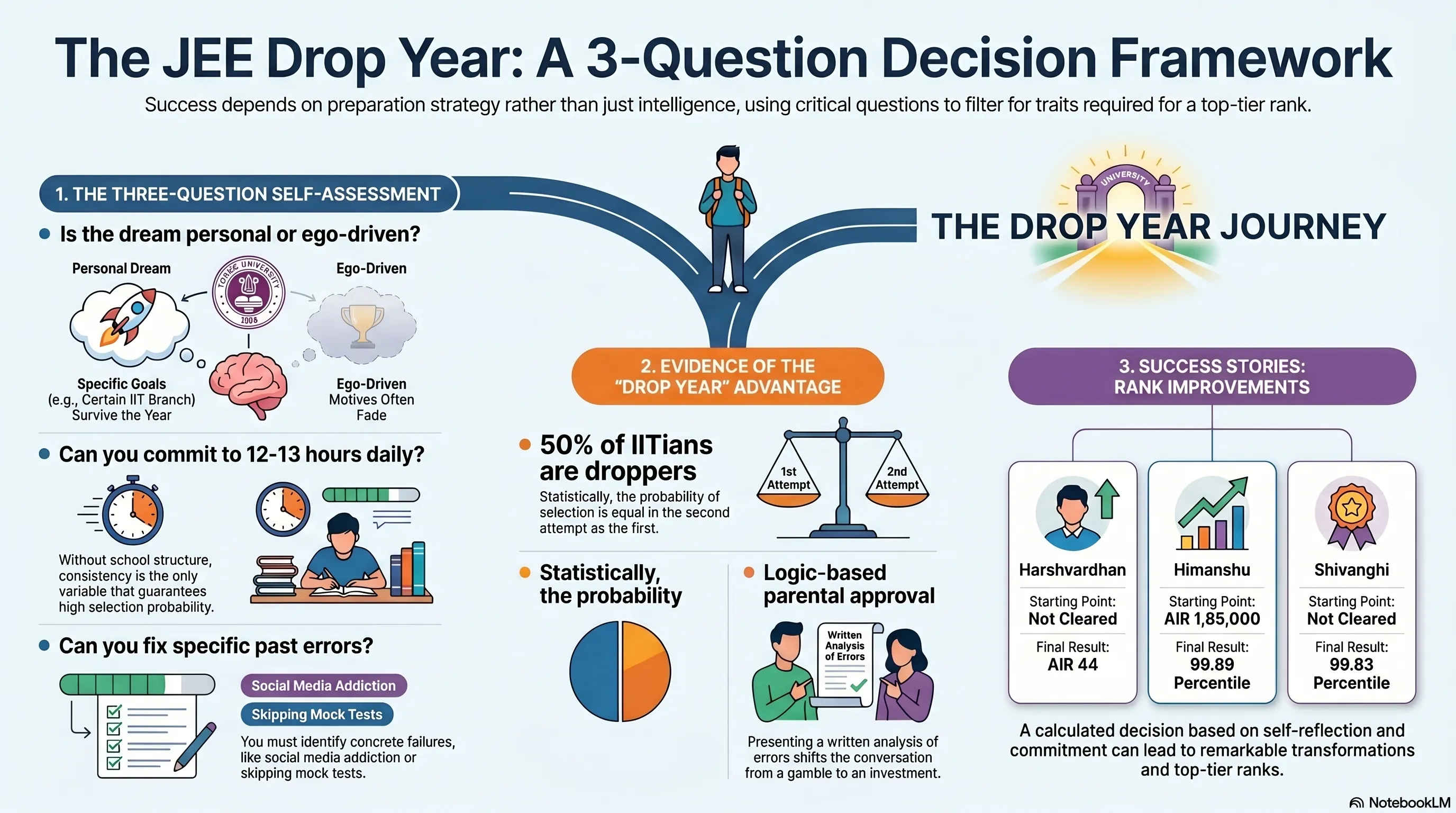
A JEE drop year is worth taking only if three conditions are simultaneously true: your IIT dream is non-negotiable and deeply personal, you can genuinely commit to consistent 12–13 hours of daily study for a full year, and you can honestly identify your past mistakes and stop repeating them. If even one of these three is missing, a drop year will likely produce the same result as Class 12.

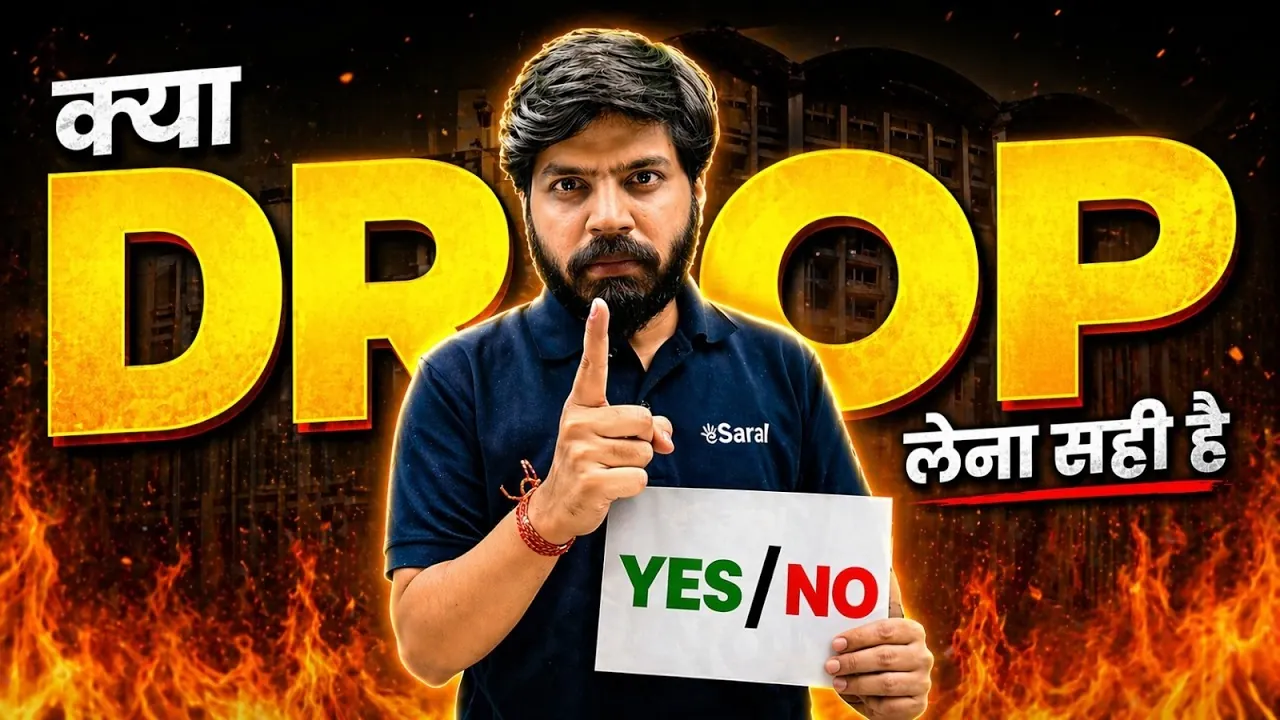
Table of Contents
- Is a JEE Drop Year Worth It?
- Question 1: Is Your IIT Dream Truly Non-Negotiable?
- Question 2: Can You Stay Consistent for an Entire Year?
- Question 3: Can You Honestly Identify and Fix Your Past Mistakes?
- What the Data Says: Drop Year Success Stories from eSaral Students
- How to Convince Your Parents About a JEE Drop Year

eSaral › JEE › JEE Main ›JEE Drop Year Decision

Is a JEE Drop Year Worth It?
The short answer: Yes — for students who meet specific conditions. But the qualifier matters enormously.
IIT is worth three additional years of preparation, not just one — provided you are the right candidate for a drop year. The four years inside a top-5 IIT — the network, the facilities, the exposure, the opportunities that follow — are genuinely incomparable to any other college in India.
Here is a data point worth anchoring your decision on: roughly 50% of IIT selections every year come from drop-year students. As many students reach IIT in their second attempt as in their first. So the probability of getting selected in a drop year is not lower than in Class 12 — it is, statistically, roughly equal, provided you prepare differently.
The question is not whether a drop year is worth it in the abstract. The question is whether you are the right candidate for one. That is what the three-question framework answers.
Question 1: Is Your IIT Dream Truly Non-Negotiable?
What This Question Is Really Asking
This is not about whether you want to go to IIT. Everyone wants to go to IIT. This is about whether your desire is deep enough to survive 365 days of grinding, self-doubt, social isolation, and uncertainty — and still keep going.
Ask yourself this, as honestly as you can: If I don't get into IIT this year, will I regret not giving it one more structured attempt for the rest of my life?
If the answer comes from your gut — not from comparison with a friend, not from placement statistics you read online, not from someone shaming you — and the answer is yes, then your dream passes the first test.
The Difference Between a Real Dream and an Ego Reaction
Many students confuse a genuine long-term aspiration with a short-term emotional reaction. "Mujhe duniya ko dikhana hai" (I have to prove the world wrong) is not a foundation for a drop year. It lasts three months. Then it fades. Then you're back to old habits.
A real dream is personal. Harshvardhan, who scored AIR 44 after his drop year from eSaral, described it this way: "I knew exactly which branch of which IIT I wanted to enter. That specificity kept me grounded on the days when motivation disappeared."
| Type of Motivation | Drop Year Durability |
|---|---|
| Specific IIT branch + personal reason | High — lasts the full year |
| General desire for IIT prestige | Medium — fades after 3–4 months |
| Revenge/ego / social pressure | Low — collapses under the first setback |
| Someone else's dream for you | Very Low — causes burnout fast |
If your IIT dream is personal, specific, and non-negotiable — your answer to Question 1 is YES. Move to Question 2.
If the answer is no — or even "maybe" — do not take a drop year. Give the upcoming exam your best, join the best college available to you, and build your career from there. Non-IITians succeed at the highest levels every day.
Join JEE Dropper Batch Now – Online & Offline Available
Start your focused drop year with structured mentorship, expert faculty, and a proven study system. Choose flexible online learning or classroom coaching, follow a disciplined plan, and maximize your chances of securing a top rank in JEE.
Question 2: Can You Stay Consistent for an Entire Year?
Why Consistency Is the Only Variable That Matters
A drop year is not harder than Class 11+12 because the syllabus is different. It is harder because you have no external structure. No school schedule. No peer group pulling you into class. No teacher tracking your attendance. Just you, the syllabus, and 365 mornings where you have to choose to show up.
Ask yourself honestly: Can I study for 12–13 hours every day, attend every live or recorded class without skipping, and give every scheduled mock test for an entire year?
What Consistency Actually Looks Like in Practice
"Consistent" does not mean robotic. It does not mean zero recreation. Every successful eSaral dropper had some daily downtime. Harshvardhan used to take breaks. Mahip (who scored 99.63 percentile) played with his younger brother every evening. Shivanghi (who scored 99.83 percentile in her drop year) had personal interests she maintained throughout.
The key: they limited distractions to one hour per day. Not as guilt. As a planned, earned break.
| Study Pattern | Expected Outcome |
|---|---|
| 12–13 hours/day, consistent, all classes attended | High selection probability |
| 8–10 hours/day, but with frequent missed classes | Moderate — ceiling hit at 95–97 percentile |
| Inconsistent — good weeks and bad weeks | Likely repeat of Class 12 result |
| First 3 months strong, then motivation crashes | Almost certain failure |
If your honest self-assessment says yes — you can sustain 12–13 hours daily for one full year — your answer to Question 2 is YES. Move to Question 3.
If you know, honestly, that this level of discipline is not where you currently are, don't take a drop year. The structure won't create the discipline. The discipline has to come first.
Question 3: Can You Honestly Identify and Fix Your Past Mistakes?
Why This Is the Most Important Question
This is where most students stumble. Not because they can't study. But because they take a drop year and do the same things they did in Class 11 and 12, just in a different year.
The most common errors that cause drop years to fail:
- Academic errors: Skipping doubt sessions, letting backlogs build, missing tests, not interacting with teachers, surface-level concept understanding
- Behavioural errors: Excessive scrolling, gaming, social media, Snapchat, romantic distractions, sleeping late
- Environmental errors: Wrong coaching, no peer accountability, no structured timetable
A student, Saransh Gupta, mentored Himanshu, who improved from AIR 1,85,000 to 99.89 percentile in his drop year — identified his core error bluntly: "I was addicted to scrolling. I wasted 6–7 hours a day on reels. I admitted this to my parents and to myself. Then I deleted the apps."
Two-Part Honesty Test
Part A: Can you name, specifically, what cost you marks last year? Not vague answers like "I didn't study hard enough." Specific ones: Which chapters were weak? Which tests did you skip? Which distractions took the most hours?
Part B: Can you commit to fixing each of those specific things — even the uncomfortable ones?
If you can answer both parts concretely, your answer to Question 3 is YES.
What the Data Says: Drop Year Success Stories from eSaral Students
Over the past 10 years, more than 4,000 students taught by Saransh Gupta and the eSaral faculty team have gone from dropper to IITian. These are not inspirational anecdotes — they are patterns.
| Student | Drop Year Starting Point | Final Result |
|---|---|---|
| Harshvardhan | JEE not cleared in Class 12 | AIR 44 |
| Himanshu | AIR ~1,85,000 | 99.89 percentile |
| Shivanghi | Not cleared in Class 12 | 99.83 percentile |
| Mahip | Moderate percentile | 99.63 percentile |
| Kavyanjali | Not cleared | 99.2 percentile |
| Vineet | Not cleared | 99.49 percentile |
What did they have in common? All three of Saransh Sir's questions were answered yes by every single one of them — before they enrolled in the drop-year batch.
How to Convince Your Parents About a JEE Drop Year
Once you've worked through the three questions and your answers are all you, the next challenge is often the conversation at home.
Here is a framework that works:
Step 1: Show your self-analysis, not just your desire. Parents trust logic over emotion. Present a written list of what went wrong in Class 12 and what specifically you will do differently. This signals maturity.
Step 2: Separate the investment from the gamble. A drop year with a structured plan is not a gamble. It is an investment. Frame it that way. The cost of one year is real. But the cost of spending 40 years in a career that doesn't match your ability is far higher.
Step 3: Cite realistic data. Roughly half of the IIT selections each year are from drop-year students. This is not a path for the desperate — it is the path that half of IITians walk.
Step 4: Set a mutual agreement. Offer a milestone review — at 3 months and 6 months — where you show test scores, class attendance records, and mock results. This gives your parents visibility and gives you accountability.
💡 A Note to Parents: If your child can genuinely answer all three questions with yes, please consider allowing the drop year. One year invested in this framework rarely goes to waste — even for students who fall short of IIT. The discipline, resilience, and work ethic built in a serious drop year preparation pay dividends for decades.
Frequently Asked Questions
Find answers to common questions.
Should I take a drop year for JEE if my rank is very low?
A low rank alone is not a reason to take or skip a drop year. The decision depends on your answers to three questions: Is IIT non-negotiable for you? Can you stay consistent for 12 months? Can you honestly identify and fix your past mistakes? If all three are yes, take the drop year regardless of how low the rank was.
How many hours should a JEE dropper study per day?
A JEE dropper should target 12–13 hours of focused study daily. This includes live or recorded class time, self-study, assignment completion, and scheduled mock tests. Successful eSaral droppers who reached 99+ percentile — including students who scored AIR 44 — maintained this schedule consistently, with one hour of planned recreation daily.
Is a JEE drop year worth it in 2026?
Yes, for the right student. Approximately 50% of IIT selections every year come from drop-year students, making the probability of success comparable to attempting JEE in Class 12. The IIT brand, network, and opportunity advantage justify the investment — provided the student has genuine motivation, consistency, and the ability to correct past mistakes.
What are the biggest mistakes JEE droppers make?
The most common drop year mistakes are: repeating the same academic habits that failed in Class 12, skipping doubt sessions or letting concept backlogs build, inconsistent class attendance, and not limiting digital distractions. Students who failed in their drop year typically did the same things they did in Class 11–12, just in a different year.
Can I crack JEE in a drop year without coaching?
It is possible, but significantly harder. Successful JEE droppers — including those at eSaral — consistently credited structured daily classes, doubt-solving systems, and peer accountability as critical to their improvement. Self-study alone rarely bridges a large percentile gap in one year. For JEE Main and Advanced preparation, structured dropper batch coaching with daily classes and mock tests is strongly recommended.