JEE Dropper Batch 2027: How to Go from Any Rank to IIT in One Year
A JEE dropper batch for 2027 is a one-year intensive programme for JEE 2026 students who missed their target IIT rank, combining live classes, personalised mentorship, and AI-powered test analysis to help achieve 99+ percentile in JEE Main and crack JEE Advanced — with proven results like AIR 79 and students moving from 3-lakh rank to IIT Bombay in a single year.
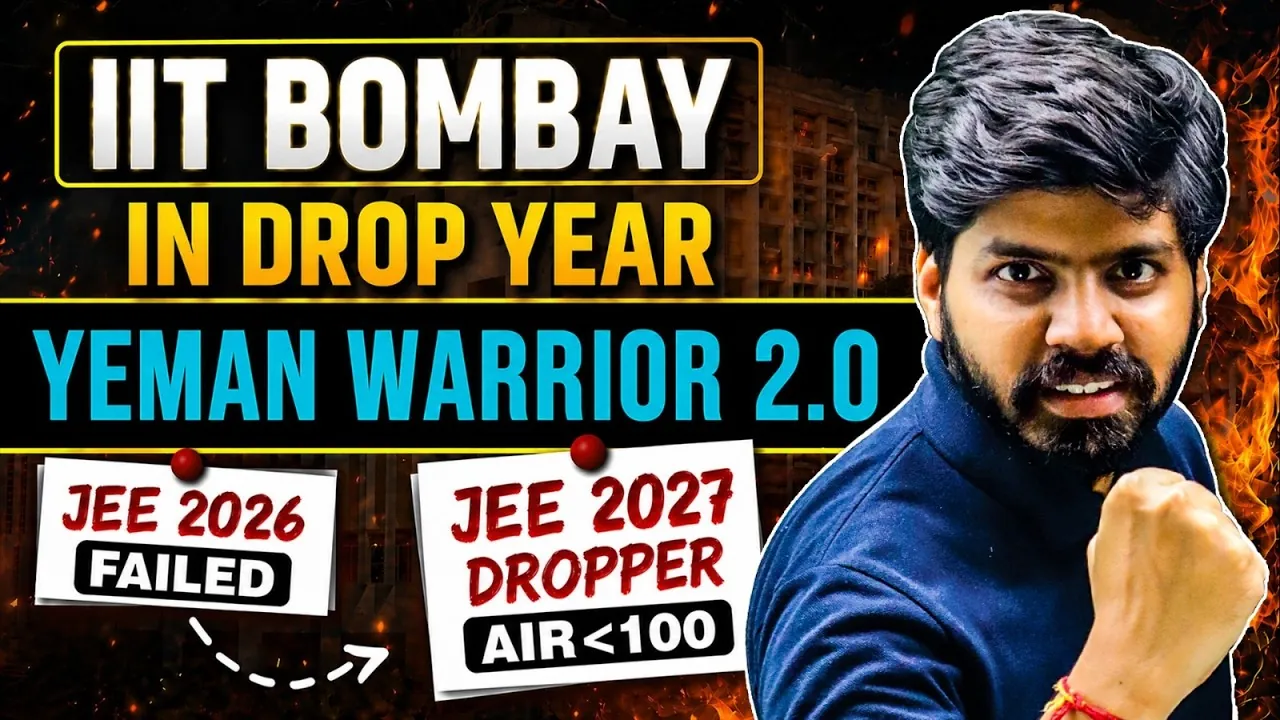
Table of Contents
- Does a Drop Year Actually Work for JEE?
- How Much Improvement Is Realistically Possible?
- The Biggest Trap Droppers Fall Into (And How to Avoid It)
- What Does the Best JEE Dropper Strategy Look Like?
- How Many Tests Should a Dropper Attempt?
- Online vs Offline Dropper Batch — Which Is Better?
- The eSaral Yoddha Warrior 2.0 Batch for JEE 2027

eSaral › JEE › JEE Main ›JEE Dropper Batch 2027

Does a Drop Year Actually Work for JEE?
Yes — JEE drop year preparation absolutely works when done with the right structure and mentorship.
The data from eSaral's 2025 batch speaks clearly. Harsh, a dropper, achieved AIR 44 in JEE Advanced. Yaman, another dropper, moved from a 1-lakh rank in Class 12 to IIT Bombay. Shweta came in with a 3-lakh rank and landed at IIT Kharagpur. Nidhi went from 90,000 rank to IIT Roorkee.
These are not exceptions. In eSaral's JEE 2025 batch, approximately 50% of the 1,250+ students who crossed the 99th percentile mark were droppers. The results table below shows the scale:
| Percentile Band | Number of eSaral Students |
|---|---|
| AIR 79 | 1 |
| 99.99 (AIR 44, AIR 73) | 2 |
| 99.98 | 12+ |
| 99.97 | 18+ |
| 99.96 | 25+ |
| 99.95 | 30+ |
| 99.00 and above | 1,250+ total |
The evidence is unambiguous. Drop year works — for students who commit to working.
How Much Improvement Is Realistically Possible?
Can a 3-Lakh Rank Student Reach IIT in One Year?
Yes. Shweta entered eSaral's dropper batch with a 3-lakh JEE Advanced rank. She exited with a seat at IIT Kharagpur. Yaman's starting rank was 1 lakh — he ended at IIT Bombay. A student who could barely hear during preparation used only audio from eSaral's classes and cracked IIT Hyderabad with a 97.5th percentile.
The improvement is not magic. It is a product of three things: starting from basics, consistent daily practice, and relentless test analysis.
What Percentile Do You Need in JEE Main for JEE Advanced?
To be safe for the JEE Advanced qualification, you need a 99+ percentile in JEE Main. The January attempt should be your primary target. Scoring 99.9+ in January frees you to focus entirely on JEE Advanced preparation from February onward without worrying about JEE Mains again.
| JEE Main Percentile | Likely Outcome |
|---|---|
| 99.9+ | Comfortably qualifies for JEE Advanced; IIT top branches within reach |
| 99.0–99.9 | JEE Advanced qualifier; older IITs reachable depending on category |
| 97–99 | Qualifies for JEE Advanced; newer IITs, NITs |
| Below 97 | Risk of not qualifying for JEE Advanced |
.webp)
The Biggest Trap Droppers Fall Into (And How to Avoid It)
"Main Toh Jaanta Hoon" — The Overconfidence Problem
The single most dangerous mindset a dropper can carry into their drop year is: "I already know this."
If you knew it well enough, the rank would have reflected it. That is not a harsh statement — it is an honest one. I made this same mistake in my own Class 12 year. The students who succeeded in their drop year — Harsh, Yaman, and Nidhi — all had one thing in common: they started from zero. They went back to basics, chapter by chapter, as if seeing the material for the first time.
Here is what typically happened in Class 11 and 12 that led to underperformance:
- Backlogs built up and were never cleared
- Test papers were attempted but never properly analysed
- Doubts accumulated and were never resolved
- No one was tracking whether you were attending class or not
A good dropper batch fixes all four of these problems structurally — not through motivation, but through accountability systems.
What Does the Best JEE Dropper Strategy Look Like?
Step 1: Start from the Basics — No Shortcuts
Every chapter, every concept, from the foundation. This is non-negotiable.
Step 2: Cover the Syllabus by December
A well-planned dropper batch completes the entire JEE syllabus by December. Not a rushed single-shot coverage, but chapter by chapter with proper depth. After December, all remaining time goes into revision.
Step 3: Two Full Revisions Before JEE Main January
The revision cycle that works:
- Revise within 24 hours of each class
- Weekly revision every Sunday
- Full chapter revision every 28 days
- Two complete syllabus revisions before January JEE Main
- Two additional revisions before JEE Advanced in May
Step 4: Daily Question Practice (Minimum 80–100 Questions Per Day)
With approximately 300 study days available, you need to solve a minimum of 80–100 questions daily. These cannot be easy questions. JEE Main difficulty has been rising every year. JEE 2026 January and April sessions were among the toughest in recent history. Your practice material must be at or above the Advanced level.
Step 5: Mandatory Test Analysis After Every Test
Solving tests without analysing them is one of the most common reasons students stagnate. After every test:
- Record every mistake in a dedicated error book
- Categorise errors: conceptual gaps, calculation errors, time management issues, or silly mistakes
- Track which sub-topics within chapters are consistently weak (e.g., not "Rotational Motion" broadly, but specifically "Moment of Inertia")
An AI-powered analysis report after each test can do this automatically — pinpointing your exact weak sub-topics and giving you a chapter-level performance map.
Step 6: Work With a Mentor, Not Just a Teacher
Teachers deliver content. Mentors track your progress, call you when you miss class, review your notes, analyse your test reports, and hold you accountable for daily targets. In Classes 11 and 12, no one tracked you. In your drop year, that changes.
A structured dropper batch provides:
- Dedicated mentors with direct phone access
- Regular note and homework checking sessions
- Backlog recovery sessions for topics you fall behind on
- Parent-teacher meetings (PTMs) for transparency
- Health and sleep tracking to prevent burnout
How Many Tests Should a Dropper Attempt?
The Test Strategy That Works for JEE 2027
Volume of tests matters — but only if every test is followed by analysis. Here is the structure that produces results:
| Test Type | Frequency | Duration | Syllabus |
|---|---|---|---|
| Chapter-level JEE Main test | After each chapter | 1 hour | Single chapter |
| Chapter-level JEE Advanced test | After each chapter | 1.5 hours | Single chapter |
| 28-day cumulative JEE Main | Monthly | 3 hours | All chapters covered |
| 28-day cumulative JEE Advanced | Monthly | 6 hours | All chapters covered |
| Revision phase full tests | Weekly | 3 / 6 hours | Full syllabus |
| All-India test series | Final 2 months | 3 / 6 hours | Full syllabus |
A serious dropper batch provides 200+ compulsory tests in a year, with full analysis support for each one. The All-India test series component is critical — it puts you against thousands of students simultaneously, giving you a realistic rank projection before the actual exam.
See the JEE Advanced marks vs rank page for a breakdown of how marks translate to ranks historically.
Online vs Offline Dropper Batch — Which Is Better?
How to Choose Between Online and Offline JEE Dropper Preparation
Both formats work. The deciding factor is not the medium — it is the quality of teaching and the personalisation of mentorship.
| Parameter | Online Dropper Batch | Offline Dropper Batch |
|---|---|---|
| Teaching quality | Depends on the platform | Depends on coaching |
| Access to the best faculty | Possible nationally | Limited to local or Kota |
| Personalisation | Varies widely | Varies widely |
| Doubt resolution | Platform-dependent | Proximity-dependent |
| Cost | Generally lower | Generally higher |
| Flexibility | Higher | Lower |
| Monitoring | Platform analytics + mentors | In-person |
The real differentiator is whether the online batch offers two-way live interaction rather than recorded lectures. In a properly designed live online batch, you can raise your hand, get unmuted, and have your doubt resolved in real time — exactly like an offline class.
At eSaral, the live online batch has been deliberately structured to replicate the Kota offline experience: interactive two-way classes, a dedicated online doubt counter, mentor call-ins when a student misses class, and homework that gets physically checked. The eSaral Gurukul offline batch at Kota runs in parallel for students who prefer in-person study.
"eSaral ki online class bhi Kota wali feel deti hai" — this is the feedback we receive consistently from students who switch from local coaching to eSaral online.
The eSaral Yoddha Warrior 2.0 Batch for JEE 2027
For students planning a drop year targeting JEE 2027, eSaral has launched the JEE 2027 Yoddha Warrior 2.0 batch. Key details:
- Format: Live online (interactive, two-way) + Offline Gurukul at Kota
- Target: Top 100 AIR in JEE Advanced; IIT Bombay CS, IIT Delhi CS
- Scholarship: Available based on JEE Main percentile (60% off as base scholarship, with additional merit scholarships)
- Syllabus completion: Full JEE + Advanced syllabus by December 2026
- Tests included: 250+ tests (200 compulsory)
- AI analysis: 20-page AI-powered test analysis report per test
- Doubt solving: 5-layer system — live class interaction, dedicated doubt counter, text/image doubt tool, mentor escalation, teacher callback
- Material: 30,000+ questions; no additional books required; content 3–4 levels above JEE Advanced
Faculty teaching in the batch include IIT alumni with 19–26 years of teaching experience, responsible for producing AIR 1, 2, 3, 5, 6, 7, 9, 10, 12, 13, and 14 in the past years.
Explore the full course details at eSaral JEE Online/Offline Courses.
Frequently Asked Questions
Find answers to common questions.
Is a drop year worth it for JEE Advanced if my current rank is above 1 lakh?
Yes, a drop year for JEE Advanced is worth it if you are committed to structured preparation. Students at eSaral have moved from 1-lakh rank to IIT Bombay and from 3-lakh rank to IIT Kharagpur in a single drop year. The key factor is not your starting rank — it is the quality of your preparation strategy and daily consistency.
How many hours should a JEE dropper study per day?
A JEE dropper should target 12 focused study hours per day. This includes 4–5 hours of live or recorded lectures, 4–5 hours of question practice, and 2 hours of revision. Time management and schedule adherence matter more than raw hours — sporadic 14-hour sessions followed by burnout days do not produce results.
Which is the best JEE dropper batch in India for 2027?
The best JEE dropper batch in India for 2027 is one that offers IIT-qualified faculty, personalised mentorship with direct mentor access, 200+ tests with AI-powered analysis, and two-way live classes. eSaral's JEE 2027 Yoddha Warrior batch meets all these criteria, with over 1,250 students achieving 99+ percentile in 2025, approximately half of whom were droppers.
Can I crack JEE Advanced in a drop year starting from basics?
Yes. Starting from basics in a drop year is not a setback — it is the correct strategy. Students who scored AIR 44 (Harsh) and those who moved from 3-lakh rank to IIT Kharagpur (Shweta) all began their drop year preparation from foundational concepts. Trying to skip basics because "you already know it" is the most common dropper mistake.
Is eSaral's online dropper batch as effective as Kota's offline coaching?
eSaral's online dropper batch is designed to replicate the Kota offline experience through two-way live classes, dedicated online doubt counters, homework checking, and mentor accountability. Students who switched from local offline coaching or even Kota-based coaching consistently report that eSaral's online personalisation exceeds what most large-batch offline centres offer.
When should a JEE dropper start preparation for JEE 2027?
A JEE 2027 dropper should start preparation immediately — ideally in May 2026. With the JEE Main January 2027 attempt approximately 8 months away and the full syllabus to cover from basics, every month lost at the start directly compresses revision time. Starting in May gives enough runway to complete the syllabus by December and complete two full revisions before the January attempt.