JEE Dropper Preparation: How to Get Into IIT in 1 Year
JEE droppers succeed through disciplined 10–12 hour daily study, personalized mentorship, 200+ tests with detailed mistake analysis, early JEE Advanced preparation, and a structured 12-month roadmap focused on consistency, revision, and emotional resilience.


Table of Contents

eSaral › JEE › JEE Main ›JEE Dropper Preparation: How to Get Into IIT in 1 Year

🚀 Checkout eSaral Courses
Why Droppers Fail (And How to Avoid It)
The Most Common Mistakes Droppers Make
Your first attempt already taught you what NOT to do. Most droppers fail in their second attempt because they repeat the exact same mistakes—just faster. The three most common errors are:
1. Lack of Discipline & Consistency: You had 12 months during 12th grade. You didn't stay regular. You skipped classes when you felt demotivated. You delayed test analysis. This year, that inconsistency will destroy you twice as fast because the competition is fiercer.
2. No Personalised Mentorship: During your school years, no one watched your individual progress. You were one of thousands in a classroom. In a dropper year, personalised guidance—someone who knows your weak chapters, your test patterns, your emotional triggers—is the difference between success and failure.
3. Underestimating JEE Advanced Difficulty: JEE Main has gotten harder. JEE Advanced is unforgiving. Many droppers improve their Main score but fail Advanced because they don't expose themselves to the right difficulty level early enough. You need to practice Advanced-level problems from month 6, not month 10.
💡 Expert Insight by Prateek Gupta, IIT Bombay : "In 2024, I watched three droppers in my mentorship—one scored 87 percentile in Main the first year, one 92. All three had the same issue: they'd solved thousands of problems but never analyzed their mistakes. The student who improved to AIR 47 in Advanced wasn't the one who solved the most questions. She was the one who kept a detailed mistake notebook and revisited errors every Sunday. Discipline beats raw effort every time."
What Successful Droppers Do Differently
The droppers who succeed share three non-negotiable habits:
| What Separates Top Droppers | Why It Matters |
|---|---|
| Regular homework & test checking | Identifies weak topics before exams, not after |
| Structured daily schedule (10–12 hrs) | Builds consistency; prevents procrastination |
| 200+ full-length tests over 12 months | Tests your stamina, exam strategy, time management |
| Personalized mentorship (1-on-1) | Someone knows YOUR progress, YOUR weaknesses, YOUR pace |
| JEE Advanced problem exposure from month 6 | Prevents last-minute panic when you realize Main ≠ Advanced |
| Emotional support network (mentor + peers) | Handles the psychological pressure unique to droppers |
Join eSaral's Droppers Batch – Available in both Online & Offline modes. Get expert guidance, structured preparation, and personalised mentorship to crack JEE/NEET with confidence!
The 12-Month JEE Dropper Preparation Timeline
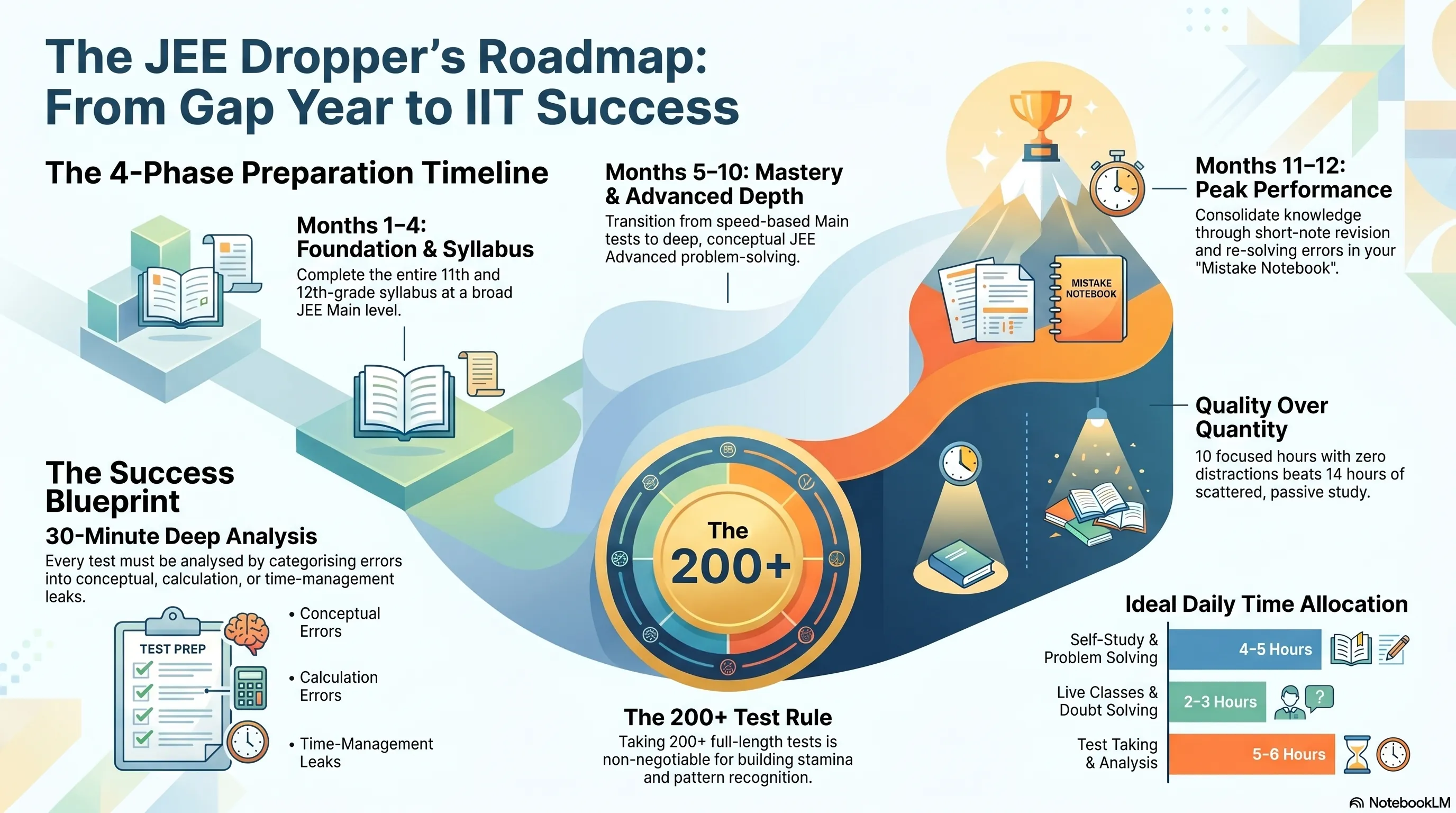
Your dropper year breaks into four clear phases:
Phase 1: Foundation & Syllabus Completion (Months 1–4)
Goal: Complete all of the 11th and 12th syllabus at the JEE Main level.
This is NOT the time to go deep. It's time to go broad. You need to understand every topic, solve chapter-wise problems, and take chapter-level tests. By the end of month 4, you should have seen every single topic that can appear on JEE Main.
Action Items:
- Enrol in eSaral's structured JEE 1-year dropper batch or foundation course
- Complete video lessons for all chapters (don't skip even "easy" chapters)
- Solve all chapter-wise practice problems (minimum 3 difficulty levels: Basic → Intermediate → Advanced)
- Take chapter tests every week (not optional)
Phase 2: JEE Main Mastery & Test Strategy (Months 5–7)
Goal: Reach 95+ percentile in JEE Main consistently; master test-taking strategy.
Now you stop doing individual chapters and start doing half-length tests (2–3 subjects), then full JEE Main tests. This phase teaches you time management, question-selection strategy, and which topics bleed marks on actual exams.
Action Items:
- Take 60+ JEE Main full-length tests
- Analyse each test for: wrong topics, calculation errors, and time leaks
- Identify your "weak" subjects and allocate extra time
- Practice mock exams in actual exam conditions (8:30 AM–11:30 AM)
Phase 3: JEE Advanced Problem Exposure (Months 8–10)
Goal: Jump to Advanced difficulty; build problem-solving intuition at great difficulty.
JEE Main and JEE Advanced are not the same game. Main is speed + accuracy. Advanced is depth + conceptual thinking. Now you practice problems that require multiple concepts, unusual approaches, and higher mental load.
Action Items:
- Take 50+ JEE Advanced full-length tests
- Study conceptual modules specifically for Advanced (provided in eSaral's JEE Advanced program)
- Practice "topper-level" problems (2A difficulty in eSaral's exercise system)
- Still take some JEE Main tests to maintain speed
Phase 4: Revision & Peak Performance (Months 11–12)
Goal: Consolidate, revise smartly, and peak exactly on exam day.
You've now seen everything. This phase isn't about learning new things—it's about sharpening execution, fixing weak areas, and building confidence through repeated success on harder problems.
Action Items:
- Take 40+ tests (mix of Main + Advanced)
- Do full-syllabus revisions with short notes
- Re-solve your mistake notebook problems (crucial)
- Reduce study volume slightly, focus on quality
Join eSaral's Droppers Batch – Available in both Online & Offline modes. Get expert guidance, structured preparation, and personalised mentorship to crack JEE/NEET with confidence!
Your Month-by-Month Study Roadmap
Month 1–2: Physics Foundation
- Mechanics (kinematics, forces, energy, momentum)
- Waves and oscillations
- Take 4 chapter tests per subject per week
Month 2–3: Chemistry Foundation
- Atomic structure, chemical bonding, stoichiometry
- Thermodynamics, equilibrium basics
- Take 4 chapter tests per subject per week
Month 3–4: Mathematics Foundation
- Sets, algebra, trigonometry
- Coordinate geometry, functions
- Calculus basics
- Complete all 11th syllabus topics
Month 5: First Half-Syllabus Tests
- Attempt 12–15 tests covering Topics 1–50% of syllabus
- Analyze weak areas
- Begin targeted revision of weak chapters
Month 6: Full Syllabus Main Tests + Advanced Exposure
- Take 10 JEE Main full tests
- Begin Advanced-level practice problems (start with 1–2 chapters)
- Analyze performance patterns
Month 7–8: Advanced Problem Mastery
- Take 15 JEE Advanced tests
- Solve 2A-level problems across all chapters
- Identify topics where Advanced differs from Main
Month 9–10: Mixed Testing + High Difficulty
- Take 25 tests (mixture of Main and Advanced)
- Focus on questions you got wrong; understand the root cause
- Revise entire chapters that still have leaks
Month 11: Full Revisions + Final Drills
- Complete 2 full revisions of entire syllabus via short notes
- Take 15 final tests
- Re-attempt all problems from your mistake notebook
Month 12: Final Peak + Exam Simulation
- Take 10 final full-length tests under exact exam conditions
- Sleep well; avoid learning new concepts
- Boost confidence through high-success-rate problem solving
Join eSaral's Droppers Batch – Available in both Online & Offline modes. Get expert guidance, structured preparation, and personalised mentorship to crack JEE/NEET with confidence!
How Many Hours Should You Study Daily?
The Honest Study Hour Reality
Target: 10–12 hours of focused study per day.
This breaks down as:
| Activity | Daily Time | Notes |
|---|---|---|
| Live Classes + Doubt Solving | 2–3 hours | Interactive, real-time |
| Self-Study & Problem Solving | 4–5 hours | Uninterrupted focus |
| Test Taking | 3 hours | Full-length tests, 2–3 per week |
| Test Analysis + Revision | 2–3 hours | Most important; often skipped |
| Sleep | 7–8 hours | Non-negotiable for dropper success |
What NOT to do:
- ❌ Study 14 hours with phone distractions = waste of time
- ❌ Passive video watching for 6 hours = mental exhaustion without retention
- ❌ Solving problems without analysis = repetitive mistakes
What TO do:
- ✅ 10 focused hours with zero phone distractions > 14 hours of scattered effort
- ✅ Active problem-solving (pen on paper) > passive note-taking
- ✅ Test analysis (30 mins per test) > just taking tests
Mastering Tests and Analysis
Why 200+ Tests Are Non-Negotiable
During droppers' first year, they took maybe 50–80 tests total. That's why they failed. You need 200+ tests across 12 months because:
Test 1–50: You learn exam format, time management, and question selection Test 51–100: You develop consistency; identify weak topics Test 101–150: You master difficult topics; reduce silly errors Test 151–200+: You peak; your brain recognises patterns and executes faster
Each test is a data point. Without 200 data points, you're guessing in the exam hall.
The Science of Test Analysis (The Part Most Droppers Skip)
Taking a test is 3 hours. Analysing it is 30 minutes—and that's the most important 30 minutes. Here's the eSaral analysis framework:
Immediate Analysis (15 minutes after test):
- Mark every question as: ✅ Correct, ❌ Wrong, or ⏳ Not Attempted
- Identify why you got each wrong:
- Conceptual misunderstanding (C)
- Calculation error (Calc)
- Time management (T)
- Silly mistake (S)
- Skipped (Sk)
Deep Analysis (Next day): 3. Re-solve every wrong question with fresh paper 4. Was your first approach correct? If no, learn the right approach 5. Note the topic and sub-topic 6. Add to your "Mistake Notebook"
Weekly Analysis (Every Sunday): 7. Review all mistakes from week 8. Group by topic—which chapters are leaking points? 9. Allocate next week's study time based on weak chapters
Test Report Reading:
- eSaral provides a 20-page analysis report per test (subject-wise, topic-wise, question difficulty breakdown)
- Spend 10 minutes reading this report
- It tells you exactly which chapters to prioritise next week
Handling the Emotional Side of a Dropper Year
The Psychological Reality Droppers Face
You've already failed once. You know the weight of that. You're watching friends move to college. You're explaining to relatives why you're doing a drop year. The pressure is real, and it's different from your 12th-grade pressure.
Three Pillars of Emotional Success
1. Mentorship as Emotional Support, Not Just Academics Your mentor isn't just answering doubts about physics. They're the person you call at 10 PM when you're panicking before a test. They're the person who remembers that you're human, not just a rank-machine. eSaral's mentorship model includes:
- Weekly 1-on-1 calls (not just academic, but also motivational)
- Mentor intervention if your test scores drop suddenly
- Peer groups so you don't feel alone in the dropper journey
💡 Student Success Story: Divya, AIR 142 in JEE Advanced 2024, had 1.5 lakh rank in Main first year. She joined eSaral's dropper batch in June 2023. By September, her Main mock scores had jumped to 92 percentile. But in October, her test scores dropped for 2 weeks. Her mentor noticed, called her, and learned she was anxious about her parents' expectations. The mentor helped her reframe the goal from "prove myself" to "enjoy the process." Her scores recovered, and she eventually scored 620 in Advanced.
2. Measurable Progress Tracking: Droppers need to see improvement to stay motivated. eSaral's dashboard shows:
- Percentile improvements month-over-month
- Topic-wise improvement tracker
- Test performance graph (week-by-week)
- Peer comparison (anonymous, just to benchmark)
Seeing "85 percentile to 92 percentile in 2 months" on a graph is the fuel that keeps you going.
3. Peer Community You're not alone. Thousands of droppers are doing this right now. eSaral's dropper batches intentionally build peer groups:
- Study partners for accountability
- Peer doubt-solving forums
- Group revision sessions
- Success stories from students exactly like you
🚀 Checkout eSaral Courses
Frequently Asked Questions
Find answers to common questions.
Is it realistic to get into IIT as a dropper in 1 year?
Yes, absolutely. Every year, hundreds of droppers crack IIT with the right system. In 2024, eSaral's dropper batches produced 47 students with AIR under 500, and 3 with AIR under 100. The requirement isn't genius-level intelligence—it's consistency, discipline, and structured guidance. If you were close in your first attempt (80+ percentile), 1 year is sufficient.
I scored 75th percentile in JEE Main in my first year. Can I get into a top IIT now?
Yes, if you're willing to focus entirely on JEE Advanced. Droppers with 75–85 percentile Main scores often score 480–550+ in JEE Advanced after focused preparation. The Main curriculum is foundational; Advanced requires depth and problem-solving intuition. You've already seen the Main content—now master its advanced application.
What's the difference between JEE Main and JEE Advanced that I should know as a dropper?
JEE Main focuses on breadth and speed—you face 90 questions in 3 hours. JEE Advanced focuses on depth and conceptual thinking—75 questions, but each one requires multiple concepts or unconventional approaches. Main is 11th + 12th curriculum mixed. Advanced goes deeper into select chapters. Study for Main with speed; study for Advanced with depth. They overlap 60%, but your strategy must differ from month 6 onwards.
How many hours per day do top-performing droppers actually study?
Most successful droppers (AIR under 500) study 10–12 hours daily, but with breaks. The breakdown: 2 hours live class + doubt solving, 5 hours self-study, 3 hours tests + analysis, 7–8 hours sleep. What matters is focus quality, not raw hours. A student studying 10 focused hours beats one studying 14 scattered hours every time.
Can I get a full scholarship for a dropper batch?
eSaral offers scholarships up to 100% based on JEE Main/Advanced scores and financial need. Check eSaral's scholarship page or contact admissions directly. Additionally, merit scholarships are available—the higher your current score, the higher your potential scholarship.