JEE Dropper Year Preparation: Complete Guide to Crack IIT in 2027
A JEE drop year works when a student identifies their exact gaps — conceptual depth, test practice, or subject imbalance — and fixes them systematically over 12 months. Students who combine structured daily practice, regular mock tests with analysis, and mentorship support have achieved rank jumps from 3 lakh to IIT-grade ranks in a single dropper year. The key is treating the drop year as your peak year, not a backup plan.

Table of Contents
- Should You Take a Drop Year for JEE?
- Why JEE 2026 Did Not Go as Planned — Be Honest With Yourself
- Is a 3 Lakh → IIT Rank Jump Actually Possible?
- 5 Things Every JEE Dropper Must Do Differently This Year
- How to Structure Your 12-Month JEE Dropper Preparation Timeline
- What to Look for in the Best JEE Dropper Batch

eSaral › JEE › JEE Main ›JEE Dropper Year Preparation

🚀 Checkout eSaral Courses
Should You Take a Drop Year for JEE?
Taking a drop year for JEE is one of the most important decisions of your life. And it deserves a straight, honest answer — not a motivational speech.
Take a drop year if:
- You genuinely left preparation incomplete — backlogs, missed classes, or weak test practice
- You were not coached at the right level (JEE Advanced demands deep conceptual clarity that many coaching centres don't build)
- Your Class 12 responsibilities genuinely divided your focus and you know a focused year would change your outcome
- Your target is specifically IIT — and you are willing to commit 100% to getting there
Do not take a drop year if:
- You are taking it only because of family or peer pressure
- You plan to "try again" without fixing what went wrong the first time
- You are not willing to change your daily schedule, study habits, or approach
The honest truth: every year, students who take a structured, mentored drop year make enormous rank improvements. Students who take an unstructured drop year often end up in the same position. The drop year itself does not help. What you do in it does
Why JEE 2026 Did Not Go as Planned — Be Honest With Yourself
Before deciding what to do next, you need an honest audit of what went wrong. Here are the most common reasons JEE 2026 results fell short of expectations:
| Root Cause | What It Looks Like | What Needs to Change |
|---|---|---|
| Conceptual gaps | Could not attempt questions that looked "different" from the textbook | Rebuild from basics, not shortcuts |
| Test practice missing | Knew concepts but ran out of time in the exam | Daily timed practice + mock test analysis |
| Subject imbalance | Neglected one subject (often Maths or Chemistry) | Equal attention to all three subjects |
| Backlog accumulation | Fell behind in classes, never caught up | Mentored catch-up sessions + structured schedule |
| Wrong question level | Only practised standard problems, not JEE Advanced-level | Level-wise question banks, from easy to JEE+2 |
| No guidance system | Missed classes; no one followed up | Mentors who track attendance and performance |
JEE Advanced 2026, in particular, showed that Physics and Chemistry required conceptual depth at a level many students were simply not trained for. Students who had strong basics — not just formula memorisation — performed best.
Is a 3 Lakh → IIT Rank Jump Actually Possible?
Yes. And this is not a marketing claim — these are documented outcomes from real students.
Here are three examples from eSaral's dropper batches:
- A student with a 3 lakh rank in JEE Mains reached IIT Kharagpur in her dropper year
- A student with a 1 lakh rank reached IIT Bombay in his dropper year
- Udayankar — a student with a visual impairment who studied entirely by listening — achieved 97.5 percentile, cracked JEE Advanced, and is today at IIT Hyderabad in Computer Science
These rank jumps are possible because of one simple reason: JEE is not primarily a memory test. It rewards problem-solving speed, conceptual clarity, and exam temperament — all of which can be built in 12 months of the right preparation.
1600 students from eSaral became IITians in 2026 alone.
5 Things Every JEE Dropper Must Do Differently This Year
1. Start From Basics — Without Ego
The biggest mistake droppers make is assuming they already know the fundamentals. JEE Advanced 2026 proved that students with genuine conceptual clarity at the basic level outperformed everyone else, regardless of how many advanced problems they had attempted.
Start every chapter from the first principle. If a concept feels "too easy to revisit," that is exactly why your exam result surprised you.
2. Never Let a Backlog Build Again
In Class 11–12, backlogs built silently — a missed class here, a skipped chapter there. Before you knew it, entire subjects were gaps you carried into the exam.
This year: one chapter at a time, fully completed, before moving forward. Your mentor's job is to ensure this.
3. Balance All Three Subjects Every Week
JEE 2026 had a pattern shift — Maths was harder, which meant students with strong Maths could score more even as Physics and Chemistry became more challenging. No one can predict which subject will be hardest next year. The only safe strategy is equal preparation across Physics, Chemistry, and Maths — every single week.
4. Practise Tests, Not Just Problems
Solving problems is not the same as taking tests. A test puts you under time pressure, forces prioritisation, and exposes exam temperament weaknesses. Most students who scored below expectations in JEE 2026 had practised plenty of problems — but had not practised enough under exam conditions.
Your dropper year must include regular chapter-wise tests, full JEE Main 3-hour mock tests, and full JEE Advanced 6-hour (2-paper) mock tests, followed by structured analysis of every attempt.
5. Get Mentorship That Holds You Accountable
The biggest structural difference between students who succeed in their dropper year and those who don't is consistent accountability. A mentor who calls you when you miss class, reviews your test analysis with you, and helps you build a recovery plan for backlogs is not a luxury — it is the infrastructure that makes everything else work.
How to Structure Your 12-Month JEE Dropper Preparation Timeline
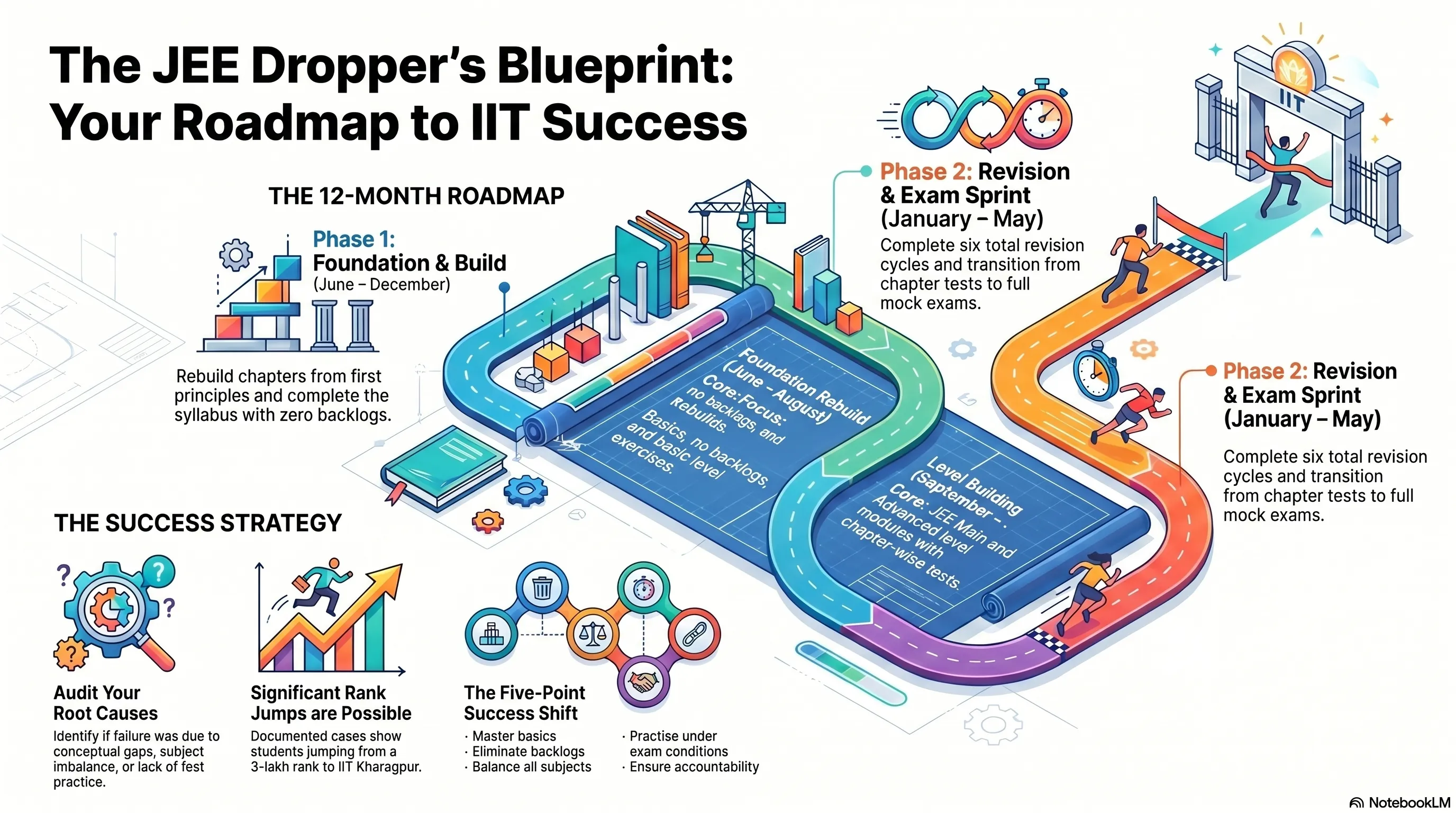
Here is a month-by-month structure that has produced IIT results for dropper students:
| Phase | Months | Focus |
|---|---|---|
| Foundation Rebuild | June – August | Complete all chapters from basics; no backlogs allowed; CPP (basic level) + Module Exercise 1 |
| JEE Main Level Build | September – October | Module Exercise 1A + JEE Main chapter-wise tests; JEE Main mock tests begin |
| JEE Advanced Level Build | November – December | Module Exercise 2 + 2A (JEE Advanced level); JEE Advanced chapter-wise tests |
| First Revision Cycle | December | Complete syllabus revision before JEE Main January |
| JEE Main January | January | Second revision + 2 full mock tests per week + analysis; appear for JEE Main Session 1 |
| Advanced Push | February – April | JEE Advanced+1 and +2 level quizzes; Rank Booster material; 4 full JEE Advanced mocks |
| Final Revision | April – May | 4 complete revision cycles before JEE Advanced; topic-wise weak area focus |
| JEE Advanced | May | Exam |
How to Use This Timeline
- Syllabus target: Complete by end of December
- JEE Main revisions: 2 full revision cycles before January attempt
- JEE Advanced revisions: 4 full revision cycles before May
- Tests: Chapter-wise JEE Main → Chapter-wise JEE Advanced → Full JEE Main mock → Full JEE Advanced mock (after each chapter)
What to Look for in the Best JEE Dropper Batch
Not all dropper batches are equal. Here is what genuinely matters — and what to verify before enrolling:
Teaching Quality
The faculty must have IIT-level credentials and real classroom track records. Look for faculty with 15+ years of experience who have personally taught students who reached AIR 1–100. Teaching about JEE is different from teaching students to crack JEE.
Question Bank Depth
The material must go from basic (CPP level) all the way to JEE Advanced+2 level — questions that are harder than what appears in the actual exam. If the question bank does not challenge you beyond the exam, you will not be prepared for when the exam gets harder.
Test Frequency and Analysis Quality
Weekly tests are necessary. But test analysis is more important than the test itself. A 20-page personalised test analysis report — showing your accuracy by chapter, your time per question vs. a topper's time, and your specific weak topics — is what converts test-taking into real improvement.
Mentorship System
Two dedicated mentors per student is the standard to look for. Mentors should track attendance, call proactively when sessions are missed, conduct homework checks, and help with study planning beyond just academic content.
Doubt Solving — 5 Layers
Doubts that go unresolved in theory become questions that go unattempted in the exam. The best batches offer: in-class audio-video interaction, video solutions, text-based doubt tools, live doubt-solving sessions, and direct mentor escalation to faculty.
Affordability and Scholarship
Top-quality JEE preparation should not be inaccessible. Look for batches that offer percentile-based scholarships on your JEE Mains score — so that your existing performance reduces your investment.
eSaral's Super Warrior JEE Dropper Batch — is built on every one of these criteria. It has the highest selection ratio of any dropper batch in eSaral's six-year history. If you want IIT Bombay faculty, the most interactive online classes available, and a proven mentorship system, this batch is worth a serious look.
Registration is open. Scholarships are available based on your JEE Mains percentile. Check the JEE courses page for details.
🚀 Checkout eSaral Courses
Frequently Asked Questions
Find answers to common questions.
Should I take a drop year for JEE if my rank was above 1 lakh?
Yes — if you have a genuine reason your preparation was incomplete. A rank above 1 lakh with real preparation gaps (missed classes, weak test practice, subject imbalance) is fully recoverable in a structured drop year. Students have jumped from 3 lakh rank to IIT in one year. The rank is not the barrier — your preparation quality is.
How many hours should a JEE dropper study per day?
The right target is 10–12 focused hours per day, including classes, self-study, and test analysis. Quality matters more than raw hours — a 10-hour day with proper breaks, test analysis, and doubt resolution outperforms a 14-hour day of passive reading. Build your schedule around efficiency and sleep (minimum 7 hours) to maintain performance across 12 months.
Is it possible to crack JEE Advanced in a dropper year without going to Kota?
Completely possible. Online dropper batches with live interactive classes, personalised mentorship, and JEE Advanced-level test series produce IIT results every year. The key factors — faculty quality, question depth, test frequency, and mentorship — are now available online at the same level as the best Kota centres. eSaral's online dropper batch has produced 1,550+ IITians in 2025 alone.
What was different about JEE Advanced 2026 that droppers should prepare for?
JEE Advanced 2026 had a notably higher conceptual depth in Physics and Chemistry. Students who had built genuine understanding from first principles — not just formula-based preparation — performed significantly better. For 2027, droppers must focus on deep conceptual clarity, reading-heavy Physics questions, and multi-step problems in Chemistry, alongside strong Maths fundamentals.
How is a dropper year different from Class 12 preparation
In Class 12, you split focus between board exams, coaching, and JEE simultaneously. In a dropper year, your only target is JEE — which means 100% of your study time can go toward JEE-level content, JEE-level tests, and JEE-level question practice. This undivided focus, combined with the fact that you now know the syllabus, makes the dropper year structurally more efficient if used well.