JEE Dropper Year Preparation Strategy 2027: Complete Guide by IIT Bombay Faculty
JEE Dropper Year Preparation Strategy 2027 focuses on building a disciplined 10–12 hour daily study routine with strong theory, Advanced-level practice, regular tests, error analysis, and consistent revision to improve ranks and crack IIT.

Table of Contents

eSaral › JEE › JEE Main ›JEE Dropper Year Preparation Strategy 2027

🚀 Checkout eSaral Courses
Why Most Drop Years Fail — And How Yours Won't
Every dropper starts with ambition. The first week is full of 12-hour study sessions, colour-coded timetables, and social media announcements. By week four, the schedule breaks. Revision slips. The test series becomes optional. The original fire fades.
This pattern is not a character flaw — it is a strategy problem.
The droppers who make it to IIT don't have superhuman willpower. They have a system. They replaced motivation (which fluctuates) with process (which compounds). Yaman had a 1 lakh rank after Class 12. Today he is at IIT Bombay. Shweta had a 3 lakh rank. She is now at IIT Kharagpur. Ayush had an 80,000 rank and cracked JEE Main in his drop year to reach IIT Bombay. Each one followed the same structured approach outlined in this guide.
Is a Drop Year Worth It for JEE?
A drop year is worth it if — and only if — you are ready to commit to the process described in this article without compromise. It is not worth it if you plan to study 5–6 hours casually and hope for a dramatically different result. The exam does not change. Your preparation must.
How Many Hours Should a JEE Dropper Study Daily?
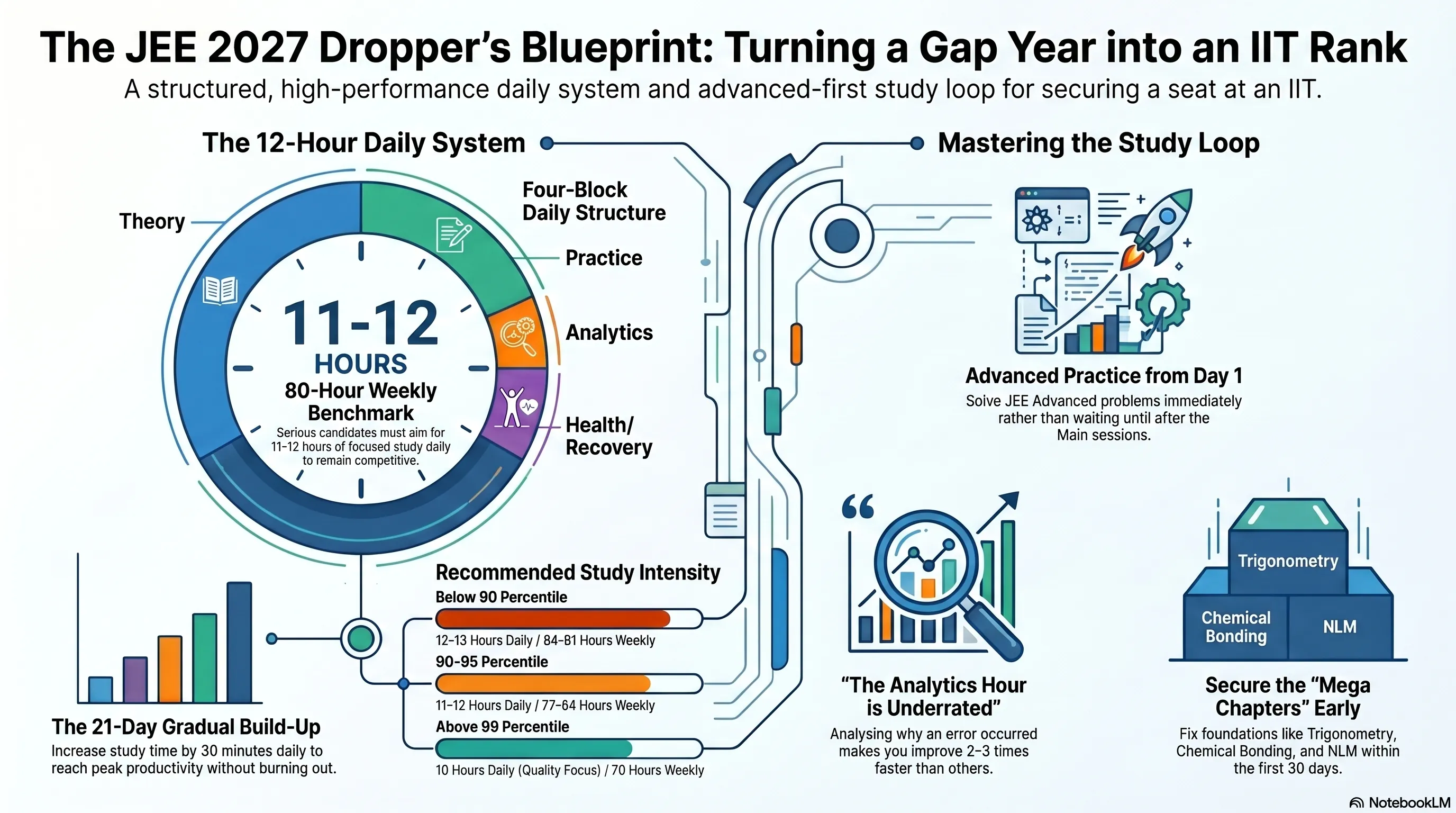
80 hours per week is the minimum benchmark for a serious JEE 2027 dropper. That works out to roughly 11–12 hours of focused study every day.
This number is non-negotiable for a specific reason: out of 15 lakh students appearing for JEE Main, approximately 5 lakh are preparing seriously. Your competition is not the full list — it is those 5 lakh. And among droppers specifically, the average preparation intensity is already high.
How to Build Up to 12 Hours Without Burnout
Most droppers try to jump from 7–8 hours to 12 hours overnight after watching a motivational video. This fails within days. The correct approach:
- Start where you are — track your honest daily average this week
- Add 30 minutes each day — not more, not less
- Reach 12 hours over 2–3 weeks — sustainably
- Track it on paper — write numbers 1 to 12 in a small diary; cross each off as hours complete
This method was used by Saransh Gupta during his own drop year preparation and later adopted by students in eSaral's Warrior Batch. The physical act of crossing hours creates real-time feedback and satisfaction that keeps you consistent.
Study Hours by Current Percentile
| Current JEE Main Percentile | Recommended Daily Study Hours | Weekly Total |
|---|---|---|
| Below 90 | 12–13 hours | 84–91 hrs |
| 90–95 | 11–12 hours | 77–84 hrs |
| 95–99 | 10–11 hours | 70–77 hrs |
| Above 99 | 10 hours (quality over quantity) | 70 hrs |
Data based on preparation patterns of eSaral Warrior Batch toppers, 2023–2025.
The Ideal Daily Timetable for JEE 2027 Droppers
A JEE dropper's day has four non-negotiable blocks. The exact timing is yours to decide — whether you are a morning person or a night owl doesn't matter. The block structure does.
Your Daily Block Structure
| Block | Activity | Duration |
|---|---|---|
| Theory | Lecture + same-day notes revision | 5–6 hours |
| Practice | Module problems + JEE Advanced PYQs | 5 hours |
| Analytics | Daily review + next-day planning | 1 hour |
| Health | Exercise, walk, recovery | 1 hour |
| Sleep | Non-negotiable, cognitive recovery | 6–7 hours |
The remaining 1–2 hours cover meals, hygiene, and short breaks between blocks.
Weekly Testing Schedule
- Chapter-wise tests: 1 hour each, spread through the week after completing a chapter
- Sunday full test: 3-hour JEE Main paper OR 2 JEE Advanced papers alternating
- Monthly review test: Full-length paper with detailed error analysis
What Should Theory Time Look Like?
Theory is not passive watching. It is active engagement with concepts at JEE Advanced depth. If you are revising only from NCERT or pre-made notes, your score ceiling is approximately 50–60 marks in Advanced. For a competitive rank, every concept must be understood at the why level, not just the what level.
What Is the Correct Study Process for a Drop Year?
The right process is: Theory → Notes Revision → Practice → Test → Analysis → Repeat. Most droppers short-circuit this loop by skipping practice or analysis. Here is what each stage must look like:
Stage 1 — Theory (Depth-First)
Every concept must be studied with reasoning. You cannot carry unresolved doubts into the next chapter. Backlogs in a drop year compound fast — one skipped doubt becomes five confused chapters by month three.
If your coaching does not allow for interactive Q&A with faculty, you must find a source that does. eSaral's Warrior Batch is built on this principle, with 5-layer doubt solving so no student moves forward with an uncleared concept.
Stage 2 — Personal Notes (Daily, Same Day)
Make your own notes. Do not borrow notes from a friend or buy pre-made notes. Borrowed notes produce borrowed ranks — which means no rank at all.
Spend 30 minutes per subject on the same day as the lecture to revise and consolidate your notes. This alone will eliminate 80% of the forgetting that typically kills a dropper's revision cycle.
Stage 3 — Practice (Advanced Level From Day 1)
Here is where most droppers make a critical error: they practice only JEE Main PYQs from 2022–2024 and consider it sufficient. It is not. Those papers represent the floor, not the ceiling.
Your practice must include:
- Module exercises at JEE Advanced difficulty — problems where your first attempt yields below 50–60% accuracy in the toughest exercise sets
- JEE Advanced PYQs — do not save these for after JEE Main Session 1; begin them from Day 1 of your drop year
- Thought-provoking problems — at least some problems per week where you spend 40–60 minutes thinking through a single question
The dropper who only prepares for JEE Main during the drop year almost never cracks JEE Advanced. The dropper who prepares for JEE Advanced from Day 1 typically handles JEE Main with ease.
Stage 4 — Chapter-Wise Tests
After completing each chapter's theory and practice:
- Take a 1-hour JEE Main chapter test
- Take a 1-hour JEE Advanced chapter test
- Review errors before moving to the next chapter
Stage 5 — Error Analysis and Course Correction
Every 21–28 days, take a full-length review test. Analyse your errors by category: conceptual gaps, calculation mistakes, time management, question reading errors. Then go back to the theory stage for weak areas.
This is the full loop. eSaral's Warrior Batch structures this cycle for both online and offline students, and it is the same process that produced the results listed throughout this article.
The Mega Chapters You Cannot Afford to Ignore
Certain chapters are the structural foundation of JEE. Every other chapter in that subject either builds on them or references them. If these are weak, the entire subject collapses regardless of how many other chapters you cover.
Mathematics Mega Chapters
- Quadratic Equations — algebraic reasoning used in coordinate geometry, functions, and inequalities
- Trigonometry — essential for calculus, vectors, and 3D geometry
- Functions — the backbone of all calculus questions in JEE Advanced
Master these three with Advanced-level problem solving before anything else in Maths.
Chemistry Mega Chapters
| Branch | Mega Chapter | Why It's Critical |
|---|---|---|
| Inorganic | Periodic Table + Chemical Bonding | Explains all periodic trends, reactions, and properties |
| Physical | Mole Concept | Foundation of stoichiometry, electrochemistry, and thermodynamics |
| Organic | GOC (General Organic Chemistry) | Without GOC, every organic reaction is memorisation, not understanding |
Physics Mega Chapters
- Kinematics (1D and 2D) — used in every mechanics problem
- Newton's Laws of Motion (NLM) — the physics engine of the entire paper
- Centre of Mass (COM) — essential for rotational dynamics and collision problems
- Work, Power and Energy — appear in mechanics, thermodynamics, and modern physics applications
⚠️ Important: If any of these mega chapters are weak going into your drop year, fix them in the first 30 days. Do not save them for later. Later never comes the way you plan it to.
How to Build a Grind Mindset That Lasts 12 Months
Motivation is a short-term resource. It spikes after watching videos like this one and drops within 72 hours. The students who make it through a full drop year replace motivation with a system of small, daily commitments.
The 21-Day Hour Tracker Challenge
For the next 21 days, do this every day without exception:
- Write the numbers 1 to 12 in a small diary
- Cross each number off as you complete each hour of study
- Review the crossed numbers at the end of each day
- Add 30 minutes to the previous day's total until you reach 12 hours
This is not a gimmick. The physical action of crossing hours creates a psychological feedback loop that reinforces the behaviour. After 21 days of consistent execution, the habit is embedded.
What You Must Sacrifice
To reach the study hours and process quality that IIT demands, certain things must go — at least for this year:
- Extended phone and social media use
- Non-essential social events
- Gaming and entertainment as a default
This is not about being robotic. It is about understanding that every great outcome requires a period of investment where comfort is consciously reduced. As Saransh Gupta puts it: "You, your room, your books, your goal — and nothing else. Disappear from the world. Then come back shining when results are announced."
Handling the Mental Lows
Every dropper hits multiple low points — moments where the original enthusiasm is completely gone and doubt creeps in. When this happens:
- Remember why you started — specifically, not vaguely
- Remember who doubted you — and decide that proving yourself is worth the discomfort
- One bad day is not a trend — reset with the next hour, not the next week
Udaya Shankar, who is visually impaired, scored 97.5 percentile in JEE Main and went on to crack JEE Advanced. He is now at IIT Hyderabad. The obstacles you face in your drop year are real — but they are not bigger than this.
🚀 Checkout eSaral Courses
Frequently Asked Questions
Find answers to common questions.
Is eSaral good for droppers?
eSaral is specifically strong for JEE droppers. The Warrior Batch is built around the complete drop-year process: Advanced-level modules, 5-layer doubt solving, chapter-wise and full-length test series, and faculty mentoring by IIT Bombay toppers including AIR-41 Saransh Gupta. Many droppers — including students who went from 3 lakh rank to IIT Kharagpur — have used this exact programme.
How many hours should a JEE dropper study daily?
A JEE dropper should study a minimum of 11–12 hours per day, totalling 80 hours per week. This includes 5–6 hours of theory, 5 hours of practice problems, and 1 hour of daily analytics. Students below 90 percentile may need to push to 12–13 hours to close the gap with more prepared peers.
What is the best strategy for a JEE drop year?
The best JEE drop year strategy combines four elements: consistent 80-hour study weeks, Advanced-level practice from Day 1 (not just JEE Main PYQs), deep mastery of mega chapters in all three subjects, and weekly testing with error analysis. Motivation alone does not work — structured process does.
Should a JEE dropper prepare for JEE Advanced from Day 1?
Yes. Droppers who save JEE Advanced preparation for after JEE Main Session 1 almost never build the depth needed to crack Advanced. Preparing at Advanced level from Day 1 also makes JEE Main significantly easier. Both exams are then covered by one preparation standard, not two separate cycles.
How is eSaral's Warrior Batch different from other dropper courses?
eSaral's Warrior Batch is structured around the full drop-year cycle: IIT Bombay faculty-taught theory, Advanced-difficulty module exercises, chapter-wise and full-length tests, 5-layer doubt solving, and monthly analytics reviews. Unlike platforms that only provide video content, Warrior Batch students follow the exact process that produced IIT results for droppers from 1 lakh, 3 lakh, and 80,000 rank starting points.