JEE Main 2027 Preparation Timetable: 6-Month Daily Roadmap by IIT Bombay Faculty
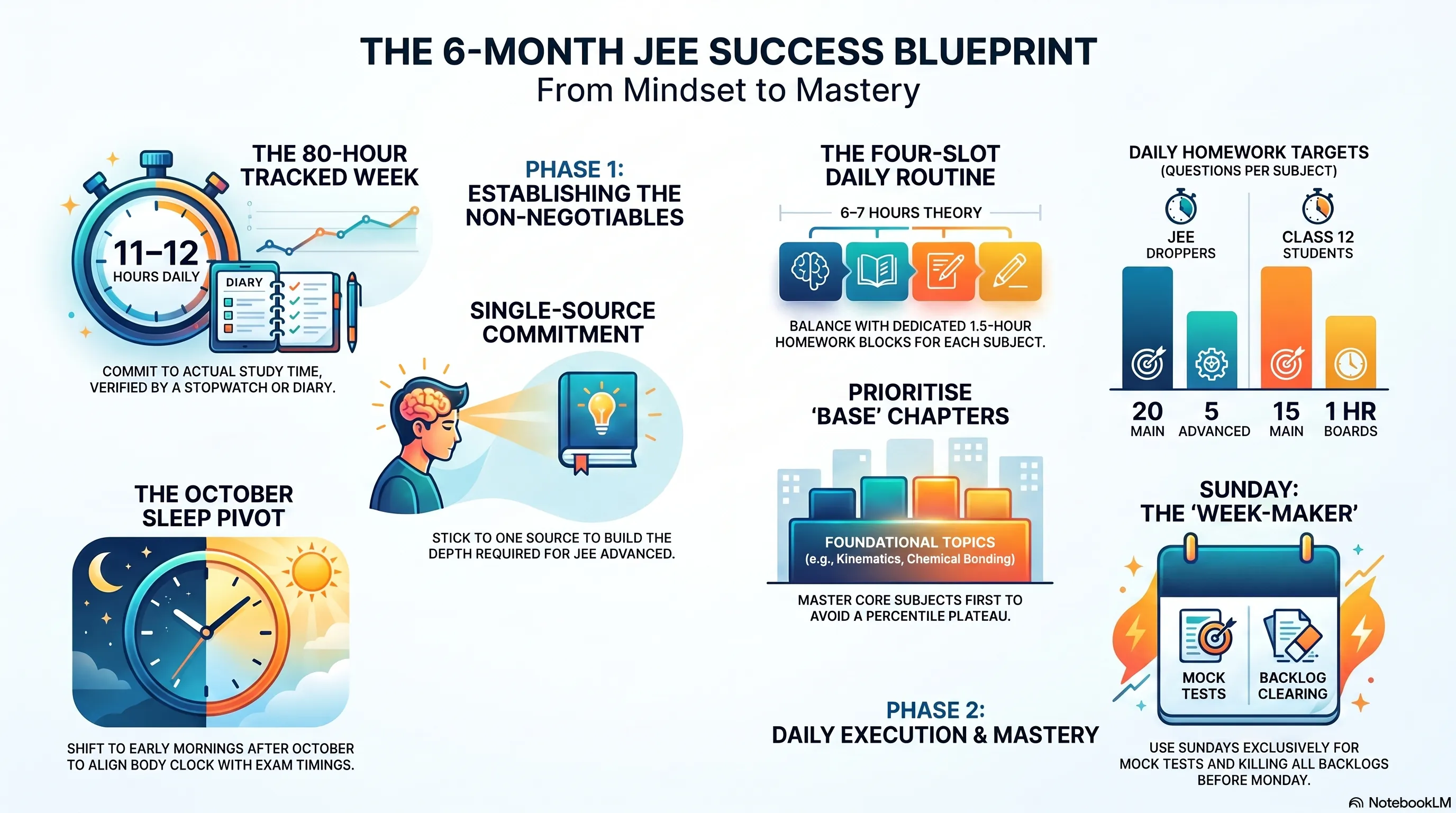
A 6-month JEE Main 2027 preparation timetable requires 80 tracked study hours per week, divided into four daily slots covering theory, Physics, Chemistry, and Maths homework. Droppers solve 20 JEE Main + 5 JEE Advanced questions per subject daily; Class 12 students solve 15 with an extra slot for board preparation. Sunday is reserved for chapter-wise or full-length mock tests and weekly backlog clearance. The three most common mistakes to avoid are randomness in schedule, instant distraction, and neglecting health.


Table of Contents
- Is It Really Possible in 6 Months?
- The Two Non-Negotiable Basics
- Late Night vs Early Morning: What Should You Choose?
- Most Important Chapters for JEE Main and JEE Advanced
- Exact Daily Timetable for JEE Droppers
- Exact Daily Timetable for Class 12 Students
- Sunday: The Week-Maker
- 3 Mistakes That Will Cost You Your IIT Seat

eSaral › JEE › JEE Main ›JEE Main 2027 Preparation Timetable: 6-Month Daily Roadmap by IIT Bombay Faculty

🚀 Checkout eSaral Courses
Is It Really Possible in 6 Months?
Six months sounds short — but students have done far more with far less time. Abhinav went from 64 percentile to IIT Delhi in just 100 days. Shubham started at 13 percentile, studied while his mother woke up at 4:30 AM only to find him still reading, and made it to IIT Delhi while also scoring 80% in his Class 12 boards. Piyush had a rank of 14,800-something and came back with 99.8 percentile and a rank of 1,400 to reach IIT Delhi.
Ashish had brain surgery and missed nine months of Class 11 and 12 entirely. He started in December, studied for 120 days, and secured IIT Guwahati after starting with a 36th percentile score in January.
These are not rare exceptions. They are the direct product of one specific timetable — the same one covered in this guide. So yes, it is possible. The question is whether you will execute it.
Before reading further, write this down somewhere visible: "I will be consistent." Every successful student makes this promise to themselves. Without it, no timetable works.
The Two Non-Negotiable Basics
Before looking at the schedule itself, two fundamentals must be in place. Skip either one and the rest of the plan collapses.
Basic 1: 80 Hours of Study Per Week — Tracked
There is no shortcut here. The math is simple: 80 hours per week divided across 7 days equals 11 to 12 hours of actual study per day. Not hours of sitting at a desk — hours of tracked study.
Tracked means a stopwatch runs only when you are actively studying. The moment you drift — a friend calls, you pick up your phone, your mind wanders — the clock stops. Sitting at a desk thinking about something else does not count as study time.
Two tracking methods work well:
- Chit Method: Carry 12 paper slips in your pocket. Tear and discard one only after completing one genuine hour of study. When all 12 are gone, the day is done.
- Diary Method (Knock It Off): Write 1 to 12 in a diary. Cross off each number as you complete each hour. Seeing uncrossed numbers pulls you back when distraction hits.
The psychological effect of visible progress matters. Seven hours in and tempted to stop? Three uncrossed numbers on that page will stop you before your phone does.
Basic 2: Pick One Source and Stay There
Jumping between teachers and platforms is one of the fastest ways to fail JEE Main. One teacher per subject, one source for theory, and full commitment to that source. Students who hop between lectures never build the depth that JEE Advanced demands. Theory alone cannot crack this exam anymore — JEE Main 2026 was the toughest paper in history, and JEE Advanced 2026 followed the same trend.
Late Night vs Early Morning: What Should You Choose?
This question distracts more students than almost anything else. Here is the direct answer: it does not matter which one you choose — what matters is that you pick one and stay consistent.
Abhinav, who went from 64 percentile to IIT Delhi in 100 days, studied until 5 AM every night. Another student woke at 4 AM every day. Both got selected. What neither of them killed was the choice of schedule — what would have killed them is switching between the two.
The preparation period is split into two phases:
| Phase | Sleep Schedule Rule |
|---|---|
| Now until October | Choose either late night (up to 3 AM) or early morning — and stick to it every single day |
| After October | Sleep by midnight. Wake early. Align your body clock with morning exam timing |
After October, the shift to earlier sleep is essential. JEE Main morning sessions start at 8 AM. Students who enter the exam hall sleep-deprived waste months of preparation in a single sitting. Adjust the body clock before the exam, not during it.
The only rule before October: no experimenting. Sleeping at 3 AM one night and 10 PM the next night confuses the brain and makes it chronically lazy. Make your schedule boring. Same wake time, same sleep time, every day.
Most Important Chapters for JEE Main and JEE Advanced
Not all chapters deserve equal time. These are the chapters that function as either the base of multiple other topics or carry the highest standalone weightage in both JEE Main and JEE Advanced.
Mathematics
| Chapter | Why It's Critical |
|---|---|
| Quadratic Equations | The base of all of Class 11 and 12 Maths |
| Trigonometry | Base of most Maths topics |
| Functions | Base of most Maths topics |
| 3D Geometry | High weightage in JEE Main and JEE Advanced |
| Vectors | High weightage in JEE Main and JEE Advanced |
Quadratic Equations, Trigonometry, and Functions form the entire foundation of Maths. Weakness in any one of them will block progress in nearly every other chapter. 3D Geometry and Vectors are relatively independent but are among the highest-weightage chapters across both exams.
Chemistry
| Chapter | Why It's Critical |
|---|---|
| Periodic Table | The base of all Inorganic Chemistry |
| Chemical Bonding | The base of all Inorganic Chemistry |
| Mole Concept | The base of all Physical Chemistry |
| General Organic Chemistry (GOC) | The base of all Organic Chemistry |
| Coordination Compounds | Highest single-chapter weightage in JEE Main and JEE Advanced |
Mole Concept is not a declining topic — it is now embedded indirectly into almost every Physical Chemistry question. Coordination Compounds is Class 12's most important Inorganic chapter and consistently carries the most weightage across both exams.
Physics
| Chapter | Why It's Critical |
|---|---|
| Kinematics | Base of all mechanics chapters |
| Newton's Laws of Motion (NLM) | Base of all mechanics chapters |
| Centre of Mass (COM) | Base of all mechanics chapters |
| Work, Power & Energy | Base of all mechanics chapters |
| Ray Optics | High standalone weightage — no dependency on other chapters |
Kinematics, NLM, COM, and Work-Energy form the mechanical foundation of Physics. Any JEE Advanced question in Electrostatics, Rotation, or Thermodynamics will layer these concepts on top. Ray Optics is a standalone chapter with consistently high JEE Main and JEE Advanced weightage.
💡 Expert Tip by Prateek Gupta, IIT Bombay: Superficial coverage of foundational chapters is the single biggest reason students plateau at 90–95 percentile. JEE Main 2026 was the toughest in history and JEE Advanced 2026 followed — surface-level theory no longer moves the needle. Depth in these base chapters does.
Exact Daily Timetable for JEE Droppers
This schedule applies to dropper students who have already cleared the 75% board attendance criterion. Monday through Saturday follows a four-slot structure.
Slot 1 — Theory (6–7 Hours)
Attend live classes and complete a revision of that session's content immediately after. This is the only theory source — no parallel lectures from other platforms. eSaral's JEE dropper courses run four live sessions daily in this phase.
Slot 2 — Physics Homework (1.5 Hours)
Solve 20 JEE Main-level questions and 5 JEE Advanced-level questions from Physics. The Advanced questions ensure the JEE Advanced edge is never lost. When JEE Advanced preparation intensifies later, the concepts will already be familiar.
Slot 3 — Chemistry Homework (1.5 Hours)
Same structure: JEE Main questions first, with a small Advanced-level set built in.
Slot 4 — Maths Homework (1.5 Hours)
Same structure. Note that Maths homework sometimes runs to 2 hours — on those days, Physics or Chemistry homework can be trimmed to 1 hour each to maintain the total.
Total Daily Study: ~11–12 tracked hours
Exact Daily Timetable for Class 12 Students
Class 12 students follow the same Slot 1 (theory) structure as droppers. The difference is in homework volume and one additional slot for board preparation.
Homework Slots — Adjusted for Board Exam Reality
| Slot | Subject | Duration | Questions |
|---|---|---|---|
| Slot 2 | Physics | 1 hr 15 min | 15 JEE Main-level |
| Slot 3 | Chemistry | 1 hr | 15 JEE Main-level |
| Slot 4 | Maths | 1 hr 15 min | 15 JEE Main-level |
| Slot 5 | Board Preparation | 1 hr | Varies |
The question count drops from 20 to 15 per subject compared to droppers. This is a realistic adjustment — not a compromise, but a recognition of the time constraint Class 12 boards impose.
Slot 5 — Board Preparation (1 Hour Daily)
This slot rotates through the week:
- 3 days: Fourth and fifth board subjects (English, Physical Education, etc.)
- 3 days: Writing practice — paper presentation, answer structuring, handwriting for board evaluation
Board preparation is not optional. 75% attendance and minimum score criteria must be met, and the board exam itself requires a distinct skill set that cannot be improvised in the final weeks.
Sunday: The Week-Maker
Sunday is not a rest day. It is the most important day of the week. Every Sunday, choose one of two options:
Option A — Chapter-wise Tests: Take three separate chapter-wise tests (one each for Physics, Chemistry, Maths). Alternate between JEE Main level one on Sunday and JEE Advanced level the next.
Option B — Backlog + Revision (if weekday tests are already scheduled): If your platform runs tests on Tuesday, Thursday, and Saturday — as eSaral does — use Sunday to clear the week's backlog and revise everything covered Monday through Saturday.
Additionally, within every 21-day cycle:
- Day 21: One full JEE Main mock test (3 hours)
- Day 42: One full JEE Advanced mock test (6 hours), followed by 2 hours of detailed analysis
The Backlog Rule: No backlog from the current week should carry into the next week. Whatever was missed Monday through Saturday must be cleared by Sunday night. One week's backlog must die on that week's Sunday.
After the test, spend 2 hours on analysis — not on attempting more questions. Understanding why a wrong answer was wrong is worth more than attempting 50 new questions.
3 Mistakes That Will Cost You Your IIT Seat
Hundreds of students follow the right timetable for two weeks and then derail. These three mistakes are responsible for most of those failures.
Mistake 1: Randomness in Schedule
The brain operates best on predictability. Studying until 3 AM one night and sleeping at 10 PM the next night does not give the brain time to adapt — it stays in a permanent state of sluggishness. Pick a fixed sleep and wake time. Make your life boring on purpose. Family members should be able to set a clock by your routine.
Ideal schedule examples:
- Sleep 10 PM–1 AM → Wake 5–6 AM
- Sleep 9–10 PM → Wake 4 AM
Either works. Switching between them does not.
Mistake 2: Instant Distraction
There is a common version of this mistake: a notification arrives, a friend shows up at the door, and the study session ends. The fix is not willpower — it is scheduling. Out of 24 hours, even with 11–12 study hours and 6–7 sleep hours, roughly 1–2 hours remain. That is the designated distraction hour.
Fix that hour. Tell friends that 8–9 PM is open. Outside that window, phone goes on airplane mode, notifications off. A friend who respects your goals will adjust to your schedule.
Mistake 3: Neglecting Health
30 minutes of physical activity every day is non-negotiable. Students who sacrifice sleep and exercise in the name of extra study hours almost always suffer declining focus and retention within weeks. The body fuels the brain. Protect both.
💡 Expert Tip by Prateek Gupta, IIT Bombay: The most common mistake over-sincere students make is treating health as a variable. It is not. 30 minutes of movement daily is a fixed cost of performing at full capacity for six months.
🚀 Checkout eSaral Courses
Frequently Asked Questions
Find answers to common questions.
Is it possible to crack JEE Main 2027 with just 6 months of preparation?
Yes — multiple students have done it in far less time. Students have reached IIT Delhi in 100 days starting from 64 percentile, and others have secured IIT from 13 percentile within a single academic year while also clearing Class 12 boards. Six months is sufficient if preparation is structured, consistent, and tracked at 80 hours per week.
How many hours should a JEE dropper study daily to get 99 percentile?
A JEE dropper targeting 99+ percentile in JEE Main needs 11 to 12 tracked study hours per day, which amounts to 80 hours per week. These hours must be genuinely productive — a stopwatch running only during active study, not during breaks or distraction. Both late-night and early-morning schedules work, provided the same schedule is followed every single day.
Which chapters are the most important for JEE Main 2027?
In Maths, the highest-priority chapters are Quadratic Equations, Trigonometry, Functions, 3D Geometry, and Vectors. In Chemistry, Periodic Table, Chemical Bonding, Mole Concept, General Organic Chemistry, and Coordination Compounds are foundational. In Physics, Kinematics, Newton's Laws, Centre of Mass, Work-Power-Energy, and Ray Optics carry the highest combined weightage and conceptual importance across JEE Main question papers.
How should a Class 12 student balance JEE preparation and board exams?
Class 12 students follow the same four-slot daily structure as droppers but solve 15 questions per subject instead of 20 (reducing total homework time slightly). The freed hour goes to Slot 5 — dedicated board preparation. Three days per week cover the fourth and fifth board subjects; the other three days focus on writing practice and paper presentation. Sunday remains identical to the dropper schedule.
What is the best way to handle backlog during JEE preparation?
The non-negotiable rule is that no backlog from a given week should survive into the next. Whatever chapters, questions, or theory sessions were missed from Monday through Saturday must be cleared by Sunday night. If tests fall on weekdays, Sunday becomes a full backlog and revision day. If not, Sunday is used for chapter-wise or full-length mock tests.