JEE Main Prep Strategy for Droppers: The 5-Step IIT Cycle (2027)
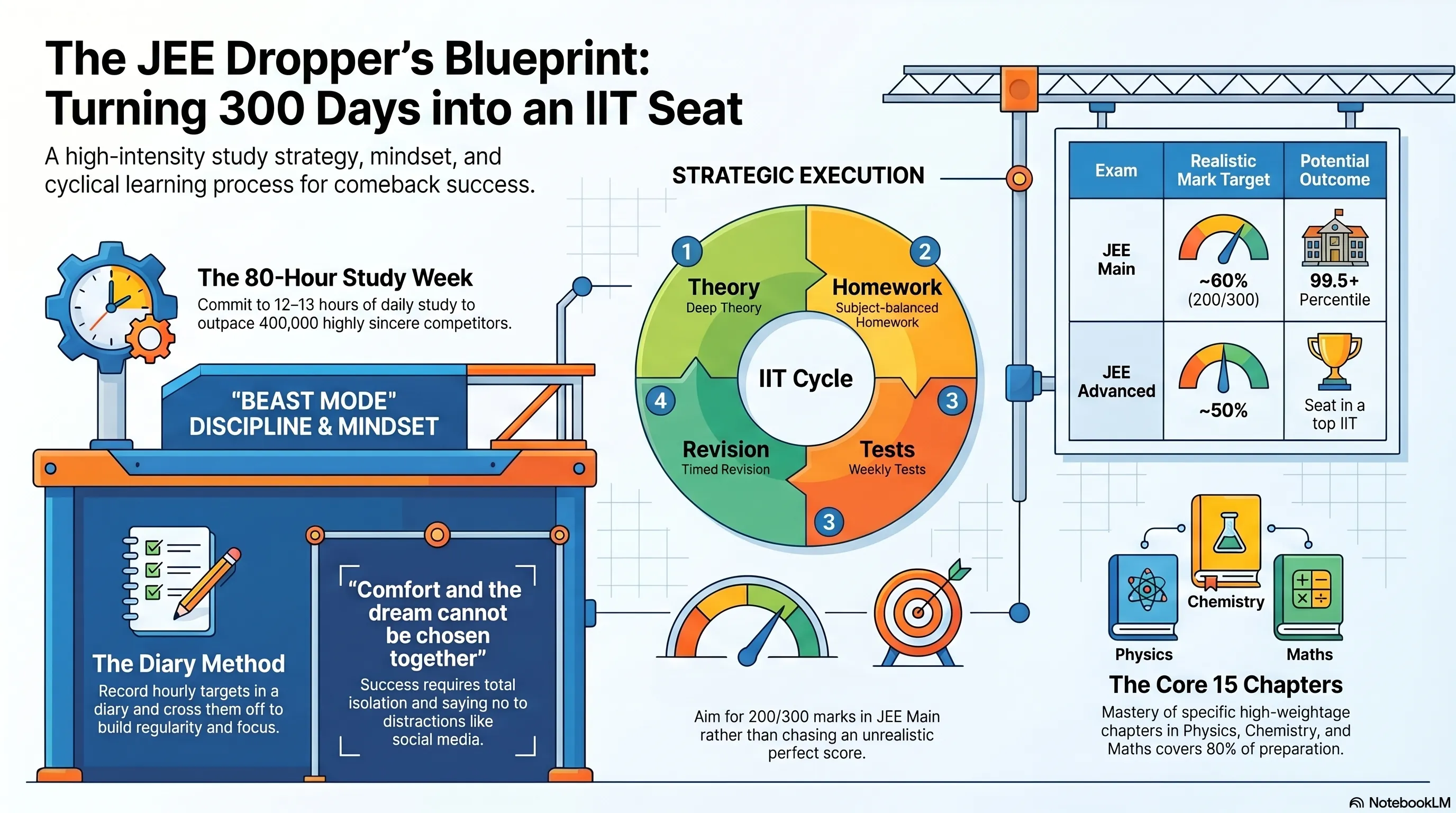
JEE Main preparation strategy for droppers, as explained by Prateek Gupta sir, rests on five steps: an 80-hour weekly study target, understanding exactly how many marks you need, prioritising 15 high-weightage chapters, following the four-part IIT Cycle of theory, revision, homework and tests, and building a daily self-competition mindset.
Table of Contents
- Is It Really Possible to Crack JEE in the Time You Have Left?
- Beast Mode On: Why 80 Hours a Week Is the Real Target
- Real eSaral Dropper Comeback Stories
- Understanding the Exam: How Many Marks Do You Actually Need?
- The 15 Chapters That Decide Your JEE Main and Advanced Score
- The IIT Cycle: A 4-Part Process to Cover the Syllabus Fastest
- The Mindset That Turns Less Time Into Better Results

eSaral › JEE › JEE Main ›JEE Main Prep Strategy for Droppers: The 5-Step IIT Cycle (2027)

🚀 Checkout eSaral Courses
Is It Really Possible to Crack JEE in the Time You Have Left?
The first question most students ask is whether it is even possible to turn things around in the time left. According to Prateek Gupta sir, the answer is yes — and the proof is in students who have already done it with less time than most droppers have today.
- Pankaj reached IIT Delhi in 8 months.
- Manthan reached IIT Bombay in 7 months.
- Hundreds of other students completed the same turnaround in even less time.
- This year, Surat — whose entire Class 11 was wasted — scored 99.8 percentile in January JEE Main.
- Piyush, a dropper whose Class 12 rank was around 18,80,000, scored 99.8 percentile in his first attempt.
- Prateek Gupta sir himself completed his IIT Bombay dream in 9 months.
💡 Expert Tip by Prateek Gupta, IIT Bombay Alumnus: "It is possible. It can be done. Students have been doing it for years. The question is — do you want to do it?"
This sets up the foundation of the entire strategy: the time left is not the real constraint. What you do with it is.
Beast Mode On: Why 80 Hours a Week Is the Real Target
The first concrete part of the strategy is what Prateek Gupta sir calls "Beast Mode." The target he sets is simple: 80 hours of study a week — without this, the comeback does not happen.
To make this concrete, he shares the story of Abhinav, a student from the Warrior Batch. Abhinav scored just 64 percentile in the January JEE Main attempt. He had already taken a drop year before that and did not study at all for the first six months of it. When he saw his low percentile in January, it hurt his ego enough to change.
From February to mid-May (with some days still wasted), Abhinav studied 15–16 hours a day for 100 continuous days. In that window:
- He went from 64 percentile to 97.8 percentile.
- He then cracked JEE Advanced.
- He is now studying at IIT Delhi.
The point Prateek Gupta sir makes from this story is direct: if Abhinav turned an impossible situation possible in 100 days, a dropper with 300 days left has no excuse not to try. He is also clear that droppers don't need to do 15–16 hours a day like Abhinav did — 80 hours a week (roughly 12–13 hours a day on average) in the time remaining is enough to make 99 percentile and an IIT seat realistic.
The Diary Method to Increase Study Hours
To actually hit these hours, Prateek Gupta sir recommends a simple diary method:
- Buy a small diary.
- Every night before sleeping, write down the next day's study target in hours — for example, 12 or 14 hours, numbered 1 to 12 (or 14).
- As soon as you finish one hour of study, cross it off.
- Keep crossing off hours through the day.
The reasoning behind this is practical: after about 6 hours, tiredness sets in, and that is exactly when distractions creep in — friends calling, the habit of scrolling, excessive gaming, pointless outings, daydreaming, and overthinking. With the diary in your pocket reminding you that hours are still left to cross off, motivation, regularity, and discipline build gradually. According to Prateek Gupta sir, the students mentioned in this article followed exactly this method.
He is also blunt about the trade-off: if you are not ready to put in this many hours, it may be better not to attempt this path at all, because out of the 16–18 lakh students appearing next year, around 4 lakh are preparing with serious sincerity — many studying 10 hours a day since Class 8, 9, or 11. To beat that level of competition, you need to study more, and for longer, than they do.
Real eSaral Dropper Comeback Stories
Beyond Abhinav, Prateek Gupta sir shares two more turnaround stories that anchor this strategy in real outcomes.
One student scored just 13 percentile with Class 12, and friends told him to give up on JEE. His mother encouraged him to try once more. He joined eSaral, first focused on cracking his Class 12 boards well, and is now headed to IIT Delhi — a turnaround achieved in 100 days.
Another student, Aashish, scored 36th percentile in Class 12. He went through brain surgery during that year, and doctors told him he could not study for 6 months. He did zero preparation in that period and started fresh from December with a 36 percentile first attempt. After joining eSaral, he is now studying at IIT Guwahati.
Prateek Gupta sir frames these as proof that the right care, guidance, and direction can make an "impossible" IIT dream possible — whichever batch a student comes from, whether the Warrior Batch, the Prahaar Batch, or the Bounce Back Batch. He also shares that 1,600 eSaral students are going to IIT this year, of which more than 800 are droppers — with top scorers like Arya, who secured AIR 378.
A new Warrior Batch, named after Abhinav, and a new Prahaar Batch — "Prahaar Backlog Express" — are both launching soon, with registration details shared in the description and inside the eSaral app.
Understanding the Exam: How Many Marks Do You Actually Need?
The second part of the strategy is understanding what the exam actually demands, rather than chasing an unrealistic number.
Prateek Gupta sir explains this using two columns — JEE Main and JEE Advanced:
| Exam | Realistic Target | What It Gets You |
|---|---|---|
| JEE Main | ~60% marks (around 200 out of ~300) | 99.5+ percentile |
| JEE Advanced | ~50% marks | A seat in a top IIT (possibly one or two branches below the very top branch); below 50% typically gets the CS branch in a lower IIT |
He is direct about a common mistake: students target 300/300 in JEE Main, which is the wrong target and creates unnecessary pressure. The real benchmark to chase from today is 200 marks (around 60%).
To make the gap feel manageable, he walks through the math: if you are currently scoring 100 marks and need to reach 200 in six months, that is roughly 16–17 extra marks a month — achievable by getting 4–5 chapters genuinely right. Even if you are currently at 50 marks, needing +150 over six months works out to about 25 marks a month, or less than one extra mark a day — which he calls "completely possible."
He also references a "secret growth graph" — the e^x curve — to describe how progress feels in JEE preparation: for a long stretch, you put in heavy effort with little visible improvement, and then at a certain point, the same effort starts producing results at a much faster rate. On this curve, today is day 0, the next 21 days are the critical window for building the syllabus-coverage process described below, and the final point is JEE Main with a 99.9 percentile result. Most students never get past this early flat stretch — they study for two or three days, stop, and restart.
The 15 Chapters That Decide Your JEE Main and Advanced Score
Prateek Gupta sir identifies 15 chapters across Maths, Chemistry, and Physics that he says decide most of a student's JEE Main and Advanced outcome.
Mathematics — 5 Base Chapters
- Quadratic Equations
- Trigonometry
- Functions
- Coordinate Geometry
- 3D Geometry and Vectors
Quadratic, Trigonometry, and Functions form the base of Class 11 and 12 Maths, especially Calculus — without them, neither class is completed well. Coordinate Geometry feeds into nearly every other chapter. 3D and Vectors carry the highest weight among these five.
Chemistry — 4 Base Chapters
- General Organic Chemistry (GOC) — the basis of all of Organic Chemistry
- Mole Concept — the basis of all of Physical Chemistry
- Chemical Bonding and Periodic Table — the basis of all of Inorganic Chemistry
- Coordination Compounds
Prateek Gupta sir flags a specific trend for 2026: the visible weightage of pure Mole Concept questions in JEE Main and Advanced has gone down, but its real weightage has actually gone up, because Mole Concept is now embedded inside most Organic questions and several Inorganic questions. Coordination Compounds, meanwhile, is the chapter that — averaged over the last 10 years — has been asked most consistently in JEE Main, even though GOC and Bonding weightage moves up and down from year to year.
Physics — 4 Base Chapters Plus 1 Standalone Chapter
- Electrostatics
- Centre of Mass
- Work, Power and Energy (WPE)
- Newton's Laws of Motion (NLM)
At the JEE Advanced level, Electrostatics questions repeatedly draw on concepts from Centre of Mass, WPE, and NLM, so these three are treated as a base for Electrostatics rather than standalone chapters.
There is also one standalone chapter with no direct connection to the others, but heavily asked in both JEE Main and JEE Advanced: Ray Optics.
💡 Expert Tip by Prateek Gupta, IIT Bombay Alumnus: "If you do these 15 chapters properly, 80% of your work is done."
For the official syllabus these chapters sit within, you can check eSaral's JEE Main syllabus page.
The IIT Cycle: A 4-Part Process to Cover the Syllabus Fastest
The third and fourth parts of the strategy combine into what Prateek Gupta sir calls "The IIT Cycle" — the process he says thousands of his students have used to cover the syllabus at the fastest possible rate. It has four parts: Theory, Revision, Homework, and Tests.
1. Theory — Go Deep, Not Easy
Prateek Gupta sir warns against chasing "easy" theory or one-shot videos, saying these can quietly damage a student's IIT rank without the student realising it. Preparation needs to go to depth, at an advanced and tough level — ideally a level where only 70–80% is understood the first time in class.
💡 Expert Tip by Prateek Gupta, IIT Bombay Alumnus: "If everything is understood in class the first time, that means you are being given an easy pass. This is a very tough syllabus — until your teacher takes you to a high level regularly, your JEE Advanced will not happen."
Time allotment: A maximum of 6 hours a day for theory if four classes are running on a given day (as is currently the case in the Prahaar and Warrior batches), plus 1 to 1.25 hours for same-day notes revision.
2. Revision — Same Day, With a Timer
Whatever is taught in class should be revised the same day, or the next morning if classes run late at night. The key instruction here is to use a timer: with 3 classes in a day, notes should be revised within 1 hour; with 4 classes, within 1.5 hours. Without a timer, revision tends to stretch out because overthinking creeps in while going through notes.
3. Homework — Timed, Subject-Balanced
Daily homework follows revision. If theory takes 6 hours and revision takes 1 hour, homework should take a minimum of 5 to 5.5 hours until the full syllabus is completed — roughly 1.5 hours per subject. (Prahaar Batch students are expected to finish the syllabus by the end of November; Warrior Batch students by mid-December, with this routine running until then.)
The rule here is also timed: if you get stuck on two trap questions in Maths, solve what is solvable within the allotted time and move on — don't let one subject eat into the others. Any extra 30 minutes to an hour should go toward whichever subject feels weakest at that point in the syllabus (this shifts — Fluid Mechanics can suddenly make Physics feel weak, Thermodynamics or Ionic Equilibrium can make Chemistry feel weak, and Maths, in his words, "always feels weak").
4. Tests — Weekly and Cumulative
The fourth part is regular testing:
- Three 3-hour chapter-wise tests every week — one each for Physics, Chemistry, and Maths — ideally on Sundays. eSaral provides chapter-wise tests for both JEE Main and JEE Advanced for every student; students outside eSaral can use eSaral's separate test series or their own chapter-wise tests, as long as they are actually testing themselves.
- A 3-hour test every 21–28 days, alternating pattern: a cumulative JEE Main-pattern test for one 21-day block, followed by two JEE Advanced-pattern tests in the next block.
- 3 hours of test analysis after every Sunday test, to identify weak areas.
After analysis, the cycle repeats: go back to theory for weak areas, revise, practice more, and test again. This loop — Theory → Revision → Homework → Tests → Analysis → back to Theory — is the complete IIT Cycle.
Prateek Gupta sir points to his own track record as proof that this cycle works: he became an IITian this way, his elder brother secured AIR 41 the same way, his brother's friend secured AIR 2, another acquaintance secured AIR 1, and one of his own students secured AIR 79 this year.
You can find chapter-wise and full-syllabus practice resources, including JEE Main previous year papers and JEE Advanced previous year papers, to apply to the homework and test stages of this cycle.
The Mindset That Turns Less Time Into Better Results
The final part of the strategy is mindset. Prateek Gupta sir lists four specific mindset shifts:
- Accept that it will be tough. You may need to say no to friends, relationships, and habits like scrolling — both comfort and the dream cannot be chosen at the same time. Going against your own mind's pull toward comfort, rest, and distraction is part of the process.
- Compete with yourself daily. Ask one question every day: "Am I better today than I was yesterday?" If the answer is yes for 21 days straight, he says you become unstoppable.
- Commit to a genuinely hard six months. He frames this as a guarantee: a period of intense, focused work — enough that people around you start to notice your absence and wonder where you disappeared — followed by a result that surprises everyone. He says this pattern repeats every year among the students who commit to it.
- Isolate yourself to work. Build one space, sit in it for 10–12 hours a day with the same routine, and stay cut off from outside distractions during that time.
Prateek Gupta sir closes by sharing his own 7-year track record: he has seen students move from 39 percentile to 99 percentile, from 26 percentile into an IIT, from 15 percentile to 99 percentile, and this year, a student moved from 13 percentile into IIT Delhi. His closing line is a direct promise to students: "I will be with you till the very end."
🚀 Checkout eSaral Courses
Frequently Asked Questions
Find answers to common questions.
Is it possible to crack JEE Main with only a few months left as a dropper?
Yes — Prateek Gupta sir points to multiple real examples, including Pankaj (IIT Delhi in 8 months), Manthan (IIT Bombay in 7 months), and a student who went from 64 percentile to 97.8 percentile in 90 days. Time left is less important than what is done with it.
How many hours should a JEE dropper study every day?
The target Prateek Gupta sir sets is 80 hours a week, which works out to roughly 12–13 hours a day on average. Some students, like Abhinav, studied 15–16 hours a day for 100 days, but he clarifies droppers don't need to match that — 80 hours a week is enough to make 99 percentile realistic.
What percentage is needed for a 99 percentile in JEE Main?
According to Prateek Gupta sir, scoring around 60% marks (roughly 200 marks) in JEE Main is enough for 99.5+ percentile, given current paper difficulty trends. Targeting 100% or even 90% creates unnecessary and unhelpful pressure.
What is the diary method for increasing JEE study hours?
It involves writing your next day's study-hour target in a small diary every night, numbering each hour, and crossing one off as soon as it is completed. This builds discipline because the diary acts as a constant reminder of hours still left to complete.
What is the "IIT Cycle" study method mentioned in this JEE Main preparation strategy for droppers?
The IIT Cycle is a four-part daily process — Theory, Revision, Homework, and Tests — followed by analysis and a return to Theory for weak areas. Prateek Gupta sir says this exact cycle helped him, his brother (AIR 41), and his own students (including an AIR 79 ranker) become IITians.