JEE NEET Preparation From Class 10: The Agni Batch Roadmap (2029)
JEE NEET preparation from Class 10 works best in an integrated three-year batch where board exam coaching and JEE/NEET coaching run side by side under separate expert teachers. eSaral's Agni batch follows this model, helping students like Purvi clear JEE Advanced while also topping their Class 10 and Class 12 boards.


Table of Contents
- Why Start JEE and NEET Preparation From Class 10?
- What Is the Agni Batch and How Does Purvi Agni 2029 Work?
- Who Teaches You in the Agni Batch?
- Class 10 to JEE/NEET 2029: The Preparation Roadmap
- Why an Early Start Gives You a Competitive Edge
- Mentorship, Discipline and Subject-Balance Support
- Study Material, Tests and Doubt-Solving Support

eSaral ›Foundation courses ›JEE NEET Preparation From Class 10: The Agni Batch Roadmap (2029)

Why Start JEE and NEET Preparation From Class 10?
This year's JEE Advanced topper Purvi, now headed to IIT Delhi, scored 96% in her CBSE Class 10 boards and was the 8th merit holder in the MP Board for Class 12 — a rank in the top few out of lakhs of students. Purvi achieved this as a student in eSaral's Agni batch, described as India's only and most successful 10th-plus-JEE batch, which runs for a full three years of JEE (or NEET) preparation alongside Class 10 and Class 12 board studies.
Purvi is not an isolated case in this batch. Priya and Hiral, also Agni batch students, are now at IIT Delhi. Ayush scored 98.4% in his Class 10 boards, around 90% in Class 12, and is now at IIT Bombay. Prerna topped the ICSE board in both Class 10 and Class 12 and is now studying at AIIMS.
💡 Expert Tip by Prateek Gupta, IIT Bombay : Dream big — big dreams are the ones that actually lead to big success. Before anything else, decide that you will dream big for your Class 10 boards and for JEE or NEET.
If you are a Class 10 student who already knows you want to become an IITian or a doctor, and you also want to top your Class 10 boards, this preparation path is built for exactly that combination.
What Is the Agni Batch and How Does Purvi Agni 2029 Work?
Because eSaral names its batches after its top-performing students, the new batch is called Purvi Agni JEE 2029 and Purvi Agni NEET 2029. It is described as India's only and most powerful 10th-plus-JEE-NEET integrated batch, combining three years of JEE preparation, three years of NEET preparation, and Class 10 and Class 12 board preparation into a single program.
Key features of the batch, as described in the announcement:
- Live, two-way interactive classes that feel like an offline classroom — audio and video stay on, so doubts can be raised and resolved live with the teacher.
- Home-based or offline format: most students study Class 10 from home or their own school while preparing for JEE/NEET alongside; students who want to move to Kota for Class 11 and 12 can convert the batch into its offline variant, including offline Class 10 preparation if needed.
- Only 200 seats are available in this batch; admissions close once the seats are filled.
- The highest lifetime lowest fee is currently running on this batch.
- A ₹3,000 Olympiad course is included free with the batch, at no extra cost.
Who Teaches You in the Agni Batch?
The Agni batch is structured around two separate sets of expert teachers — one team for Class 10, and a separate team for JEE/NEET.
Class 10 teachers are the same faculty credited with what is described as one of the most historic Class 10 results in the country last year:
| Result Metric | Outcome |
|---|---|
| Students scoring 95%+ | Around 30% of students |
| Students scoring around 90% | Around 50% of students |
| Pass result | 100% |
| Highest score | 499 out of 500 (AIR 2) |
JEE and NEET teachers are described as Kota legends, not teaching anywhere else in India. Students taught by these teachers achieved AIR 79, 112, 175, 236, 260, 286, and 378 in JEE Advanced 2026, with more than 1,600 students reaching IITs. In NEET 2024 and 2025, students taught by these teachers reached AIIMS Delhi, AIIMS Bhopal, AIIMS Patna, AIIMS Jodhpur, and AIIMS Rishikesh.
Teachers in this batch have collectively taught students who secured All India Ranks 1, 2, 3, 4, 5, 7, 8, 9, and 10 across both JEE and NEET.
Class 10 to JEE/NEET 2029: The Preparation Roadmap
The roadmap described for a Class 10 student joining in 2026 and targeting boards plus JEE/NEET in 2029 follows these steps:
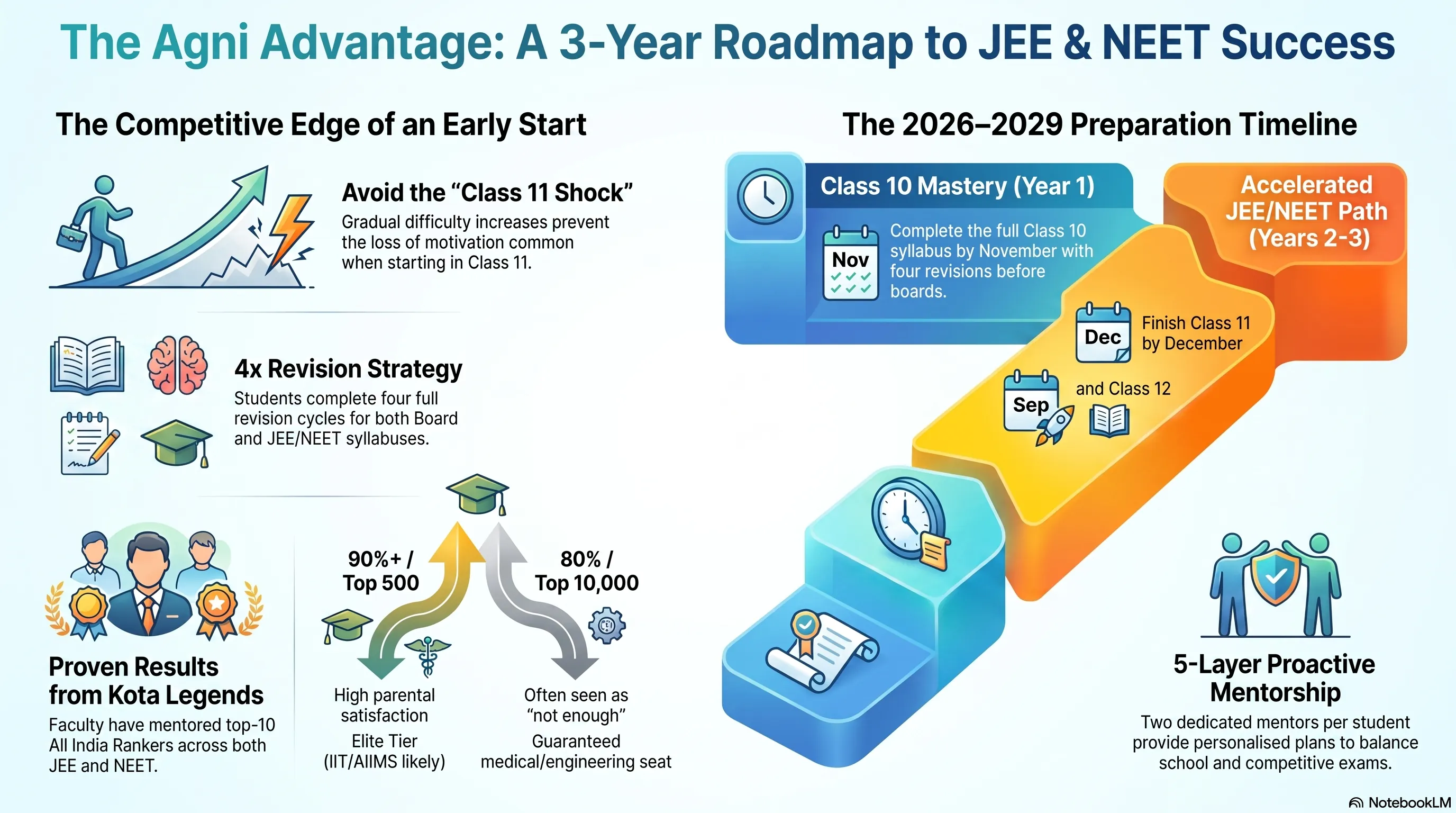
- Complete the full Class 10 syllabus by November, including preparation for periodic tests and half-yearly exams along the way.
- First revision before Pre-Board 1.
- Second revision before Pre-Board 2.
- Two further revisions before the actual board exam — a total of four revisions of the Class 10 syllabus before the boards.
- Alongside Class 10, complete a minimum of three chapters of the Class 11 JEE/NEET syllabus by December this year; students who want to cover more can do so.
- Progress through the Class 11 syllabus in stages — three, then six, then eight chapters — so that the full Class 11 JEE/NEET syllabus is finished by December next year, roughly three to four months ahead of students who start preparation only in Class 11.
- Complete the Class 12 JEE/NEET syllabus by September, instead of December, which is when most other students finish.
- Begin Class 12 board preparation from June 2028, ahead of the 2029 board exam.
- Complete two full revisions by January, since JEE Main's first attempt is held in January, and NEET — already moving to a CBT pattern from this year through 2027 and 2028 — may also have an earlier first round around February-March.
- Complete two more revisions before the second JEE Main or NEET paper, and before JEE Advanced.
Why an Early Start Gives You a Competitive Edge
A key distinction made in the roadmap is that board exams are absolute exams, where every student can score 90%+, while JEE and NEET are competitive exams, where rankings are relative — only one student gets AIR 1, the next gets AIR 2, and so on. The student who covers more ground earlier ends up with a better rank.
| Score | In Class 10 Boards | In JEE Advanced / Main | In NEET |
|---|---|---|---|
| 90% | Parents are happy | — | — |
| 80% | Seen as "not enough" by most people | Top 500 students in the country | — |
| 80% | — | — | Top 10,000–120,000 students; effectively a guaranteed medical seat |
A common mistake among students who start JEE/NEET preparation only after Class 10 is that they suddenly face a steep jump in difficulty in Class 11 and lose motivation. Starting JEE/NEET preparation from Class 10 itself avoids this shock, because the difficulty increases gradually rather than all at once.
Students who begin in Class 10 (instead of Class 11, Class 12, or a drop year) get more time overall — their syllabus finishes earlier, they get more rounds of revision, and they attempt more tests and more questions than students who start later. More preparation time translates directly into a better rank.
Mentorship, Discipline and Subject-Balance Support
The batch includes a five-layer mentorship system, built around two dedicated mentors per student. Rather than students having to attend class to get help, mentors proactively call students — because cracking Class 10 boards or JEE/NEET depends on discipline and regularity, and staying regular alone for three years is not realistic for most students. Mentors step in specifically during the periods when students get distracted or fall off track.
Mentors also help with:
- Balancing school and JEE/NEET preparation, with a personalised plan depending on whether the student attends tuition separately or studies at home.
- Balancing subjects in Class 10 — Science, Maths (Basic or Standard), SST, English, Hindi, AI/IT — and later, balancing Physics, Chemistry, Maths or Physics, Chemistry, Biology with Class 12 boards.
- Note-making, homework timing and amount, and test-taking technique — board exams reward paper-presentation skills, while JEE/NEET reward speed and accuracy, so the guidance differs for each.
- Regular checks on notes and homework, and test analysis after every test so mistakes are corrected immediately rather than repeated.
Study Material, Tests and Doubt-Solving Support
Study Material
Students receive study material for Classes 8, 9, and 10, as well as for JEE and NEET. A Class 10 student gets material for Science, Maths, SST, and English, with the option to order printed material separately. JEE students get JEE Main and JEE Advanced-pattern material; NEET students get NEET-pattern material. Over the next three years, JEE/NEET students are given 500 questions to practise, while Class 10 students practise 7,000–8,000 questions. Full NCERT support is provided across Class 10, JEE, and NEET, along with previous year questions (board, JEE, and NEET) and short notes from eSaral.
For students who want to start practising directly from the NCERT textbooks and solutions referenced in this preparation plan, eSaral provides NCERT Solutions for Class 10, including subject-wise solutions for Class 10 Maths and Class 10 Science, as well as the NCERT Books for Class 10 and individual subject PDFs for Science, Maths, Physics, Chemistry, Biology, English, and Hindi. For board-exam practice, the Class 10 Maths, Science, English, and Social Science 2023 question papers are also available.
Tests and Analysis
Class 10 students take 100+ tests, while JEE/NEET students take 300+ tests across the three-year program. Every single test comes with a 20-page analysis report, generated using AI combined with eSaral's academic expertise, covering each student's strengths, weaknesses, and weak sub-topics.
Doubt-Solving
Most doubts — about 99% — are resolved directly inside the live, interactive class, since homework is discussed in the same class it was assigned in. Beyond that, students get textual and video solutions, a chat-based doubt-solving tool where they can send a text or an image of their doubt, live or offline doubt-solving classes staffed by expert teachers, and the option to connect personally with faculty if a doubt still isn't resolved.
Revision Cycle
The program runs four full revisions of the Class 10 syllabus and four full revisions of the JEE/NEET syllabus, along with a proper revision of the Class 11 syllabus. This extra revision matters because JEE and NEET cover two years of syllabus, compared to one year for board exams, which is part of why these exams are tougher.
Once a student moves into the JEE/NEET phase, the batch adds "Abhyas" speed-practice sessions, with a full analysis of each student's daily routine, timetable, study habits, and time management, plus dedicated backlog-recovery sessions — because even AIR 1 rankers fall behind sometimes. Tests are held live online, or in CBT-pattern format under exam-centre-like conditions for offline students. A live online or offline study room is provided at no extra charge, regular PTMs are held, mentor contact numbers are shared with both students and parents, live video conferencing connects parents with mentors and students with mentors, and "Super Mentorship" sessions are run to increase overall study hours.
Frequently Asked Questions
Find answers to common questions.
Can a Class 10 student really start JEE and NEET preparation?
Yes — eSaral's Agni batch is built specifically for this. Students like Purvi, Priya, Hiral, Ayush, and Prerna started JEE or NEET preparation from Class 10 and went on to top their boards while securing seats at IIT Delhi, IIT Bombay, and AIIMS.
What is eSaral's Agni batch?
The Agni batch is described as India's only and most successful 10th-plus-JEE-NEET batch, running three years of JEE or NEET preparation alongside Class 10 and Class 12 board studies. The newly launched version is named Purvi Agni JEE 2029 and Purvi Agni NEET 2029.
How many students are admitted to the Purvi Agni 2029 batch?
Only 200 students are admitted to this batch. Admissions close once these 200 seats are filled.
Can the Agni batch be converted to an offline Kota batch?
Yes. Students who want to come to Kota for Class 11 and 12 can convert this batch into its offline variant, with fees adjusted accordingly; Class 10 preparation can also be taken offline in Kota if preferred.
How does eSaral's mentorship work in the Agni batch?
Each student gets two dedicated mentors as part of a five-layer mentorship system. Mentors proactively call students to maintain discipline and regularity, help balance school with JEE/NEET preparation, and guide subject balance, note-making, homework, and test-taking technique.