Magnetic Field due to Infinite Straight Conductor | Magnetic Effects of Current Class 12

Table of Contents

Home > Magnetic Effects of Current > Magnetic Field due to Infinite Straight Conductor

Magnetic field due to a long straight conductor
Here we will discuss all the cases involved in the magnetic field due to Conductor such as Magnetic Field due to Infinite Straight Conductor, and many more discussed below:
Consider a long straight conductor XY through which current I is flowing from $X$ to Y. Let $P$ be the observation point at a distance 'r' 'from the conductor XY. Let us consider an infinitesimally small current element $\mathrm{CD}$ of length d\ell. Let s be the distance of $\mathrm{P}$ from the mid-point $\odot$ of the current element. Let $\theta$ be the angle that OP makes with the direction of the current. The magnetic field at $P$ due to the current element $C D$ is
$\mathrm{dB}=\frac{\mu_{0}}{4 \pi} \frac{\mathrm{Id} \ell \sin \theta}{\mathrm{s}^{2}}[\text { Biot-Savart's law }]$
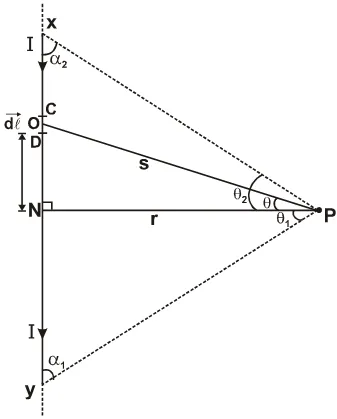 The magnetic field at P due to the whole of the conductor XY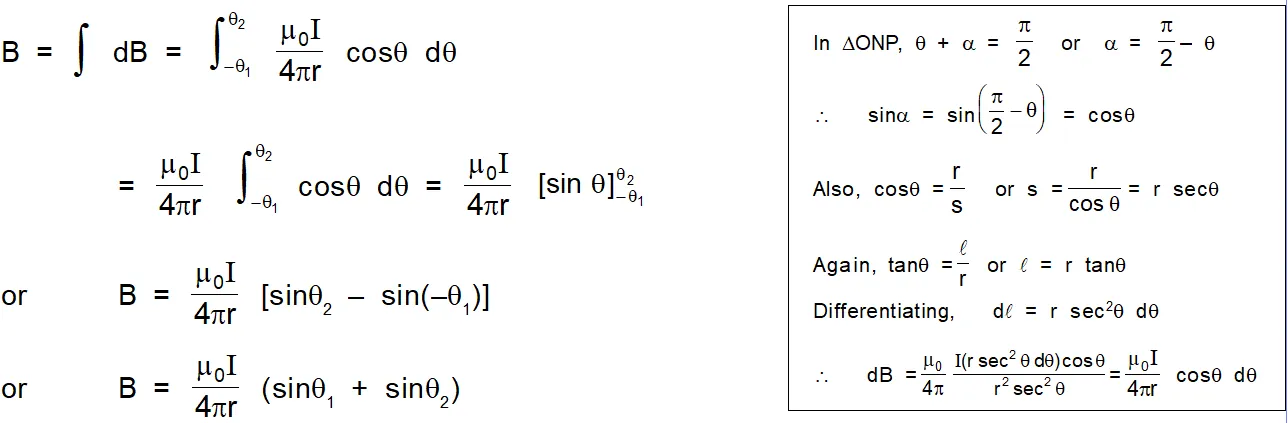
Case I :
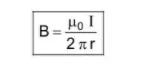
If the conductor is infinitely long, then $\theta_{1}=90^{\circ}$ and $\theta_{2}=90^{\circ}$
$\mathrm{B}=\frac{\mu_{0} \mathrm{I}}{4 \pi}\left[\sin \frac{\pi}{2}+\sin \left(\frac{\pi}{2}\right)\right]=\frac{\mu_{0} \mathrm{I}}{4 \pi \mathrm{r}}[1+1]=\frac{\mu_{0}}{4 \pi} \frac{2 \mathrm{I}}{\mathrm{r}}$ Or
Case II :
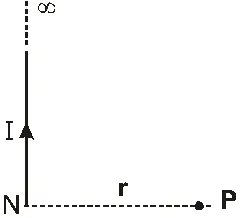
If a conductor is of infinite length but one end is in front of point $P$, i.e., one end of the conductor starts from point $N$, then $\theta_{1}=0^{\circ}$ and $\theta_{2}=90^{\circ}$ 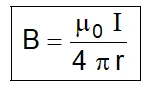
Case III :
Conductor is finite length and point P is just in front of the middle of the conductor 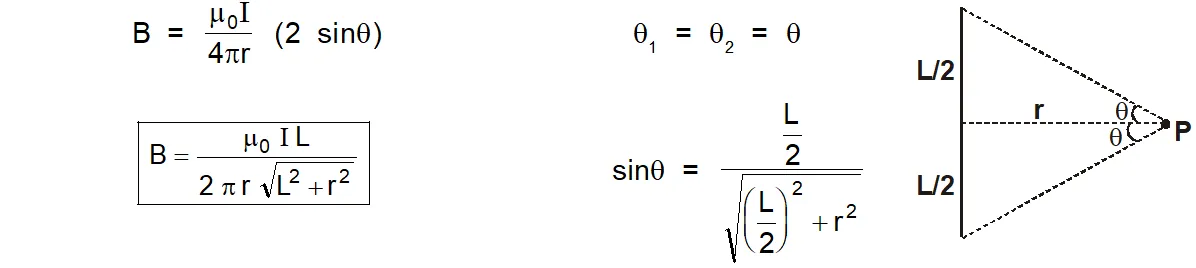
Case IV :
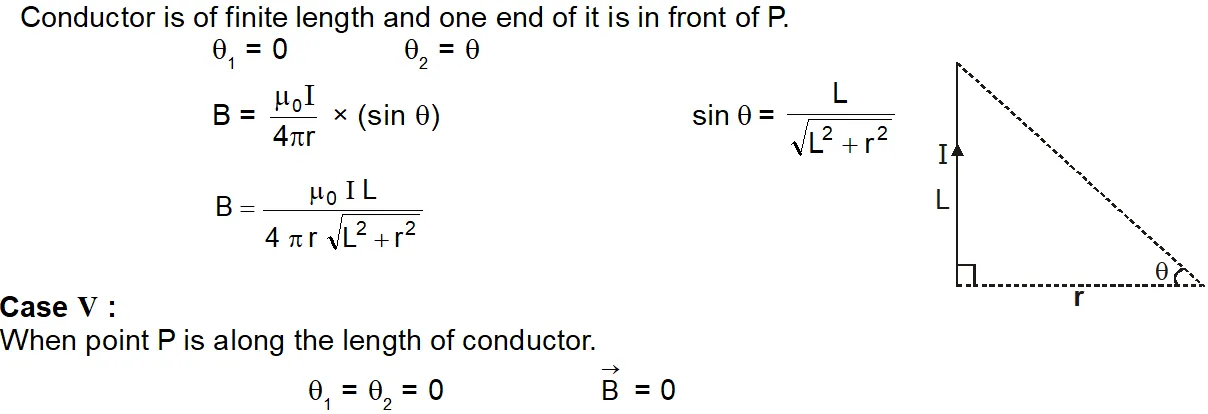
Also Read:
Biot Savart's Law
Click here for the Video tutorials of Magnetic Effect of Current Class 12
About eSaral At eSaral we are offering a complete platform for IIT-JEE & NEET preparation. The main mission behind eSaral is to provide education to each and every student in India by eliminating the Geographic and Economic factors, as a nation’s progress and development depend on the availability of quality education to each and every one. With the blend of education & technology, eSaral team made the learning personalized & adaptive for everyone.
For free video lectures and complete study material, Download eSaral APP.
Frequently Asked Questions
Find answers to common questions.
How does the magnetic field due to an infinite straight conductor vary with distance?
The field varies inversely with distance r — that is, B ∝ 1/r. If you double the distance from the wire, the field reduces to half. This is different from a point charge (E ∝ 1/r²) and is a direct consequence of the cylindrical symmetry of the infinite wire.
What is the difference between the magnetic field of a finite and infinite straight conductor?
What is the magnetic field due to an infinite straight wire carrying current I at distance r?
The magnetic field is B = μ₀I / 2πr, where μ₀ = 4π × 10⁻⁷ T·m/A. This formula applies when the wire is infinitely long and the point P is at a perpendicular distance r from the wire. The field direction is given by the right-hand thumb rule — tangential to concentric circles around the wire
Why is the general formula B = (μ₀I/4πr)(sin φ₁ + sin φ₂) important for JEE?
This general formula covers all four standard cases by simply substituting the appropriate angles. JEE Advanced problems rarely use a perfectly infinite wire — they use finite segments, L-shaped wires, or rectangular loops. Knowing this formula allows you to handle any geometry without re-deriving from scratch, saving crucial time in the exam.
Can Ampere's Circuital Law also give the magnetic field due to an infinite straight wire?
Yes. For an infinite straight wire, the result B = μ₀I/2πr can be derived more simply using Ampere's Circuital Law by choosing a circular Amperian loop of radius r centred on the wire. Both Biot-Savart and Ampere's methods give identical results; Ampere's method is faster when high symmetry exists.
What is the direction of the magnetic field around an infinite straight conductor?
The magnetic field lines form closed concentric circles in a plane perpendicular to the wire, centred on the wire. The direction — clockwise or anticlockwise — depends on the current direction and is determined using the right-hand thumb rule: thumb along current, fingers curl in the direction of B.