NEET 2027 Computer Based Test: Complete Chapter-Wise Preparation Guide
NEET 2027 will be conducted as a Computer Based Test (CBT), replacing the previous OMR sheet format. Students must now practice on digital platforms. A chapter-wise CBT test series with AI-powered analysis helps identify weak subtopics, track time patterns, and correct mistakes before the actual exam.
Table of Contents
- What Is the NEET 2027 CBT Format Change?
- Why Chapter-Wise Tests Are Non-Negotiable for NEET
- How Does a CBT Test Series Differ from OMR Practice?
- What Should a Good NEET Chapter-Wise CBT Test Series Include?
- How AI Analysis Reports Help You Improve Faster
- How to Use Chapter-Wise Analysis to Build a Revision Strategy

eSaral › NEET › Neet test-series› Re-NEET 2026 Question Paper with Solution

What Is the NEET 2027 CBT Format Change?
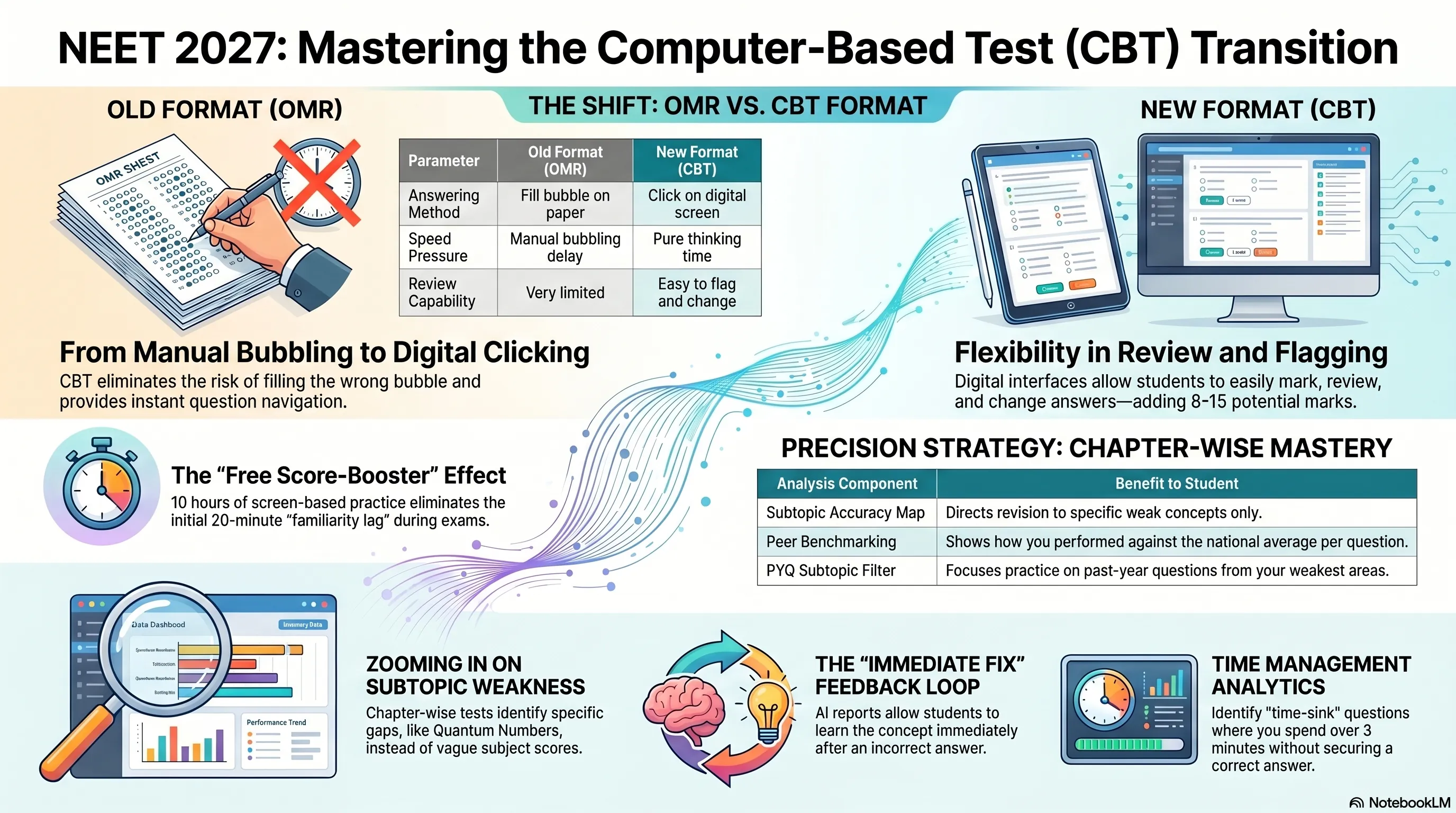
NEET 2027 will no longer use the traditional pen-and-paper OMR sheet. The exam is moving to a fully digital, computer-based test format. Here's a quick summary of what changes and what stays the same:
| Parameter | Old Format (OMR) | New Format (CBT) |
|---|---|---|
| Mode | Pen and paper | Computer / digital screen |
| Answering Method | Fill bubble on OMR sheet | Click on screen interface |
| Review & Change | Limited | Easy to mark, review, and change |
| Speed Pressure | Manual bubbling takes time | Pure thinking time — no bubbling delay |
| Practice Method | Sample OMR sheets | CBT mock tests on digital platforms |
| Devices Supported | N/A | Mobile, laptop, tablet |
The total number of questions, subject distribution (Physics, Chemistry, Biology), and marking scheme remain aligned with the official NEET exam pattern. What changes is entirely the interface and medium of answering.
The key implication: practising on paper is no longer sufficient. Your practice must mirror the exam — digital, timed, and on a screen.
Why Chapter-Wise Tests Are Non-Negotiable for NEET
Every topper who has cracked NEET and made it to AIIMS Delhi, AIIMS Bhopal, AIIMS Patna, or any Government Medical College shares one common habit: they tested themselves chapter by chapter before attempting full-length mocks.
Here's why this approach works:
You Cannot Fix What You Cannot See
A full-length NEET mock gives you a total score. But it doesn't tell you which subtopics inside Atomic Structure are costing you marks. A chapter-wise test zooms in. After each test, you know exactly whether your weak point is Quantum Numbers, Spectral Series, or Bohr's Model.
Chapter Strength Adds Up to Subject Strength
NEET has 97 chapters across Physics, Chemistry, and Botany + Zoology. If even 10 of those chapters have a 40% accuracy rate, your overall score suffers significantly. The only way to fix chapters is to test them individually, identify the gap, and revisit.
Time Management at the Subtopic Level
Full mocks show you how much time you spent per subject. Chapter-wise tests show you something far more precise: how much time you spend on easy versus difficult questions within a single chapter. This is actionable data.
The NEET question papers from past years show clearly that chapter-level accuracy determines toppers from average performers. Check the NEET 2023, NEET 2022, and NEET 2021 papers — you'll see that certain subtopics repeat every year. Knowing which ones you're weak in is half the battle won.
How Does a CBT Test Series Differ from OMR Practice?
Most students underestimate how much the format of a test influences performance. Here is a direct comparison:
What Changes in CBT vs OMR Practice
Interface Familiarity: In CBT, questions appear on screen with clickable options. Navigation between questions is instant. There's a timer on screen. Students unfamiliar with this interface often report "blank mind" in the first 10 minutes of their first CBT exam. Daily CBT practice eliminates this.
Review and Flagging: CBT allows you to mark questions for review and return to them. This feature, used well, can add 8–15 marks in the actual exam. Students who only practise on OMR never develop this skill.
No Manual Errors: OMR practice has a unique risk — accidentally filling the wrong bubble. CBT removes this entirely. Students who've only practised OMR sometimes make this mistake under stress.
Device Accessibility: A good CBT test series should work on mobile, laptop, and tablet — because students practise on different devices at different times.
According to NTA guidelines, the NEET 2027 CBT will be conducted at designated test centres on computers. But your practice can happen anywhere. This is actually an advantage — practise in your room, from your phone, at your own time.
What Should a Good NEET Chapter-Wise CBT Test Series Include?
Not all test series are equal. Here's what separates a genuinely useful chapter-wise CBT test series from one that just gives you a score and moves on:
1. Complete Syllabus Coverage — All 88+ Chapters
A test series should cover every chapter of the NEET syllabus — Physics, Chemistry, Botany, and Zoology. Each chapter should have its own dedicated test of 45 questions covering all subtopics, with a 60-minute timer. This mirrors the intensity of a real NEET section.
2. Previous Year Question (PYQ) Integration by Subtopic
The last 10–12 years of NEET PYQs should be tagged chapter-wise and subtopic-wise. This means after you identify a weak subtopic, you can immediately practise PYQs from that specific subtopic — not random questions, but targeted past paper questions.
Compare: NEET 2020, NEET 2019 papers show that some subtopics appear year after year. A system that tags PYQs by subtopic lets you exploit this pattern.
3. Multi-Level Difficulty
Each test should include Easy, Medium, and Difficult questions in a distribution similar to what NEET actually delivers. Real NEET papers have been Easy (2022), Moderate (2023), and Tough (some past papers) — you need exposure to all levels.
4. Peer Benchmarking
You should be able to see, for each question, what percentage of other students got it right. This contextualises your own performance. If 80% of students got a question right and you got it wrong, that's a high-priority revision item. If only 20% got it right and you also got it wrong, that's expected difficulty.
5. Immediate Concept Fix After Every Wrong Answer
The moment you submit a test, you should be able to click on any wrong answer and see the concept behind it, learn it right there, and attempt a similar question. This closes the learning loop instantly instead of waiting for a revision session days later.
How AI Analysis Reports Help You Improve Faster
This is where modern NEET preparation has genuinely changed. A well-designed AI analysis report after every chapter-wise test can do in 10 minutes what used to take a student 45–60 minutes to manually analyse.
What a 20-Page AI Analysis Report Should Cover
Here's what a genuinely useful per-test AI report looks like:
| Analysis Component | What It Tells You |
|---|---|
| Overall Score & Accuracy | Correct / Incorrect / Skipped with accuracy % |
| Time Insights | Avg time per correct Q, per incorrect Q, per skipped Q |
| Difficulty Breakdown | How many Easy / Medium / Difficult you skip or get wrong |
| Peer Comparison (Q-by-Q) | % of students who got each question right vs you |
| Subtopic Accuracy Map | Which subtopics you're strong/weak in within this chapter |
| PYQ Subtopic Filter | Past year Qs from your weak subtopics |
| Deep AI Insight | AI-flagged subtopics dragging your chapter score down |
| Strength & Improvement Areas | Clear, actionable buckets: what to revise first |
Time Insights Are Underrated
Consider this: a student who completes Atomic Structure in 33 minutes with 90% accuracy looks good on score. But the time analysis might reveal they spent 6 minutes on one incorrect question — a pattern that, replicated across 45 questions in NEET, would cause a time crisis in the actual exam.
The Subtopic Breakdown Changes Everything
Imagine you score 33/45 in Atomic Structure. Without subtopic analysis, you know you're "okay" at the chapter. With subtopic analysis, you find out:
- Spectral Series & Rydberg Formula: 4/4 ✅
- Basic Atomic Structure: 7/7 ✅ (Strong)
- Quantum Numbers: 1/4 ❌ (Weak)
- Bohr's Model: 3/4 ✅
Now you don't revise the entire chapter — you target Quantum Numbers specifically. This is how toppers study.
The "Fix It" Feature: Learning in the Test Interface
After each incorrect answer, you should have the ability to:
- Select the reason you got it wrong (forgot formula / didn't study topic / didn't understand question / ran out of time)
- Learn the concept behind the question immediately
- Attempt a similar question right there
This closes the feedback loop — learning happens at the moment of failure, which is when the brain retains it best.
How to Use Chapter-Wise Analysis to Build a Revision Strategy
Here's a step-by-step approach to turn chapter-wise test data into a structured revision plan:
Step 1: Complete Chapter-Wise Tests in Sequence
Follow the chapter order of your school/coaching curriculum. Don't skip chapters. 88 tests across Physics, Chemistry, and Biology = one chapter cleared per day = under 3 months to cover the full syllabus with testing.
Step 2: Review the AI Report Within 24 Hours
After each test, spend 10 minutes reviewing the report. Note your 2–3 weakest subtopics. Don't re-read the entire chapter — go directly to those subtopics.
Step 3: Use the PYQ Filter for Weak Subtopics
Pull up the PYQs tagged to your weak subtopics. Check how questions from those subtopics appeared in NEET 2022 and NEET 2021. Pattern recognition across years is a legitimate strategy.
Step 4: Re-Attempt Similar Questions
Use the "similar question" feature linked to each incorrect answer. Confirm that you've actually learned the concept — don't just read the solution and assume you've got it.
Step 5: Track Subtopic Progress Across Multiple Test Attempts
After 2–3 tests per chapter (as revision checkpoints), the AI should show you whether your previously weak subtopics have improved. This multi-attempt tracking is what separates a smart test series from a random question bank.
Frequently Asked Questions
Find answers to common questions.
Is NEET 2027 confirmed to be computer-based (CBT)?
Yes, NTA has announced that NEET 2027 will shift to a Computer Based Test (CBT) format, replacing the OMR pen-and-paper method. This change affects all NEET UG aspirants. Students should immediately shift their practice to digital platforms to get comfortable with on-screen answering before the exam.
How many chapter-wise tests should I attempt for NEET 2027 preparation?
.
A complete NEET chapter-wise test series covers 88+ chapters across Physics, Chemistry, Botany, and Zoology. Attempting all 88 chapter-wise tests — one per chapter — gives you full syllabus coverage with performance data at the subtopic level. This is the minimum recommended for a student targeting a score above 650.
What is the best way to practise for NEET 2027 CBT at home?
The best way to practise for NEET 2027 CBT is to use a digital test series that runs on mobile and laptop, gives you timed 45-question chapter-wise tests, and provides subtopic-level analysis after each attempt. Consistent daily practice on-screen builds the interface familiarity that reduces exam-day anxiety significantly.
Can I use past NEET papers for chapter-wise CBT practice?
Yes, and you should. Previous year NEET question papers from 2019 to 2023 contain real exam questions that are tagged by chapter and subtopic in a good test series. Studying patterns from the NEET 2019 paper to the NEET 2023 paper shows which subtopics repeat. Matching these with your AI analysis data is a powerful strategy.
Is a chapter-wise test series better than full-length NEET mock tests?
Both serve different purposes. Chapter-wise tests help you build and verify subject strength at the micro level — subtopic by subtopic. Full-length mock tests test your endurance, time management, and overall strategy. The recommended approach is to complete chapter-wise tests first, build chapter-level confidence, and then shift to full-length mocks in the 3 months before the exam.