NEET 2027 Physics Preparation Strategy: A Chapter-by-Chapter Roadmap for Droppers
NEET 2027 Physics preparation for droppers means covering the syllabus chapter by chapter, reading NCERT line by line for scores above 170, practicing concept builders before tough questions, giving regular chapter-wise computer-based tests, and analysing every test to fix weak sub-topics.
Table of Contents
- Why NEET 2027 Preparation Should Start Right Away
- NEET 2027 Is Almost Certainly Going Computer-Based
- Know Your Physics Syllabus Down to the Smallest Detail
- Should You Start Physics From the Basics Again?
- The NCERT Strategy: How Much Should You Really Read?
- Which Physics Chapters Carry the Most Weightage?
- How to Practice Physics Questions the Right Way
- Why Test-Taking Strategy Decides Your Final Score
- How to Revise Physics Without Wasting Time

eSaral › NEET › NEET 2027 Physics Preparation Strategy: A Chapter-by-Chapter Roadmap for Droppers

Why NEET 2027 Preparation Should Start Right Away
Many droppers ask whether they should start NEET 2027 preparation only after their NEET 2026 result is declared. Since students can already estimate their score from the answer key, starting early is strongly recommended. If your NEET score is under 500 and you are not getting a medical college in your category, delaying preparation only wastes time.
There is also discussion that NEET may be held twice a year going forward, which means the first attempt could fall as early as February. This makes it necessary to complete the full syllabus by December or January, leaving enough time for tests and revision before the exam window opens.
Toppers who scored 700, 690, and 685 out of 720 studied for 10 to 12 hours a day. A five-hour average study routine is unlikely to be enough to clear NEET, given how many other droppers are putting in that level of effort.
NEET 2027 Is Almost Certainly Going Computer-Based
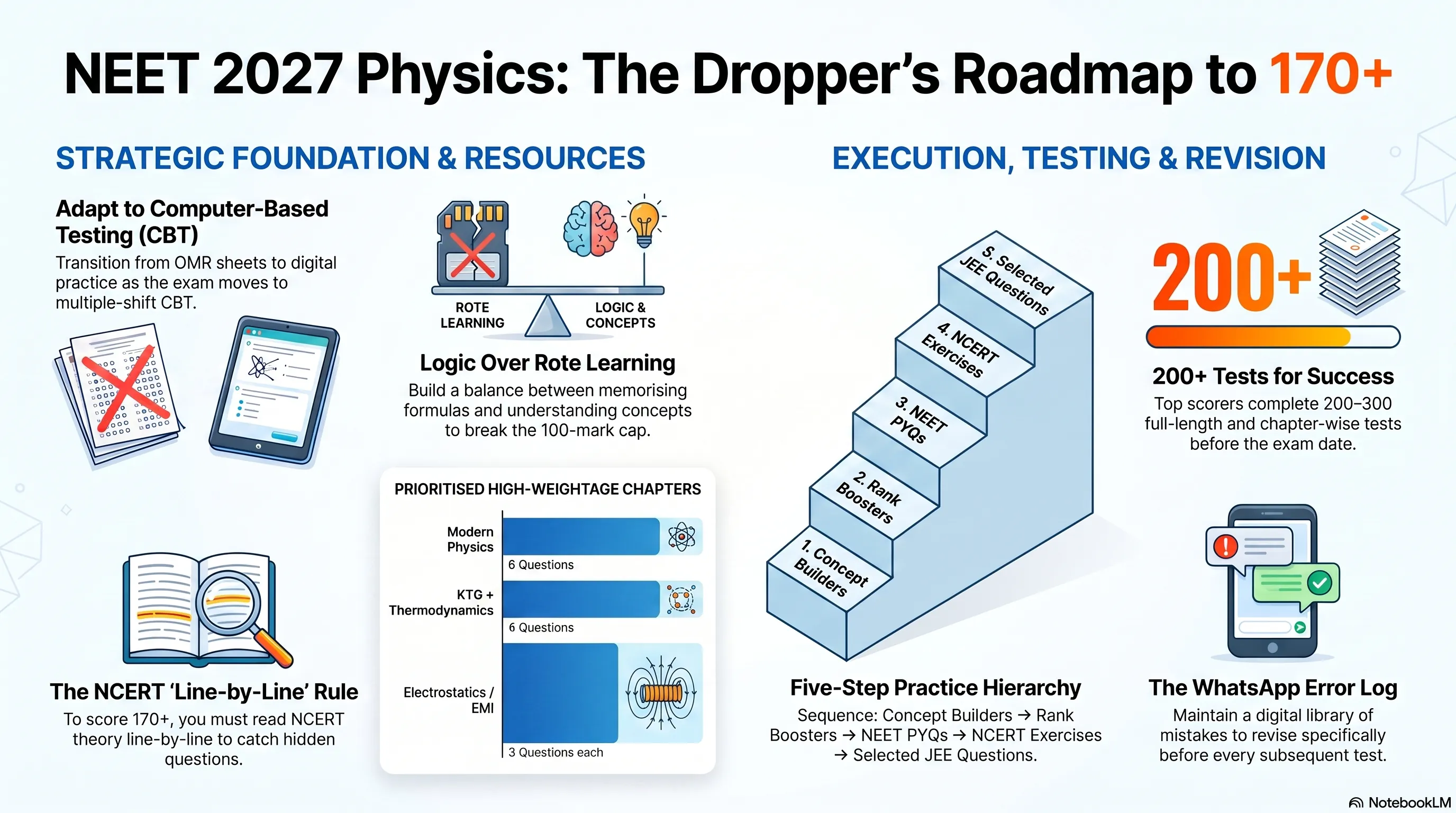
NEET has traditionally been conducted through OMR sheets, but that is expected to become a thing of the past. An official announcement has already come from the Education Ministry, and it is almost 100% certain that NEET will move to Computer-Based Test (CBT) mode — confirmation of the exact format is still awaited, but preparation should assume CBT going forward. You can check the official NEET exam pattern for further reference as updates are released.
Since more students appear for NEET than for JEE, and JEE itself requires multiple shifts, NEET is also likely to be conducted in multiple shifts once it goes computer-based. When exams run in multiple shifts, difficulty levels vary — some shifts turn out easy, some moderate, and some tough — which may also require NTA to introduce a percentile-based normalisation system, similar to how multiple-shift exams are typically normalised.
Because of this shift, droppers should stop practising primarily on OMR sheets. OMR-based test-taking strategy is different from computer-based test-taking strategy, so continuing to practice only on paper will work against you on exam day.
Know Your Physics Syllabus Down to the Smallest Detail
Before deciding what to study, you need to know your syllabus in minute detail — what is included and what is not. This year, a question on least count (related to negative and positive error) was set, and it eventually had to be dropped and treated as a bonus for everyone. Many students had skipped that portion because they did not realise it was part of the syllabus.
Small topics like this are often missed simply because students don't check the syllabus closely enough. Go through the NEET syllabus carefully so that no chapter or sub-topic is left unchecked.
Should You Start Physics From the Basics Again?
If your score is 450 or above, you can skip starting from the basics — but only for chapters where you are already scoring well. List out all 30 Physics chapters, identify the ones you're strong in, and you can skip basic-level study for those specific chapters.
For chapters where you are not scoring well, start from the basics again, even if it feels repetitive. This drop year should not have any gaps left in your preparation.
Study Physics Logically, Not by Rote
Physics has two components: things you must memorise (formulas and facts) and things you must understand logically. Students who score 180 out of 180 in Physics build a balance between the two — they memorise what needs to be memorised and understand concepts logically rather than rote-learning "if this appears, apply this."
Purely rote-based preparation caps your score around 100 marks. NEET Physics now tests logic up to JEE Main and even some JEE Advanced-level conceptual depth, so understanding concepts logically actually makes Physics easier, not harder.
Doubts should never be left unclear. If a concept isn't clear in class, ask immediately — whether in an online live class (where you can raise your hand and get unmuted) or an offline batch. Students who leave a doubt unclear in Class 11 often find that it keeps troubling them later, and confidence in that chapter never fully builds. Tackle Physics chapter by chapter: it's never the whole subject that is strong or weak; it's individual chapters — so focus fully on whichever chapter is currently being taught.
The NCERT Strategy: How Much Should You Really Read?
If your target is around 140–150 marks in Physics and your teachers are covering all the concepts well in class, you do not need to read NCERT theory line by line.
But if your target is 170 or higher, NCERT must be read line by line. Every year, one or two NEET questions come directly from hidden or less-obvious lines in NCERT — this year's question on the scattering experiment graph was exactly this kind of question, and it is generally not covered by teachers in regular classes.
💡 NCERT Marking Technique: Once you've covered a topic well in class, go through NCERT and mark or cross out lines you already know so you don't need to revise them again — for example, a basic definition you're already confident about. This leaves only about 10% of NCERT lines that actually need revision, letting you revise ten times faster than students who read the whole book line by line every time.
Reference books other than NCERT are generally not recommended for building theory — with enough good-quality videos and classes available today, reading theory from books is largely a waste of time.
Which Physics Chapters Carry the Most Weightage?
Looking at the chapter-wise question distribution in the 2026 NEET paper gives a sense of which chapters need extra focus, based on the last several years of analysis. You still need to study everything, but some chapters consistently carry more weight than others. You can cross-check the full breakdown on the NEET Physics weightage page.
| Chapter / Topic | 2026 Weightage | Notes |
|---|---|---|
| Modern Physics (Atomic, Photoelectric Effect, Dual Nature, Nuclear Physics combined) | 6 questions | Highest-scoring topic almost every year; NCERT reading strongly recommended |
| Electrostatics | 3 questions | Consistently important |
| EMI (Electromagnetic Induction) | 3 questions | Consistently important |
| KTG + Thermodynamics (combined) | 4 questions | Usually 3–4 questions every year |
| Ray Optics | Lower this year | Still an important chapter overall |
| Current Electricity | 1 question this year | Usually 2–4 questions; don't underestimate it |
| Semiconductors | Important | Frequently tested |
| EM Waves | Small chapter, high value | Based on only about four formulas — a "small packet, big impact" chapter |
| Units and Dimensions | Important | Compact, scoring topic |
If NEET students are deciding which chapters to prioritise when time is short, Modern Physics, Electrostatics, EMI, KTG-Thermodynamics, Current Electricity, Semiconductors, EM Waves, and Units & Dimensions are the ones to get to a very strong level — without ignoring the rest of the syllabus.
How to Practice Physics Questions the Right Way
A common mistake droppers make after a tough NEET paper is jumping straight into JEE Main and JEE Advanced-level questions. Instead, always start a chapter with concept-builder (easy-level) questions, unless that chapter is already very strong for you. Only chapters you're already confident in can be approached directly with tougher questions.
The Practice Sequence
- Concept Builders – Easy-level questions to build the base of every chapter.
- Brain Boosters / Rank Boosters – Tougher questions that take more time; roughly 15–20 such questions appeared in both the 2025 and 2026 NEET papers, especially in the harder shifts.
- NEET Previous Year Questions (PYQs) – A must-do, covering the last 10–15 years. Very easy repeated questions can be skipped, but the last two years (2025 and 2026) should be done in full. You can go through recent papers on the NEET question paper page, including the 2023, 2022, 2021, 2020, and 2019 papers.
- NCERT Back-Exercise Questions – Both numericals and theory-based questions should be attempted at least once.
- JEE Main PYQs (Selected) – Not full papers; pick selected, chapter-wise questions from the last 5–10 years rather than attempting everything.
- JEE Advanced PYQs (Selected) – JEE Advanced questions are relevant, but not all of them. JEE Advanced is a different format — only 48 questions in 3 hours compared to NEET's 180 questions in 3 hours — so only NEET-relevant JEE Advanced questions should be picked, not the full paper.
- Irodov (Selected) – A few NEET-relevant Irodov questions can also be attempted, again selectively.
Modules, sheets, or DPPs (also called CPPs — Core Practice Problems) are essential, but only if they are actually discussed in class. If they aren't discussed, they lose most of their value. If your coaching material is already good, you don't need to add HC Verma's Objective 1 and 2 books — but if your material is weak, these can help build strong concepts through single-correct and multiple-correct type questions.
Why Test-Taking Strategy Decides Your Final Score
Many droppers leave testing for the last stretch — this is a mistake. One student who scored 700 gave at least 200 tests. Another dropper, now at AIIMS Jodhpur, gave around 300 tests — a full test every day in January–February, and two tests a day in March–April.
Full-syllabus, 3-hour tests matter the most after the syllabus is completed (by December, in this plan), but chapter-wise tests should be given regularly through the year to know exactly where you stand in each chapter. Since the exam format has moved to computer-based testing, chapter-wise tests should now be given on a computer or mobile device — not on OMR sheets — so your test-taking habit matches the real exam.
Test Analysis Is the Real Differentiator
Almost every dropper or Class 12 student scoring 680+ shares one habit: they analyse every test in detail. A good test report should show:
- Time taken per question, compared with the average time other students took
- What percentage of students got each question right or wrong
- Chapter-wise and sub-topic-wise breakdown of correct, incorrect, and skipped questions
- Clear identification of weak subtopics, not just weak chapters
For example, one student's report showed her atomic structure chapter was strong overall, except for one specific sub-topic — radius and velocity of the electron — where she had one correct, two incorrect, and one skipped. Another showed 4 correct, 3 incorrect, 1 skipped in Nuclear Energy, Mass Defect and Binding Energy, and 13 correct, 9 incorrect, 3 skipped in Photoelectric Effect and Einstein's Equation.
The mistake most droppers make is re-studying everything with equal intensity instead of targeting these specific weak subtopics. Identify the weak sub-topic, fix it directly, and your score improves far faster than a generic full revision.
How to Revise Physics Without Wasting Time
Good notes are your best revision tool. In a drop year, it's worth rebuilding Physics notes fresh, highlighting important points and using short forms — but keeping them concise rather than long. Separate short notes are only worth making for chapters that are genuinely very weak.
Mark Your Notes and Modules
Use a marking system in your existing notes rather than always creating new short notes:
- Cross out lines or definitions you already know well, so you don't waste time re-reading them.
- Tick or write "good" next to lines you specifically want to revise before the exam.
- In your practice modules, mark questions as easy, good, or very good. Anything you couldn't solve should be marked good or very good — these are the ones that need repeated revision.
This exact marking technique was used by the faculty member behind this strategy to secure an AIR-41 in JEE, and many students who reach the top 100 or top 1,000 in NEET use some version of it.
Keep a Test-Analysis Notebook
Every wrong answer should be logged with the actual reason for the mistake — for example, "conceptual mistake" — rather than left unexamined. One topper maintained this by photographing each wrong question and messaging it to himself on WhatsApp, building a running library of his own mistakes that he revised before every subsequent test. Many students scoring in the top 50 nationally maintained a version of this habit, and it stopped them from repeating the same mistakes.
Between chapter-wise tests, full-syllabus tests, NCERT marking, and a dedicated error log, this four-part approach — theory, practice, testing, and revision — is what has taken droppers from scores like 121 to 171, and helped others cross the 680–710 mark in Physics-heavy NEET attempts.
Frequently Asked Questions
Find answers to common questions.
Will NEET 2027 be conducted as a computer-based test?
It is almost certain NEET 2027 will move to computer-based test (CBT) mode. An official announcement has already come from the Education Ministry, though the exact format is still to be confirmed. Droppers should prepare on computers or mobile devices rather than OMR sheets.
How many hours should NEET droppers study Physics and other subjects daily?
Toppers scoring 685–710 out of 720 studied 10 to 12 hours a day, not around 5 hours. Since many other droppers put in this level of effort, matching or exceeding it is necessary to stay competitive for NEET.
Is reading NCERT necessary for NEET Physics preparation?
It depends on your target score. If you're aiming for around 140–150 marks and your teacher covers concepts well, NCERT theory reading isn't required. For 170 or higher, NCERT must be read line by line, since occasional questions come from its lesser-known lines.
Which Physics chapters carry the highest weightage in NEET?
Modern Physics carried the highest weightage in the 2026 NEET paper with 6 questions, followed by Electrostatics and EMI with 3 questions each, and KTG-Thermodynamics with 4 questions combined. Current Electricity, Semiconductors, EM Waves, and Units & Dimensions are also consistently important.
How many mock tests should a NEET dropper attempt before the exam?
Top scorers gave anywhere from 200 to 300 tests across their drop year, including daily tests in January–February and two tests a day in March–April. Chapter-wise tests should run throughout the year, with full-syllabus tests becoming the priority after the syllabus is completed.