NEET 2028 Preparation for Class 11: Complete 2-Year Strategy to Crack AIIMS
NEET 2028 preparation from Class 11 is achievable in two years, and students who start from scratch with a structured, mentored programme have earned top-100 ranks and seats in AIIMS Delhi, AIIMS Jodhpur, and AIIMS Rishikesh. The 2028 exam will be in CBT (computer-based) mode, making daily interactive learning, regular CBT-mode mock testing, and subject-balanced preparation across Physics, Chemistry, and Biology more important than ever.


Table of Contents
- Can You Really Crack NEET 2028 Starting From Class 11?
- What Is New About NEET 2028 That Every Student Must Know
- The 5 Mistakes That Cost Students Their AIIMS Seat
- Subject-Wise Preparation Strategy for NEET 2028
- How to Structure Your 2-Year NEET Preparation Timeline
- What Does a High-Quality NEET Coaching Programme Actually Look Like?

eSaral › NEET › NEET 2028 Preparation for Class 11

Can You Really Crack NEET 2028 Starting From Class 11?
Every year, students ask this question — and every year, the answer is the same: yes, two years is enough. Not just to qualify, but to earn a top-100 rank and an AIIMS seat.
Here are real student results from eSaral's NEET batches:
- Praveen completed preparation in under two years and is now at AIIMS Jodhpur
- Saif used under two years of focused preparation and is now at AIIMS Delhi
- Manjari prepared in under two years — despite a period of illness that cost her weeks — and is now at AIIMS Kalyani
These students did not have a head start. They had two years, the right guidance, and the discipline to use both well.
The students who struggle in two years are not those who started late. They are those who spent time without structure — doing theory without practice, attending classes without testing, and building backlogs without recovering them. Two years of the right preparation is more than enough. Two years of the wrong preparation is never enough.
💡 Expert Tip by Prateek Gupta, IIT Bombay: Every year after NEET results, students tell me: "Sir, if only I had known this two years ago, I would have a top-100 rank today." This article is exactly that — the advice they wish they had received on Day 1 of Class 11.
What Is New About NEET 2028 That Every Student Must Know
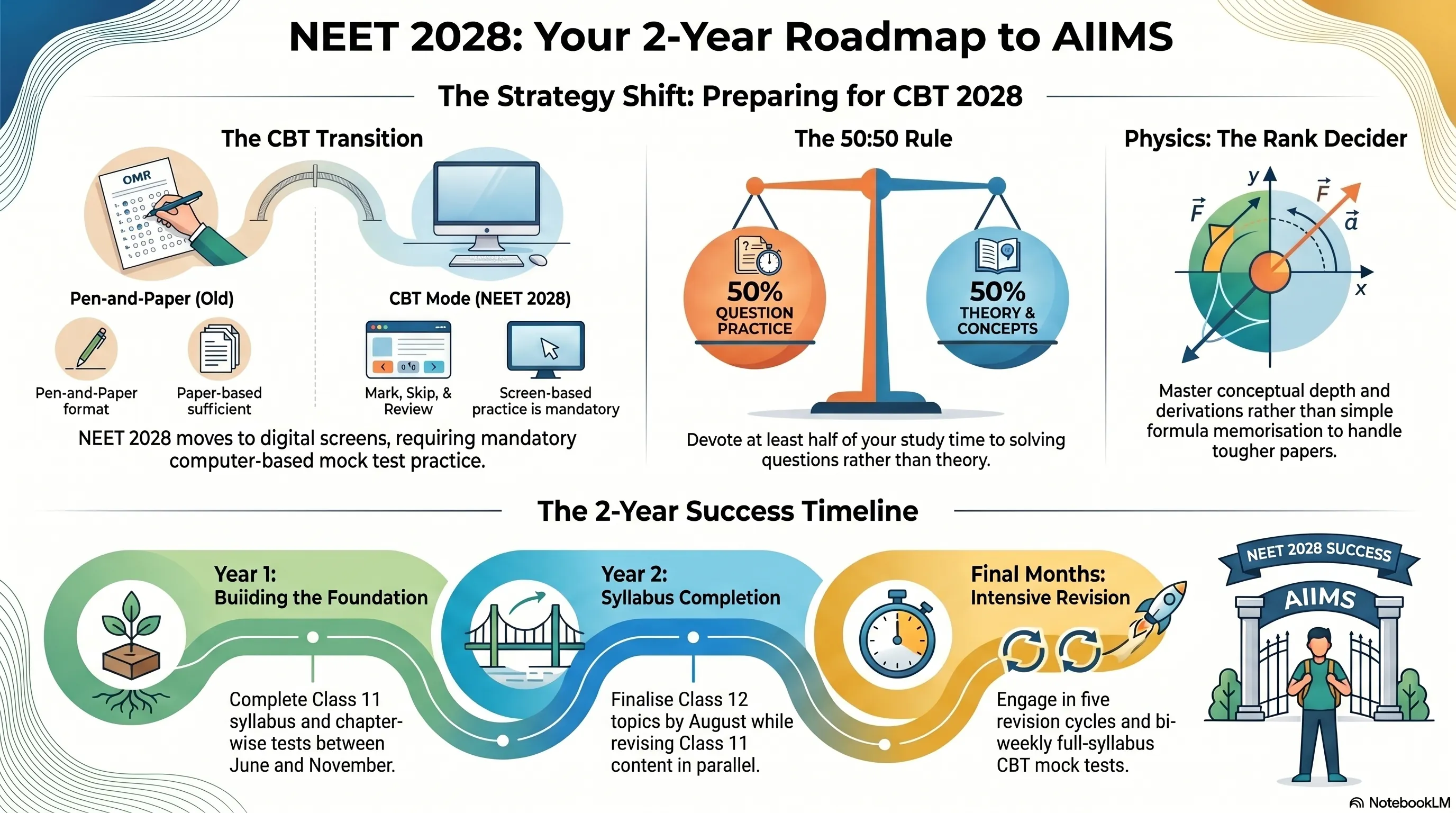
NEET 2028 will be conducted in CBT (Computer-Based Test) mode — a fundamental shift from the pen-and-paper format that students have used for years. This changes how you must prepare, not just what you prepare.
What CBT Mode Means for Your Preparation
| Feature | Pen-and-Paper (Old) | CBT Mode (NEET 2028) |
|---|---|---|
| Medium | OMR sheet, physical paper | Computer screen, mouse/keyboard |
| Practice requirement | Practice on paper sufficient | Must practice on screen regularly |
| Reading style | Physical paper | Digital reading — different fatigue profile |
| Navigation | Linear | Can mark, skip, and review digitally |
| Test practice | Paper mock tests | CBT mock tests on screen mandatory |
JEE students have prepared for computer-based exams for years. NEET 2028 aspirants now need the same mindset. If your mock tests are not on a computer screen, you are not preparing for the actual exam.
Why the Paper Level Is Going Up
NEET 2025 Physics was at a significantly higher level than previous years. Historically, NEET has had phases of challenging papers — with Rank 1 scores as low as 670–680 out of 720 — and the trend is returning to that level. If you plan your preparation assuming the paper will be easy, that assumption could cost you your AIIMS seat.
According to NTA's official NEET exam pattern, the exam is 200 questions (180 to attempt) across Physics, Chemistry, and Biology, testing conceptual depth across the full NEET syllabus.
The 5 Mistakes That Cost Students Their AIIMS Seat
These are not hypothetical. They come directly from students who appeared in NEET and fell short — and shared exactly what went wrong.
Mistake 1: Treating Theory as Preparation
Reading NCERT and watching lectures is not preparation. It is orientation. Preparation is what happens when you close the book and solve questions. Students who spent 80% of their time on theory and 20% on question practice almost always underperform in NEET. The ratio should be closer to 50-50 at minimum, and weighted toward questions in the final 6 months.
Mistake 2: Ignoring Physics Until It Was Too Late
Many NEET aspirants deprioritise Physics because Biology feels more natural and Chemistry feels more scoreable. But NEET 2025 proved that Physics can be the deciding factor. Students who had invested deeply in Physics — conceptual clarity, not just formula memorisation — had a structural advantage. No one can predict which subject will be most decisive in 2028. The safest strategy: prepare all three equally.
Mistake 3: Not Taking Mock Tests in Exam Conditions
Knowing the answer when you have unlimited time is not the same skill as finding the answer in 3 hours across 180 questions. Reading speed, decision-making under pressure, and question prioritisation are exam skills — they only develop through regular timed testing. Students who had taken fewer than 20 full mock tests before NEET consistently reported running out of time or making sequence-related errors.
Mistake 4: Letting Backlogs Accumulate
A missed class in Week 3 becomes a chapter gap by Month 2. A chapter gap in Month 2 becomes a subject weakness by the exam. The students who perform best are not necessarily the most talented — they are the most consistent. They never let a backlog survive more than one week.
Mistake 5: Preparing Without Mentorship
Knowing what to study is only half the equation. Knowing how to study — how many hours, which topics to prioritise this week, what your test analysis is revealing, when to revise — requires external guidance. Students who prepared without consistent mentorship made avoidable structural errors for months before anyone flagged them.
💡 Expert Tip by Prateek Gupta, IIT Bombay: The single biggest difference I see between students who reach AIIMS and those who fall short is not intelligence — it is accountability. The students who succeed have someone checking their homework, tracking their tests, and calling them when they miss a session. Build that infrastructure into your preparation from Day 1.
Subject-Wise Preparation Strategy for NEET 2028
Physics: Conceptual Clarity First, Formulas Second
NEET Physics in 2025 tested at a level that surprised many students. The questions that matched eSaral's lecture content and module exercises — and did not appear in any other coaching material — came directly from building conceptual depth, not surface coverage.
What to focus on:
- Build each concept from first principles before attempting questions
- Practise reading-heavy, multi-step Physics problems weekly
- Use visualisation-based learning for mechanics, electrostatics, and optics
- Never skip derivations — they appear directly in NEET questions
Check the NEET Physics chapter-wise weightage to prioritise chapters by marks contribution.
Chemistry: NCERT Is the Base, Depth Is the Edge
NEET Chemistry in 2025 was largely NCERT-based — which means every coaching material covered it. The differentiator was students who had gone slightly deeper than NCERT in Organic and Physical Chemistry.
What to focus on:
- Complete NCERT line by line — every line matters in NEET Chemistry
- Build reaction mechanisms in Organic Chemistry, not just end products
- Use the NEET Chemistry chapter-wise weightage to allocate revision time smartly
- Practise 20–30 Chemistry questions daily as a non-negotiable habit
Biology: Reading Speed Determines Your Score
Biology makes up 360 of 720 marks in NEET. Most students know this — which means competition in Biology is the fiercest. The differentiator at the top-100 rank level is reading speed and accuracy together.
What to focus on:
- NCERT Biology word-for-word — diagram labels, exceptions, and exact terminology
- Read each chapter at least 4–5 times across your two years
- Practise reading NEET-style questions quickly — time yourself on Biology sets
- Never treat Biology as "easy" — at the top-rank level, one missed NCERT line is one rank dropped
How to Structure Your 2-Year NEET Preparation Timeline
Here is a month-by-month structure that has produced AIIMS results for students starting from Class 11:
| Phase | Months | Key Activities |
|---|---|---|
| Foundation — Class 11 Physics, Chemistry, Biology | June – November (Year 1) | Complete Class 11 syllabus from basics; CPP + Module Exercise 1; chapter-wise tests after each chapter |
| Class 11 Consolidation | December (Year 1) | Class 11 revision + first full NEET mock test; identify weak chapters |
| Class 12 Build | January – August (Year 2) | Complete Class 12 syllabus; Module Exercise 2 (advanced level); parallel 11th revision |
| Full Syllabus Tests Begin | September (Year 2) | Chapter-wise tests complete; 3-hour full NEET mock tests every 2 weeks |
| Intensive Revision | October – February (Year 2) | 4–5 full revision cycles; Rank Booster material; AI-powered test analysis |
| All-India Test Series | March – April (Year 2) | Compete with all NEET aspirants nationally; final weak-area targeting |
| Final Preparation | May (Year 2) | Last revision; exam strategy; CBT mode practice |
| NEET 2028 | May 2028 | Exam |
Daily Schedule: What a Productive NEET Day Looks Like
A realistic daily schedule for a Class 11 NEET aspirant:
- School + travel: 7–8 hours
- Live interactive classes: 3–4 hours
- Homework + question practice: 2–3 hours
- Test analysis / revision: 1 hour
- Sleep: 7–8 hours (non-negotiable — cognitive function depends on it)
Total study outside school: 6–8 focused hours. Quality beats quantity here.
What Does a High-Quality NEET Coaching Programme Actually Look Like?
Not all coaching is equal. Here is what genuinely separates programmes that produce AIIMS results from those that do not:
Two-Way Interactive Classes — Not Lectures
The most common reason students fail despite attending coaching is unresolved doubts in theory. When a student cannot ask a question in class, doubts accumulate → questions go unattempted → test scores drop → confidence falls → preparation becomes passive. The solution is live, two-way interaction — where your video is on, you can raise your hand, and the teacher addresses your doubt in real time, just as in a physical classroom.
5-Layer Doubt Solving
No single doubt-solving method works for every student. A complete system includes:
- In-class audio-video interaction with the teacher during live sessions
- Video solutions for every homework question
- Text-based doubt tool — photograph your doubt, get a written resolution
- Live doubt-solving sessions — dedicated time slots on the app with teachers available
- Mentor escalation — if a doubt is still unresolved, your mentor connects you directly to the subject teacher
Personalised 20-Page Test Analysis Reports
A test score tells you what happened. A good analysis report tells you why — and what to do next. After every test, you should receive a report that shows your accuracy by chapter, your time per question versus a top-ranker's time, your weakest topics at the sub-topic level, and a specific improvement plan for the next 4 weeks.
Two Dedicated Mentors Per Student
One mentor is not enough when preparation covers two full years, three subjects, and hundreds of tests. You need:
- Someone who tracks your attendance and calls within 24 hours if you miss a class
- Someone who reviews your test analysis with you weekly and adjusts your study plan
- Someone you can call when you are struggling emotionally or motivationally
- Someone who holds your parents informed when your progress needs external support
200 Tests in CBT Mode
All chapter-wise tests, full NEET mock tests, and revision series tests must be in CBT mode — on a computer or laptop screen, simulating the exact environment of NEET 2028. By the time you sit your actual exam, the interface should feel so familiar that it requires zero adaptation.
eSaral's NEET 2028 Brahmos Special 2.0 batch —is built on every one of these criteria. Faculty from eSaral's teaching team have collectively produced over 25,000 doctors, with multiple AIR-1, AIR-5, AIR-9, and top-100 ranks. Seats are limited because the batch is two-way interactive. Check the NEET question paper archive to see the level you are preparing for. Scholarships are available based on your Class 10 board percentage.
Frequently Asked Questions
Find answers to common questions.
Can I crack NEET 2028 if I start preparation in Class 11 from scratch?
Yes. Two years of structured preparation from Class 11 is sufficient to crack NEET 2028 and earn a top-100 rank. Multiple eSaral students — including those at AIIMS Delhi and AIIMS Jodhpur — completed their NEET preparation in under two years starting from scratch. The critical factor is consistent daily practice, not the starting point.
What is CBT mode in NEET 2028 and how should I prepare for it?
CBT (Computer-Based Test) mode means NEET 2028 will be conducted on a computer screen rather than pen and paper. To prepare, all your mock tests and chapter-wise tests should be taken on a computer or laptop. Practising on screen builds reading speed for digital text, familiarity with navigation tools, and reduces exam-day adaptation time significantly.
How many hours should a Class 11 student study for NEET per day?
Class 11 NEET aspirant should target 6–8 focused study hours daily outside school, covering live classes, homework, question practice, and test analysis. Sleep of at least 7–8 hours is essential for memory consolidation. Sustained quality study across two years matters far more than occasional 12-hour marathon sessions.
Is NCERT enough for NEET 2028 Biology and Chemistry?
NCERT is the essential base for Biology and Chemistry in NEET — every line, diagram label, and exception matters. However, NEET 2025 showed that Physics required conceptual depth beyond standard preparation, and Chemistry occasionally tests beyond surface NCERT. Studying NCERT thoroughly plus a structured module with advanced-level exercises is the recommended approach.
How is NEET 2028 different from previous NEET exams?
The most significant change is the shift to CBT (computer-based) mode, which requires digital screen practice in addition to content preparation. The paper level has also been trending upward since NEET 2025, with Physics showing significantly higher conceptual difficulty. Students targeting top-100 ranks must prepare for a challenging exam, not a moderate one.