Neural Control and Coordination - NEET Previous Year Questions with Complete Solutions
Neural Control and Coordination is a high-weightage NEET Biology chapter covering neuron structure, action potential, synapse, brain, eye, and ear physiology, contributing an average of 3–5 questions annually in NEET.
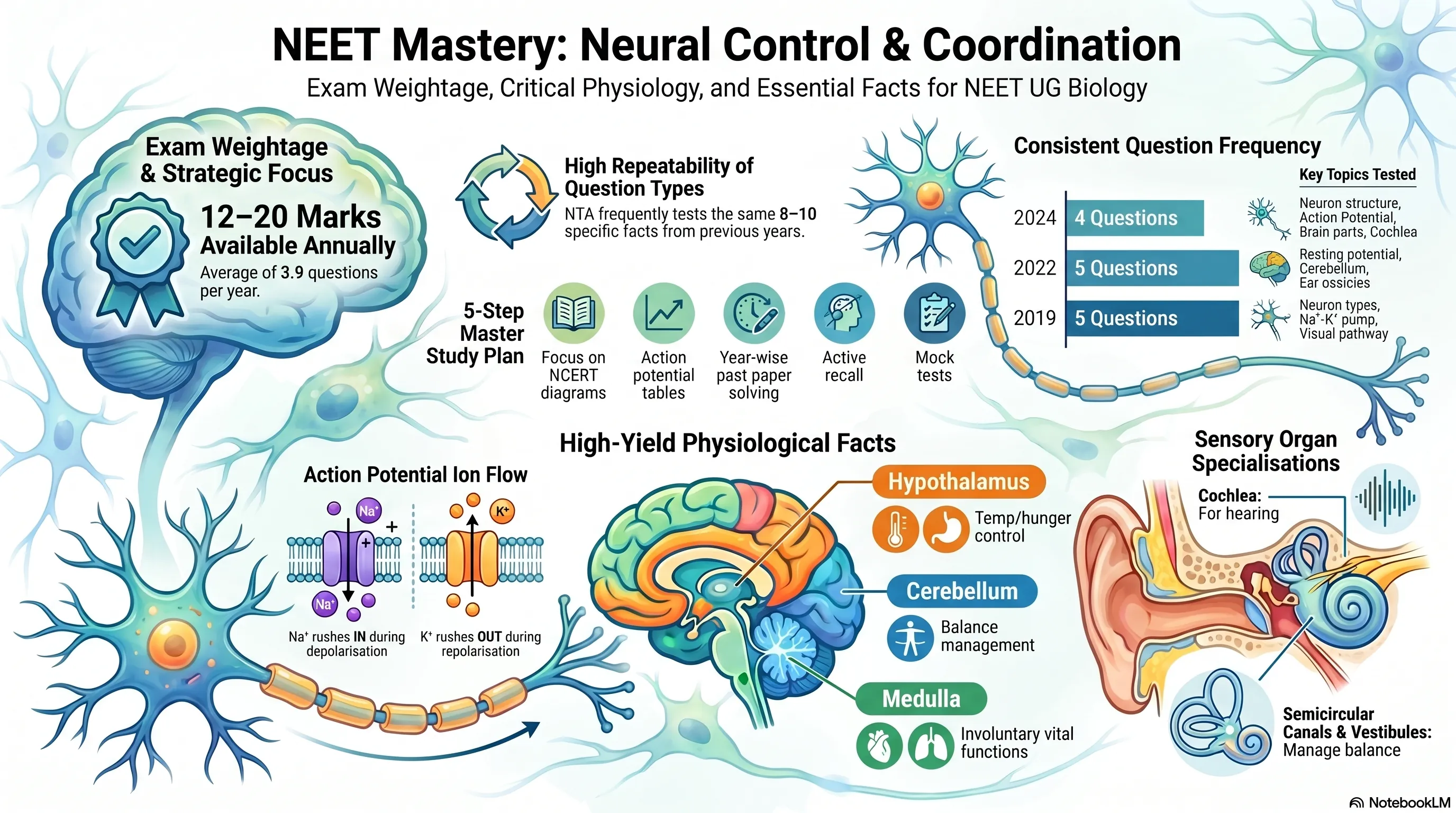
Table of Contents
- Why Neural Control and Coordination Is a High-Priority NEET Chapter
- NEET Previous Year Questions — Neural Control with Solutions
- Chapter Overview: Topics and Subtopics
- NEET Weightage Analysis: Year-Wise Question Count
- Key Concepts You Must Know Before Solving PYQs
- How to Study Neural Control for Maximum NEET Marks

eSaral › NEET ›Neural Control and Coordination

Why Neural Control and Coordination Is a High-Priority NEET Chapter
Neural Control and Coordination (Class 11, Chapter 21) is one of the most consistently tested chapters in NEET UG Biology. It contributes 3–5 questions every year — approximately 12–20 marks — across a range of question types from direct structural recall (neuron parts, brain regions) to applied physiology (action potential mechanism, synaptic transmission) and sensory organ anatomy (eye and ear).
The chapter is particularly valuable for NEET because of its medical relevance — questions about the nervous system connect directly to clinical scenarios that NEET's medical focus demands. NTA exploits this through questions about neurotransmitters, nerve conduction disorders, reflex actions, and eye/ear anatomy.
What makes this chapter highly learnable is its structure: the key testable facts are finite and organized into clear anatomical and physiological categories. A student who has built four strong reference tables — neuron structure, brain parts, action potential steps, and eye/ear anatomy — can answer virtually every NEET question from this chapter.
💡 Expert Tip by eSaral Biology Faculty: "Neural Control and Coordination looks intimidating because of the volume of terminology — axon, myelin, Schwann cells, nodes of Ranvier, synaptic vesicles, acetylcholine, cerebellum, medulla oblongata — the list seems endless. But here is the key: NEET tests the same 8–10 specific facts year after year. Master those specific facts cold and this chapter gives you 3–5 marks reliably. The way to identify those facts is to solve PYQs year by year — not topic by topic."
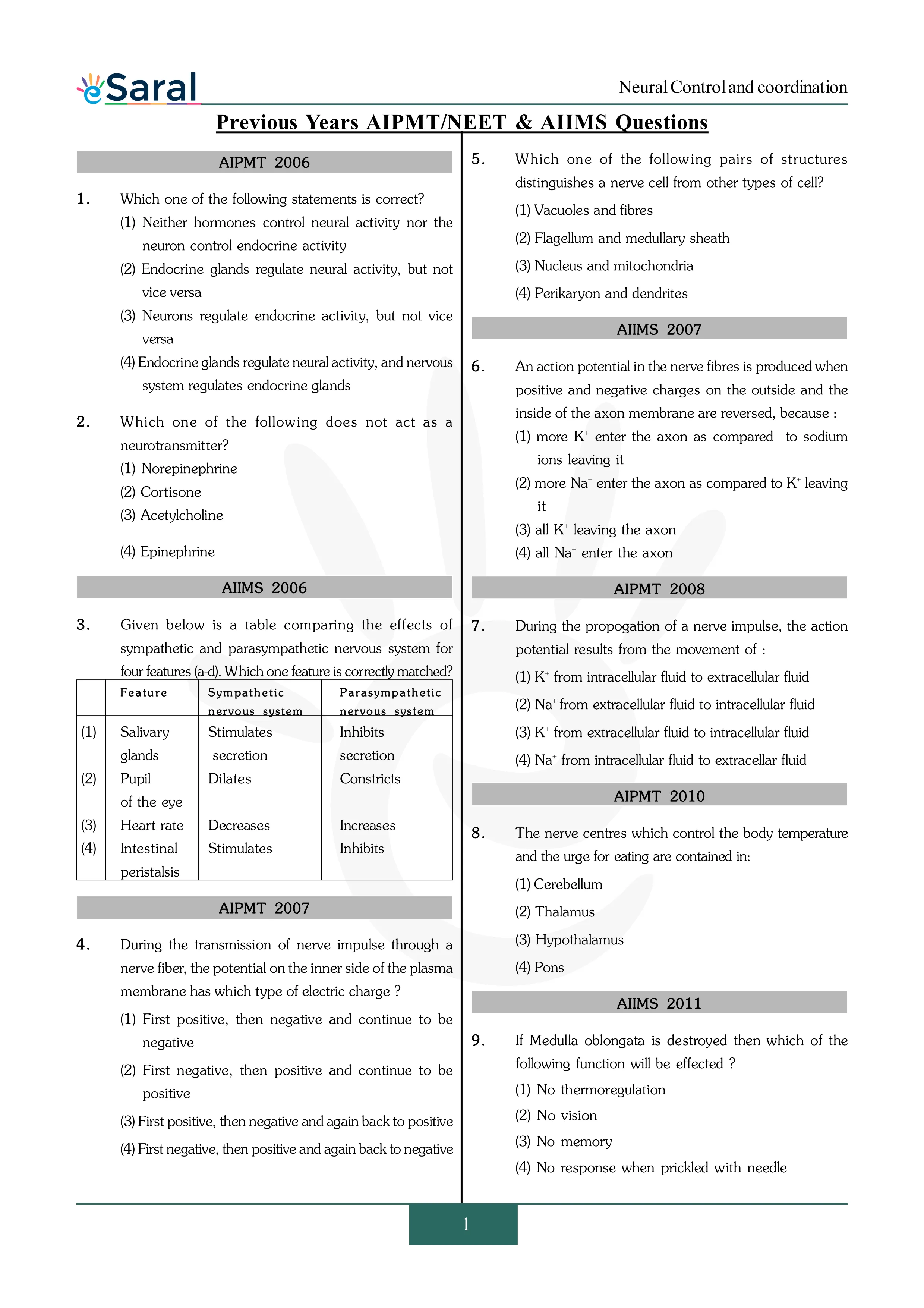
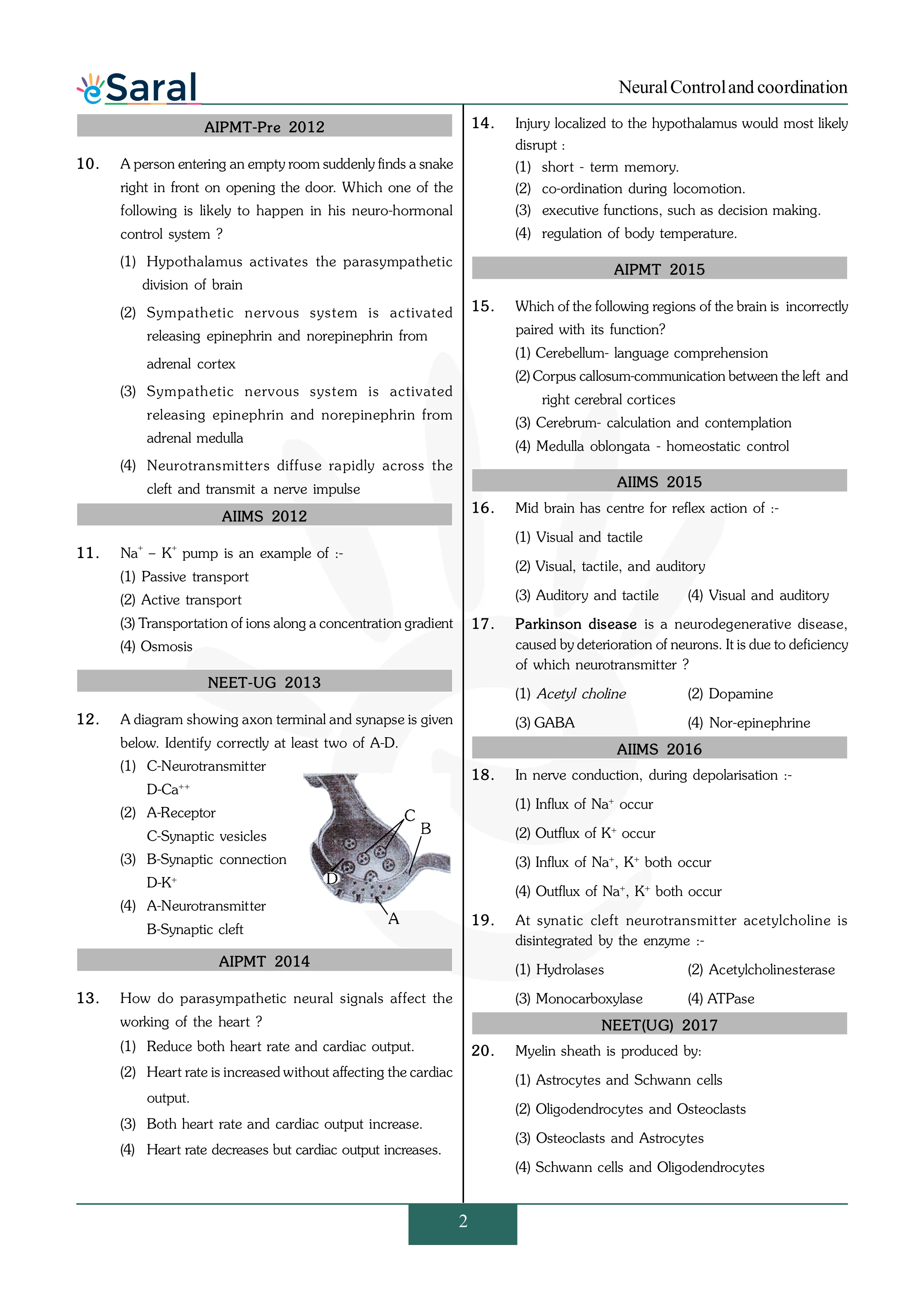
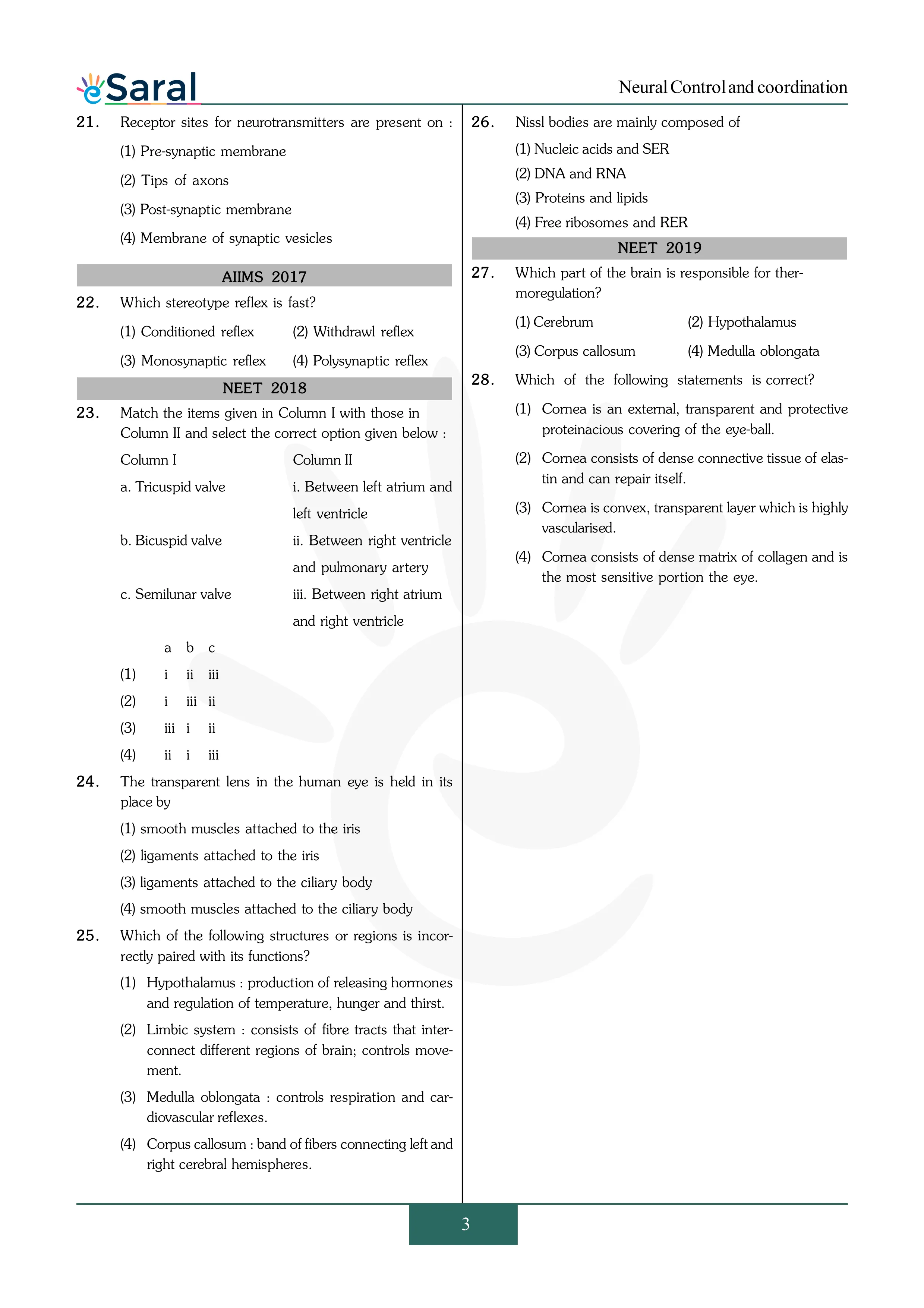
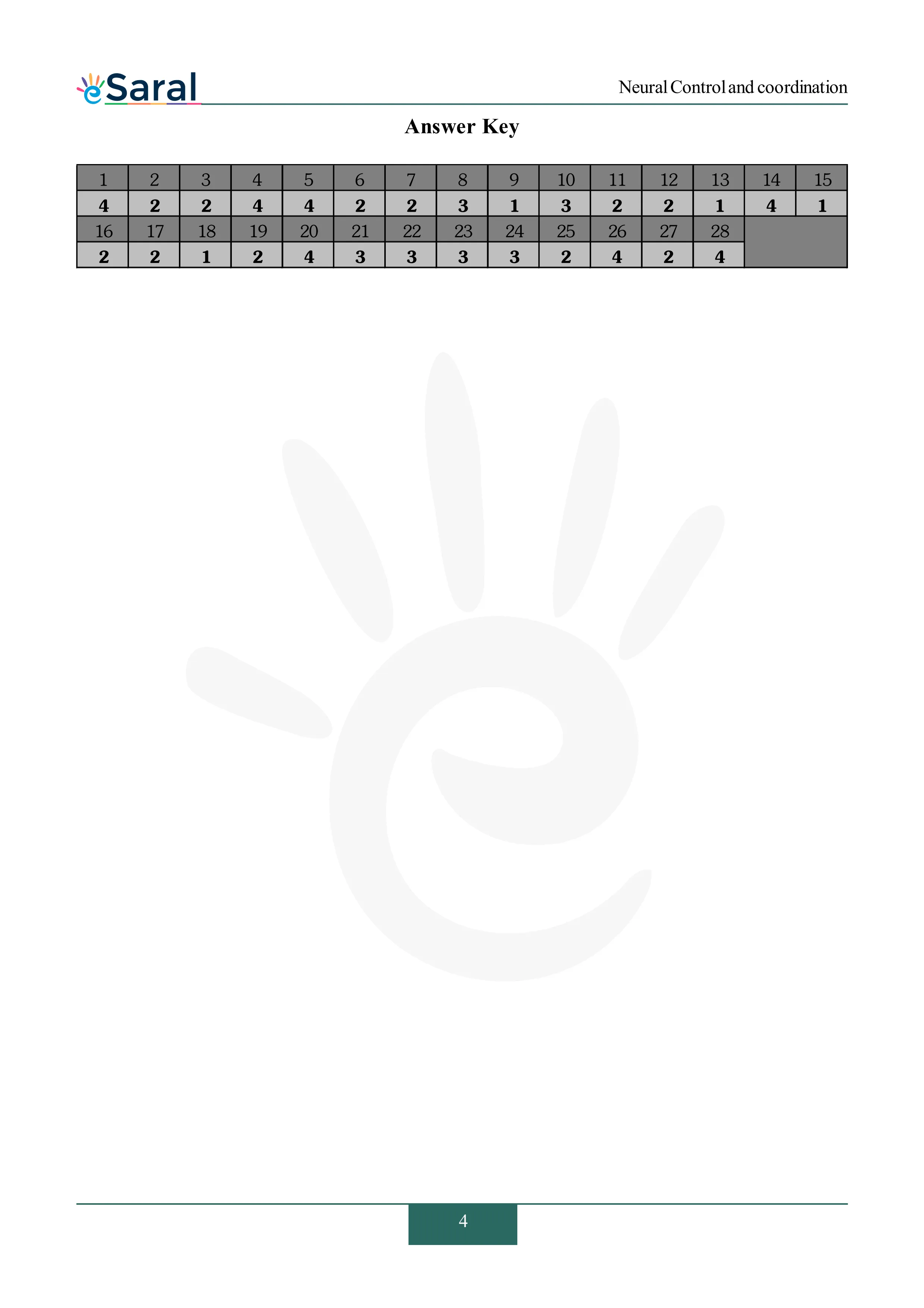
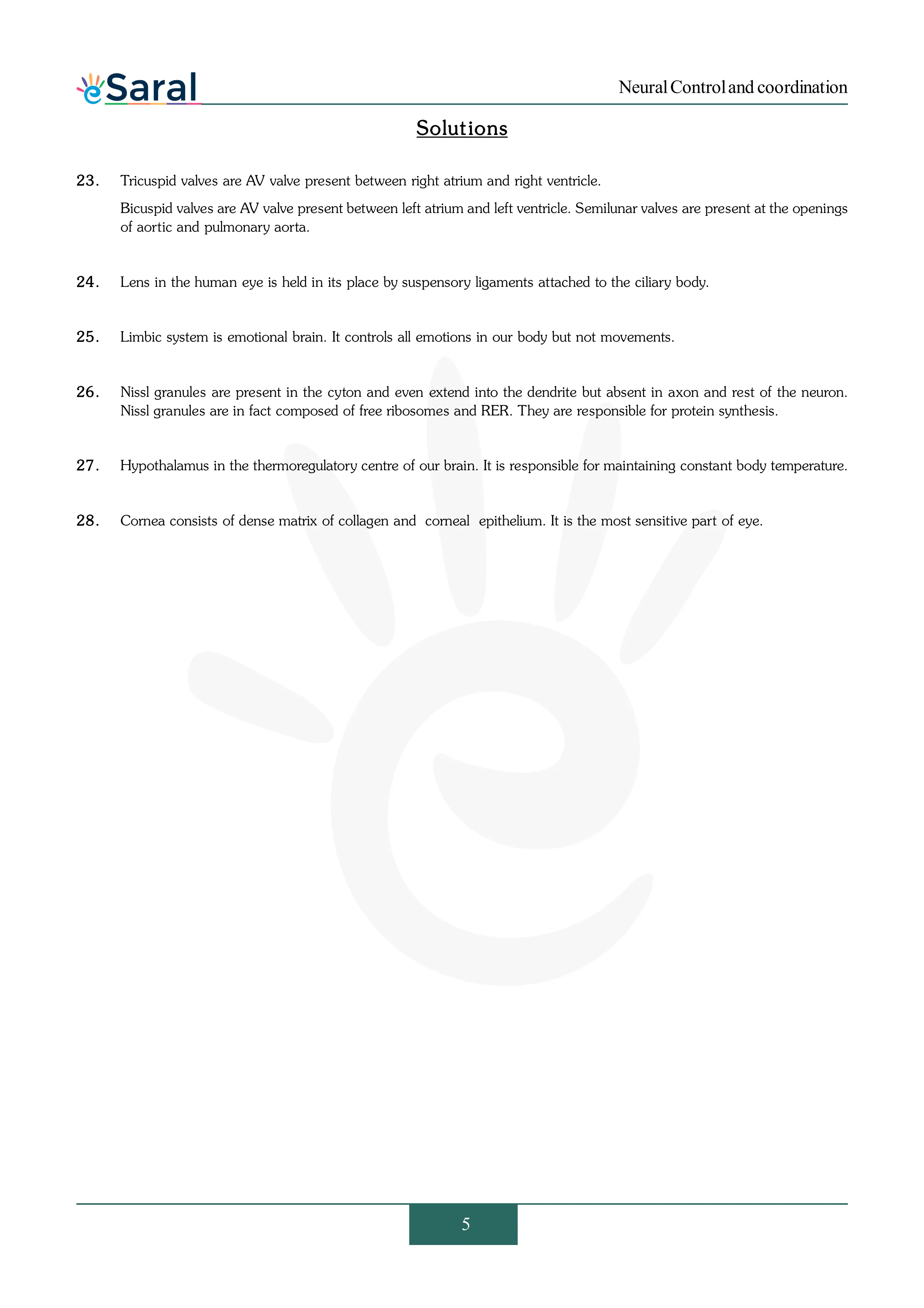
NEET Previous Year Questions — Neural Control with Solutions
Chapter Overview: Topics and Subtopics
What This Chapter Covers
| Topic | Key Subtopics | NEET Frequency |
|---|---|---|
| Neural System Overview | Central (CNS) and peripheral (PNS) nervous systems, autonomic NS | Medium |
| Neuron Structure | Cell body (soma), dendrites, axon, axon terminals, myelin sheath, Schwann cells, nodes of Ranvier, myelinated vs unmyelinated | Very High |
| Types of Neurons | Sensory (afferent), motor (efferent), interneuron (relay) | High |
| Resting Membrane Potential | Na⁺-K⁺ pump, concentration gradients, −70 mV resting potential | Very High |
| Action Potential | Depolarisation, repolarisation, hyperpolarisation, refractory period | Very High |
| Impulse Conduction | Saltatory conduction (myelinated), continuous conduction (unmyelinated) | High |
| Synapse | Structure, types (electrical and chemical), synaptic vesicles, neurotransmitters | Very High |
| Neurotransmitters | Acetylcholine, dopamine, GABA, norepinephrine — functions and release | High |
| Human Brain | Forebrain (cerebrum, thalamus, hypothalamus), Midbrain, Hindbrain (pons, cerebellum, medulla oblongata) | Very High |
| Spinal Cord | Structure, grey matter (H-shape), white matter, central canal | High |
| Reflex Action and Reflex Arc | Types of reflexes, components of reflex arc | High |
| Eye Structure and Function | Sclera, cornea, iris, lens, retina, rods and cones, blind spot, yellow spot | Very High |
| Ear Structure and Function | Pinna, tympanum, ossicles, cochlea, organ of Corti, semicircular canals | Very High |
NEET Weightage Analysis: Year-Wise Question Count
How Many Questions Come From Neural Control in NEET?
| NEET Year | Questions | Key Topics Tested |
|---|---|---|
| NEET 2024 | 4 | Neuron structure, action potential, brain parts, cochlea |
| NEET 2023 | 3 | Synapse and neurotransmitters, reflex arc, eye structure |
| NEET 2022 | 5 | Resting potential, myelinated neurons, cerebellum function, ear ossicles |
| NEET 2021 | 3 | Action potential steps, synaptic cleft, retina structure |
| NEET 2020 | 4 | Brain parts and functions, nodes of Ranvier, neurotransmitters, reflex |
| NEET 2019 | 5 | Neuron types, Na⁺-K⁺ pump, visual pathway, semicircular canals |
| NEET 2018 | 3 | Synapse structure, hypothalamus function, rods and cones |
| NEET 2017 | 4 | Myelin sheath, action potential, medulla oblongata, cochlea |
Average: 3.9 questions per year — approximately 16 marks. This makes Neural Control and Coordination one of the top-5 highest-scoring Biology chapters in NEET. The high repeatability of question types makes it extremely efficient to prepare.
💡 Expert Tip by eSaral Biology Faculty: "Two subtopics appear in NEET almost every single year without exception: action potential (depolarisation-repolarisation sequence with ion movements) and brain parts and functions (which lobe/region controls which function). Commit both to memory with precise terminology. In the action potential: Na⁺ rushes IN during depolarisation, K⁺ rushes OUT during repolarisation. Getting the ion directions wrong is the most common error in this chapter."
Key Concepts You Must Know Before Solving PYQs
1. Neuron Structure — Labelled Reference
| Structure | Description | Key Function |
|---|---|---|
| Cell body (Soma) | Contains nucleus and most organelles; Nissl's granules (RER) present | Metabolic centre of the neuron |
| Dendrites | Short, branched projections from cell body | Receive signals from other neurons or receptors |
| Axon | Single long projection; conducts impulse away from cell body | Transmits nerve impulse to next neuron or effector |
| Myelin sheath | Lipid-rich insulating layer around axon; formed by Schwann cells (PNS) or oligodendrocytes (CNS) | Speeds up impulse conduction (saltatory) |
| Nodes of Ranvier | Gaps in the myelin sheath along the axon | Site of action potential regeneration in saltatory conduction |
| Axon terminals (synaptic knobs) | Swellings at the end of axon branches | Release neurotransmitters into the synaptic cleft |
| Synaptic vesicles | Membrane-bound sacs in the axon terminal | Store and release neurotransmitters |
Critical NEET fact: Nissl's granules are present in the cell body and dendrites but absent in the axon.
2. Resting and Action Potential — Step-by-Step
Resting Membrane Potential (−70 mV):
- Outside of membrane: high Na⁺, low K⁺
- Inside of membrane: low Na⁺, high K⁺, negatively charged proteins
- Na⁺-K⁺ pump: pumps 3 Na⁺ OUT and 2 K⁺ IN (active transport) — maintains the gradient
- The inside is negative relative to outside = −70 mV (polarised state)
Action Potential Sequence:
| Phase | Ion Movement | Membrane Potential Change |
|---|---|---|
| Resting | No net ion movement | −70 mV (polarised) |
| Depolarisation | Na⁺ channels open → Na⁺ rushes IN | −70 mV → +35 mV (becomes positive inside) |
| Repolarisation | Na⁺ channels close; K⁺ channels open → K⁺ rushes OUT | +35 mV → −70 mV (returns to negative) |
| Hyperpolarisation | K⁺ channels slow to close → excess K⁺ leaves | −70 mV → briefly more negative (−90 mV) |
| Refractory period | Na⁺-K⁺ pump restores original ion distribution | Returns to resting −70 mV |
Memory rule: Depolarisation = Doors open for Na⁺ (IN). Repolarisation = Return of K⁺ (OUT).
3. Synapse Structure and Neurotransmission
Components of a Chemical Synapse:
- Pre-synaptic membrane — membrane of the axon terminal
- Synaptic cleft — gap between pre- and post-synaptic membranes (~20–40 nm wide)
- Post-synaptic membrane — membrane of the receiving cell (next neuron or effector)
- Synaptic vesicles — contain neurotransmitter molecules in the axon terminal
Process of Synaptic Transmission:
- Action potential arrives at axon terminal
- Depolarisation opens voltage-gated Ca²⁺ channels → Ca²⁺ flows in
- Ca²⁺ triggers fusion of synaptic vesicles with pre-synaptic membrane
- Neurotransmitter released into synaptic cleft by exocytosis
- Neurotransmitter binds receptors on post-synaptic membrane
- Ion channels open → new action potential generated (or inhibited)
- Neurotransmitter removed by enzymatic degradation or reuptake
Key Neurotransmitters Tested in NEET:
| Neurotransmitter | Location/Function |
|---|---|
| Acetylcholine | Neuromuscular junction; parasympathetic NS; most widely tested |
| Dopamine | Reward, movement control; deficiency → Parkinson's disease |
| GABA (γ-aminobutyric acid) | Major inhibitory neurotransmitter in CNS |
| Norepinephrine | Sympathetic NS; fight-or-flight response |
| Serotonin | Mood, sleep regulation; deficiency → depression |
4. Human Brain — Parts and Functions
| Brain Region | Division | Key Functions |
|---|---|---|
| Cerebrum | Forebrain | Thinking, memory, voluntary movement, sensory perception, speech, intelligence |
| Thalamus | Forebrain | Relay station for sensory signals to cerebral cortex |
| Hypothalamus | Forebrain | Temperature regulation, hunger, thirst, circadian rhythms, links nervous and endocrine systems |
| Limbic system | Forebrain | Emotion, behaviour, long-term memory (hippocampus) |
| Midbrain | Midbrain | Visual and auditory reflexes (superior and inferior colliculi) |
| Pons | Hindbrain | Breathing rhythm, facial movements, relays signals between brain parts |
| Cerebellum | Hindbrain | Coordination of voluntary movements, balance, posture, fine motor skills |
| Medulla oblongata | Hindbrain | Controls involuntary functions: heart rate, breathing, blood pressure, swallowing, vomiting |
Critical NEET distinctions:
- Cerebellum ≠ Cerebrum — students constantly confuse these
- Hypothalamus = temperature + hunger + thirst + linking nervous and endocrine systems
- Medulla oblongata = involuntary vital functions (cardiac, respiratory, vasomotor centres)
5. Eye Structure — Key Facts for NEET
| Structure | Function | NEET Tested Fact |
|---|---|---|
| Sclera | Tough outer coat; maintains eye shape | Becomes cornea anteriorly |
| Cornea | Transparent anterior part of sclera | Main refractive surface of eye |
| Iris | Coloured, muscular diaphragm | Controls pupil size (amount of light entering) |
| Lens | Biconvex transparent structure | Focuses image on retina; accommodation |
| Retina | Innermost layer; contains photoreceptors | Rods (dim light, peripheral, no colour) and Cones (bright light, colour, central) |
| Yellow spot (Fovea centralis) | Region of maximum visual acuity | Contains only cones; point of sharpest vision |
| Blind spot (Optic disc) | Point where optic nerve leaves retina | No rods or cones; cannot detect light |
| Vitreous humour | Gel-like fluid filling posterior chamber | Maintains shape of posterior eye |
| Aqueous humour | Watery fluid in anterior chamber | Nourishes cornea and lens |
6. Ear Structure — Key Facts for NEET
| Structure | Location | Function |
|---|---|---|
| Pinna | External ear | Collects and directs sound waves |
| Tympanic membrane (eardrum) | Between external and middle ear | Vibrates in response to sound waves |
| Malleus, Incus, Stapes | Middle ear (ossicles) | Amplify and transmit vibrations to oval window |
| Eustachian tube | Connects middle ear to pharynx | Equalises air pressure on both sides of tympanum |
| Cochlea | Inner ear | Contains organ of Corti — converts sound vibrations to nerve impulses |
| Organ of Corti | Within cochlea | Has hair cells (receptor cells for hearing) |
| Semicircular canals | Inner ear | Detect rotational movements (balance/equilibrium) |
| Utricle and Saccule | Inner ear (vestibule) | Detect linear acceleration and head position (static equilibrium) |
Critical NEET fact: Cochlea = hearing. Semicircular canals = rotational balance. Utricle/Saccule = linear balance/gravity.
How to Study Neural Control for Maximum NEET Marks
Step-by-Step Study Plan
Step 1 — Read NCERT Chapter 21 completely and mark every diagram (Day 1) NEET Neural Control questions are directly NCERT-based. Read without skipping — especially the labelled diagrams: neuron structure, synapse, brain (sagittal section), eye, and ear. Mark every diagram in NCERT and write the function of each labelled part beside it. Diagrams in this chapter are not decorative — they are testable.
Step 2 — Build the action potential table (Day 1–2) Write the action potential table from memory: resting state → depolarisation → repolarisation → hyperpolarisation → restoration. For each phase, write which ion moves, in which direction, and what happens to the membrane potential. The ion movement direction (Na⁺ IN for depolarisation; K⁺ OUT for repolarisation) must be reflex. This is the most calculation-free but most fact-precise topic in the chapter.
Step 3 — Make the brain parts-and-functions table (Day 2) Write each brain region, its division (fore/mid/hind), and its three most important functions. Focus on: hypothalamus (temperature, hunger, thirst), cerebellum (coordination, balance), medulla oblongata (cardiac, respiratory, vasomotor centres), and cerebrum (voluntary functions, intelligence). These four are tested in NEET almost every year.
Step 4 — Study eye and ear with labelled diagrams (Day 3) Draw both the eye and ear diagrams from the NCERT diagrams, labelling every structure. Then write the function of each structure beside its label. The most tested eye facts: fovea (only cones, sharpest vision) vs blind spot (no photoreceptors). The most tested ear facts: cochlea/organ of Corti (hearing) vs semicircular canals (rotational balance) vs utricle/saccule (linear balance).
Step 5 — Solve PYQs year-wise from 2024 to 2017 (Day 4–5) Work through all NEET Neural Control PYQs from the complete NEET chapter-wise PYQ collection on eSaral year by year. Map every question to one of the six key concept areas. After 5 years of PYQs, you will have seen every important question template at least twice — and the chapter will feel completely predictable.
Frequently Asked Questions
Find answers to common questions.
How many questions come from Neural Control and Coordination in NEET?
Neural Control and Coordination contributes 3–5 questions in almost every NEET UG Biology paper. The average over the last 8 years is approximately 3.9 questions per year — around 16 marks. It is one of the top-5 highest-scoring Biology chapters in NEET, with highly predictable question types making it one of the most efficient chapters to prepare.
What are the most important topics of Neural Control for NEET?
The six highest-frequency topics are: neuron structure (especially Nissl's granules, myelin sheath, nodes of Ranvier), action potential mechanism (ion movements during each phase), synapse structure and Ca²⁺-triggered neurotransmitter release, human brain parts and functions (hypothalamus, cerebellum, medulla oblongata), eye structure (fovea vs blind spot, rods vs cones), and ear structure (cochlea vs semicircular canals vs utricle/saccule).
What is the difference between rods and cones in the retina?
Rods are photoreceptors that function in dim light, are responsible for peripheral vision, detect only black and white (no colour), and are more numerous — about 120 million in the human retina. Cones function in bright light, detect colour (three types — red, green, blue), are concentrated at the fovea centralis, and number about 6–7 million. The fovea contains only cones, giving the sharpest colour vision. The blind spot has neither rods nor cones.
What happens to ions during action potential depolarisation and repolarisation?
During depolarisation: voltage-gated Na⁺ channels open and Na⁺ rushes INTO the cell — the inside becomes positive (membrane potential rises from −70 mV to approximately +35 mV). During repolarisation: Na⁺ channels close and K⁺ channels open — K⁺ flows OUT of the cell, restoring the negative internal potential back to −70 mV. The Na⁺-K⁺ pump then restores the original ion distribution during the refractory period.
What is the difference between the cerebrum and cerebellum in NEET?
The cerebrum (forebrain) is the largest brain region responsible for intelligence, memory, voluntary movement initiation, sensory perception, speech, and all higher cognitive functions. The cerebellum (hindbrain) is responsible for coordination of voluntary movements, maintenance of balance and posture, and fine motor control — but does not initiate movements. Confusing these two is one of the most common errors in NEET Neural Control questions.