Redox Reactions - NEET Previous Year Questions with Complete Solutions
Redox Reactions is a high-scoring NEET Chemistry chapter focused on oxidation numbers, oxidising/reducing agents, disproportionation, and balancing reactions, contributing ~2–3 questions annually while strengthening multiple Class 12 chemistry topics.
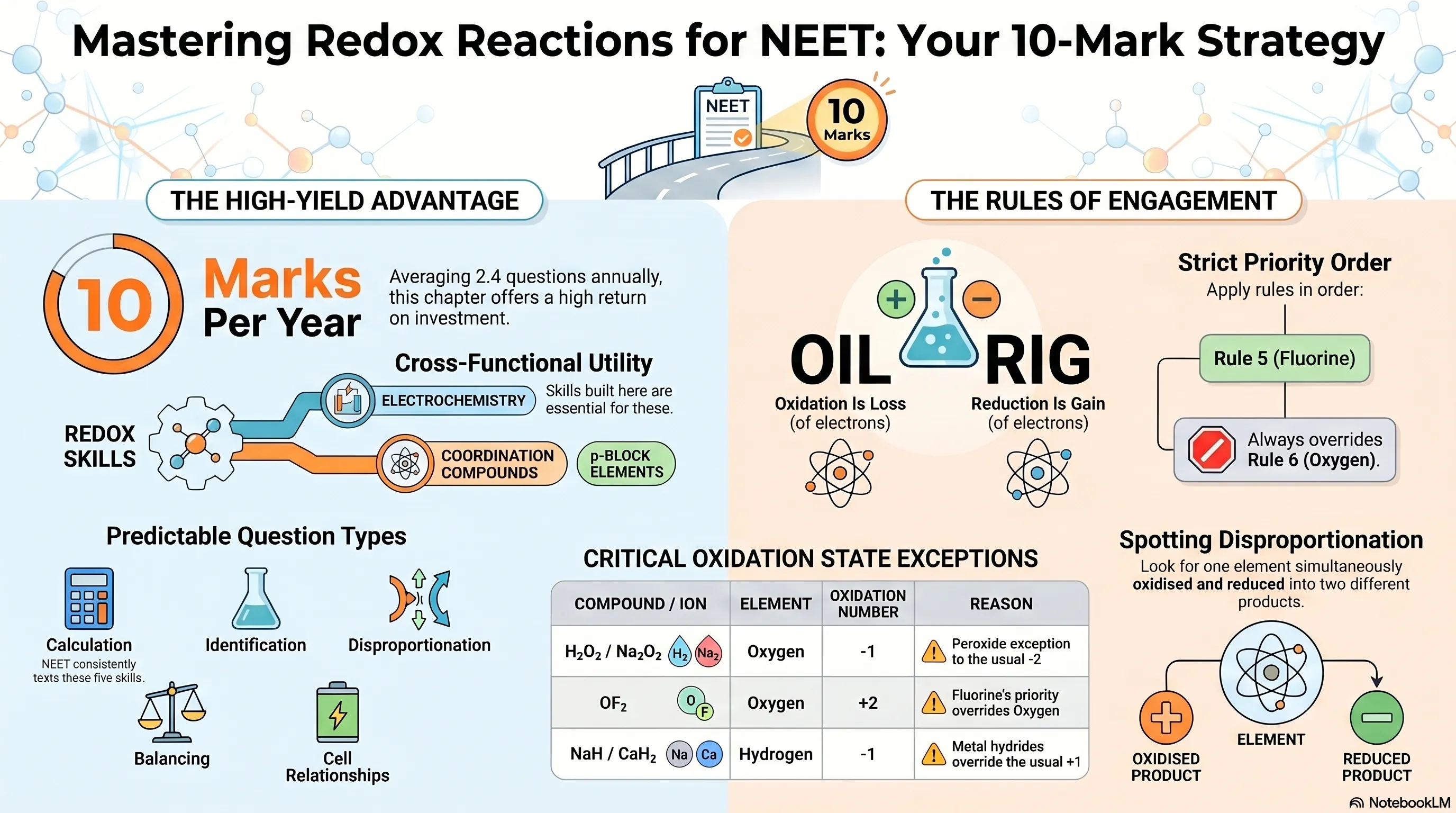
Table of Contents
- Why Redox Reactions Is a Must-Master Chapter for NEET
- NEET Previous Year Questions — Redox Reactions with Solutions
- Chapter Overview: Topics and Subtopics
- NEET Weightage Analysis: Year-Wise Question Count
- Key Concepts You Must Know Before Solving PYQs
- How to Study Redox Reactions for Maximum NEET Marks

eSaral › NEET ›Redox Reactions - NEET Previous Year Questions with Complete Solutions

Why Redox Reactions Is a Must-Master Chapter for NEET
Redox Reactions (Class 11, Chapter 8) is one of the most cross-functional chapters in all of NEET Chemistry. It contributes 2–3 direct questions every year — but more importantly, the skills it builds (oxidation number calculation, identifying oxidising/reducing agents, balancing equations) are used in Electrochemistry, Coordination Compounds, Inorganic Chemistry, and p-Block Elements throughout Class 12.
A student who has not mastered oxidation number rules will lose marks not just in the Redox Reactions section but across multiple chapters — making this chapter a high-leverage investment. The good news is that the question types are highly predictable: almost every Redox question in NEET tests one of five skills — oxidation number calculation, agent identification, disproportionation, balancing half-reactions, or electrochemical cell relationships.
💡 Expert Tip by eSaral Chemistry Faculty: "Oxidation number calculation is the backbone of Redox Reactions — and it is tested in NEET directly at least once every year. The rules are simple and finite. A student who has drilled the oxidation number rules for 30 minutes and then solved 20 practice problems will get every oxidation number question in NEET correct. There is almost no other topic in Chemistry where 30 minutes of focused practice guarantees full marks — take advantage of it."
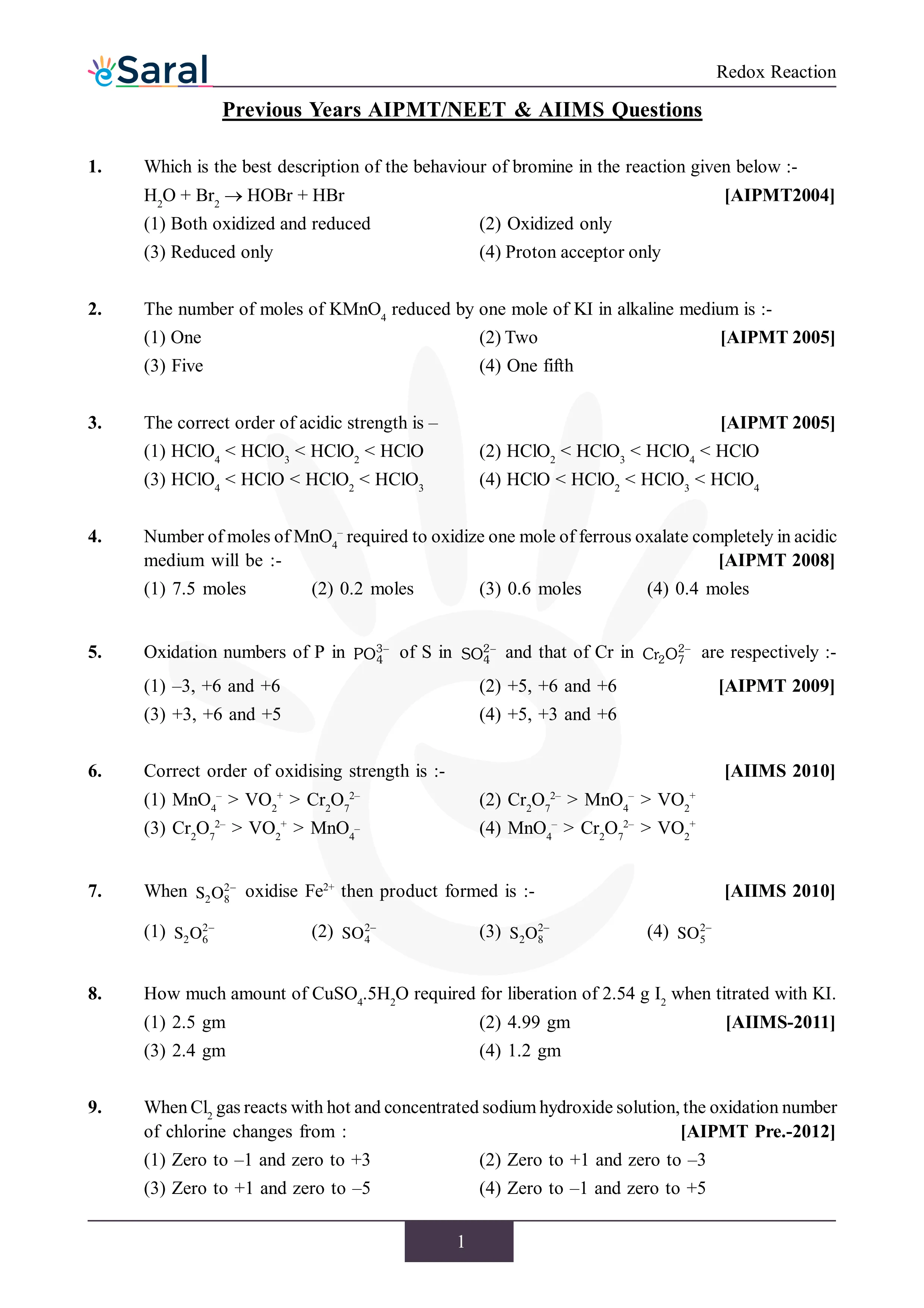
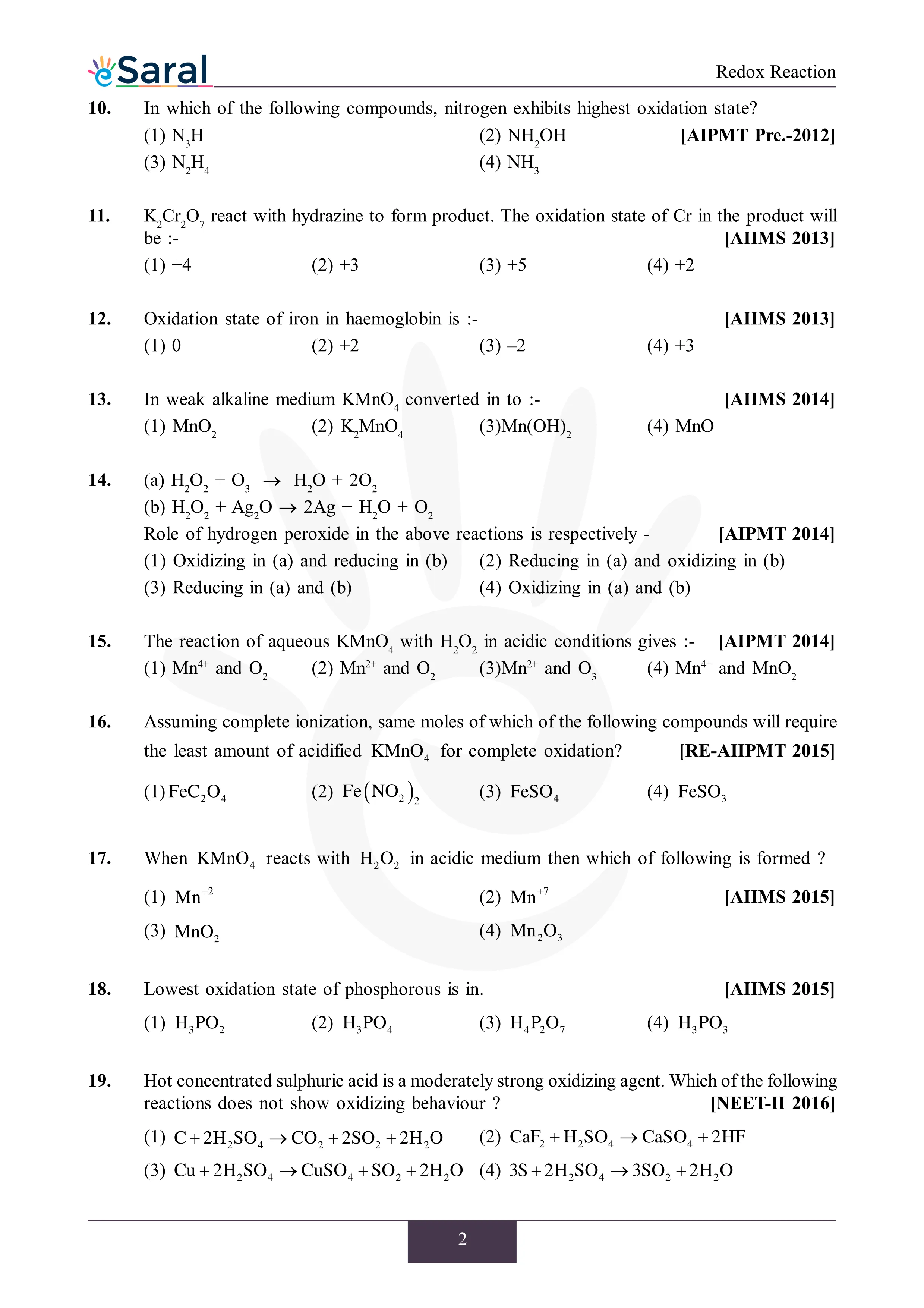
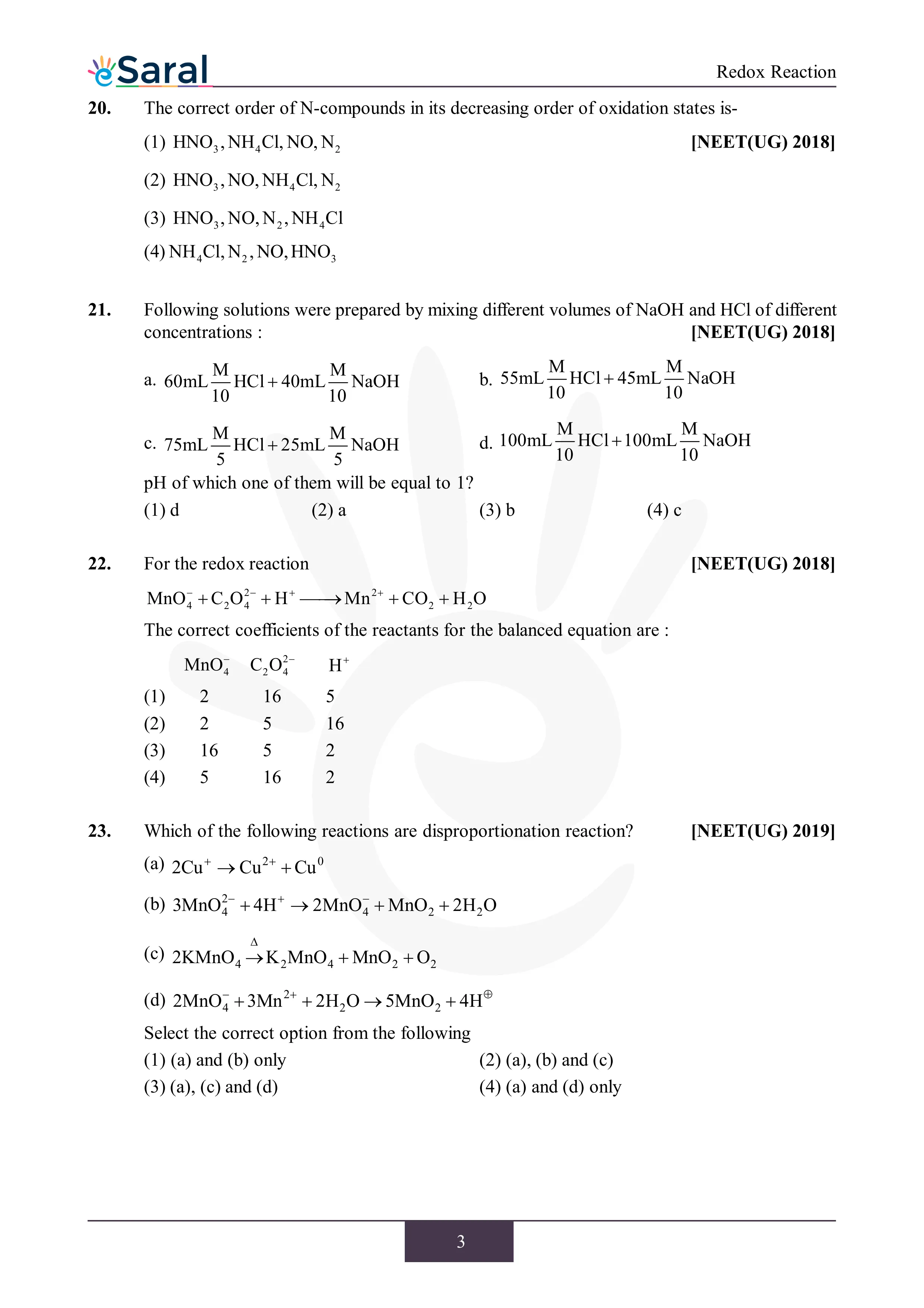
NEET Previous Year Questions — Redox Reactions with Solutions

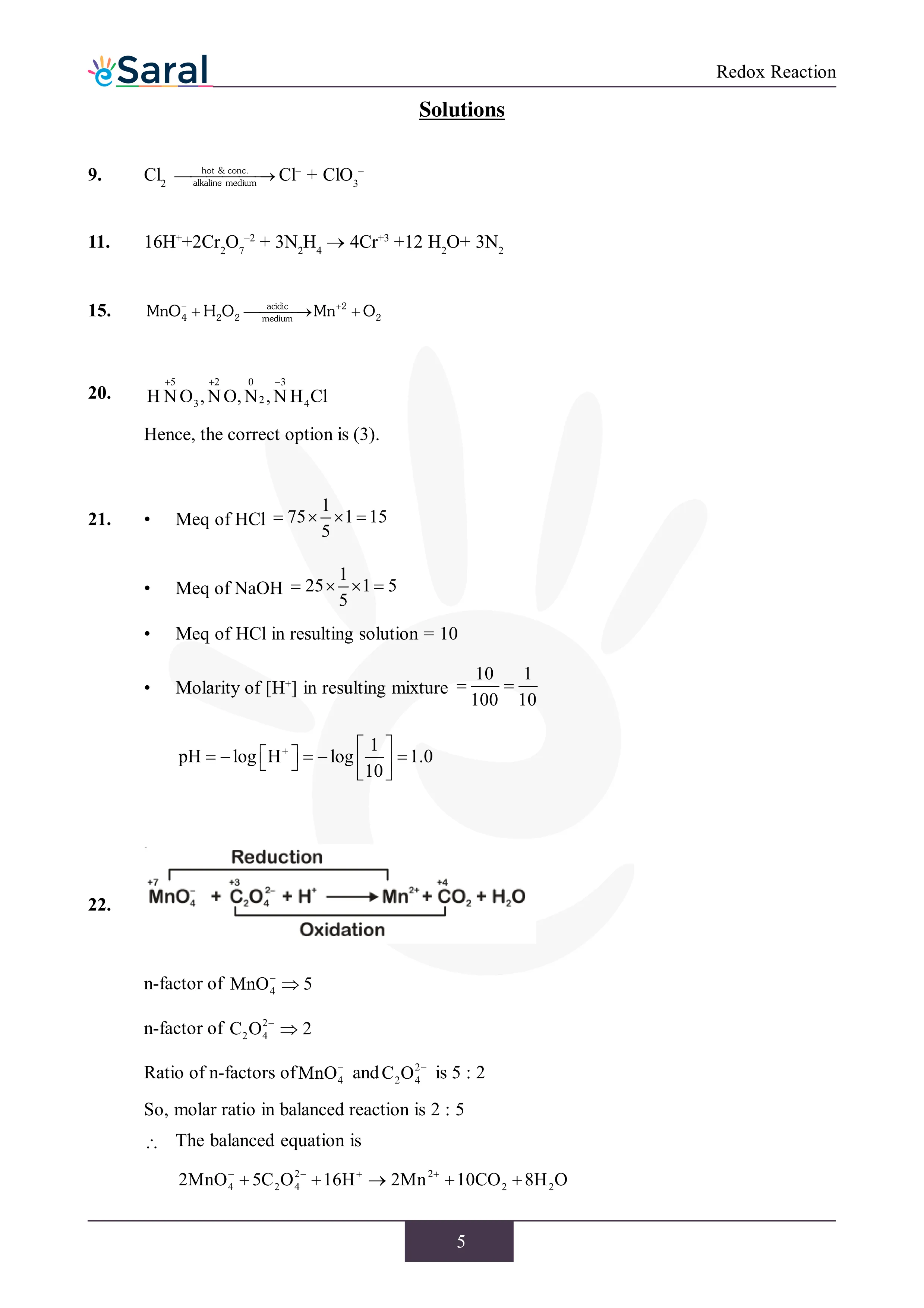
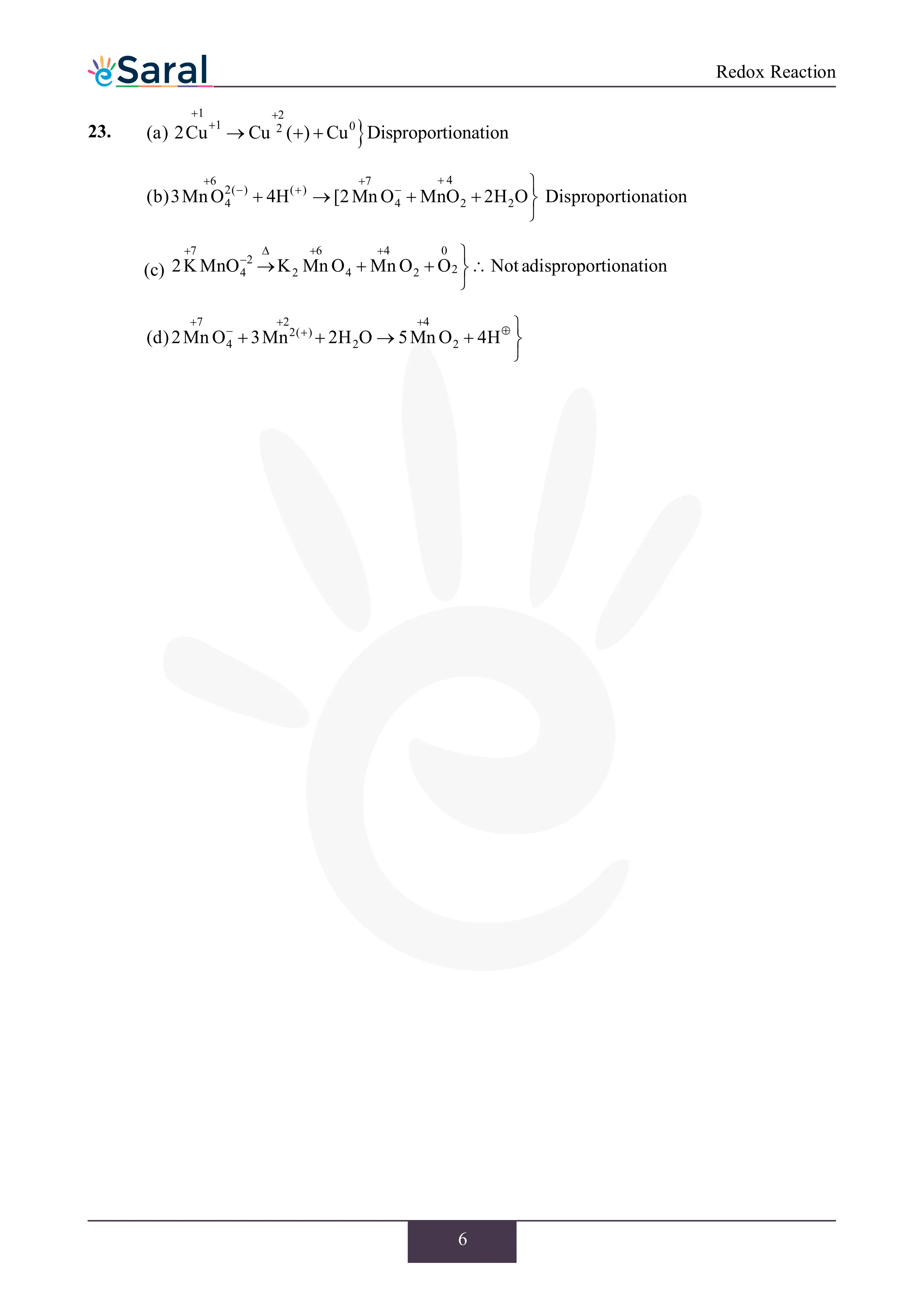
Chapter Overview: Topics and Subtopics
What This Chapter Covers
| Topic | Key Subtopics | NEET Frequency |
|---|---|---|
| Classical Concept | Oxidation as addition of oxygen / removal of hydrogen; reduction as opposite | Low |
| Electronic Concept | Oxidation = loss of electrons; reduction = gain of electrons (OIL RIG) | High |
| Oxidation Number | Rules for assigning oxidation states; calculating for complex molecules | Very High |
| Oxidising and Reducing Agents | Agent identification from oxidation number changes | Very High |
| Types of Redox Reactions | Combination, decomposition, displacement, disproportionation | High |
| Disproportionation Reactions | Same element simultaneously oxidised and reduced | High |
| Balancing Redox Equations | Ion-electron (half-reaction) method; oxidation number method | High |
| Redox in Acidic vs Basic Medium | Different steps for balancing in acidic (H⁺/H₂O) vs basic (OH⁻/H₂O) medium | Medium |
| Electrochemical Cells | Relationship between redox reactions and Galvanic/electrolytic cells | Medium |
| Oxidising Power and Reducing Power | Trends, electrochemical series, standard electrode potentials | Medium |
NEET Weightage Analysis: Year-Wise Question Count
How Many Questions Come From Redox Reactions in NEET?
| NEET Year | Questions | Key Topics Tested |
|---|---|---|
| NEET 2024 | 2 | Oxidation number calculation, disproportionation reaction |
| NEET 2023 | 3 | Balancing redox in acidic medium, oxidising/reducing agent, oxidation state |
| NEET 2022 | 2 | Oxidation number of unusual elements, displacement redox |
| NEET 2021 | 2 | Disproportionation, oxidation number in complex compound |
| NEET 2020 | 3 | Ion-electron method, agent identification, electronic concept |
| NEET 2019 | 2 | Oxidation number, combination redox reaction |
| NEET 2018 | 2 | Balancing half-reactions, reducing agent identification |
| NEET 2017 | 3 | Oxidation number in polyatomic ion, displacement, disproportionation |
Average: 2.4 questions per year — approximately 10 marks. Given that oxidation number skills feed into multiple other chapters, the effective return from mastering this chapter is considerably higher.
💡 Expert Tip by eSaral Chemistry Faculty: "Disproportionation reactions appear in NEET almost every alternate year — and students consistently lose these marks. The rule is simple: in a disproportionation reaction, one element in the reactant is simultaneously oxidised and reduced. So the same element must appear in two different products with different oxidation states. When you see a question asking which of the following is a disproportionation reaction — check whether the same element is in multiple products with different oxidation numbers."
Key Concepts You Must Know Before Solving PYQs
1. Oxidation Number Rules — Complete Reference
These rules must be applied in strict priority order (Rule 1 overrides Rule 2, etc.):
| Rule | Statement | Example |
|---|---|---|
| Rule 1 | Oxidation number of a free element (uncombined) = 0 | O₂: O = 0; Fe: Fe = 0; Cl₂: Cl = 0 |
| Rule 2 | Oxidation number of a monoatomic ion = its charge | Na⁺ = +1; Mg²⁺ = +2; Cl⁻ = −1; O²⁻ = −2 |
| Rule 3 | Sum of oxidation numbers in a neutral compound = 0 | In H₂O: 2(+1) + (−2) = 0 ✓ |
| Rule 4 | Sum of oxidation numbers in a polyatomic ion = charge of ion | In SO₄²⁻: S + 4(−2) = −2 → S = +6 |
| Rule 5 | Oxidation number of F in all compounds = −1 | HF: F = −1; OF₂: F = −1 (O = +2 here!) |
| Rule 6 | Oxidation number of O in most compounds = −2 | Exception: peroxides (−1), superoxides (−½), OF₂ (+2) |
| Rule 7 | Oxidation number of H in most compounds = +1 | Exception: metal hydrides (NaH, CaH₂) — H = −1 |
| Rule 8 | Oxidation number of alkali metals (Group 1) = +1 always | Na, K, Li, Rb = +1 in all compounds |
| Rule 9 | Oxidation number of alkaline earth metals (Group 2) = +2 always | Mg, Ca, Ba, Sr = +2 in all compounds |
Critical Exceptions Tested Directly in NEET
| Compound/Ion | Element | Oxidation Number | Reason |
|---|---|---|---|
| H₂O₂ (hydrogen peroxide) | O | −1 | Peroxide — not the usual −2 |
| Na₂O₂ (sodium peroxide) | O | −1 | Peroxide |
| KO₂ (potassium superoxide) | O | −½ | Superoxide |
| OF₂ (oxygen difluoride) | O | +2 | F is more electronegative than O; F = −1 overrides |
| NaH, CaH₂ (metal hydrides) | H | −1 | Hydride — not the usual +1 |
| N₂H₄ (hydrazine) | N | −2 | Calculate: 2N + 4(+1) = 0 → N = −2 |
| NH₂OH (hydroxylamine) | N | −1 | 2-step calculation |
| Cr₂O₇²⁻ (dichromate) | Cr | +6 | 2Cr + 7(−2) = −2 → 2Cr = +12 → Cr = +6 |
| MnO₄⁻ (permanganate) | Mn | +7 | Mn + 4(−2) = −1 → Mn = +7 |
| Fe₃O₄ | Fe | +8/3 (≈+2.67) | Mixed oxide: one Fe²⁺ + two Fe³⁺ |
2. Identifying Oxidising and Reducing Agents
| Term | Definition | What It Does to Itself |
|---|---|---|
| Oxidising agent | Causes oxidation in another substance | Gets reduced itself (oxidation number decreases) |
| Reducing agent | Causes reduction in another substance | Gets oxidised itself (oxidation number increases) |
Memory rule — OIL RIG:
- Oxidation Is Loss (of electrons)
- Reduction Is Gain (of electrons)
Step-by-step agent identification:
- Assign oxidation numbers to all atoms in reactants and products
- Identify which atom's oxidation number increased → that element was oxidised → its compound is the reducing agent
- Identify which atom's oxidation number decreased → that element was reduced → its compound is the oxidising agent
3. Types of Redox Reactions
| Type | Description | Example |
|---|---|---|
| Combination | Two substances combine; one or both undergo change in oxidation state | 2Mg + O₂ → 2MgO |
| Decomposition | One compound breaks down with change in oxidation state | 2H₂O₂ → 2H₂O + O₂ |
| Displacement | One element displaces another from its compound | Zn + CuSO₄ → ZnSO₄ + Cu |
| Disproportionation | Same element is simultaneously oxidised AND reduced | Cl₂ + 2NaOH → NaCl + NaOCl + H₂O |
| Comproportionation | Two different oxidation states of the same element combine to give one intermediate state | — |
Disproportionation — Key Examples for NEET
| Reaction | Element Undergoing Disproportionation | Oxidation States |
|---|---|---|
| Cl₂ + 2NaOH → NaCl + NaOCl + H₂O | Cl | Cl₂ (0) → NaCl (−1) and NaOCl (+1) |
| 2H₂O₂ → 2H₂O + O₂ | O | H₂O₂ (−1) → H₂O (−2) and O₂ (0) |
| 4HClO₃ → HCl + 3HClO₄ | Cl | HClO₃ (+5) → HCl (−1) and HClO₄ (+7) |
| P₄ + 3NaOH + 3H₂O → 3NaH₂PO₂ + PH₃ | P | P₄ (0) → NaH₂PO₂ (+1) and PH₃ (−3) |
4. Balancing Redox Reactions — Ion-Electron (Half-Reaction) Method
Steps for Acidic Medium:
- Write separate half-reactions for oxidation and reduction
- Balance all atoms except O and H
- Balance O atoms by adding H₂O to the deficient side
- Balance H atoms by adding H⁺ to the deficient side
- Balance charges by adding electrons (e⁻) to the more positive side
- Multiply half-reactions to equalise electrons transferred
- Add the two balanced half-reactions; cancel common terms
Steps for Basic Medium: Steps 1–5 same as acidic, then: 6. Add equal OH⁻ to both sides to neutralise H⁺ (H⁺ + OH⁻ → H₂O) 7. Simplify
5. Quick Oxidation Number Calculation — Worked Examples
| Compound / Ion | Unknown Element | Calculation | Answer |
|---|---|---|---|
| KMnO₄ | Mn | (+1) + Mn + 4(−2) = 0 → Mn = +7 | +7 |
| K₂Cr₂O₇ | Cr | 2(+1) + 2Cr + 7(−2) = 0 → 2Cr = +12 → Cr = +6 | +6 |
| Na₂S₂O₃ | S | 2(+1) + 2S + 3(−2) = 0 → 2S = +4 → S = +2 | +2 |
| SO₄²⁻ | S | S + 4(−2) = −2 → S = +6 | +6 |
| SO₃²⁻ | S | S + 3(−2) = −2 → S = +4 | +4 |
| H₂SO₃ | S | 2(+1) + S + 3(−2) = 0 → S = +4 | +4 |
| NO₃⁻ | N | N + 3(−2) = −1 → N = +5 | +5 |
| NO₂⁻ | N | N + 2(−2) = −1 → N = +3 | +3 |
| NH₄⁺ | N | N + 4(+1) = +1 → N = −3 | −3 |
| XeF₄ | Xe | Xe + 4(−1) = 0 → Xe = +4 | +4 |
How to Study Redox Reactions for Maximum NEET Marks
Step-by-Step Study Plan
Step 1 — Memorise the oxidation number rules in priority order (Day 1) Write all nine oxidation number rules on a single card. The priority order matters — Rule 5 (F = −1 always) overrides Rule 6 (O = −2 usually), which is why O = +2 in OF₂. Practise applying the rules to 15 compounds immediately after writing them. Target: any oxidation number calculated in under 45 seconds.
Step 2 — Build the exceptions table (Day 1) Make a dedicated flashcard for oxidation number exceptions: H₂O₂ (O = −1), OF₂ (O = +2), NaH (H = −1), KO₂ (O = −½), and unusual oxidation states of S, N, Cr, Mn, and Cl in common compounds. These exceptions account for approximately 60% of all oxidation number questions in NEET.
Step 3 — Practise oxidising/reducing agent identification with 10 reactions (Day 2) For each reaction, assign oxidation numbers to all atoms, identify which element's oxidation number increased (oxidised = reducing agent) and which decreased (reduced = oxidising agent). The OIL RIG mnemonic keeps direction clear: Oxidation Is Loss (of electrons), Reduction Is Gain.
Step 4 — Study disproportionation reactions with 4 examples (Day 2) Learn the four main disproportionation reactions: Cl₂ + NaOH, H₂O₂ decomposition, P₄ + NaOH, and HClO₃. For each, verify that the same element appears in two products with different oxidation states. This is the entire skill NEET tests for disproportionation — recognition, not derivation.
Step 5 — Practise balancing half-reactions in acidic medium (Day 3) Work through the ion-electron method for 3–4 standard half-reactions: MnO₄⁻ → Mn²⁺, Cr₂O₇²⁻ → Cr³⁺, and one involving sulphur or nitrogen. The sequence (balance atoms → add H₂O for O → add H⁺ for H → add e⁻ for charge) must be automatic.
Step 6 — Solve PYQs year-wise from 2024 to 2017 (Day 4) Work through all NEET Redox Reactions PYQs from the complete NEET chapter-wise PYQ collection on eSaral. For every question, identify which of the five concept areas it tests. After completing 5 years of PYQs, the chapter's question space will feel completely familiar.
Frequently Asked Questions
Find answers to common questions.
How many questions come from Redox Reactions in NEET?
Redox Reactions contributes 2–3 questions directly in most NEET UG Chemistry papers — approximately 8–12 marks. More importantly, oxidation number skills are applied across Electrochemistry, Coordination Compounds, and p-Block Elements in Class 12, making the effective contribution of mastering this chapter significantly larger than the direct question count.
What are the most important topics of Redox Reactions for NEET?
The five highest-frequency topics are: oxidation number calculation (especially exceptions — H₂O₂, OF₂, NaH, metal hydrides), identification of oxidising and reducing agents, disproportionation reactions (Cl₂ + NaOH; P₄ + NaOH), balancing by ion-electron method in acidic medium (MnO₄⁻ and Cr₂O₇²⁻ half-reactions), and reducing power of halide ions. These five areas account for over 90% of all Redox questions in NEET.
How do you find oxidation number in NEET questions?
Apply the nine rules in priority order: F = −1 always (Rule 5) overrides O = −2 usually (Rule 6). For any unknown element X in a compound or ion: write the sum equation (known oxidation numbers × number of atoms) + X × (number of X atoms) = charge of species (0 for neutral, charge value for ion). Solve for X. For peroxides, O = −1; for superoxides, O = −½; for OF₂, O = +2; for metal hydrides, H = −1.
Which is the strongest reducing agent among halide ions?
I⁻ (iodide) is the strongest reducing agent among halide ions. Reducing power increases down the halogen group: F⁻ < Cl⁻ < Br⁻ < I⁻. Iodide has the largest ionic radius — its outermost electrons experience the least nuclear attraction and are most easily donated. F⁻ is the weakest reducing agent because fluorine's small size and high nuclear charge hold its electrons most tightly.
Where can I get all NEET chapter-wise PYQs for Chemistry with solutions?
eSaral provides a free, complete collection of NEET chapter-wise previous year questions with solutions for Physics, Chemistry, and Biology — organised by chapter and year, with no sign-up required. For timed exam practice, the eSaral NEET Test Series provides full mock tests with detailed performance analysis.