What is the biggest mistake NEET droppers make in the first 2 months?

Table of Contents
- Why the First Two Months Feel So Confusing for NEET Droppers
- The Single Biggest Mistake—and Why It Is So Easy to Fall Into
- What Actually Matters in a NEET Drop Year?
- A Realistic 8-Week Recovery Roadmap for NEET Droppers
- Common Panic Mistakes Students Make When They Realise They're Off Track
- How Many Hours Should a NEET Dropper Study Each Day?

Home » What Is the Biggest Mistake NEET Droppers Make in the First 2 Months?

So you've decided to take a drop year. That decision already took courage most students won't admit they need more time. But here's the reality: the drop year is often won or lost in the first two months. What you do in July and August quietly shapes your NEET UG performance the following May.
The eSaral Academic Team has worked with thousands of repeaters across NEET dropper batches. Every year, we observe the same patterns. This guide explains where droppers usually go wrong, why these mistakes happen, and how you can correct them before they become difficult to reverse.
Let's get started.
Why the First Two Months Feel So Confusing for NEET Droppers
The beginning of a drop year is emotionally challenging. You're recovering from a disappointing result, your friends have moved on to college, and you're questioning whether taking a drop was the right decision. This mental uncertainty is completely normal, but it often leads to poor preparation habits.
The "Relief Phase" Trap
After NEET results, many droppers enter a relief phase lasting two to three weeks. Taking a short break is healthy and necessary. The problem begins when this recovery period quietly extends into the entire first month, delaying serious preparation.
The Comparison Spiral
Social media can make this even harder. Watching friends share college orientation photos while you're preparing again often creates unnecessary pressure. This usually pushes students toward one of two extremes—complete inaction or unplanned, chaotic studying. Neither approach is productive.
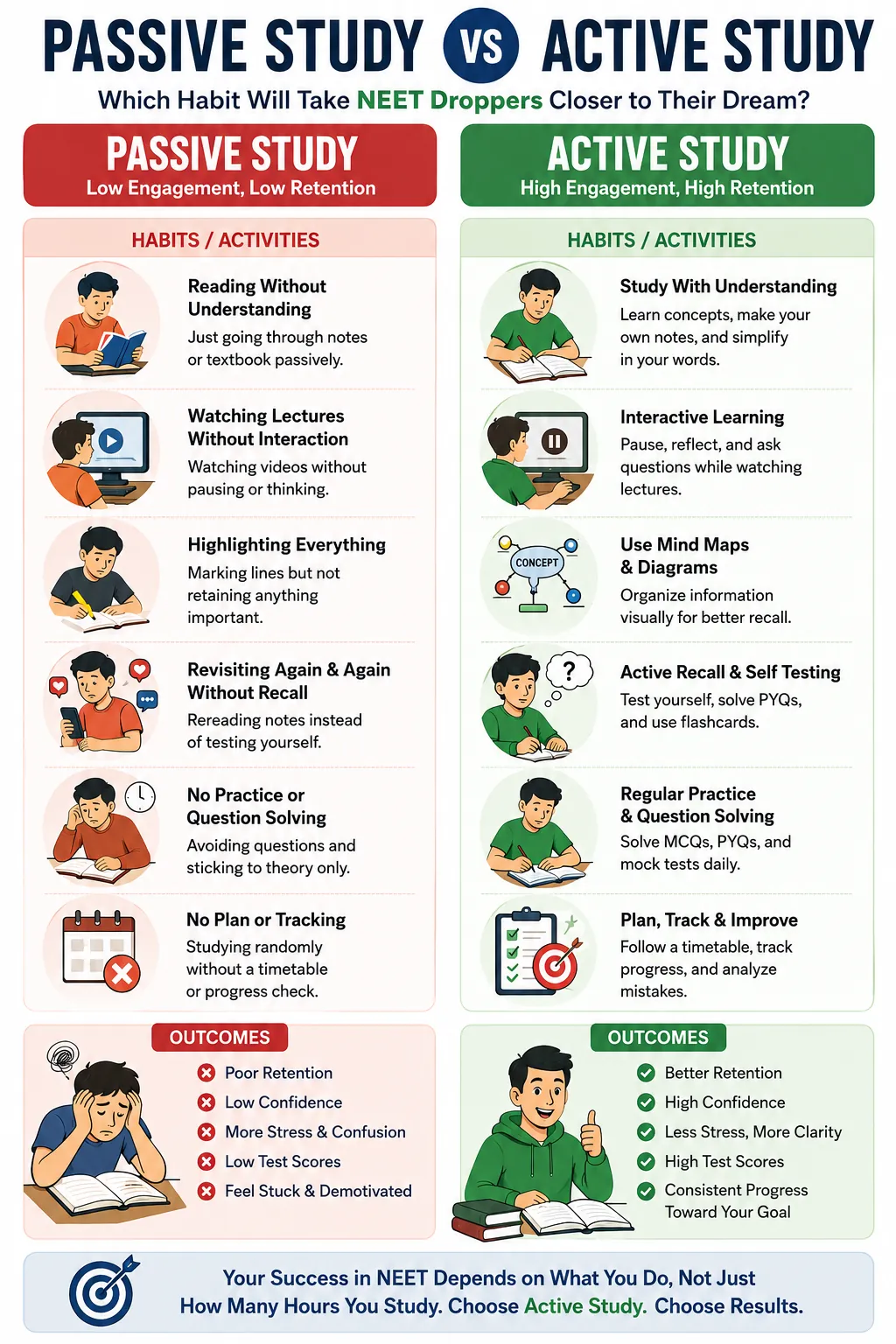
Expert Tip by eSaral Academic Team: The first two months are not about studying the maximum number of hours. They are about building the right study system. A student who develops strong habits in July is far more likely to succeed than someone who studies 14 hours a day without a clear plan.
The Single Biggest Mistake—and Why It Is So Easy to Fall Into
The biggest mistake is passive revision disguised as active study. Many students reopen their Class 11 and Class 12 notebooks, read through familiar material, and feel productive simply because they recognize the content. However, familiarity is not the same as learning.
Why Passive Revision Feels Productive
Your brain has already seen much of this material before. Reading it again creates a feeling of familiarity, which is often mistaken for genuine understanding. Learning psychologists refer to this as the Fluency Illusion. Although it feels like effective studying, very little long-term retention actually occurs.
What This Mistake Costs You
Most droppers recognize this problem only around October or November. By then, they have already lost 10 to 12 weeks of meaningful concept-building—nearly one-third of the effective preparation period before the NEET UG examination. Recovery is still possible, but it becomes much more difficult.
In eSaral's 2025 dropper batch, students who shifted to active problem-solving during the first six weeks consistently outperformed those who relied mainly on passive note revision, improving their mock test scores by an average of 47 marks by December.
| Study Mode | Activity | Learning Outcome |
|---|---|---|
| Passive (Less Effective) | Re-reading notes and only watching lectures | Familiarity without long-term retention |
| Active (Recommended) | Solving questions, self-testing, and identifying weak areas | Strong conceptual understanding |
| Active (Recommended) | Writing explanations from memory | Deep learning and better recall |
| Active (Recommended) | Attempting timed chapter tests immediately after revision | Exam-ready retention and accuracy |
What Actually Matters in a NEET Drop Year?
Here's the practical answer: the NEET Exam Pattern consists of 720 marks distributed across Physics, Chemistry, and Biology. Biology alone contributes 360 marks (50% of the paper), making it the single most important scoring subject.
Ironically, many droppers spend the first two months focusing heavily on Physics because it feels more difficult, while underinvesting in Biology because it appears easier. This imbalance often leads to unnecessary score loss. A balanced strategy based on the NEET Syllabus and chapter-wise weightage is far more effective than simply studying the toughest subject first.
Subject-Wise Priority in the First 2 Months
| Subject | NEET Weightage | First 2-Month Priority |
|---|---|---|
| Biology (Botany + Zoology) | 360 marks (50%) | NCERT line-by-line mastery, diagram practice, and regular revision |
| Chemistry | 180 marks (25%) | Build Physical Chemistry concepts, strengthen Organic Chemistry basics, and practice numericals |
| Physics | 180 marks (25%) | Identify weak chapters, strengthen formula clarity, and solve concept-based problems daily |
For chapter-level data, review NEET Chemistry weightage and NEET Physics weightage to know exactly which chapters contribute the most marks.
Expert Tip by eSaral Academic Team: "Droppers who scored 600+ in our 2025 batch had one thing in common—they treated NCERT Biology like a sacred text in months one and two. Not as 'already done.' As something to master at a new depth."
A Realistic 8-Week Recovery Roadmap for NEET Droppers
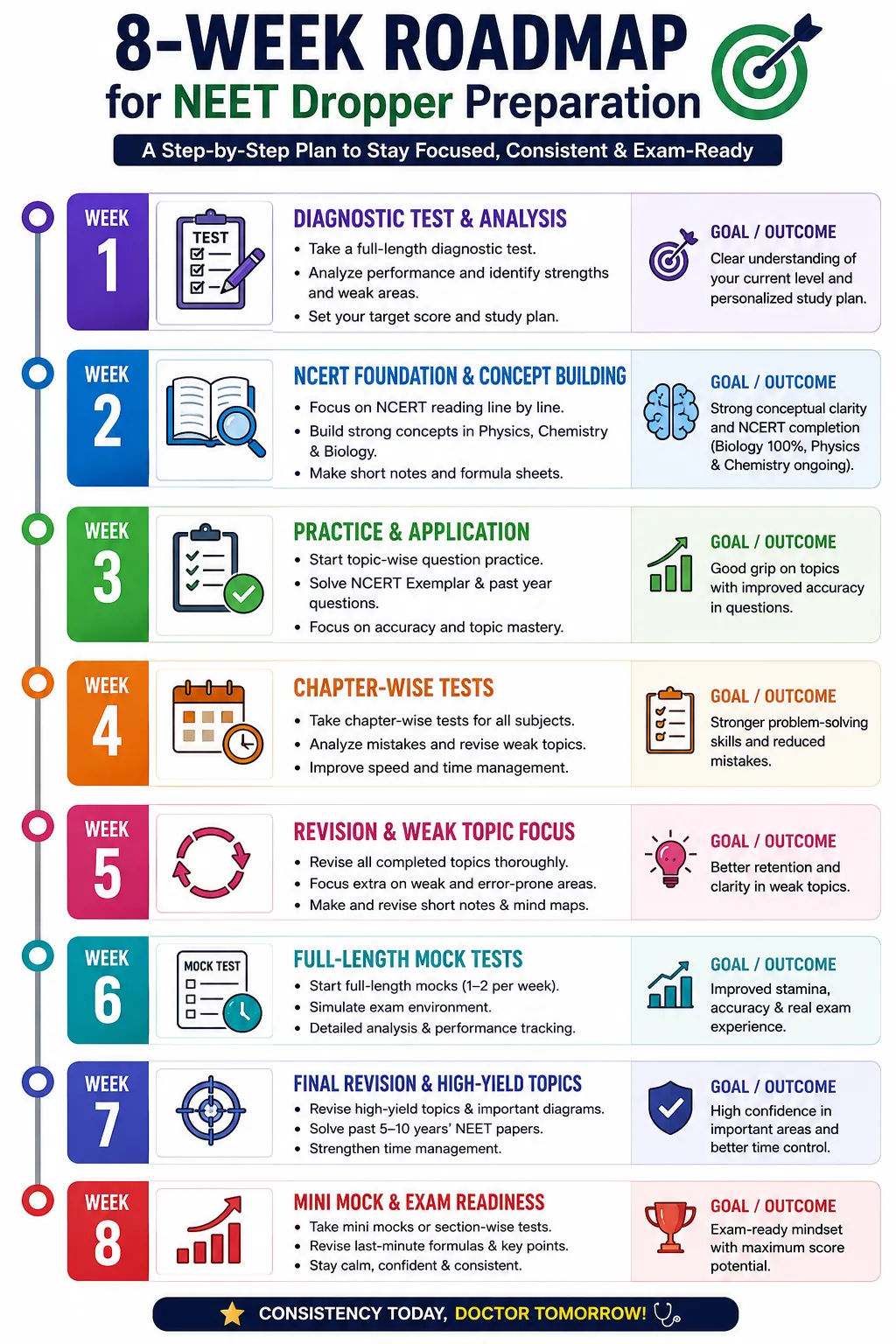
This roadmap assumes you are starting in early July. Adjust the calendar dates if needed—the sequence matters more than the exact dates.
Step 1 — Week 1: Honest Diagnostic (Days 1–7)
Solve one full NEET previous year question paper under exam conditions. Don't guess—solve honestly. Score yourself. This gives you a real baseline, not a feel-good one.
Step 2 — Week 1: Gap Mapping (Days 5–7 simultaneously)
From your diagnostic test, list every chapter where you scored below 60%. These are your priority zones. Not your starting zones—your priority zones.
Step 3 — Weeks 2–3: Rebuild, Don't Revise
Start with Biology NCERT. For every chapter, read once, close the book, and write down everything you remember. Then re-read to check gaps. This active recall method is 3x more effective than passive reading, per decades of cognitive science research.
Step 4 — Week 4: First Chapter Test Sprint
Attempt chapter-wise MCQs from past NEET papers (2019–2023) on every Biology chapter you rebuilt. Aim to cover at least 10 chapters. Track accuracy, not just attempt count.
Step 5 — Weeks 5–6: Chemistry and Physics Weak Chapters
Focus on your identified weak chapters only. Do not attempt to cover everything. Depth over breadth at this stage. Use formula sheets daily—write them, don't just read them.
Step 6 — Week 7: Mini Mock (Half-Paper)
Attempt a 45-question timed mock for each subject separately. Identify time management gaps now, while you still have months to fix them.
Step 7 — Week 8: Reflect and Reset
Review what worked in 7 weeks. Redesign your October–March schedule based on actual data from your performance, not assumptions. Commit to one full-length mock per week from Week 9 onward.
Common Panic Mistakes Students Make When They Realise They're Off Track
Around Week 6 or 7, many droppers realise they've been passive for too long. The panic that follows often creates a second wave of mistakes.
Switching Resources Constantly
A dropper who panics will suddenly buy 3 new books, subscribe to 2 new platforms, and restart from "better" material. This resource-switching kills continuity. Stick to NCERT + one reliable question bank + past papers. That's the complete toolkit.
Studying 14–16 Hours Without Structure
Sleep deprivation destroys memory consolidation. NTA's own NEET question design rewards students who think clearly under pressure—not students who crammed the most. Sustainable 8–10 focused hours beat exhausted 14-hour sessions every time.
Skipping Mock Tests Because "I'm Not Ready Yet"
This is extremely common and extremely damaging. You are never "ready" for your first mock—that is the point. Mocks are diagnostic tools, not performance stages. Start them immediately.
How Many Hours Should a NEET Dropper Study Each Day?
A NEET dropper should aim for 8 to 10 focused hours of active study per day—not seat time, but actual engaged work. Research on spaced learning and the forgetting curve consistently shows that quality of attention matters far more than raw hours logged.
Structure your day around three study blocks (morning, afternoon, evening) with genuine breaks between them. Reserve the final 30 minutes of every day for a quick review of what you studied that day—write it from memory, without notes.
| Time Slot | Activity | Duration |
|---|---|---|
| 6:00 AM – 9:00 AM | Biology NCERT (active recall method) | 3 hours |
| 10:00 AM – 1:00 PM | Chemistry / Physics concept + problems | 3 hours |
| 3:00 PM – 5:00 PM | Previous year MCQ practice | 2 hours |
| 6:00 PM – 7:30 PM | Weak chapter revision / formula drills | 1.5 hours |
| 9:00 PM – 9:30 PM | Daily memory recall review | 30 min |
If you want that structure built for you, eSaral's NEET Dropper Batch offers subject-wise pacing, IIT-faculty-led concept sessions, and weekly mock tests designed specifically for repeaters. It is worth exploring if you want to stop guessing and start executing.
Bookmark this guide and come back to it at the end of Week 2 and Week 7 to check whether your preparation is on the right track. You have more time than you think — if you start correctly, right now.
Frequently Asked Questions
Find answers to common questions.
How should a NEET dropper plan the first two months of their drop year?
Start with a diagnostic test using a past NEET paper, map your weak chapters honestly, and build a subject-wise weekly schedule. Prioritise active recall over re-reading. Attempt chapter-wise MCQs from previous NEET papers within the first three weeks. Do not wait until you feel "ready
Why do NEET droppers fail even after taking a drop year?
Most NEET droppers who fail a second time made the same preparation mistakes — passive study, poor time management, skipping mocks until late, and not using NCERT deeply enough for Biology. The drop year itself is not enough. The *strategy* inside that year is what decides the result.
What is the biggest mistake NEET droppers make in the first 2 months?
The biggest mistake is passive revision — re-reading old notes and feeling productive without actually rebuilding weak concepts. This creates a false sense of progress that only becomes visible when mock test scores don't improve. Active problem-solving and self-testing from Day 1 is the correct approach for any serious NEET dropper.
How many mock tests should a NEET dropper attempt in the first two months?
At minimum, one diagnostic full-length mock at the very start, then one half-paper mock per subject by Week 7. From Month 3 onward, one full-length mock per week is the standard target. Starting mocks early — even when you feel unprepared — is one of the highest-ROI habits a NEET dropper can build.
Should a NEET dropper join a coaching institute or study at home?
Both can work — the deciding factor is structure and accountability, not the location. Droppers who study at home without a structured plan and regular mock tests consistently underperform. If home study is your choice, ensure you have a fixed schedule, weekly targets, and at least one full mock test every fortnight from the start
Which subject should a NEET dropper focus on most in the first two months?
Biology should get the most attention — it carries **360 marks out of 720** in NEET UG. NCERT Biology must be studied line by line, not summarised. Diagrams and definitions from NCERT frequently appear verbatim in NEET questions. Chemistry and Physics weak chapters should run in parallel, not be delayed.
Is it normal to feel lost and unproductive in the first month of a drop year?
Yes — almost every NEET dropper goes through a difficult adjustment phase in the first few weeks. It is normal and expected. The key is setting a firm start date (no later than Week 2), using a structured daily timetable, and anchoring your motivation to a concrete daily goal rather than a distant outcome.