Errors in Measurement - NEET Previous Year Questions with Solutions

Table of Contents

eSaral › NEET Physics › Errors in Measurement NEET Previous Year Questions with Solutions

Here you will find Complete Errors in Measurement NEET Previous Year Questions with detailed solutions.
Get complete NEET previous year questions for Physics, Chemistry, and Biology.
You will find all the solutions at the end of this page:
How to Approach Errors in Measurement NEET PYQs
A 3-Step Method That Works
NEET errors questions are almost always solvable in under 90 seconds if you follow this structured approach:
- Identify the formula connecting the measured quantities to the derived quantity.
- Apply the propagation rule for each operation (addition → absolute errors add; multiplication → relative errors add).
- Convert to the form the question asks — absolute, relative, or percentage.
Common Mistakes to Avoid
- Subtracting errors instead of adding them in multiplication/division problems (errors always add up, never cancel).
- Forgetting the power multiplier when a variable appears with an exponent.
- Mixing up absolute and relative error in the final answer step.
Practise NEET PYQs below, and cross-reference each solution with the NCERT Class 11 Physics textbook, which provides the conceptual base for all NTA questions on this topic.
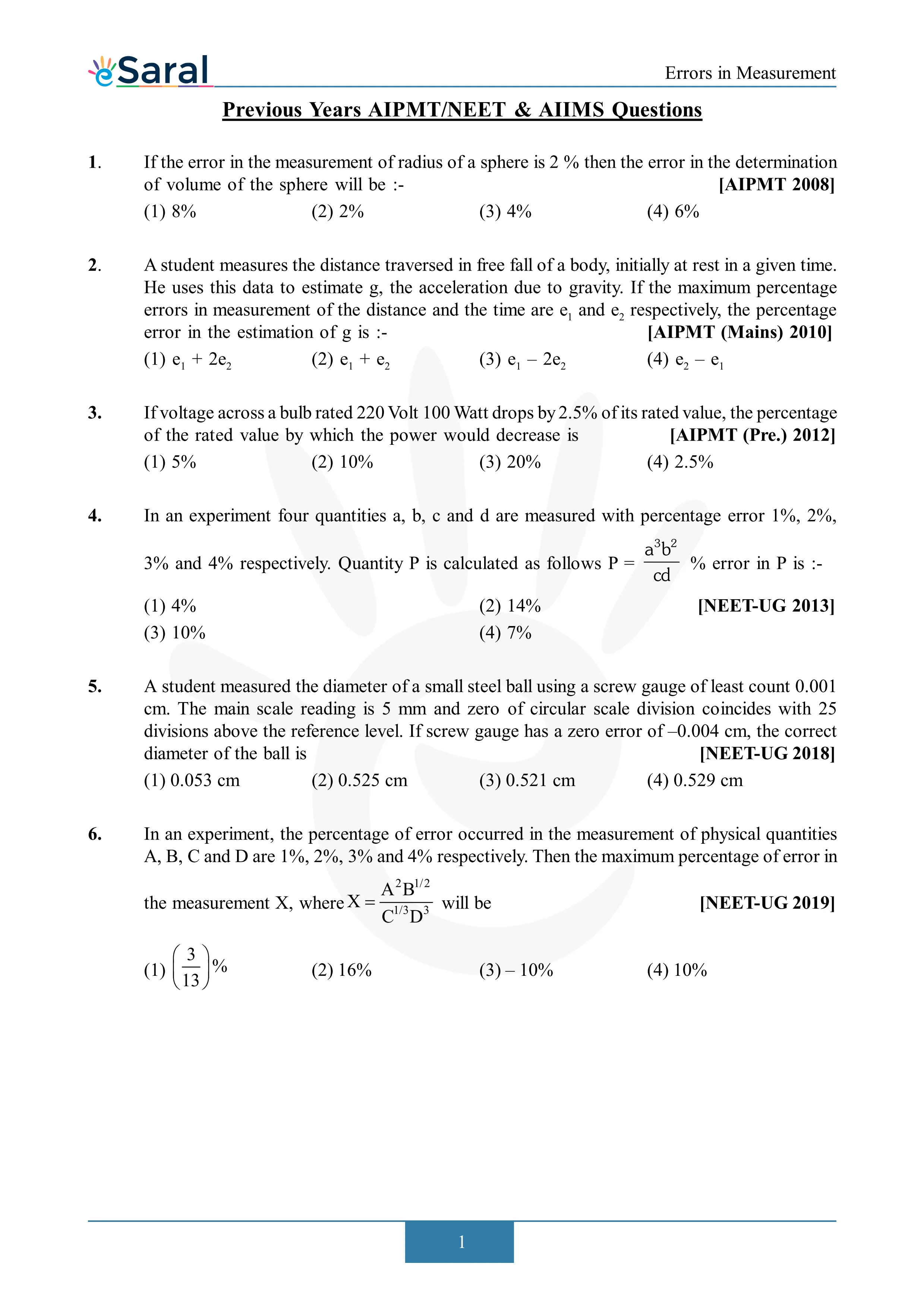

Year-Wise NEET Question Pattern: Errors in Measurement
Understanding which sub-topics NTA has tested helps you prioritise your revision time.
Year-Wise NEET Question Pattern: Errors in Measurement
Understanding which sub-topics NTA has tested helps you prioritise your revision time.
| NEET Year | Sub-Topic Tested | Question Format |
|---|---|---|
| 2024 | Percentage Error in Derived Quantity | Formula-Based Calculation |
| 2023 | Absolute Error & Significant Figures | Single-Step Calculation |
| 2022 | Error Propagation (Multiplication) | Formula Application |
| 2021 | Relative Error in Pendulum Period | Multi-Step Derivation |
| 2020 | Systematic vs Random Error | Conceptual MCQ |
| 2019 | Percentage Error Using Power Rule | Formula-Based Calculation |
| 2018 | Error in Measured Resistance (Ohm’s Law) | Formula Application |
| 2017 | Mean Absolute Error from Repeated Readings | Data-Based Calculation |
Key Observation: Formula-based error propagation (especially involving powers and products) has appeared in 6 out of the last 8 years. This makes it the highest-ROI topic within the Errors in Measurement chapter for NEET preparation.
For additional Physics and Chemistry practice, explore NCERT Solutions for Class 11, which cover all major concepts frequently tested in NEET.
Frequently Asked Questions
Find answers to common questions.
How do you calculate percentage error when a formula has powers?
When a physical quantity Z = Aᵐ × Bⁿ / Cᵖ, the percentage error in Z equals m×(%ΔA) + n×(%ΔB) + p×(%ΔC). The power of each variable acts as a multiplier for its percentage error. This rule applies whether the variable is in the numerator or denominator — errors always add, never subtract. This is the single most tested concept in NEET error questions.
What is the difference between absolute error and relative error in NEET Physics?
Absolute error is the magnitude of the difference between the measured value and the true value (ΔA = |A_true − A_measured|). Relative error is the ratio of absolute error to the true value (ΔA/A). NEET questions often ask for percentage error, which is simply relative error multiplied by 100. Knowing which form the question asks for in the final step prevents common calculation mistakes.
How many questions from Errors in Measurement come in NEET every year?
Typically 1–2 questions come from the Errors in Measurement topic in NEET Physics each year. These questions are part of the broader Units and Measurements chapter, which itself contributes 2–3 questions per exam. Since NTA has consistently included error propagation questions since 2017, this sub-topic is considered high-priority for NEET aspirants.
Where can I find NEET previous year questions for Units and Measurement Chapter 1 (not just errors)?
eSaral's NEET PYQ bank covers all sub-topics of Units and Measurements — including dimensional analysis, significant figures, and measuring instruments — alongside errors. You can access chapter-wise PYQs with solutions in the eSaral app. The NCERT Solutions for Class 11 Physics also provide a solid conceptual base for every question type NTA has set from this chapter
What are the main types of errors students must know for NEET?
For NEET, students must know: (1) Absolute error, (2) Mean absolute error, (3) Relative/Fractional error, (4) Percentage error, (5) Systematic error, and (6) Random error. Gross errors are rarely tested. The calculation-based questions almost always involve the first four types. Systematic vs. random error appears in conceptual MCQs asking students to identify error sources or suggest remedies.
Is Errors in Measurement important for NEET or can it be skipped?
It cannot be skipped. Errors in Measurement appears in NEET almost every year, and the questions are formulaic — meaning with the right preparation, they are near-certain marks. The topic takes 3–4 hours to master fully, offering one of the best effort-to-mark ratios in the entire NEET Physics syllabus. Skipping it is strategically unsound.