eSaral NEET Dropper Batch 2027: One-Year AIIMS Roadmap
Explore the eSaral NEET Dropper Batch 2027 roadmap featuring interactive live classes, dual mentorship, CBT-based test series, AI-powered performance analysis, structured study plans, and comprehensive preparation for NEET and AIIMS success in one year.


Table of Contents

eSaral › NEET › eSaral NEET Dropper Batch 2027: One-Year AIIMS Roadmap

Why NEET 2026 Scores Are Lower Than Expected
The NEET 2026 paper was tougher than what most droppers had prepared for, and time management became the deciding factor for a large number of students. Chemistry took up more time than expected, which left less time for Physics — an "achievable" paper ended up incomplete for many. Seeing a greater difficulty level in Chemistry also dented confidence mid-exam, which in turn affected pacing across the rest of the paper.
A combination of factors is behind this year's results:
- 15 extra minutes were available this year, which should have helped
- Biology was comparatively easier, which should also have helped
- Despite this, time management broke down for many students because of tougher Chemistry
- Physics got rushed, and papers that students could otherwise attempt were left incomplete
- Silly mistakes increased as a result of the pressure
Because of this combination, the overall cutoff is expected to fall this year even though individual sections had helpful factors built in.
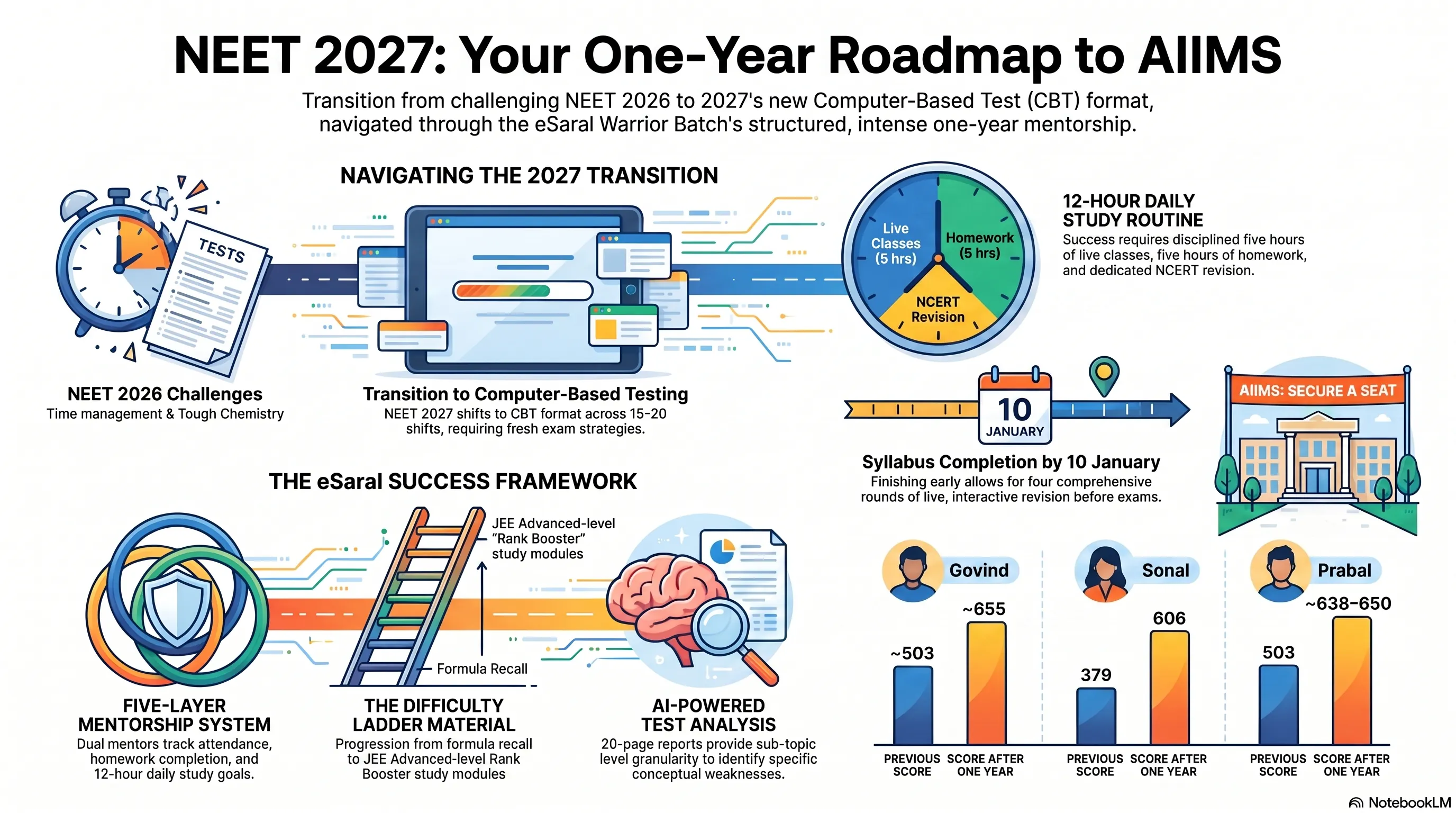
There's a second layer to this for anyone planning a drop year. NEET 2027 is expected to move to a computer-based test (CBT) format, with an estimated 22–25 lakh students appearing across roughly 15–20 shifts — which means some shifts will inevitably be tougher than others. For dropper-year students who have already attempted NEET multiple times on OMR sheets and given hundreds of OMR-based mock tests, this is a real shift: NEET 2027 will need to be attempted in an entirely new format, on a computer, which itself takes fresh strategy and practice.
Is One Year Enough to Crack AIIMS?
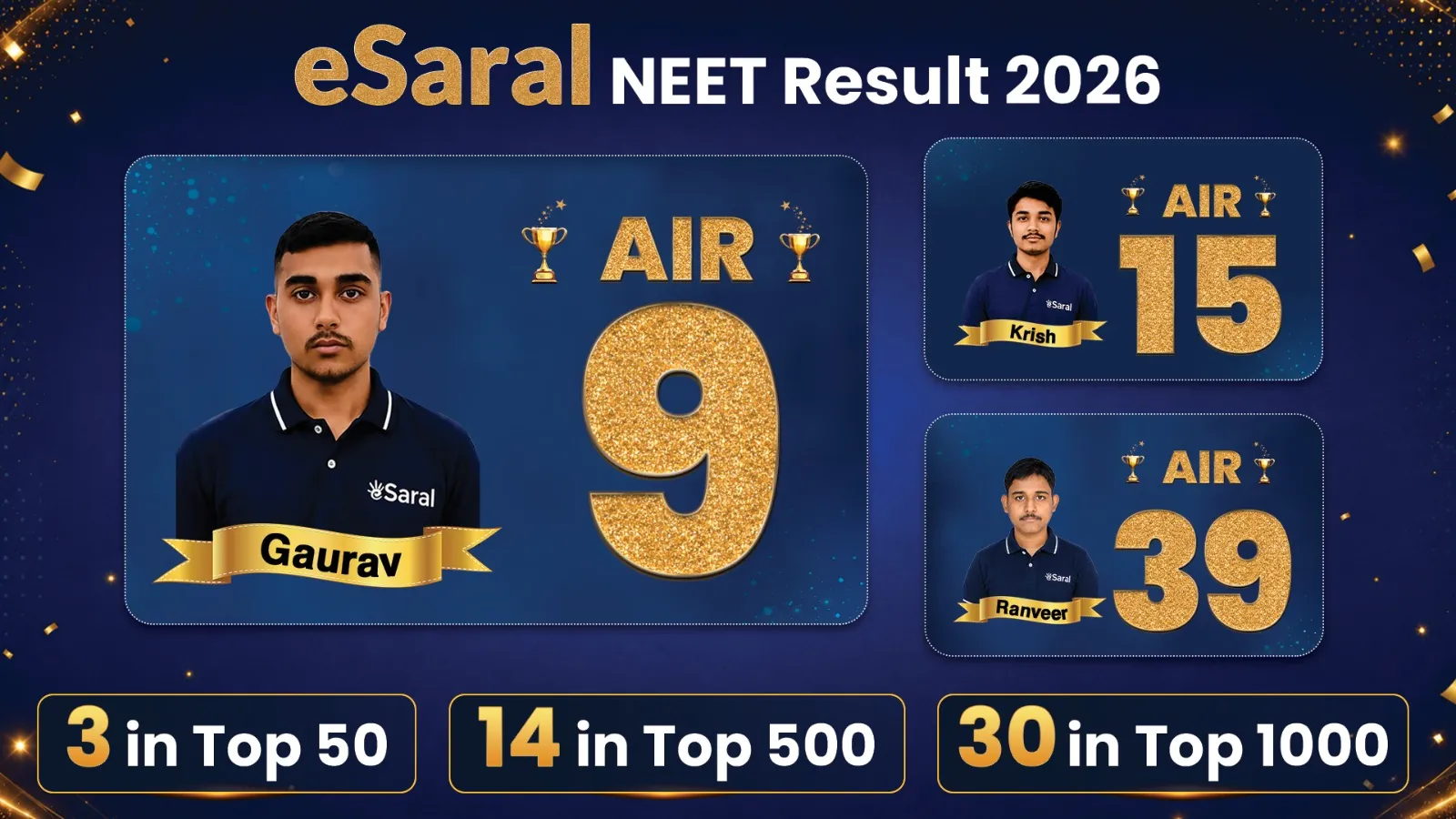
Yes — based on actual results from droppers who prepared for exactly one year. Praveen reached AIIMS Jodhpur after a single year of preparation, with a rank jump described as going from around the 12,22,000 range to a rank of 2,400. Gaurav is now at AIIMS Gorakhpur, also after one year of preparation.
This year's numbers add to that picture. Students scored 705, 700, 690, 685, and 671 marks, with strong scores continuing below that as well — and there are genuine chances of three ranks in the top 100 this year. This is only the third year an institute has produced results at this level, making it one of the fastest institutes to reach top-100 ranks in that timeframe. A large share of these students prepared for only one year. Beyond AIIMS Jodhpur and Gorakhpur, AIIMS Delhi, AIIMS Bhopal, and AIIMS Patna are described as completely achievable within a single drop year as well.
Individual improvement stories reinforce this:
| Student | Earlier Score | Score After One Year |
|---|---|---|
| Prabal | 503 (also cited as 510–512) | ~638–650 |
| Govind | ~503 | ~655 |
| Sonal | 379 | 606 |
Several students improved their scores by 200 marks or more, crossing the 600 mark within one year, and hundreds of students have gone on to become doctors from a Government Medical College (GMC) through this approach.
What's Included in the eSaral NEET Dropper Batch
The NEET 2027 Warrior Batch is built specifically around this one-year turnaround.
Two-Way Interactive Live Classes
Classes run as two-way interactive live sessions, meaning students can unmute and clear a doubt directly with the teacher during class, and see multiple methods for solving a tough question in real time — so most doubts are resolved inside the class itself. The teaching team includes faculty with AIR ranks of 1 (twice), 3, 5 (twice), 8, 9, 10, 13, 19, 37, 39, 50, 57, and 65 between them, having produced top-100 ranks across multiple years.
Five-Layer Mentorship Program
Every student is assigned two mentors, and the system is designed to keep students accountable across the full year:
- A call goes out immediately if a student misses a class
- Homework is checked continuously across Physics, Biology, and Chemistry
- Completion of tough JEE Main-level PYQs and moderate JEE Advanced-level PYQs is tracked
- Whether a student is putting in roughly 12 hours of daily study is monitored, with motivation — and, where needed, direct pressure — applied
- Every test is mandatory; missing one triggers an immediate call, including to parents
- After each test, students receive a 20-page test analysis report, and mentors, teachers, and directors help interpret it — for example, guiding a student from 550 to 700, or from 400 toward 600–650
Parent-teacher meetings (PTMs) and a super-mentorship track are also part of the program, which can push total study hours to 14–15 hours a day for students who opt in.
Study Material and Test Series
The material set follows a difficulty ladder:
- CPP — for formula recall
- Module Exercise 1 — around NEET 2024/2025 difficulty level
- Module Exercise 2 — slightly above NEET 2025 level
- Special 27 — tougher than last year's "Special 26," built for a JEE Main-tough-level shift; the first 200 students receive this delivered free
- Rank Booster — for a JEE Advanced-level shift
Across the year, students get 200–250 CBT-based tests: chapter-wise tests after every chapter, 3-hour full CBT tests, part-syllabus and half-syllabus tests, full-syllabus tests, and an All India Test Series where students compete against lakhs of students nationwide. A distinguishing feature is the 20-page AI-powered test analysis report after every test, which drills down to the sub-topic level — for example, in Chemical Bonding, it separates whether the actual mistake is in VSEPR theory or MOT, rather than just flagging the whole chapter as weak.
For subject-specific preparation, the NEET Chemistry weightage breakdown is useful context — this year alone, eight questions came from Coordination Compounds, with five direct and three requiring deeper conceptual understanding, and the batch also covers JEE Main/Advanced-level Isomerism, Thermodynamics, and Ionic Equilibrium, plus organic reaction mechanisms across the full A–F range. On the Physics side, the NEET Physics weightage page is a useful reference alongside the batch's calculative and multi-concept question practice.
Students also get access to digitized previous-year papers, including the full NEET question paper archive, with year-wise papers for NEET 2023, NEET 2022, NEET 2021, NEET 2020, and NEET 2019.
The One-Year Roadmap: Syllabus, Revision and Study Hours
The daily structure is built around roughly 12 hours of study: three live classes totaling 5 hours, 5 hours of homework at a tough level, and 2 hours for notes and NCERT revision — Biology in particular requires this dedicated NCERT revision time.
💡 Expert Tip: "December mein syllabus khatam kara dunga, maximum January 10 tak" — the syllabus is planned to finish by December, or January 10 at the latest, specifically because there's a chance NEET could be conducted more than once, with a first attempt possibly as early as February–March. Finishing the NEET syllabus early leaves room for four full rounds of revision before the final attempt, and all of that revision is delivered two-way interactive and live, not pre-recorded.
On paper-attempting strategy specifically, one NEET student was advised roughly a month before the exam to attempt the paper in two rounds rather than straight through — a change that took their score to 660. With more time after that first exam, the same approach was pushed further and added another 50–60 marks. This two-round attempt strategy is part of what the batch works on with students through the year, alongside speed-practice sessions, digitized previous papers, and dedicated backlog-recovery sessions for any student who falls behind schedule.
Tests throughout the year are conducted live with cameras on, to recreate exam-day competition and peer pressure, and students also get access to an online library to support self-study outside of class and homework hours.
Doubt-Solving System and Recorded Lecture Support
Most doubts are resolved where they come up — in class, through discussion of the CPP, Special 27, and Module homework. For anything left over, students get textual and video solutions, followed by a chat-based doubt-solving tool. On top of that, there are dedicated live doubt-solving classes scheduled opposite the batch's regular timing — for example, a morning batch gets evening doubt sessions — accessible through the app. This runs all year: a doubt from a September chapter can still be resolved through live doubt sessions in October, or by connecting directly with a teacher.
Frequently Asked Questions
Find answers to common questions.
Is one year enough to crack AIIMS after a low NEET 2026 score?
Yes, based on actual results — Praveen reached AIIMS Jodhpur and Gaurav reached AIIMS Gorakhpur after exactly one year of preparation. This year's droppers scored 705, 700, 690, 685, and 671 marks, with genuine chances of three top-100 ranks, in only the third year this results pattern has been produced.
How does eSaral's mentorship program help NEET droppers improve their marks?
Every student gets two mentors who track class attendance, homework completion across all three subjects, and daily study hours, with immediate calls if a class or test is missed. This structure is behind score jumps like Sonal's 379 to 606 and Govind's roughly 503 to 655 within a single year.
What study material and tests are included in the NEET 2027 preparation batch?
Students get CPP, Module Exercise 1 and 2, Special 27, and Rank Booster material, along with 200–250 CBT-based tests — chapter tests, full CBT tests, part and full syllabus tests, and an All India Test Series — each followed by a 20-page AI-powered test analysis report down to the sub-topic level.
How is NEET 2027's computer-based test different from the OMR-based NEET droppers are used to?
NEET 2027 is expected to move to a computer-based format with an estimated 22–25 lakh students across roughly 15–20 shifts, meaning droppers who have only practiced on OMR sheets will need dedicated CBT practice, which is why the batch includes 200–250 CBT-based tests through the year.
What is the fee for the eSaral NEET dropper batch, and is scholarship available?
Offline batch fees are ₹75,000 for English medium and ₹50,000 for Hindi medium, both for the first 100 students. Scholarships of up to 100% are available based on NEET score through a scholarship test, making this one of the more affordable options for Kota-level offline and online preparation.