JEE Main 2027 Syllabus: Complete Chapter-Wise Breakdown with Weightage & Priority Topics
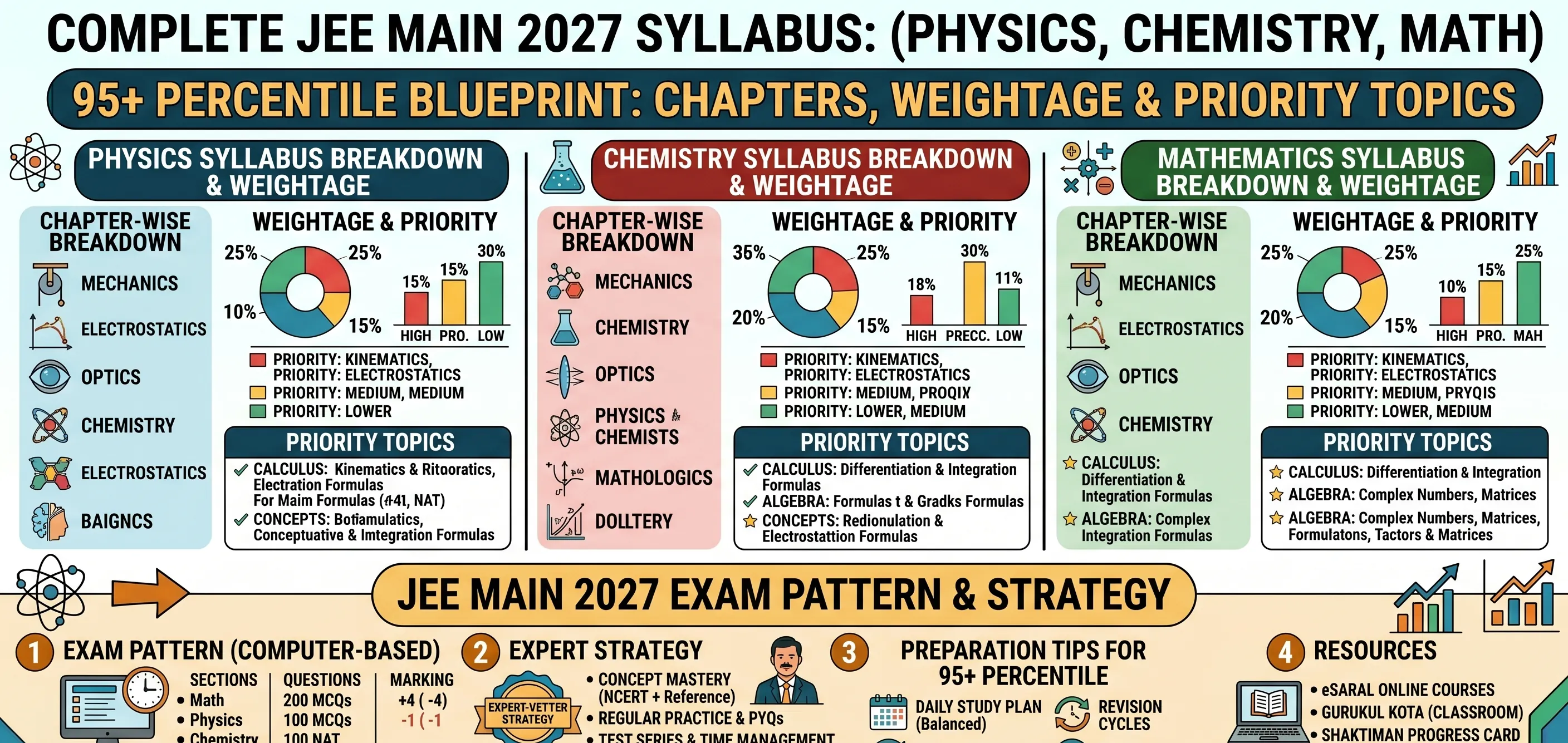
The JEE Main 2027 syllabus covers Physics, Chemistry, and Mathematics from Class 11 and Class 12 NCERT. Physics has 29 chapters across mechanics, electrodynamics, optics, and modern physics. Chemistry covers physical, inorganic, and organic topics across 28 chapters. Mathematics spans 25 chapters, including calculus, algebra, and coordinate geometry. NTA prescribes equal marks weightage of 100 marks per subject in Paper 1.
Table of Contents
- JEE Main 2027 Syllabus — Official Overview
- Physics Syllabus: All Chapters with Weightage
- Chemistry Syllabus: All Chapters with Weightage
- Mathematics Syllabus: All Chapters with Weightage
- Class 11 Topics You Must Cover First for JEE Main
- JEE Main 2027 Exam Pattern
- How to Study the JEE Main Syllabus Efficiently
- Strategy for Students Who Struggled in Class 11

JEE Main 2027 Syllabus — Official Overview
The JEE Main syllabus is prescribed by the National Testing Agency (NTA) and is largely aligned with the NCERT curriculum for Classes 11 and 12. As per the NTA official website, Paper 1 (B.E./B.Tech) tests three subjects — Physics, Chemistry, and Mathematics — each carrying 100 marks.
Physics
29 chapters · 100 marks · Mechanics to Modern Physics
Chemistry
28 chapters · 100 marks · Physical + Inorganic + Organic
Mathematics
25 chapters · 100 marks · Algebra to Calculus
| Feature | JEE Main Paper 1 | JEE Advanced |
|---|---|---|
| Conducting Body | NTA | IITs (rotating) |
| Mode | Computer-Based Test (CBT) | CBT (2 papers) |
| Sessions per Year | 2 (Jan + Apr) | 1 (May–June) |
| Total Marks | 300 | 360 |
| Syllabus Basis | Class 11 + 12 NCERT | JEE Main + extended topics |
| Negative Marking | −1 per wrong MCQ | −1 / −2 depending on type |
Physics Syllabus: All Chapters with Weightage
Physics in JEE Main is split into two sections: Class 11 (mechanics-heavy) and Class 12 (electrodynamics-heavy). Historically, Class 12 topics carry slightly higher weightage — but Class 11 mechanics forms the backbone of your entire physics understanding.
Class 11 Physics Chapters
| # | Chapter | Avg. Marks (Last 5 Years) | Priority |
|---|---|---|---|
| 1 | Units, Dimensions & Measurement | 4 | Medium |
| 2 | Kinematics (Motion in 1D & 2D) | 6 | High |
| 3 | Laws of Motion (NLM) | 8 | High |
| 4 | Work, Energy & Power | 6 | High |
| 5 | Rotational Motion | 6 | High |
| 6 | Gravitation | 4 | Medium |
| 7 | Properties of Solids & Fluids | 4 | Medium |
| 8 | Thermodynamics | 4 | Medium |
| 9 | Kinetic Theory of Gases | 3 | Medium |
| 10 | Oscillations (SHM) | 4 | Medium |
| 11 | Waves | 3 | Medium |
Class 12 Physics Chapters
| # | Chapter | Avg. Marks (Last 5 Years) | Priority |
|---|---|---|---|
| 12 | Electrostatics | 8 | High |
| 13 | Current Electricity | 7 | High |
| 14 | Magnetic Effect of Current | 7 | High |
| 15 | Magnetism & Matter | 3 | Medium |
| 16 | Electromagnetic Induction | 6 | High |
| 17 | Alternating Current (AC) | 5 | High |
| 18 | Electromagnetic Waves | 2 | Low |
| 19 | Ray Optics & Optical Instruments | 6 | High |
| 20 | Wave Optics | 4 | Medium |
| 21 | Dual Nature of Radiation & Matter | 4 | Medium |
| 22 | Atoms & Nuclei | 4 | Medium |
| 23 | Semiconductor Electronics & Devices | 4 | Medium |
In JEE Main Physics, Electrostatics + Current Electricity + Magnetic Effects together contribute nearly 22–25 marks every attempt. Nail these three chapters before touching any lower-priority topic. In Class 11, NLM and Work-Energy Theorem are non-negotiable — they appear in electrostatics problems too.
Chemistry Syllabus: All Chapters with Weightage
Chemistry is the most consistently scoring subject in JEE Main. Unlike Physics and Mathematics, it rewards memory alongside understanding. The subject is divided into three parts: Physical Chemistry (calculation-based), Inorganic Chemistry (fact and concept-based), and Organic Chemistry (reaction and mechanism-based).
Physical Chemistry
| Chapter | Avg. Marks | Priority |
|---|---|---|
| Mole Concept & Stoichiometry | 5 | High |
| Atomic Structure | 4 | High |
| States of Matter (Gas Laws) | 3 | Medium |
| Thermodynamics | 4 | High |
| Equilibrium (Chemical + Ionic) | 5 | High |
| Redox Reactions & Electrochemistry | 5 | High |
| Chemical Kinetics | 4 | High |
| Solutions & Colligative Properties | 4 | Medium |
| Surface Chemistry | 2 | Low |
Inorganic Chemistry
| Chapter | Avg. Marks | Priority |
|---|---|---|
| Periodic Table & Periodicity | 4 | High |
| Chemical Bonding & Molecular Structure | 5 | High |
| s-Block Elements | 3 | Medium |
| p-Block Elements (Class 11) | 4 | High |
| p-Block Elements (Class 12) | 5 | High |
| d & f Block Elements | 4 | High |
| Coordination Compounds | 5 | High |
| Metallurgy | 2 | Low |
| Hydrogen & its Compounds | 2 | Low |
Organic Chemistry
| Chapter | Avg. Marks | Priority |
|---|---|---|
| General Organic Chemistry (GOC) | 5 | High |
| Hydrocarbons | 4 | High |
| Haloalkanes & Haloarenes | 4 | High |
| Alcohols, Phenols & Ethers | 3 | Medium |
| Aldehydes, Ketones & Carboxylic Acids | 5 | High |
| Amines & Diazonium Salts | 3 | Medium |
| Biomolecules | 2 | Low |
| Polymers & Chemistry in Everyday Life | 2 | Low |
In Chemistry, never skip Periodic Trends and Chemical Bonding — these two chapters from Class 11 are the foundation of every Inorganic and Organic topic that follows. Students who build these concepts well score 30–35 in Chemistry almost on autopilot. Also, Coordination Compounds alone have given 4–6 marks in almost every JEE Main session since 2020.
Mathematics Syllabus: All Chapters with Weightage
Mathematics is the deciding factor for the top percentiles. Students who cross 75+ in Maths consistently push their overall score into the 97–99 percentile range. The subject rewards practice more than any other — consistent problem-solving over months separates good scores from great ones.
| Chapter | Class | Avg. Marks | Priority |
|---|---|---|---|
| Sets, Relations & Functions | 11 | 3 | Medium |
| Complex Numbers | 11 | 4 | High |
| Quadratic Equations | 11 | 4 | High |
| Sequences & Series (AP, GP, HP) | 11 | 4 | High |
| Permutations & Combinations | 11 | 3 | Medium |
| Binomial Theorem | 11 | 4 | High |
| Trigonometry (All Parts) | 11 | 6 | High |
| Straight Lines & Pair of Lines | 11 | 5 | High |
| Circles | 11 | 5 | High |
| Conic Sections (Parabola, Ellipse, Hyperbola) | 11 | 8 | High |
| Limits, Continuity & Differentiability | 12 | 6 | High |
| Differentiation (Methods + Applications) | 12 | 7 | High |
| Integration (Indefinite + Definite) | 12 | 9 | High |
| Differential Equations | 12 | 4 | High |
| Vectors | 12 | 4 | High |
| 3D Geometry | 12 | 6 | High |
| Probability | 12 | 5 | High |
| Matrices & Determinants | 12 | 5 | High |
| Statistics | 11 | 2 | Low |
| Mathematical Reasoning & Logic | 11 | 2 | Low |
Class 11 Topics You Must Cover First for JEE Main
Many Class 12 students panic about the backlog in Class 11. The truth — backed by 37 years of N.K. Gupta Sir's teaching is that you do not need 100% of Class 11 to perform well in JEE Main. You need the right 10–20% of it, and you need it solidly.
Physics: Minimum Class 11 Coverage for JEE Main
- Units & Dimensions — Complete. Takes just 2–3 classes. Non-negotiable for dimensional analysis problems.
- Vectors: Basics only — Component resolution, i-cap/j-cap addition, dot product definition. Full vectors come in Class 12 Maths.
- Kinematics — The three equations of motion. Projectile motion basics.
- NLM (Newton's Laws) — Free body diagrams + all three laws + static and kinetic friction.
- Work, Energy & Power — Work-energy theorem is critical for Electrostatics (Class 12 Chapter 1).
- Circular Motion — F_net = mv²/r. That's the core concept. Basics of torque.
- Centre of Mass & Rotational Motion — Moment of inertia, conservation of momentum. Appears in the magnetic effects of current.
Chemistry: Minimum Class 11 Coverage for JEE Main
- Mole Concept — Mole calculations are the arithmetic of all of Chemistry.
- States of Matter — Ideal gas equation (PV = nRT). This one formula comes up everywhere.
- Thermodynamics — Gibbs free energy formula (ΔG = ΔH − TΔS). Understand what spontaneous means.
- Ionic Equilibrium — pH calculation, Ksp, solubility basics.
- Redox Reactions — Balancing half-reactions. Foundation for Electrochemistry.
- Periodic Table & Periodicity — Full chapter. Learn trends thoroughly.
- Chemical Bonding — Full chapter. VSEPR, hybridisation, bond order.
Mathematics: Minimum Class 11 Coverage for JEE Main
- Logarithms — Basic log rules. Used in Chemistry and Physics calculations constantly.
- Quadratic Equations — Finding roots, Vieta's formulas, wavy curve method, modulus, and inequalities.
- Trigonometry (Compound Angles) — Standard formulas. Graphs of sin, cos, tan.
- Coordinate Geometry Basics — Straight lines and distance formula before Circles and Conics.
- Permutations & Combinations — Can wait until Probability chapter starts (typically 4 months in).
Students who came to eSaral with weak Class 11 foundations — including students now at IIT Bombay and IIT Roorkee — did not revise all of Class 11 in one go. They identified the 10–15 core topics listed above, covered them solidly in the first 6–8 weeks, then moved into Class 12. The backlog was cleared in parallel, not all at once. Break the mountain into boulders, then boulders into stones.
JEE Main 2027 Exam Pattern
Understanding the JEE Main exam pattern is as important as knowing the syllabus. The structure directly determines your time-management strategy and the order in which you should attempt the questions.
| Feature | Details |
|---|---|
| Mode | Computer-Based Test (CBT) |
| Duration | 3 hours (180 minutes) |
| Total Questions | 75 (25 per subject) |
| Total Marks | 300 |
| MCQ Section | 20 questions per subject (4 marks each; −1 for wrong) |
| Integer Answer Section | 5 questions per subject (4 marks each; no negative marking) |
| Languages Available | 13 languages, including Hindi and English |
| Sessions | January session + April session (best of two counts) |
| Eligibility | Class 12 pass or appearing; Physics + Maths + Chemistry mandatory |
For a complete breakdown of the exam pattern,n including section-wise question distribution, refer to eSaral's dedicated JEE Main exam pattern guide.
How to Study the JEE Main Syllabus Efficiently
Step 1: Map Your Current Status Against the Syllabus
Before creating a timetable, go through every chapter in all three subjects and honestly rate yourself: Strong / Needs Revision / Not Done. This one-hour exercise saves weeks of wasted effort. Most students find that 40–50% of the syllabus is either done or near-done, which means far less ground to cover than it feels.
Step 2: Follow a Subject-Wise Priority Order
Do not study subjects randomly. Follow this order to build concepts in the right sequence:
- Class 11 Physics Mechanics (NLM + WEP + Circular Motion)
- Class 12 Physics Electrostatics + Current Electricity
- Chemistry: Periodic Table → Chemical Bonding → Physical Chemistry
- Mathematics: Coordinate Geometry → Calculus (Limits → Differentiation → Integration). The remaining chapters are parallel with weekly mock tests
Step 3: Use Previous Year Papers as Your Compass
JEE Main previous year papers are the most reliable signal for what actually appears. The chapter-wise distribution in this article is based on real data from the last five years of JEE Main. Solving chapter-wise previous year questions after completing each topic will show you exactly what level of difficulty to expect — and what sub-topics NTA has historically tested most.
What Study Hours Does JEE Main Preparation Actually Require?
Students who achieve 95+ percentile in JEE Main consistently study between 6 and 8 focused hours daily over 10–12 months. However, quality matters far more than quantity. Three hours of focused problem-solving beats seven hours of distracted reading every time. In eSaral's 2025 JEE Main batch, students who maintained 5–6 focused hours per day with structured weekly revision improved by an average of 18 percentile points over 8 months.
| Target Percentile | Required Study Hours/Day | Timeline from Zero |
|---|---|---|
| 80–90 percentile | 4–5 hours | 8–10 months |
| 90–95 percentile | 5–6 hours | 10–12 months |
| 95–99 percentile | 6–8 hours | 12–14 months |
| 99+ percentile (IIT Bombay/Delhi zone) | 8–10 hours | 14–16 months |
Strategy for Students Who Struggled in Class 11
If Class 11 didn't go the way you wanted — that is one of the most common situations in JEE preparation. It is not a disqualifier. What matters is the plan you execute from here.
Is It Possible to Clear JEE Main with a Weak Class 11?
Yes — with a structured plan and genuine commitment. Ayush (from Pune), who joined eSaral's online batch with a weak Class 11, is now studying at IIT Bombay. Prachi, who started with similar challenges, is at IIT Kanpur. Manu, who had a weak Class 11, is at IIT Roorkee. These are not exceptions — they are what focused preparation over 12–14 months produces when every class is attended,d and every mentor session is used well.
The 12-Month Rebuilding Plan for Class 11 Backlog
- Months 1–2: Cover the essential Class 11 topics listed in Section 5 of this article. Do not attempt to cover all of Class 11.
- Months 3–6: Study Class 12 syllabus in parallel. Revisit the remaining Class 11 chapters for topics that feed into Class 12 content.
- Months 7–9: First full-length mock tests begin. Identify weak chapters from mock data, not from intuition.
- Months 10–12: Revision cycles. Solve the complete previous year papers. Target accuracy improvement in strong subjects first.
- Months 13–14 (if applicable): Final sprint. High-density revision, formula consolidation, and time management drills.
eSaral's JEE dropper batch is built specifically for this journey. The batch covers full Class 11 + 12, includes a dedicated mentorship system, and offers live audio-visual, interactive classes — not recorded videos you watch alone. For those who want offline Kota-quality teaching, eSaral Gurukul in Kota brings the same faculty under one roof.
Frequently Asked Questions
Find answers to common questions.
Is the JEE Main syllabus the same as JEE Advanced?
No. JEE Advanced extends beyond JEE Main in depth and introduces topics not covered in JEE Main. JEE Main is based strictly on Class 11 and 12 NCERT. JEE Advanced adds topics like complex organic synthesis, advanced mechanics, and higher-order mathematical concepts.
Which subject has the most chapters in JEE Main 2027?
Physics has the most chapters at 29, followed by Chemistry with 28 and Mathematics with 25. However, chapter count does not equal difficulty or time required — Mathematics typically demands the most practice hours per chapter for most students.
Has the JEE Main 2027 syllabus changed from 2024?
No major changes are expected for 2027 beyond what NTA revised in 2024. The 2024 revision removed some topics from earlier versions. Always verify against the official NTA notification before finalising your plan, as NTA can update the syllabus without advance notice.
How many chapters should I finish before the January 2027 session?
Aim to complete all High-priority chapters across all three subjects before the January session. That covers approximately 15 Physics chapters, 18 Chemistry chapters, and 16 Mathematics chapters. Medium-priority chapters can be completed during the gap between January and April sessions.
Is NCERT sufficient for JEE Main Chemistry?
NCERT is necessary but not fully sufficient. For Physical Chemistry, you need additional problem practice beyond NCERT. For Inorganic Chemistry, NCERT covers approximately 80–85% of what NTA tests directly. For Organic Chemistry, NCERT mechanisms must be supplemented with JEE-specific reaction practice.
Can I score 250+ in JEE Main without completing the full syllabus?
Yes. Students regularly score 250+ by mastering high-priority chapters thoroughly rather than covering all chapters superficially. Focus on the chapters marked "High" priority in the tables above — they collectively account for 200+ marks of the 300-mark paper.
Which chapter has the highest weightage in JEE Main Mathematics?
Integration (Indefinite + Definite) consistently carries the highest single-chapter weightage in Mathematics, averaging 9 marks per attempt. Conic Sections follows at 8 marks and is the top-weighted Class 11 chapter in Maths