Complete notes for Physics, Chemistry and Biology
Access comprehensive Class 11 and 12 Physics, Chemistry, and Biology notes with key concepts, formulas, solved examples, and revision summaries designed to help students excel in CBSE Boards, JEE, and NEET.
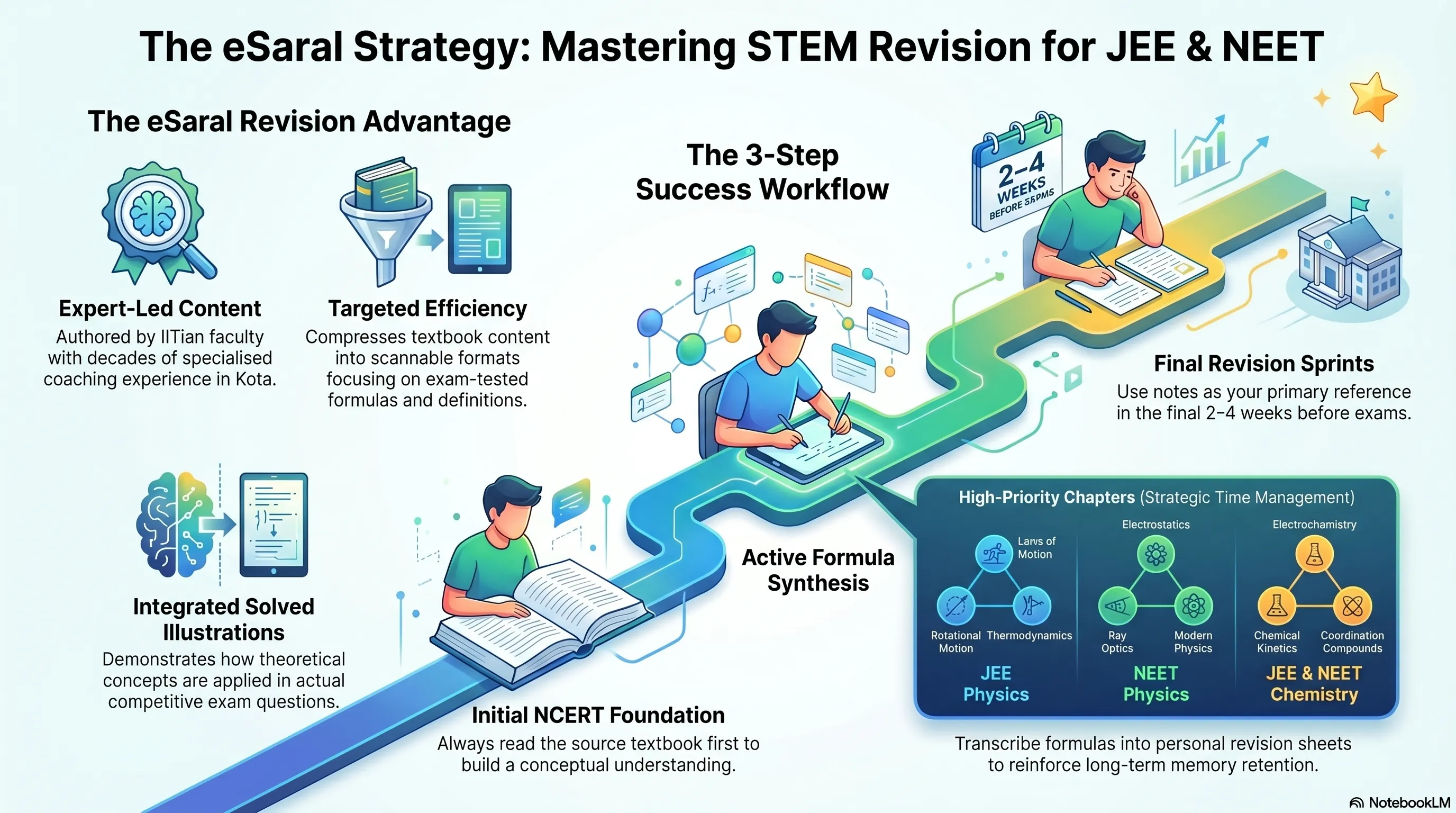
Table of Contents

esaral>class11>class12>Complete notes for Physics, Chemistry and Biology

🚀 Checkout eSaral Courses
Why These Notes Work for JEE, NEET & Boards
Good chapter notes do three things that textbooks alone cannot: they compress the essential information into a scannable format, highlight formulas and concepts that are actually tested in exams, and save revision time during the final weeks before your paper.
eSaral's chapter-wise notes are written by IITian faculty who have taught JEE and NEET students at Kota for decades. Every note covers:
| What's Included | Why It Matters |
|---|---|
| Concept explanations with examples | Builds understanding, not just memory |
| Key formulas highlighted | Saves time during last-minute revision |
| Important definitions | Directly testable in NEET and Board exams |
| Solved illustrations | Shows how concepts appear in actual exam questions |
| Quick-revision summary | For the night before your exam |
Class 11 Physics — Chapter-Wise Notes
All 15 chapters of NCERT Class 11 Physics are covered. Click any chapter to view or download the notes.
| Chapter | Notes Link |
|---|---|
| Physical World | View Notes |
| Units and Measurements | View Notes |
| Motion in a Straight Line | Notes Coming Soon |
| Motion in a Plane | View Notes |
| Laws of Motion | View Notes |
| Work, Energy and Power | View Notes |
| Systems of Particles and Rotational Motion | View Notes |
| Gravitation | View Notes |
| Mechanical Properties of Solids | View Notes |
| Mechanical Properties of Fluids | View Notes |
| Thermal Properties of Matter | View Notes |
| Thermodynamics | View Notes |
| Kinetic Theory | View Notes |
| Oscillations | View Notes |
| Waves | View Notes |
💡 High-Priority Chapters for JEE: Laws of Motion, Work-Energy-Power, Rotational Motion, Thermodynamics, Oscillations, and Waves appear in JEE Main and JEE Advanced almost every year. Prioritise these if you are short on time.
Class 12 Physics — Chapter-Wise Notes
All major chapters of NCERT Class 12 Physics are covered, including additional topics tested in JEE and NEET.
| Chapter | Notes Link |
|---|---|
| Electric Charges and Fields | View Notes |
| Electrostatic Potential and Capacitance | View Notes |
| Current Electricity | View Notes |
| Chemical Effects of Electric Current | View Notes |
| Moving Charges and Magnetism | View Notes |
| Magnetism and Matter | View Notes |
| Electromagnetic Induction | View Notes |
| Alternating Current | View Notes |
| Electromagnetic Waves | View Notes |
| Ray Optics and Optical Instruments | View Notes |
| Wave Optics | View Notes |
| Dual Nature of Radiation and Matter | View Notes |
| Atoms | View Notes |
| Nuclei | View Notes |
| Semiconductor Electronics | View Notes |
| Thermoelectric Effects of Electric Current | View Notes |
| Heating Effects of Electric Current | View Notes |
| Communication Systems | Notes Coming Soon |
💡 High-Priority Chapters for NEET: Electrostatics, Current Electricity, Magnetism, Ray Optics, Modern Physics (Atoms and Nuclei), and Semiconductors carry the highest NEET Physics weightage in Class 12.
Class 11 Chemistry — Chapter-Wise Notes
| Chapter | Notes Link |
|---|---|
| Basic Concepts of Chemistry | Notes Coming Soon |
| Atomic Structure | View Notes |
| Classification of Elements and Periodicity in Properties | View Notes |
| States of Matter | Notes Coming Soon |
| Chemical Bonding and Molecular Structure | View Notes |
| Thermodynamics | Notes Coming Soon |
| Chemical Equilibrium | View Notes |
| Ionic Equilibrium | View Notes |
| Redox Reactions | Notes Coming Soon |
| Hydrogen | Notes Coming Soon |
| s-Block Elements | View Notes |
| Carbon Family — p-Block Elements | View Notes |
| Boron Family — p-Block Elements | View Notes |
| General Organic Chemistry | View Notes |
| Hydrocarbons | View Notes |
💡 High-Priority Chapters for JEE Chemistry (Class 11): Chemical Bonding, Atomic Structure, Chemical Equilibrium, Ionic Equilibrium, General Organic Chemistry, and Hydrocarbons are the most heavily tested Class 11 Chemistry topics in JEE Main and JEE Advanced.
Class 12 Chemistry — Chapter-Wise Notes
| Chapter | Notes Link |
|---|---|
| The Solid State | View Notes |
| Solutions | View Notes |
| Electrochemistry | View Notes |
| Chemical Kinetics | View Notes |
| Surface Chemistry | View Notes |
| Principles and Processes of Isolation of Elements | Notes Coming Soon |
| p-Block Elements — Nitrogen Family | View Notes |
| p-Block Elements — Halogen Family | View Notes |
| p-Block Elements — Noble Gases | View Notes |
| p-Block Elements — Oxygen Family | View Notes |
| The d and f Block Elements | View Notes |
| Coordination Compounds | View Notes |
| Haloalkanes and Haloarenes | Notes Coming Soon |
| Alcohols, Phenols and Ethers | View Notes |
| Aldehydes, Ketones and Carboxylic Acids | View Notes |
| Amines | Notes Coming Soon |
| Polymers | View Notes |
| Biomolecules | View Notes |
| Chemistry in Everyday Life | Notes Coming Soon |
💡 High-Priority Chapters for JEE/NEET Chemistry (Class 12): Electrochemistry, Chemical Kinetics, Coordination Compounds, Aldehydes-Ketones-Carboxylic Acids, Alcohols-Phenols-Ethers, d and f Block Elements, and Biomolecules are tested in almost every JEE Main and NEET paper.
How to Use Chapter Notes Effectively
Notes are a revision and reference tool — not a replacement for first-pass learning. Here is the most effective sequence:
- Read the NCERT chapter first. Understand the concepts from the source before consulting notes.
- Open the eSaral chapter notes. Use them to consolidate, identify what is exam-relevant, and clarify anything the textbook explained unclearly.
- Write out key formulas and definitions from the notes into your own revision sheet. The act of writing reinforces memory more than re-reading.
- Attempt NCERT examples and exercises. After reading the notes, solve problems. Notes without problem-solving do not build exam readiness.
- Return to notes during revision. In the final 2–4 weeks before your exam, chapter notes are faster to revise than full textbooks. Use them as your primary revision reference.
Frequently Asked Questions
Find answers to common questions.
Are these chapter-wise notes free to access?
Yes. All eSaral chapter-wise notes for Class 11 and Class 12 Physics and Chemistry are free to access and download. Click any chapter link in the tables above to view the notes directly. No account or payment is required.
Are these notes suitable for both JEE and NEET preparation?
Yes. eSaral's notes are written specifically for JEE Main, JEE Advanced, and NEET preparation in addition to CBSE Board exams. Each set of notes highlights the concepts, formulas, and definitions most relevant to these entrance exams — not just the textbook content.
Which Class 11 Physics chapters are most important for NEET?
The highest-weightage Class 11 Physics chapters for NEET are Laws of Motion, Work-Energy-Power, Gravitation, Oscillations, and Waves. NEET typically draws 5–6 questions from Class 11 Physics. Focusing on these chapters alongside Class 12 Physics will cover the bulk of marks available.
Do these notes cover NCERT examples and solved problems?
eSaral's chapter notes include key solved illustrations and important worked examples that mirror the style of questions asked in JEE and NEET. For complete NCERT exercise solutions, eSaral also provides separate NCERT Solutions for each chapter.
Which Class 12 Chemistry chapters should I study first for JEE Main?
For JEE Main, start with Electrochemistry, Chemical Kinetics, and Coordination Compounds — these three chapters together contribute 3–4 questions in almost every JEE Main session. Follow with Aldehydes, Ketones and Carboxylic Acids, and Alcohols, Phenols and Ethers for the organic chemistry questions.