JEE Main April 2026 Marks vs Percentile Prediction: All Shifts Analysis
JEE Main April 2026 marks vs percentile predictions show 99th percentile requiring 150–160 marks in the toughest shifts and 170–185 marks in medium-difficulty shifts. April 2026 cutoffs are typically 5–10 marks higher than January because students are better prepared after an additional revision cycle. These are data-based predictions — official NTA results may vary slightly.


Table of Contents
- Why April 2026 Cutoffs Are Higher Than January
- Shift-Wise Difficulty Ranking — All 9 Shifts Categorised
- Toughest Shifts: Expected 99 Percentile Marks
- Tough Shifts: Expected 99 Percentile Marks
- Medium Shifts: Expected 99 Percentile Marks
- Complete Marks vs Percentile Table — JEE Main April 2026
- Should You Take a Drop Year Based on These Marks?

eSaral › JEE › JEE Main ›JEE Main April 2026 Marks vs Percentile Prediction

Why April 2026 Cutoffs Are Higher Than January
Before looking at specific numbers, one important context: JEE Main April 2026 cutoffs are expected to be 5–10 marks higher than January 2026 for the same percentile.
This is not because the paper was easier. It is because April students have had one extra revision cycle compared to January students. Formula retention improves. Standard-difficulty questions — the ones that are doable but require recall — get converted at a higher rate. The tougher conceptual questions remain equally hard, but the moderate ones shift from "attempted but wrong" to "attempted and correct."
💡 Expert Tip by Saransh Gupta, IIT Bombay AIR-41: This 5–10 mark April premium is consistent across years. In January 2026, my prediction of 145–150 for the toughest shift proved accurate — those shifted to roughly 150–160 in April for equivalent difficulty. The pattern holds. Use it as your planning baseline, not as a guarantee.
The overall difficulty level of April 2026 was similar to January — not significantly easier, not significantly harder. Students felt less shocked because they had seen the lengthy paper pattern in January and came mentally prepared for it. Actual difficulty per shift is categorised below.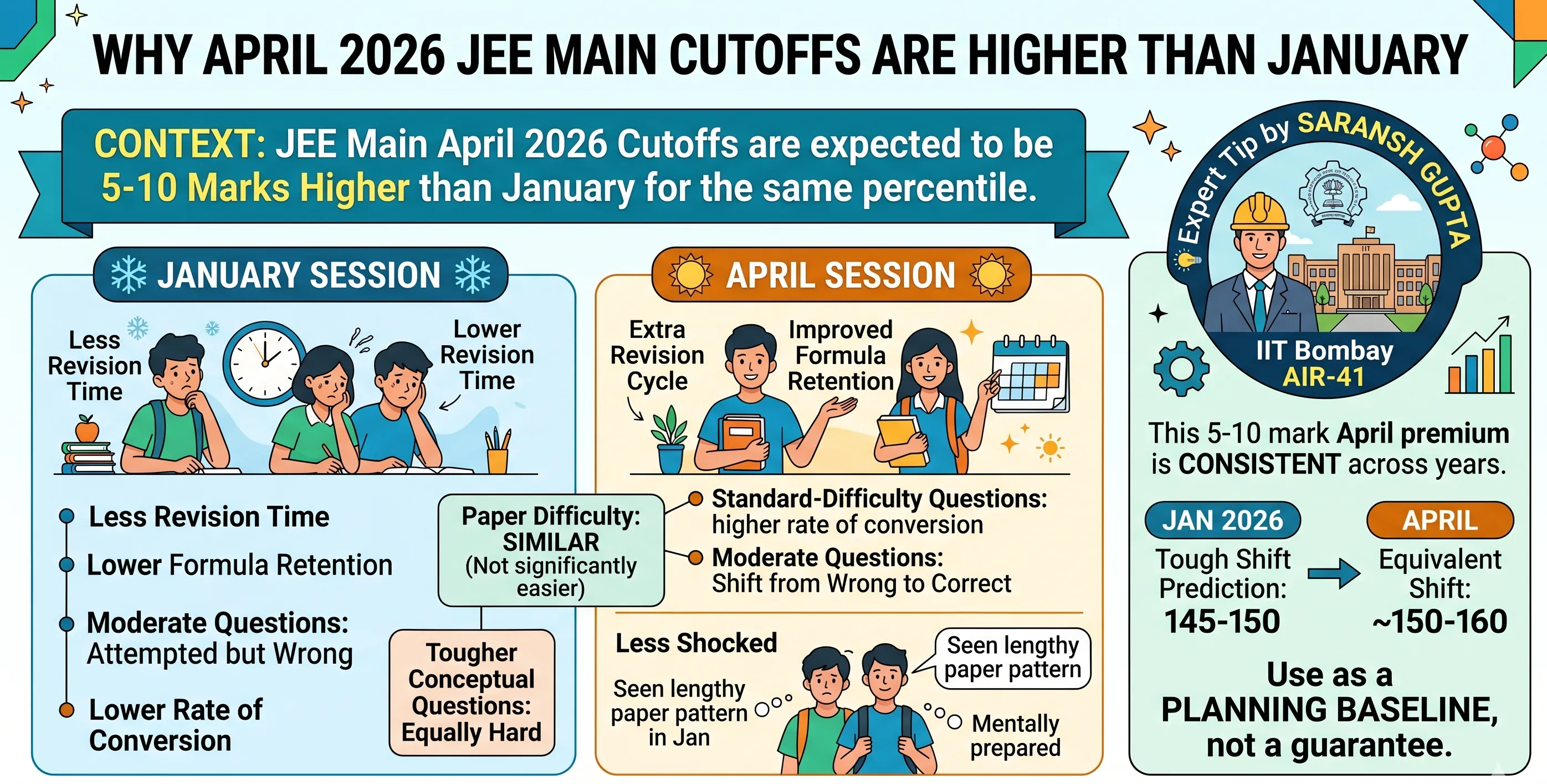
Shift-Wise Difficulty Ranking — All 9 Shifts Categorised
Based on data collected from thousands of students who uploaded their marks to the eSaral score calculator, all April 2026 shifts fall into three categories:
| Category | Shifts | What Made Them This Level |
|---|---|---|
| Toughest | April 6 Shift 1, April 8 Shift 2, April 4 Shift 1 | All three subjects are lengthy/tough; conceptual depth; JEE Advanced-level questions present |
| Tough | April 2 Shift 2, April 2 Shift 1, April 5 Shift 1 | Two subjects are very lengthy; one is doable, but not easy paper |
| Medium | April 6 Shift 2, April 5 Shift 2, April 4 Shift 2 | Physics is easier; Chemistry has fewer statement-based questions; Maths is doable but lengthy |
No shift in April 2026 fell into an "easy" category (200+ expected 99th percentile). That level of paper has not appeared this session.
Toughest Shifts: Expected 99 Percentile Marks
These three shifts had the greatest difficulty — all three subjects presented significant challenges simultaneously.
April 6 Shift 1 — Most Likely the Toughest
This shift had all three subjects in difficult-to-very-difficult territory. Questions were calculation-heavy, conceptually deep, and leaned toward JEE Advanced-style thinking rather than the standard JEE Main pattern.
Expected 99th percentile: 150–160 marks
If this had been a January shift, the 99th percentile would have been around 145. The April premium of 5–10 marks applies here.
April 8 Shift 2
This shift made a strong entry into the toughest category based on actual student score data. Initial post-exam analysis had placed it as moderate, but the real marks data revised it upward in difficulty.
Expected 99th percentile: 155–165 marks
April 4 Shift 1
Slightly less tricky on language compared to April 6 Shift 1, but chemistry was the differentiating factor — it was notably easier in this shift compared to the other two toughest shifts. This may push the 99th percentile 1–2 marks higher.
Expected 99th percentile: 155–168 marks
💡 Expert Tip by Saransh Gupta, IIT Bombay AIR-41: For the toughest shifts, even students who attempted only 15–18 questions in Physics and 12–13 in Maths could be in the 95th–99th percentile range if their accuracy was high. These were not papers where attempt count was the differentiator — accuracy on the questions you did attempt was everything.
Tough Shifts: Expected 99 Percentile Marks
These three shifts were difficult but not in the extreme category. Two subjects were very lengthy in each; one was relatively more doable.
| Shift | Expected 99th percentile |
|---|---|
| April 2 Shift 2 | 162–172 marks |
| April 2 Shift 1 | 163–173 marks |
| April 5 Shift 1 | 165–175 marks |
The gaps between these three shifts are minimal — they are very close in difficulty. In all three, two subjects consumed significantly more time, leaving the third subject under-attempted by most students regardless of preparation level.
Medium Shifts: Expected 99 Percentile Marks
Three shifts were categorised as medium difficulty — not easy, but more manageable than the toughest and tough categories.
What Made These Media?
- Physics was significantly more straightforward than in the toughest shifts
- Chemistry had fewer statement-based questions and less calculation-heavy content
- Maths was doable but still lengthy — trap questions were absent, unlike the toughest shifts
| Shift | Expected 99th percentile |
| April 6 Shift 2 | 170–185 marks |
| April 5 Shift 2 | 170–185 marks |
| April 4 Shift 2 | 170–185 marks |
These three shifts are closely clustered. Chemistry being easier in this group was the primary reason for the higher cutoff range compared to the other categories.
Complete Marks vs Percentile Table — JEE Main April 2026
This is the consolidated prediction table based on thousands of student data points from all shifts. These are data-based predictions, and the actual NTA result may vary by a small margin.
| Shift | Category | Expected 99 Percentile (Marks) |
|---|---|---|
| April 6 Shift 1 | Toughest | 150–160 |
| April 8 Shift 2 | Toughest | 155–165 |
| April 4 Shift 1 | Toughest | 155–168 |
| April 2 Shift 2 | Tough | 162–172 |
| April 2 Shift 1 | Tough | 163–173 |
| April 5 Shift 1 | Tough | 165–175 |
| April 6 Shift 2 | Medium | 170–185 |
| April 5 Shift 2 | Medium | 170–185 |
| April 4 Shift 2 | Medium | 170–185 |
Key reference point from January 2026 (verified):
- January 22 Shift 2 was predicted at 145–150 → actual result was in that range ✅
- Easiest January shift was predicted at 170–180 → came at 171 ✅
These predictions follow the same methodology. Accuracy from January 2026 was approximately 95%.
For a full understanding of how NTA calculates percentile scores using normalisation across shifts, refer to the official JEE Main exam pattern,n which explains the multi-shift scoring process.
Should You Take a Drop Year Based on These Marks?
Many students are now looking at their marks and asking this question. The honest answer:
If your marks are significantly below the 99th percentile range for your shift and your dream is a top IIT branch, a structured drop year is a legitimate, data-backed option.
Consider this: a student from eSaral's Warriors Batch came from a 1 lakh JEE Main rank and reached IIT Bombay in a single drop year. Another went from the 3 lakh rank to IIT Kharagpur. These are not exceptional cases — approximately 800 of eSaral's 1,550 IIT selections in 2025 were drop year students.
The key questions to ask:
- Did you genuinely give everything in Class 11 and 12, or were there structural gaps (backlogs, weak coaching, no mentorship)?
- Is your dream college genuinely out of reach this year based on your projected rank?
- Are you willing to commit 13 months of focused, mentored preparation?
If yes to all three, a drop year with the right structure can deliver the result.
🚀 Ready to Transform Your JEE Journey?
Join JEE Dropper Batch Now – Online & Offline Available
Start your focused drop year with structured mentorship, expert faculty, and a proven study system. Choose flexible online learning or classroom coaching, follow a disciplined plan, and maximize your chances of securing a top rank in JEE.
Use the JEE Main revision notes and JEE Main syllabus to start analysing your chapter-wise performance right now, regardless of what you decide.
Bookmark this page for updates when NTA releases the official result, and explore the JEE Main exam pattern to understand how your final percentile will be calculated across shifts..
Frequently Asked Questions
Find answers to common questions.
What marks are needed for 99 percentile in JEE Main April 2026?
In JEE Main April 2026, the expected marks for 99 percentile range from 150–160 in the toughest shifts (April 6 Shift 1, April 8 Shift 2) to 170–185 in medium-difficulty shifts (April 4, 5, and 6 Shift 2). April cutoffs are typically 5–10 marks higher than January because students are better prepared after an additional revision cycle.
Which was the toughest shift in JEE Main April 2026?
April 6 Shift 1 is predicted as the toughest shift in JEE Main April 2026, with an expected 99th percentile of 150–160 marks. April 8 Shift 2 (155–165) and April 4 Shift 1 (155–168) are close behind. In all three toughest shifts, all three subjects presented significant difficulty simultaneously — calculation-heavy, conceptually deep, and closer to JEE Advanced-style questions.
What is the expected 99th percentile for JEE Main April 6 Shift 2 2026?
The expected 99th percentile for JEE Main April 6 Shift 2 is 170–185 marks. This shift falls in the medium-difficulty category because Physics was relatively easier, Chemistry had fewer statement-based questions, and Maths was doable but lengthy without the trap questions seen in harder shifts.
Why are JEE Main April 2026 cutoffs higher than January 2026?
JEE Main April 2026 cutoffs are 5–10 marks higher than January because students have had one additional month of preparation and revision. Formula retention improves, and moderate-difficulty questions get converted at a higher rate. This April premium is consistent across years — it does not mean the paper was easier, just that students were better equipped.
How accurate are JEE Main marks vs percentile predictions?
eSaral's JEE Main marks vs percentile predictions are based on thousands of student data points uploaded to the score calculator after each shift. In January 2026, predictions were approximately 95% accurate — the toughest shift was predicted at 145–150, and the result matched; the easiest was predicted at 170–180 and came at 171. April 2026 predictions follow the same methodology.
What should I do if my JEE Main April 2026 marks are low?
If your JEE Main April 2026 marks are significantly below the99th9 percentile range for your shift, first use eSaral's score calculator for a 20-page analysis showing your exact strengths and weaknesses. Then evaluate whether a structured drop year is right for you — approximately 800 of eSaral's 1,550 IIT selections in 2025 were drop year students, including one who went from 1 lakh rank to IIT Bombay.