JEE Main April 8 Shift 2 Paper Analysis 2026: Difficulty, Cutoff & Subject-Wise Review
The JEE Main April 8 Shift 2 paper (2026) was moderate to difficult in overall feel, primarily because of its length. Physics had uniform chapter coverage with no single chapter dominating, making breadth of preparation crucial. Chemistry was statement-heavy but doable. Maths was the most time-consuming subject, with most students attempting only 12–13 questions.
Table of Contents


💡 Expert Tip by Saransh Gupta, IIT Bombay AIR-41: When a paper is "lengthy" instead of "hard," it punishes students who haven't practiced speed and accuracy together. In eSaral's Warriors Batch, we specifically design timed drills for this scenario — because NTA has been setting this trap consistently.
Physics Analysis: The Most Underrated Section
Was the Physics Paper Difficult?
Physics in this shift was uniformly distributed across chapters — no single chapter contributed a disproportionate number of questions. This means if you had a weak chapter, there was no escape. Your breadth of knowledge was tested, not just your depth.
Most students found that the questions were long and calculation-heavy. The answers weren't arriving quickly. Even students who typically score in the 98th–99th percentile reported attempting only 15 to 18 questions out of 30.
Why Physics Will Surprise Everyone with the Results
This is the section that experts are calling the most underrated of this shift. Right now, students may feel they "did okay" because nothing in Physics felt shockingly unfamiliar. But when results come:
- Students expecting 99 percentile in Physics may score lower than expected
- The 99th percentile threshold in Physics for this shift is likely 65–70 marks
| Metric | Observation |
|---|---|
| Chapter Distribution | Uniform — all chapters covered |
| Question Length | Long, calculation-intensive |
| Average Student Attempts | 15–18 out of 30 |
| Expected 99%ile Marks | 65–70 |
Expert Tip: A uniform Physics paper is tougher because you can't compensate for weak areas. Cover the entire JEE Main syllabus — not just important chapters.
Join JEE Dropper Batch Now – Online & Offline Available
Start your focused drop year with structured mentorship, expert faculty, and a proven study system. Choose flexible online learning or classroom coaching, follow a disciplined plan, and maximize your chances of securing a top rank in JEE.
Chemistry Analysis: Statement-Heavy But Doable
What Made Chemistry Lengthy?
Chemistry in this shift had an unusually high number of statement-based questions. This is not new — NTA has been increasing statement questions over the past several sessions, and students have largely adapted to them. But adapting doesn't mean fast. It means careful reading, which eats time.
The section was doable — no shocking or out-of-syllabus questions. Most students who prepared with standard material could work through it. But the time it demanded was significant.
Chemistry Attempt Numbers
Students generally managed 22–24 Chemistry questions, notably more than Physics. That said, statement-based questions carry a high risk of silly mistakes. Reading two statements carefully, matching options, and avoiding reversals takes focus.
| Metric | Observation |
|---|---|
| Question Type | Heavily statement-based |
| Time Required | 45–50 minutes |
| Average Student Attempts | 22–24 out of 30 |
| Expected 99%ile Marks | 65–70 |
The Chemistry section alone consumed roughly 45 to 50 minutes for most students, which directly squeezed time available for Maths.
Maths Analysis: Time Was the Real Enemy
How Was the Maths Paper?
Maths was lengthy — consistent with the current trend of JEE Main papers. There were no unusual surprises in Maths. The chapter coverage was balanced, and questions followed expected patterns.
The problem? By the time students reached Maths — after spending 50 minutes on Physics and 45–50 minutes on Chemistry — very little time remained. The result: most students attempted only 12–13 Maths questions. Even well-prepared students left the Maths section partially incomplete.
Subject Comparison Table
| Subject | Difficulty | Time Needed | Avg. Attempts | 99%ile Marks |
|---|---|---|---|---|
| Physics | Moderate-Hard | ~50–60 min | 15–18 | 65–70 |
| Chemistry | Moderate | ~45–50 min | 22–24 | 65–70 |
| Maths | Lengthy | ~40–50 min | 12–13 | 50–55 |
Maths is expected to have a lower 99th percentile threshold — around 50–55 marks — precisely because attempts were low across the board.
For a full breakdown of the JEE Main exam pattern and how sections are marked, refer to eSaral's official pattern guide.
How Many Questions Should You Have Attempted?
This is the question every student is asking right now. Here's an honest benchmark from faculty who've analyzed the paper:
- Physics: 15–18 attempts = solid performance for this shift
- Chemistry: 22–24 attempts = on par with peer performance
- Maths: 12–13 attempts = acceptable given time constraint
If you attempted more than these numbers with reasonable accuracy, you are likely in a strong position for this shift. If you attempted fewer, focus on analyzing where the time went — and work on speed during revision using JEE Main revision notes.
Expected 99 Percentile Score — Subject-Wise and Overall
Overall 99 Percentile Prediction
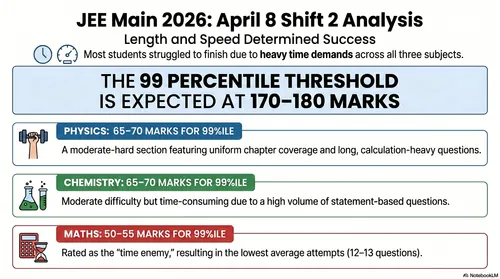
Given that this was a moderate-to-lengthy shift, the overall 99th percentile is expected to fall in the range of 170–180 marks. It is unlikely to exceed 180, given the time pressure and attempt counts.
This is consistent with similar lengthy shifts in JEE Main history. Long papers suppress top-end scores — which compresses the 99 percentile threshold downward.
Subject-Wise 99 Percentile Estimates
| Subject | Expected 99 Percentile Marks |
|---|---|
| Physics | 65–70 |
| Chemistry | 65–70 |
| Maths | 50–55 |
| Overall | 170–180 |
These are predictions based on student feedback and faculty analysis — the official NTA result will confirm the actual percentile distributions. Historically, eSaral's predictions have been within 5–8 marks of actual cutoffs.
Understand your performance better with a detailed marks vs percentile analysis for JEE Main 2026.
Bookmark this page for updated cutoff data as NTA releases official results. Also, explore eSaral's JEE Main revision notes and JEE Main exam pattern guide for structured post-exam preparation.
Frequently Asked Questions
Find answers to common questions.
What is the expected 99th percentile score for JEE Main April 8 Shift 2 2026?
The expected 99th percentile for JEE Main April 8 Shift 2 is 170–180 marks overall. Subject-wise, Physics and Chemistry are each expected to require 65–70 marks for 99 percentile, while Maths is lower at 50–55 marks due to reduced attempts caused by time pressure.
How many questions should I have attempted in JEE Main April 8 Shift 2?
For this shift, 15–18 attempts in Physics, 22–24 in Chemistry, and 12–13 in Maths reflect typical performance among well-prepared students. If you matched or exceeded these numbers with reasonable accuracy, your performance is on par with peers aiming for the 95th–99th percentile range.
Was Chemistry easy or hard in JEE Main April 8 Shift 2?
Chemistry was doable but time-consuming in JEE Main April 8 Shift 2. The paper had a high number of statement-based questions, which are not difficult conceptually but require careful reading. Most students spent 45–50 minutes on Chemistry, which directly reduced the time available for Maths.
Why did students attempt fewer Maths questions in JEE Main April 8 Shift 2?
Time was the primary reason fewer Maths questions were attempted in JEE Main April 8 Shift 2. Physics and Chemistry each consumed 45–60 minutes, leaving insufficient time for Maths. Most students could only attempt 12–13 Maths questions, which is why the expected 99th percentile in Maths for this shift is lower at 50–55 marks.
Will the JEE Main April 8 Shift 2 Physics result surprise students?
Yes — Physics in this shift is likely the most underrated section. Because questions were long and chapter coverage was uniform, even strong students attempted only 15–18 questions. When results are declared, many students expecting a high Physics percentile may find their scores lower than anticipated. The 99th percentile in Physics for this shift is expected at 65–70 marks.