JEE Main 2026 Exam Pattern (Revised) - Changed Paper Pattern, Number of Questions, Marking Scheme
JEE Mains & Advanced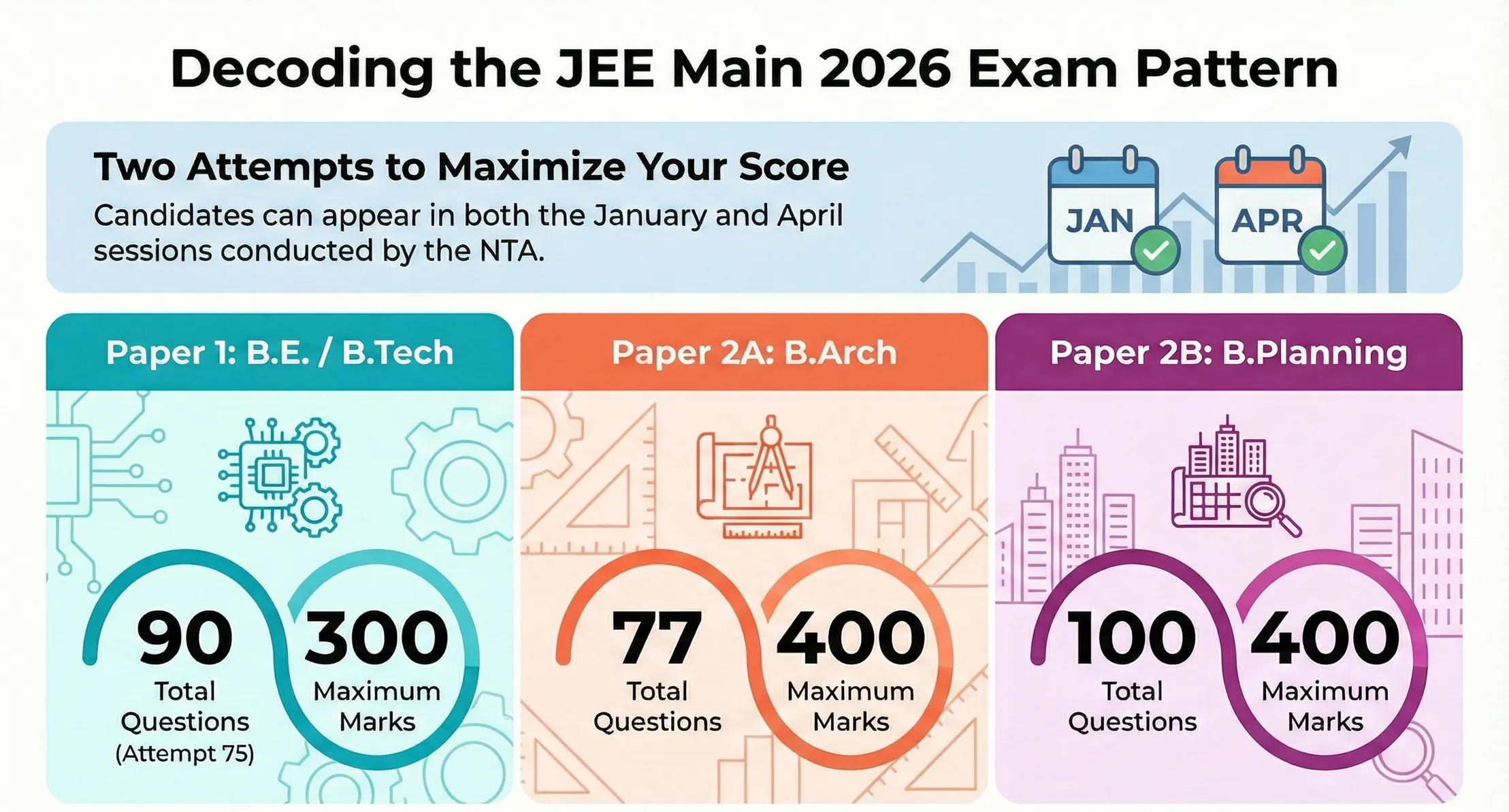

"Bhai, JEE Main 2026 ka exact pattern kya hai? Kitne questions attempt karne hain? Kya negative marking change hui hai?"
If these questions are running in your mind right now, then you've landed at the right place. clarity is not just important – it's the foundation that decides whether your preparation hits the target or misses completely.JEE Main 2026 exam pattern
Here's what you need to know upfront:
JEE Main 2026 will have two attempts – January and April sessions conducted by NTA. The structure remains familiar with three papers: Paper 1 for B.E./B.Tech, Paper 2A for B.Arch, and Paper 2B for B.Planning aspirants. The pattern follows the established framework from recent years, giving you a stable preparation roadmap.
But here's the critical part:
Paper 1 (B.E./B.Tech) presents 90 questions but you attempt only 75 worth 300 marks across Physics, Chemistry, and Mathematics [-4]. Paper 2A (B.Arch) contains 77 questions for 400 marks, while Paper 2B (B.Planning) has 100 questions also worth 400 marks.
Why this matters for your JEE 2026 strategy:
Every mark counts when lakhs of students compete for limited engineering seats. Knowing the exact question distribution, marking scheme changes, and paper structure helps you plan your 3-hour battle strategy effectively. To convert this exam pattern knowledge into marks, you must practice JEE Main Important Questions that are aligned with the latest paper structure and marking scheme. Solving these questions helps you understand how concepts are actually tested in the real exam.
This blog breaks down every single detail of the JEE Main 2026 exam pattern – the revised marking rules, question types, paper-wise breakup, and strategic insights to maximize your score. Whether you're targeting NIT, IIIT, or using this as your JEE Advanced qualifier, these specifics will shape how you approach each section.
Ready to decode the complete pattern? Let's dive in.
JEE Main 2026 Exam Pattern Overview
Let's get the facts straight about JEE Main 2026 structure. No confusion, no guesswork – just the exact blueprint you need to plan your attack strategy.
What is JEE Main and who conducts it?
JEE Main is your gateway to engineering dreams. Period.
This single exam determines your entry into NITs, IIITs, and all other Centrally Funded Technical Institutions (CFTIs) across India. But that's not all – JEE Main is also your qualifying ticket for JEE Advanced, which opens the doors to IITs.
Who's running the show?
Since 2019, the National Testing Agency (NTA) conducts JEE Main. Before that, CBSE handled it till 2018. NTA was created by the Ministry of Education as an independent, autonomous testing body. Their job? Conduct efficient, transparent, internationally standardized tests for admission to premier institutions.
Bottom line: NTA controls your JEE Main destiny. They set the rules, you follow them to win.
Number of sessions and papers
Two shots at success – that's what JEE Main 2026 gives you. January and April mean you get a second chance to improve your rank.two sessions
Mark your calendar:
· Session 1: January 21-30, 2026
· Session 2: April 2-9, 2026
Three papers, three different paths:
Paper 1 (B.E./B.Tech): Your route to engineering colleges. Physics + Chemistry + Mathematics = 75 questions out of 90 provided, worth 300 marks total.
Paper 2A (B.Arch): For future architects. Mix of CBT mode (Mathematics + Aptitude) + offline Drawing Test. 77 questions carrying 400 marks.
Paper 2B (B.Planning): Urban planning aspirants. Fully CBT mode with Mathematics, Aptitude, and Planning sections. 100 questions worth 400 marks.
Time breakdown:
· 3 hours per paper
· 3.5 hours if you're brave enough to attempt both B.Arch and B.Planning
· PwD candidates get 4 hours
Language flexibility: 13 options including English, Hindi, and 11 regional languages. Choose what makes you most comfortable.
Link to JEE Main 2026 exam pattern PDF download
Official source = zero confusion.
Head to jeemain.nta.nic.in for the complete JEE Main 2026 exam pattern. Download the official syllabus PDF directly from NTA. This document contains everything – structure, marking scheme, complete syllabus breakdown.
Download the for comprehensive JEE Main 2026 preparation resources and real-time exam pattern updates.eSaral app
Here's how your final score works: NTA merges your Paper 1 scores from both January and April sessions to create the final Merit List/Ranking. Your better attempt counts – that's the beauty of the dual-session system.
Translation: Screw up in January? April is your redemption.
Paper 1: B.Tech Exam Pattern Explained
Paper 1 is where the real battle begins for engineering aspirants. This is your ticket to NITs, IIITs, and CFTIs – plus your qualifying round for JEE Advanced.
The structure is designed to test two things:
· Your conceptual clarity across PCM
· Your problem-solving speed under pressure
Let's decode every component you need to master.
Subjects Covered: Physics, Chemistry, Mathematics
Equal weightage = Equal attention required.
Each subject contributes exactly 100 marks to your final 300-mark total. This balanced distribution means you can't afford to be weak in any single subject. Your rank depends on PCM performance combined, not individual subject strength.
The syllabus covers [Classes 11 and 12] topics – the foundation for all engineering concepts. No shortcuts here. Every chapter from both classes can appear in your paper.
Section A vs Section B: Your Question Strategy
Each subject divides into two sections with different question types:
Section A: 20 MCQs per subject
· Four options, one correct answer
· Tests conceptual understanding
· Strategy: Eliminate wrong options, guess intelligently if needed
Section B: 5 Numerical Questions per subject
· Direct numerical answers, no options
· Tests calculation accuracy
· Critical change: All 5 questions are compulsory – no option to choose 5 out of 10 anymore
This change makes Paper 1 tougher. You can't skip difficult numerical questions now. Every topic becomes equally important.
Total Questions and Marks Breakdown
Your attempt pattern for [JEE Main Paper] 1:
· Physics: 25 questions (20 MCQs + 5 numerical) = 100 marks
· Chemistry: 25 questions (20 MCQs + 5 numerical) = 100 marks
· Mathematics: 25 questions (20 MCQs + 5 numerical) = 100 marks
Total: 75 questions, 300 marks
Each question carries +4 marks for correct answers. But here's the catch: -1 mark penalty applies to both MCQs and numerical questions. Wrong answers hurt your rank directly.
Time Duration and Exam Mode
3 hours (180 minutes) for 75 questions in Computer-Based Test (CBT) mode. That gives you 2.4 minutes per question on average.
Time management becomes critical:
· Spend more time on high-accuracy subjects
· Don't get stuck on single tough questions
· Keep 15-20 minutes for final review
PwD candidates get 4 hours (240 minutes), providing adequate time for those who need it.
The exam runs in multiple languages including English, Hindi, and 11 regional languages, so language barriers shouldn't affect your performance.
Strategic takeaway: Paper 1 rewards both speed and accuracy. Practice timed tests regularly to build exam stamina. Along with mock tests, practicing JEE Main important questions for exam practice chapter-wise will sharpen accuracy and reduce negative marking under the new +4/-1 scheme.
Paper 2A: B.Arch Exam Pattern Breakdown
B.Arch aspirants, listen up.
Paper 2A is not your typical engineering exam. This is where technical knowledge meets creative vision – and the JEE Main 2026 exam pattern reflects exactly that challenge.
Unlike Paper 1's pure PCM focus, B.Arch testing demands both analytical thinking and artistic ability. You'll face computer screens for calculations and physical drawing sheets for creativity. This dual format isn't coincidence – it's designed to identify students who can think like engineers and visualize like architects.
Mathematics and Aptitude Test (CBT)
Mathematics section: 20 MCQs + 5 numerical questions, following the same Class 11-12 syllabus as B.Tech paper. Each right answer = +4 marks, each wrong answer = -1 mark. Standard JEE Main math, but with fewer questions to accommodate other sections.
Aptitude Test: This is where things get interesting. 50 MCQs worth 200 marks total – the highest weightage section in your entire B.Arch paper.
What does Aptitude Test actually check?
· and spatial reasoningThree-dimensional perception
· Awareness of famous buildings, architects, materials
· Color perception and geometric understanding
· Analytical capabilities specific to architectural thinking
Pro tip: Don't treat this as "general knowledge." These questions test whether you think like an architect – visualizing spaces, understanding proportions, recognizing design elements.
Drawing Test (Offline)
Here's where B.Arch gets real.
Physical pen-and-paper format – no computer, no options, just you and a blank sheet. Bring your own pencils, geometry box, colored pencils, and crayons. The exam center provides A4 sheets.
What you'll sketch:
· Urbanscapes: markets, street scenes, public spaces, festivals
· Landscapes: gardens, trees, riverfronts
· Rural life scenarios
The key word here is "from memory." You're not copying from reference – you're demonstrating your visual memory and freehand drawing ability.
Total Structure: 77 Questions, 400 Marks
Complete B.Arch breakdown:
· Mathematics: 25 questions (20 MCQs + 5 numerical) → 100 marks
· Aptitude: 50 MCQs → 200 marks
· Drawing: 2 questions → 100 marks (50 each)
Time allocation: 3.5 hours for general candidates, 4 hours for PwD students.
Strategic insight: Notice that Aptitude carries double the weight of Math or Drawing. Many B.Arch aspirants focus heavily on drawing practice while neglecting aptitude preparation – that's a costly mistake.
Key Changes in Drawing Section
Major update for 2026: Drawing questions reduced from 3 to just 2 questions.
What this means for you:
· Each drawing now carries 50 marks instead of 33.33 marks
· Less quantity, more quality expected
· Focus on proportional accuracy and 3D visualization
· Detailed shading and shadowing become more critical
Evaluation criteria:
· Proportional accuracy
· Perspective understanding
· Shading and depth creation
· Overall visualization skills
The examiners aren't looking for artistic masterpieces – they want to see if you can translate 3D ideas onto 2D paper with technical accuracy.
Bottom line: B.Arch isn't just about being "good at drawing." It's about spatial intelligence, technical knowledge, and creative expression working together. Train accordingly.
Paper 2B: B.Plan Exam Pattern Details
B.Planning aspirants, listen up. Paper 2B is your gateway to urban planning careers, and the 2026 pattern has some critical updates you cannot afford to miss.
The reality: Most students underestimate Paper 2B because they think "planning = easy." Wrong. This paper demands both technical precision and analytical thinking across three distinct areas.
Mathematics, Aptitude, and Planning sections
Paper 2B tests you across three sections, each targeting specific skills urban planners need:
Mathematics section uses the same syllabus as B.Tech but with different distribution. You get 20 MCQs + 5 numerical questions worth 100 marks. For numericals, you'll input integer values using the on-screen virtual keypad.
Aptitude section carries maximum weight – 50 MCQs worth 200 marks. This section evaluates spatial visualization, analytical reasoning, and 3D perception skills. These aren't random questions; they test abilities you'll actually use in planning projects.
Planning section contains 25 MCQs worth 100 marks. This specialized portion tests urban development awareness, government programs knowledge, and analytical thinking. The planning section covers general awareness, social science knowledge, and analytical skills directly related to urban planning concepts.
Key insight: The Aptitude section decides your rank more than Math or Planning. Master spatial visualization first.
All sections conducted in CBT mode
Unlike B.Arch candidates who face offline drawing tests, your entire Paper 2B happens on computer. This means faster results processing and consistent evaluation standards.
The exam interface provides specific tools for both MCQs and numerical questions. Plus, you can attempt the paper in English, Hindi, or any of the 11 regional languages.
Total number of questions and marks
Paper 2B breakdown is straightforward:
· Mathematics: 25 questions (20 MCQs + 5 numerical) = 100 marks
· Aptitude: 50 MCQs = 200 marks
· Planning: 25 MCQs = 100 marks
· Total: 100 questions = 400 marks
Time allocation: 3 hours for general candidates, 4 hours for PwD candidates.
New updates in planning section
Major change alert: All 5 numerical questions in Mathematics are now compulsory. The previous system allowed choosing 5 out of 10 questions.
Marking scheme update: +4 marks for correct answers, -1 mark for wrong answers across all sections. This includes both MCQs and numerical questions in Mathematics.
Planning section emphasis shift: Greater focus on map reading skills, chart interpretation, and quantitative reasoning. These changes align with modern urban planning demands and professional practice requirements.
Bottom line: Paper 2B rewards precision and penalizes guesswork. Master your concepts, practice numerical accuracy, and stay updated with urban development trends.
Marking Scheme and Key Changes in 2026
The marking mechanics of JEE Main 2026 will make or break your rank. Here's exactly what you need to know.
The New Scoring Reality: +4/-1 Across All Questions
JEE Main 2026 follows a uniform scoring system that rewards accuracy over guesswork. Every correct answer—whether MCQ or numerical—gives you +4 marks. This applies to all three papers: B.E./B.Tech, B.Arch, and B.Planning.
But here's the game-changer:
Now Applies to EverythingNegative marking
The biggest shift in JEE Main 2026 is the universal application of negative marking. Every wrong answer costs you -1 mark. This includes numerical questions where negative marking wasn't applied earlier.
The math is simple:
· Right answer = +4 marks
· Wrong answer = -1 mark
· No attempt = 0 marks
Strategic implication: Random guessing will hurt your percentile more than leaving questions blank.
What's Actually Changed from Previous Years
Two major shifts will impact your preparation strategy:
Change 1: No More Optional Questions
All five numerical questions in Section B are now compulsory [232]. Gone are the days when you could pick 5 out of 10 questions. This means you can't skip tough numerical problems anymore.
Change 2: Universal Negative Marking
Numerical questions now carry -1 penalty for wrong answers. Earlier, students could attempt numerical questions without fear of losing marks.
What this means for your strategy:
· You need strong conceptual clarity in all topics
· Speed with accuracy becomes more critical
· Test analysis and mistake identification matter more than ever
Language Flexibility Remains Strong
JEE Main 2026 continues to offer 13 language options: English, Hindi, Assamese, Bengali, Gujarati, Kannada, Malayalam, Marathi, Odia, Punjabi, Tamil, Telugu, and Urdu.
Download the eSaral app to stay updated with all JEE Main 2026 exam pattern changes and access detailed marking schemes.
Bottom line: The new marking scheme demands precision over speed. Every question you attempt must have a strong probability of being correct. Plan your attempt strategy accordingly.
Your JEE Main 2026 Battle Plan Starts Now
You now have the complete JEE Main 2026 exam pattern roadmap. Three papers, different structures, one goal – getting into your dream engineering or architecture college.
The reality check:
Paper 1 (B.Tech): 75 questions, 300 marks, PCM focus
Paper 2A (B.Arch): 77 questions, 400 marks, includes drawing test
Paper 2B (B.Planning): 100 questions, 400 marks, full CBT mode
The marking scheme truth:
Every correct answer = +4 marks
Every wrong answer = -1 mark (yes, even numericals now)
No more optional questions – all 5 numericals are compulsory
What this means for your preparation:
Precision beats speed. Quality practice beats quantity. Smart strategy beats random grinding.
The dual-session structure gives you two shots at your target score. Use the first attempt to understand exam pressure, use the second to maximize your rank.
Download the eSaral app for complete JEE Main 2026 preparation – updated patterns, mock tests, and expert guidance that actually works.
Your goal is not just clearing JEE Main. Your goal is:
· NIT admission through JEE Main rank
· JEE Advanced qualification (if targeting IIT)
· Architecture/Planning college admission
The pattern is clear. The marking scheme is defined. The competition is real.
What's left?
Execution. Daily grind. Smart practice. Consistent improvement.
From today, every question you solve, every test you attempt, every mistake you analyze – align everything with this exact pattern structure.
Your rank depends on how well you understand these 75/77/100 questions on exam day. Not on how many hours you studied, but on how strategically you prepared.
The clock is ticking. The pattern is set. Your preparation starts now. 🔥
Time to convert this knowledge into rank. Time to turn these 3 hours into your engineering college admission ticket.
All the best, beta. Go make these pattern details work for you. 💪🔥
Key Takeaways
Understanding the JEE Main 2026 exam pattern is essential for strategic preparation and maximizing your chances of success in this competitive engineering entrance test.
• JEE Main 2026 offers two sessions (January and April) with three papers: Paper 1 for B.Tech (75 questions, 300 marks), Paper 2A for B.Arch (77 questions, 400 marks), and Paper 2B for B.Planning (100 questions, 400 marks).
• The revised marking scheme applies +4 marks for correct answers and -1 mark for incorrect responses across all question types, including numerical questions where negative marking was previously absent.
• All numerical questions in Section B are now compulsory - the option to choose 5 out of 10 questions has been eliminated, requiring comprehensive preparation across all topics.
• Paper 2A (B.Arch) uniquely combines computer-based testing for Mathematics and Aptitude with an offline Drawing Test, while Paper 2B (B.Planning) is conducted entirely in CBT mode.
• The exam is available in 13 languages and conducted by NTA, with your best score from both sessions counting toward final rankings for admission to NITs, IIITs, and other premier institutions.
Strategic preparation aligned with these pattern changes, combined with consistent practice and conceptual clarity, will significantly improve your performance in this gateway examination to India's top engineering and architecture programs.
FAQs
Q1. How many questions are there in JEE Main 2026?
The number of questions varies by paper. Paper 1 (B.Tech) has 75 questions, Paper 2A (B.Arch) has 77 questions, and Paper 2B (B.Planning) has 100 questions.
Q2. What is the exam pattern for JEE Main 2026?
JEE Main 2026 consists of three papers: Paper 1 for B.Tech, Paper 2A for B.Arch, and Paper 2B for B.Planning. Each paper has different sections covering subjects like Physics, Chemistry, Mathematics, Aptitude, and Planning, depending on the course.
Q3. Is there negative marking for numerical questions in JEE Main 2026?
Yes, there is negative marking for both MCQs and numerical questions in JEE Main 2026. Each incorrect answer results in a deduction of 1 mark.
Q4. What is the total marks for JEE Main 2026 Paper 1?
JEE Main 2026 Paper 1 (B.Tech) is worth a total of 300 marks, with each subject (Physics, Chemistry, and Mathematics) contributing 100 marks.
Q5. In how many languages is JEE Main 2026 offered?
JEE Main 2026 is offered in 13 languages, including English, Hindi, and 11 regional languages to accommodate candidates from diverse linguistic backgrounds across India.