NEET 2026 Paper Analysis: Difficulty Level, Expected Cut Off & AIR 1 Prediction
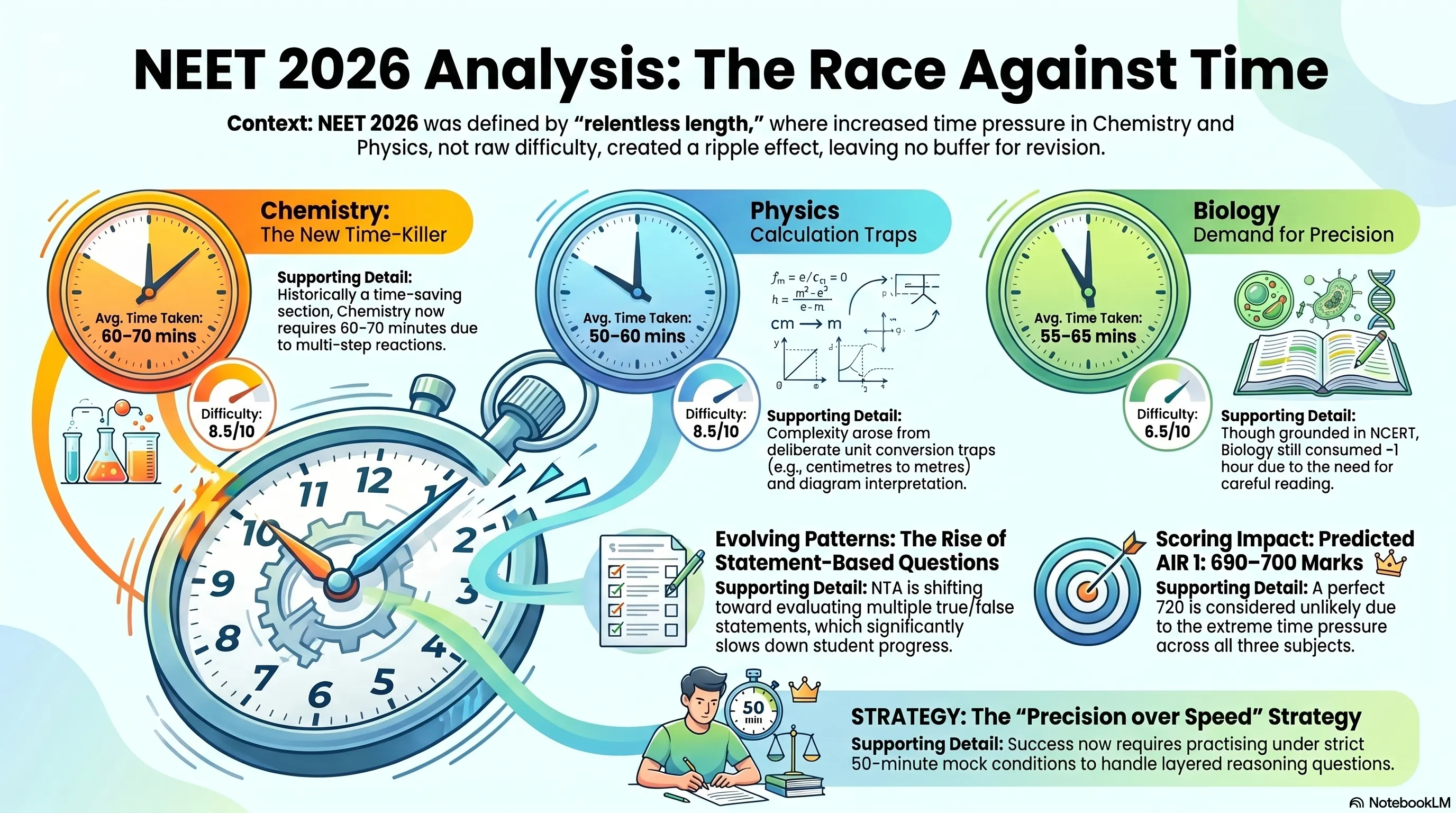
NEET 2026 was a lengthy, calculation-heavy paper. Chemistry consumed the most time — over 60 minutes for most students — while Physics was tough but slightly easier than NEET 2025. Biology offered relief but still took around an hour. AIR 1 is expected between 690–700 marks. A 50,000 rank is predicted around 480–490 marks based on this year's difficulty level.
Table of Contents

eSaral › NEET ›NEET 2026 Paper Analysis

Overall Paper Overview — Was NEET 2026 Tough?
NEET 2026 was not impossible — but it was relentlessly lengthy. NTA has once again pushed the boundaries of time management with a paper that demanded precision, speed, and mental stamina across all three subjects.
Most students who appeared reported that the total time pressure felt similar to NEET 2025, even though the raw difficulty was slightly lower. The reason? Each section independently consumed 60+ minutes, leaving almost no buffer for revision or second attempts on skipped questions.
💡 Expert Note from eSaral Academic Team: The 2026 paper mirrors NTA's emerging pattern — statement-based questions, diagram interpretation, and tricky unit conversions. Students who practised these question types in mock tests fared significantly better.
Here is a quick snapshot of the overall difficulty profile:
| Subject | Difficulty (1–10) | Avg. Time Taken | Key Challenge |
|---|---|---|---|
| Chemistry | 8.5/10 | 60–70 minutes | Lengthy reactions, tricky mechanisms |
| Physics | 8.5/10 | 50–60 minutes | Statement-based Qs, unit traps |
| Biology | 6.5/10 | 55–65 minutes | Detailed but doable |
| Overall | 8/10 | ~3 hours full | Time management |
The combined effect was that students spent most of their time on Chemistry, which then cascaded into insufficient time for Physics, causing more questions to be left unattempted than the difficulty level alone would suggest.
Chemistry Analysis — The Real Time-Killer
Why Did Chemistry Take Over an Hour?
Chemistry in NEET 2026 completely defied expectations. Going in, most students expected Chemistry to be the section that buys them back time — the reliable 45-to-50-minute section that has historically been quicker. That equation flipped in 2026.
Students scoring in the 490–516 range in previous attempts — those who were borderline qualifiers for AIIMS — reported spending 60 to 70 minutes on Chemistry alone. The questions were not impossible in isolation, but their length and layered reasoning demanded far more processing time than usual.
What Made Chemistry Difficult?
The specific challenges included multi-step reaction mechanisms that required students to trace pathways carefully rather than recall a single answer. Organic Chemistry questions in particular had longer setups. Inorganic questions were detail-heavy, demanding chapter-level mastery rather than quick pattern recognition.
💡 Expert Tip from eSaral Academic Team: For NEET 2027 aspirants, the message is clear — do not treat Chemistry as your time-saving subject anymore. Practise solving Chemistry under strict 50-minute mock conditions so the 2026 pattern does not catch you off-guard. Review NEET Chemistry weightage to prioritise the right chapters.
The ripple effect of Chemistry's time demand was significant. Students came out of Chemistry mentally tired and time-depleted, directly reducing the quality of their Physics attempts.
Physics Analysis — How Did It Compare to 2025?
NEET 2026 Physics vs NEET 2025 Physics
NEET 2025 Physics was widely considered the most difficult Physics section in recent NEET history. On a scale of 10, NEET 2025 Physics scores a 10. NEET 2026 Physics scores approximately 8.5 — still very hard, but marginally more manageable.
The key difference is that 2026 Physics was not unpredictably weird — it was methodically demanding. Students who had solid conceptual foundations could work through it. The problem was time, not comprehension.
Three Defining Features of NEET 2026 Physics
Statement-based questions appeared in significant numbers. These require students to evaluate multiple true/false statements, which is inherently slower than direct application questions.
Diagram-based questions also featured prominently. Reading and interpreting a diagram under exam pressure is time-consuming — and NTA designed these carefully.
Calculation traps through unit conversion were the third major element. Units were deliberately varied — centimetres instead of metres, picofarads instead of farads — to catch students who auto-pilot their calculations. Every number had to be checked before plugging into a formula.
| Question Type | Approx. Count | Difficulty |
|---|---|---|
| Statement-based | High | High |
| Diagram-based | Moderate-High | Moderate |
| Calculation-heavy (tricky units) | High | High |
| Straightforward application | Low | Low-Moderate |
For future preparation, practise statement-based questions from NEET previous year question papers — they are increasingly predictive of NTA's evolving style.
🚀 Ready to Transform Your NEET Journey?
Join NEET Dropper Batch Now – Online & Offline Available
Start your focused drop year with structured mentorship, expert faculty, and a proven study system. Choose flexible online learning or classroom coaching, follow a disciplined plan, and maximise your chances of securing a top rank in NEET and getting into top medical colleges like AIIMS.
Biology Analysis — Did It Save Students?
Biology Was Manageable — But Not Fast
Biology gave students the most relief of the three subjects in NEET 2026. The questions were grounded in NCERT — detailed, yes, but fair. Students who had read the NCERT thoroughly felt confident about the majority of questions.
However, "manageable" does not mean "quick." Biology still consumed approximately 55–65 minutes for most students. The questions required careful reading and recall of specific details — the kind of precision that NCERT demands at every line.
What Biology Did Right (and Wrong)
The positive: the questions were not designed to trick students through ambiguity. They tested genuine knowledge. Students who had prepared for Biology seriously felt that this section rewarded their effort.
The negative: the time it took. With Chemistry already having eaten into reserves, Biology arriving as an equally time-consuming section left no room to breathe. Students who budgeted only 45 minutes for Biology found themselves scrambling.
💡 Expert Tip from eSaral Academic Team: NCERT line-by-line reading is not optional for NEET Biology — it is the strategy. Every single question in Biology can be traced to an NCERT line or diagram. Do not rely on notes alone; read the source.
Expected AIR 1 Marks in NEET 2026
Will Anyone Score 720 in NEET 2026?
The short answer: almost certainly not. The paper's length alone makes a perfect score extremely unlikely. To score 720, a student would need to answer every single question correctly within the time limit — a task that even top scorers found pressured in 2026.
Expected AIR 1 range: 690 to 700 marks.
This estimate is based on the combined time pressure across all three sections, the difficulty of Physics (statement-based and diagram-heavy), and the fact that even high-scoring students (490–516 range) reported running out of time.
| Rank Range | Expected Marks (Approx.) |
|---|---|
| AIR 1 | 690–700 |
| AIR 100 | 670–685 |
| AIR 500 | Last year's 500-rank marks + ~15 |
| AIR 1000 | Last year's 1000-rank marks + ~12 |
| AIR 10,000 | Last year's 10,000-rank marks + ~10 |
Note: These are estimates based on student feedback and difficulty comparison. Official cut-off marks will be released by NTA after the results.
NEET 2026 Expected Cut Off — Rank-Wise Prediction
How Is the cut-off estimated?
The NEET cut-off depends on the total number of candidates, the difficulty level of the paper, and the number of available MBBS seats. In 2026, with a lengthy paper reducing average scores, the cut-off for most rank brackets is expected to trend slightly lower than a straightforward paper would produce — but only marginally.
For 50,000 rank, add approximately 10–15 marks to last year's marks at the same rank. The exact figure depends on final NTA data, but this rough guide gives you a working estimate.
For AIIMS Delhi, expect marks in the range of 680+ given the overall difficulty profile.
💡 Expert Note: Do not make college decisions based on pre-result estimates. Wait for NTA's official answer key, challenge it if needed, and then work from the actual score. Review the NEET exam pattern to understand how marking affects your final tally.
What If Your Exam Did Not Go Well?
If the paper did not go the way you hoped, this is not the end. Many students who have cracked AIIMS Delhi and other top AIIMS institutions took a gap year to strengthen their preparation. The difference between a rank of 5,000 and a rank of 500 often comes down to 12–15 marks — and that gap is absolutely closeable in one year of focused work.
What Should Droppers Do Now?
The Case for a Strategic Gap Year
If you are considering appearing for NEET 2027, the approach you take in the next 12 months will determine everything. A gap year is not a setback — it is an investment, provided it is structured.
The key principles for a productive drop year:
- Diagnose, then fix. Identify exactly which chapters cost you marks — do not guess. Use OMR analysis or go question by question through your paper once the answer key is released.
- Rebuild weak chapters from zero. Do not patch weaknesses. Rebuild them from the foundation using NCERT and then problem-solving.
- Add time management training. NEET 2026 was as much a time-management test as a knowledge test. Mock tests under strict time conditions are non-negotiable.
- Chemistry deserves the most time redistribution. Based on 2026's pattern, Chemistry timed practice is where most students will gain the most marks.
- Attempt previous year papers from NEET 2023, NEET 2022, NEET 2021, and older years to build pattern awareness.
eSaral's Warrior Batch for NEET 2027 is designed specifically for students seeking structured, IIT-faculty-led preparation that has helped students secure admission to AIIMS Delhi, AIIMS Jodhpur, AIIMS Bhopal, AIIMS Patna, and AIIMS Gorakhpur. Thousands of students have improved their rank by hundreds of thousands of positions through this programme.
🚀 Ready to Transform Your NEET Journey?
Join NEET Dropper Batch Now – Online & Offline Available
Start your focused drop year with structured mentorship, expert faculty, and a proven study system. Choose flexible online learning or classroom coaching, follow a disciplined plan, and maximise your chances of securing a top rank in NEET and getting into top medical colleges like AIIMS.
Frequently Asked Questions
Find answers to common questions.
What was the overall difficulty level of NEET 2026?
NEET 2026 was a lengthy and moderately difficult paper. It was slightly easier than NEET 2025 in terms of raw difficulty, but the extreme length of all three sections — particularly Chemistry — made it feel equally tough. Physics and Chemistry both rated around 8.5 out of 10 in difficulty.
How many marks will AIR 1 get in NEET 2026?
AIR 1 in NEET 2026 is expected to be between 690 and 700 marks. A perfect score of 720 is very unlikely given how lengthy the paper was. Even the strongest students reported time pressure across all three subjects.
What is the expected NEET 2026 cut-off for government MBBS?
The cut off for government MBBS in NEET 2026 will depend on the final NTA data. Based on this year's difficulty, cut offs are expected to be comparable to 2025 or marginally lower at the same rank brackets. Students should wait for the official NTA answer key before estimating final scores.
Was NEET 2026 Physics tougher than NEET 2025 Physics?
No — NEET 2025 Physics was tougher than NEET 2026 Physics. If 2025 Physics scores 10 on a difficulty scale, 2026 Physics scores around 8.5. However, 2026 Physics had more statement-based questions, diagram-based questions, and calculation traps through tricky unit conversions, which made it time-consuming.
Why did Chemistry take so long in NEET 2026?
Chemistry in NEET 2026 took 60–70 minutes for most students because questions were longer and more layered than in previous years. Multi-step reasoning in Organic Chemistry and detailed Inorganic questions required significantly more processing time than the 45-minute pace students had trained for.
What marks are needed for 50,000 rank in NEET 2026?
For a 50,000 rank in NEET 2026, add approximately 10–15 marks to what the 50,000 rank required in NEET 2025. The exact figure will be confirmed after NTA releases the official result and cut-off data.
Was Biology easy in NEET 2026?
Biology was the most student-friendly section in NEET 2026 — questions were NCERT-based and fair. However, it was not fast. Most students spent 55–65 minutes on Biology. The section rewarded students who had read NCERT carefully, but it did not compensate for the time already lost in Chemistry.
What should I do if NEET 2026 did not go well?
First, wait for the official answer key from NTA before drawing conclusions about your score. If the result is not what you hoped, begin planning for NEET 2027 immediately. Diagnose which chapters let you down, rebuild from fundamentals, and consider a structured dropper programme. Many AIIMS toppers have cleared from a drop year.