NEET 2027 Drop Year Preparation: Complete Strategy Guide by IIT Bombay Faculty
NEET 2027 drop year preparation requires finishing the complete syllabus by January 15, giving 250+ CBT-format tests, and studying Physics at Irodov level, Chemistry at JEE Advanced level, and Biology covering every NCERT line — over 10 months, starting from basics and building to peak difficulty.


Table of Contents

eSaral › NEET › NEET 2027 Drop Year Preparation: Complete Strategy Guide by IIT Bombay Faculty

Why NEET 2027 Is Different From Every Previous Year
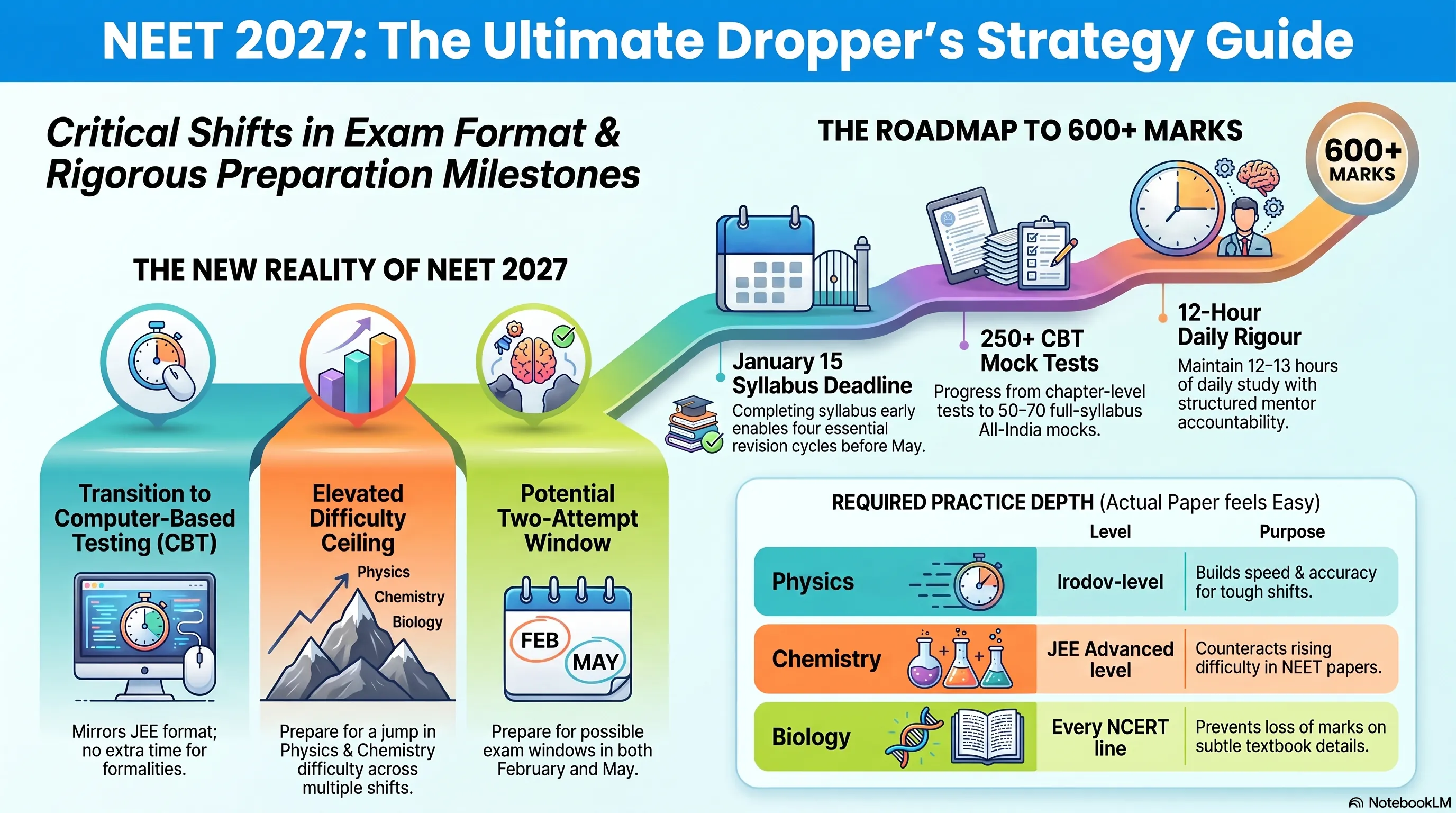
NEET 2027 is a genuinely new challenge. For the first time, the paper will be held in CBT (Computer-Based Test) mode — the same format used for JEE. That alone changes how you need to practise every single day from day one.
Beyond the mode, the paper level is climbing. NEET 2026 and Re-NEET 2026 both showed a clear jump in difficulty. Physics became harder, and Chemistry followed. With 15 to 20 shifts likely in NEET 2027 — because the exam conducting body needs to accommodate a much larger number of students across multiple sessions — there is a real possibility that at least some shifts will be significantly tougher than anything seen before.
There is also a chance NEET 2027 is held twice — a February attempt and a May attempt — based on committee recommendations that have been floated. If the syllabus is ready by January 15, you have enough runway to revise properly for both windows.
💡 Expert Note by Prateek Gupta, IIT Bombay: The exam conducting body for NEET 2027 is the same as for JEE. Expect the CBT experience — including reporting procedures and timing — to closely mirror JEE. The 15 extra minutes students got in the pen-and-paper format will most likely not apply in CBT mode.
Understanding the NEET exam pattern and the full NEET syllabus is the first step before you plan your calendar.
What Level of Preparation Does NEET 2027 Actually Demand?
This is the most important strategic question for any dropper. The answer is clear — you need to prepare at a level that makes the actual paper feel easy by comparison.
| Subject | Minimum Practice Level | Why |
|---|---|---|
| Physics | Irodov-level questions | Highest difficulty ceiling; builds speed and accuracy for tough CBT shifts |
| Chemistry | JEE Advanced level questions | Chemistry difficulty in NEET is rising; tougher practice = easier exam day |
| Biology | Highest-level NCERT — every single line | NEET Biology is still NCERT-first; one missed line can cost marks |
This does not mean you start at this level. The approach is to begin from basics and build to the highest level. Every chapter is taught from fundamentals, then pushed to the ceiling. That progression is why students with 400 marks have reached 600+ and students with 392 have reached 611 in a single year.
Check the NEET Physics weightage breakdown and NEET Chemistry weightage breakdown to prioritise which chapters deserve the most high-level practice time.
When Should You Complete the Syllabus?
The deadline is January 15. That is non-negotiable for a NEET 2027 dropper.
If NEET 2027 has a February attempt, you need at least one month of solid revision before walking into the exam hall. January 15 completion gives you that month. If the exam is only in May, you gain even more revision time — which means four full revision cycles are possible before the final paper.
The reason four revisions matter: each pass through the material consolidates retention and exposes new weak spots. By the fourth cycle, your recall is automatic and your speed in CBT mode is at its peak.
Pair your syllabus preparation with practice on NEET previous year question papers — especially NEET 2023, NEET 2022, NEET 2021, NEET 2020, and NEET 2019 — to understand how questions have evolved year on year.
How to Tackle NEET 2027's CBT Mode
Switching from pen-and-paper to CBT is not just a format change — it is a skill in itself. The students who score highest in NEET 2027 will be the ones who have done the most CBT practice before exam day.
Key points every dropper must know:
- No extra time for formalities. In CBT, you arrive one hour before the paper. All instructions, identity verification, and onboarding happen in that window. Your 3-hour clock starts clean. There are no extra 15 minutes.
- Chapter-level CBT tests first. Test after every chapter, in CBT format, from day one of your drop year. Do not wait until January to experience a screen-based test.
- Part-syllabus, half-syllabus, then full-syllabus tests. The testing sequence follows your syllabus coverage — chapter tests → part-syllabus → half-syllabus → full-syllabus mock tests.
- All-India test series in CBT format. Competing against students across India in the same format as the actual exam builds both accuracy and composure.
Practise on a laptop, tablet, or phone — whatever you have access to. The format, not the device, is what you are training for.
How Many Tests Should a NEET 2027 Dropper Give?
250+ CBT tests across the full year. That is the number that makes a NEET dropper genuinely ready for a high-stakes, multi-shift CBT exam.
This breaks down as:
- Chapter-level tests after every chapter (across Physics, Chemistry, Biology)
- Part-syllabus tests once a set of chapters is complete
- Half-syllabus tests at the midpoint
- 50–70 full-syllabus tests in the final months — including All-India mock tests
After every test, a detailed analysis is essential. The three things a test analysis must reveal:
- What you left unattempted — and why (time? confidence? topic gap?)
- Where your silly mistakes are — pattern recognition, not just counting errors
- Whether time management is the issue — and a specific fix, not just "go faster"
Identifying and fixing these three levers is what drives 60–70-mark jumps in a single month.
What the Topper Journey Actually Looks Like
The data from dropper batches is concrete. A student who scored 392 in their previous NEET reached 611. Another who scored 474 reached 660. Another went from 405 to 638. And going further back, a student ranked 12,20,000 in their attempt reached AIR 2,410 and is now studying at AIIMS.
These are not exceptional cases — they are what happens when the preparation system is right.
The pattern across every successful dropper is the same:
- Start from the basics, build to the highest level
- Never miss a class — structured accountability (mentors checking notes, homework, and attendance) removes the option of slipping
- Study 12–13 hours daily, with one hour reserved for health
- Maintain consistent sleep cycles and discipline — attitude and consistency are the fourth and fifth subjects alongside Physics, Chemistry, and Biology
Your foundation comes from the NCERT. Use Class 11 NCERT Solutions and Class 12 NCERT Solutions to lock in conceptual clarity before building to greater difficulty. Subject-specific NCERT revision — particularly Class 12 Chemistry, Class 11 Chemistry, Class 12 Physics, and Class 11 Physics — is non-negotiable at every revision cycle.
Frequently Asked Questions
Find answers to common questions.
Will NEET 2027 be held in CBT mode?
Yes, NEET 2027 is set to be held in CBT (Computer-Based Test) mode for the first time. This is a significant change from the traditional pen-and-paper format. Droppers must practise on-screen from day one — not just in the final weeks — to build comfort and speed in the new format.
Will NEET 2027 be held twice?
There is a real possibility. A committee has recommended holding NEET 2027 in two sessions — likely one in February and one in May. If you complete your NEET 2027 drop year syllabus by January 15, you are prepared for both windows with sufficient revision time before either attempt.
How many tests should a NEET 2027 dropper give to be fully prepared?
NEET 2027 dropper should give 250+ CBT-format tests across the preparation year. This includes chapter-level tests, part-syllabus tests, half-syllabus tests, and 50–70 full-syllabus mock tests. Every test must be followed by a detailed analysis covering unattempted questions, silly mistakes, and time management.
At what difficulty level should a NEET 2027 dropper prepare Physics and Chemistry?
Physics must be practised at Irodov level — higher than what NEET typically asks, so the actual exam feels manageable. Chemistry should reach JEE Advanced level, because NEET Chemistry difficulty is rising and has become comparable to tough JEE shifts. Biology requires covering every line of NCERT at the highest retention level.
Can a student with 300–400 marks in NEET realistically reach 600+ in a drop year?
Yes — this has happened in documented cases. Students with 392 have reached 611, students with 474 have reached 660, and students with 405 have reached 638 in a single drop year. The key is starting from basics, building to the highest level, maintaining 12–13 hours of daily study, and completing the syllabus with at least four revision cycles before exam day.