NEET 2027 Dropper Strategy: 10-Month Study Plan by IIT Faculty
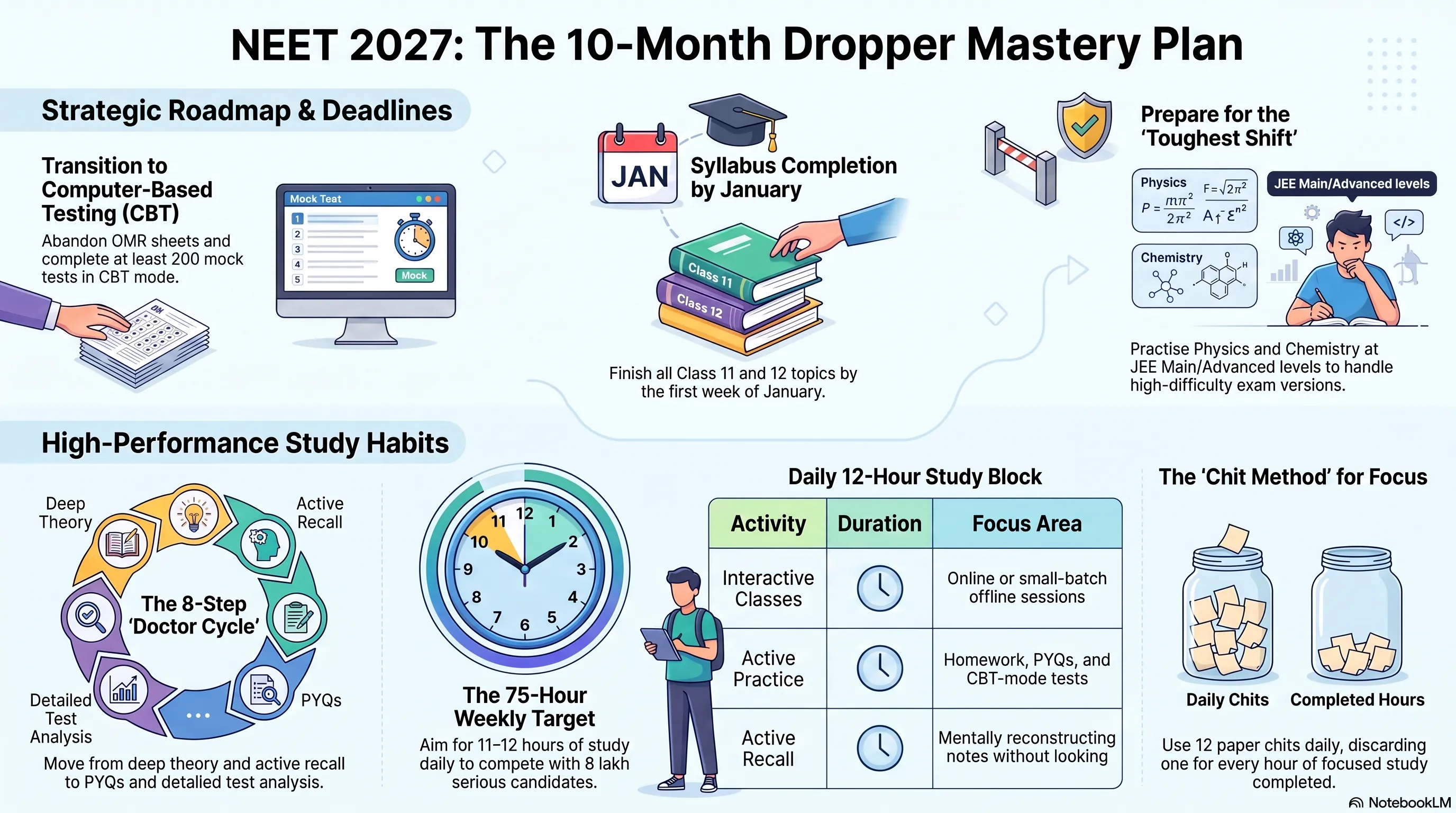
NEET 2027 preparation strategy for droppers requires completing the combined Class 11 and 12 syllabus by the first week of January, practising 100 to 150 questions daily, taking a minimum of 200 computer-based mock tests, and averaging 11 to 12 study hours a day across a 75-hour weekly target.


Table of Contents
- Why NEET 2027 Feels Overwhelming Right Now
- What eSaral's NEET 2026 Results Show
- Understand the NEET 2027 Exam Pattern First
- Will NEET 2027 Be Held Twice? Why Your Syllabus Deadline Is January
- How Tough Will NEET 2027 Be? Prepare for the Toughest Shift
- How Many Hours Should NEET Droppers Study Daily?
- The Doctor Cycle: The Study Process Behind eSaral's Toppers
- A Sample 12-Hour Daily Time Table
- The 21-Day Challenge: Building the Habit

eSaral › NEET › NEET 2027 Dropper Strategy: 10-Month Study Plan by IIT Faculty

Why NEET 2027 Feels Overwhelming Right Now
With roughly 10 months left for NEET 2027, droppers are carrying four fears at once. The full Class 11 and 12 syllabus still has to be finished, from the basics up to the toughest exam-level questions. The exam is expected to move to Computer-Based Test (CBT) mode, which means a minimum of 200 tests need to be attempted while sitting in front of a computer just to build that comfort. A large number of Previous Year Questions have to be practised, including JEE Main PYQs, to match the level the exam is expected to reach. And there is real uncertainty about whether the exam will be held once or twice.
This is the exact starting point most NEET 2027 droppers are in today, whether their last NEET score was 100, 200, 300, or 500. The rest of this guide lays out the process eSaral's faculty has used with droppers who converted this same starting point into top scores.
What eSaral's NEET 2026 Results Show
Over the last 10 years, thousands of students taught by this faculty have gone on to become doctors. In NEET 2026, students from this faculty's batches scored 705, 700, 690, 685, 671, and several similar marks, putting a good number of them within reach of a Top 100 All India Rank. Students from earlier batches are currently studying at AIIMS Delhi, AIIMS Rishikesh, AIIMS Jodhpur, AIIMS Bhopal, and AIIMS Patna, at the AIIMS of their choice.
💡 Expert Tip by Prateek Gupta, IIT Bombay : If you sit in a class and everything makes complete sense to you, that is a warning sign, not a good sign — it usually means you are being kept comfortable rather than being pushed to the level the actual exam will demand.
This is the standard the strategy below is built around: not comfort, but the toughest level of preparation.
Understand the NEET 2027 Exam Pattern First
The single biggest change students need to internalise is that the next NEET exam is expected to be conducted as a Computer-Based Test (CBT) — a shift from the OMR sheet format most droppers are used to. Practically, this means:
- No more filling bubbles on an OMR sheet. Every answer, including diagrams, has to be entered on a computer screen.
- Students need to build comfort staring at a screen for a full 3-hour exam.
- A minimum of 200 CBT-mode tests need to be attempted before the actual exam to build this familiarity.
Old OMR sheets and OMR-based practice material should be set aside completely and not revisited. For a full breakdown of how marks are distributed and what the paper structure looks like, check the NEET exam pattern and cross-check your subject-wise focus using the NEET Physics weightage and NEET Chemistry weightage breakdowns.
How Many Mock Tests Should You Give Before NEET 2027?
At minimum, 200 CBT-format mock tests should be attempted before exam day. These need to be taken on a computer screen, in an interface that mirrors the actual NTA testing experience, so the format itself stops being a source of stress on exam day.

Will NEET 2027 Be Held Twice? Why Your Syllabus Deadline Is January
There is real committee-level discussion around conducting the exam twice, similar to how JEE Main runs two attempts — one in January and one in April. If NEET follows a similar pattern, the first attempt could fall in February, with a second and final attempt in May.
The reasoning laid out is about calendar availability: mid-February to mid-March is booked with board exams, the first week of April is booked, and board exams for other boards run through late March. That effectively leaves February as the only realistic window for a first attempt, or alternatively a slot after board exams end in April, before JEE Main and JEE Advanced dates.
Because of this, droppers are advised to plan backward from February, not April or May. That means:
- The complete Class 11 and Class 12 syllabus should be finished by the first week of January.
- This requires studying both faster and in more depth than a dropper might have originally planned for.
How Tough Will NEET 2027 Be? Prepare for the Toughest Shift
In JEE Main, which runs across 10 different shifts, the difficulty varies enormously between shifts — in one shift, a 99 percentile could correspond to around 150 marks, while in another shift, the same percentile could correspond to around 200 marks. The same pattern is expected for NEET 2027: some shifts will be easy (similar to NEET 2024), some will be medium (similar to the NEET exam held on 3rd May), some will be tough (similar to NEET 2026), and some will be the toughest — a level above both NEET 2025 and NEET 2026.
The recommended response is to prepare for the toughest possible version of the paper. In practice, this means:
- Theory and questions should be practised at a level equivalent to JEE Main's tougher shifts and JEE Advanced's moderate shifts (for example, JEE Advanced 2024-level difficulty).
- Physics should include lengthy, calculation-heavy numericals.
- Chemistry should be covered in depth across Organic, Inorganic, and Physical chemistry, including multi-step organic reaction sequences.
- Biology should include multi-statement questions (for example, questions built around seven statements at once).
Preparing at this level means an easier shift on exam day becomes very manageable, while a tough shift no longer catches a student off guard. Review the complete topic list on the NEET syllabus page to map this preparation against every chapter.
How Many Hours Should NEET Droppers Study Daily?
The benchmark cited is 75 hours of study per week. One student scoring 685 marks reported averaging 11 to 12 hours of study per day, which works out to roughly 75 hours a week.
The reason this is framed as a weekly target rather than a daily one is deliberate. Daily targets tend to fail because of how mornings actually go: a student plans to wake at 6:00 AM and start studying by 6:30, but the alarm gets snoozed repeatedly, the student wakes at 8:30 instead, feels regret over the wasted morning, and pushes studying to "after breakfast," then "after lunch," then "tomorrow" — a cycle that can repeat until the exam itself arrives.
A weekly target removes this trap. Even if a student wakes late on a given day, knowing that 75 hours still have to be completed that week creates the motivation to sit down and study immediately, without procrastinating.
The Chit Method: How to Track Your Study Hours
To track study time without turning it into an obsessive, robotic exercise, the recommended method is simple: tear a sheet of newspaper into 12 chits and keep them in your pocket. Every time an hour of focused study is completed, one chit is thrown away. All 12 chits should be used up by the end of the day, starting from day one, to build the habit of a rough, honest daily estimate of study time.
Why the Bar Is Set This High
An estimated 20-plus lakh students are expected to appear for NEET, and the faculty assess that around 7 to 8 lakh of them prepare with real seriousness. Since NEET 2025, the students who go on to secure ranks have already raised their own bar — studying tougher material and studying more of it. To beat this real pool of 7 to 8 lakh serious competitors and land inside the top 10,000, averaging 11 to 12 hours of study a day is described as the bare minimum, not an aspirational target.
The Doctor Cycle: The Study Process Behind eSaral's Toppers
Every topper cited in this guide has followed the same repeating study process. It runs in this order for every chapter:
- Deep Theory: Attend a class where 70 to 80% of the content is genuinely challenging to grasp on the first pass. A class where everything feels easy is a sign that concepts and formulas are being spoon-fed rather than taught with full reasoning — a risk area for a tough NEET paper.
- Notes Recap with Active Recall: After class, close your notes and try to mentally reconstruct everything that was taught, without looking. If you can recall it fully, the notes were absorbed properly.
- Homework: Complete the homework tied to that day's theory.
- Previous Year Questions (PYQs): Practise PYQs — not just from NEET, but also from JEE Main, and selected JEE Advanced questions. You can pull real papers from the NEET question paper archive, including NEET 2023, NEET 2022, NEET 2021, NEET 2020, and NEET 2019 papers.
- Chapter Test: Take a CBT-mode test on that specific chapter.
- Review Test: Take a broader review test covering recently completed chapters.
- Test Analysis: Go through a detailed analytics report of the review test — eSaral provides a 20-page analytics report for this step.
- Revise and Re-practise: Go back over every mistake identified in the analysis, revise the concept, and re-practise similar questions before moving to the next chapter's theory.
How Many Questions Should You Practise Per Day?
From now until the end of December, the target is roughly 100 questions a day — a rough split of 50 Biology, 25 Physics, and 25 Chemistry (or a 60/20/20 split, depending on the day). Once the full syllabus is completed, the daily target increases to 150 questions a day. Based on this calculation, the faculty states a minimum target of around 400 practice questions to be completed before the NEET exam.
A Sample 12-Hour Daily Time Table
The recommended 12-hour daily study block is broken down as follows:
| Activity | Hours per Day |
|---|---|
| Live interactive class (online, small-batch, or offline small-batch class) | 5 hours |
| Practice (homework, PYQs, tests) | 5 hours |
| Notes recap (active recall) | 2 hours |
| Total | 12 hours |
A few specific notes on this breakdown:
- Classes should be either genuinely interactive online sessions or small offline batches. A class with 300–400 students in it is flagged as a red flag for selection ratio, based on patterns seen across Kota and other states.
- For notes recap, Physics generally needs the least time since formulas cover most of it. Chemistry — particularly Inorganic and Organic — and Biology, which is taught daily, need more time spent on recap since their homework load is comparatively lighter.
The 21-Day Challenge: Building the Habit
This challenge has two parts, and both need to be run together for 21 days to build lasting habits.
Part 1 — Reach 12 hours of study a day. You are not expected to hit 12 hours from day one. Starting at 6, 7, or 8 hours and building up is fine, but by the end of the 21 days, 12 hours of daily study should feel like an established habit.
Part 2 — The One-Hour Rule. Whatever your biggest daily distraction is — gaming, social media scrolling, socialising — it needs to be limited to a fixed one-hour window per day, ideally at night. This is not about eliminating it, but about capping it. Beyond that one hour, no further distraction time should be used; mornings and the rest of the day are reserved for study. Locking your phone (or having a mentor lock it, for offline students) for these 21 days is recommended as a way to break the habit of unlimited access.
To support this, eSaral assigns two mentors to every dropper. If an online class is missed, a call goes out immediately, and parents are informed if needed. If an offline class is missed, mentors follow up directly, including visiting the student's hostel. These mentors also handle homework checking, test checking, and test analysis follow-up, and are available throughout the 10 months to resolve day-to-day preparation problems.
Frequently Asked Questions
Find answers to common questions.
How many hours should NEET 2027 droppers study every day?
The target is 75 hours of study per week, which works out to roughly 11 to 12 hours a day. This is set as a weekly target rather than a daily one, since daily plans tend to break down due to inconsistent mornings and procrastination.
Will NEET 2027 be held twice?
There is committee-level discussion around a two-attempt format, similar to JEE Main's January and April shifts, which could mean a first NEET 2027 attempt in February and a final attempt in May. Because of this possibility, droppers are advised to complete their full syllabus by the first week of January.
How many mock tests should I give before NEET 2027?
A minimum of 200 computer-based tests (CBT) should be attempted before the exam. Since NEET is expected to move to CBT mode, students need this volume of practice to build comfort with typing answers and diagrams on a screen instead of using an OMR sheet.
How many practice questions should NEET droppers solve daily?
The target is around 100 questions a day (split roughly 50 Biology, 25 Physics, 25 Chemistry) until the syllabus is completed, rising to 150 questions a day after that, with a minimum of around 400 practice questions completed before the exam.
What is the "Doctor Cycle" study process for NEET preparation?
The Doctor Cycle is an eight-step repeating process: deep theory, active-recall notes recap, homework, PYQ practice (NEET, JEE Main, and select JEE Advanced), a chapter test, a review test, detailed test analysis, and revision before moving to the next chapter. Every eSaral topper cited in this guide followed this same cycle.