Why Is Class 11 Chemistry So Hard for NEET? Honest Answers + Recovery Plan (2026)
Class 11 Chemistry feels difficult for NEET because of its conceptual jump and three distinct branches, but with NCERT-focused study, high-weightage chapter prioritization, and a structured 8-week revision plan, it can become one of the highest-scoring sections.
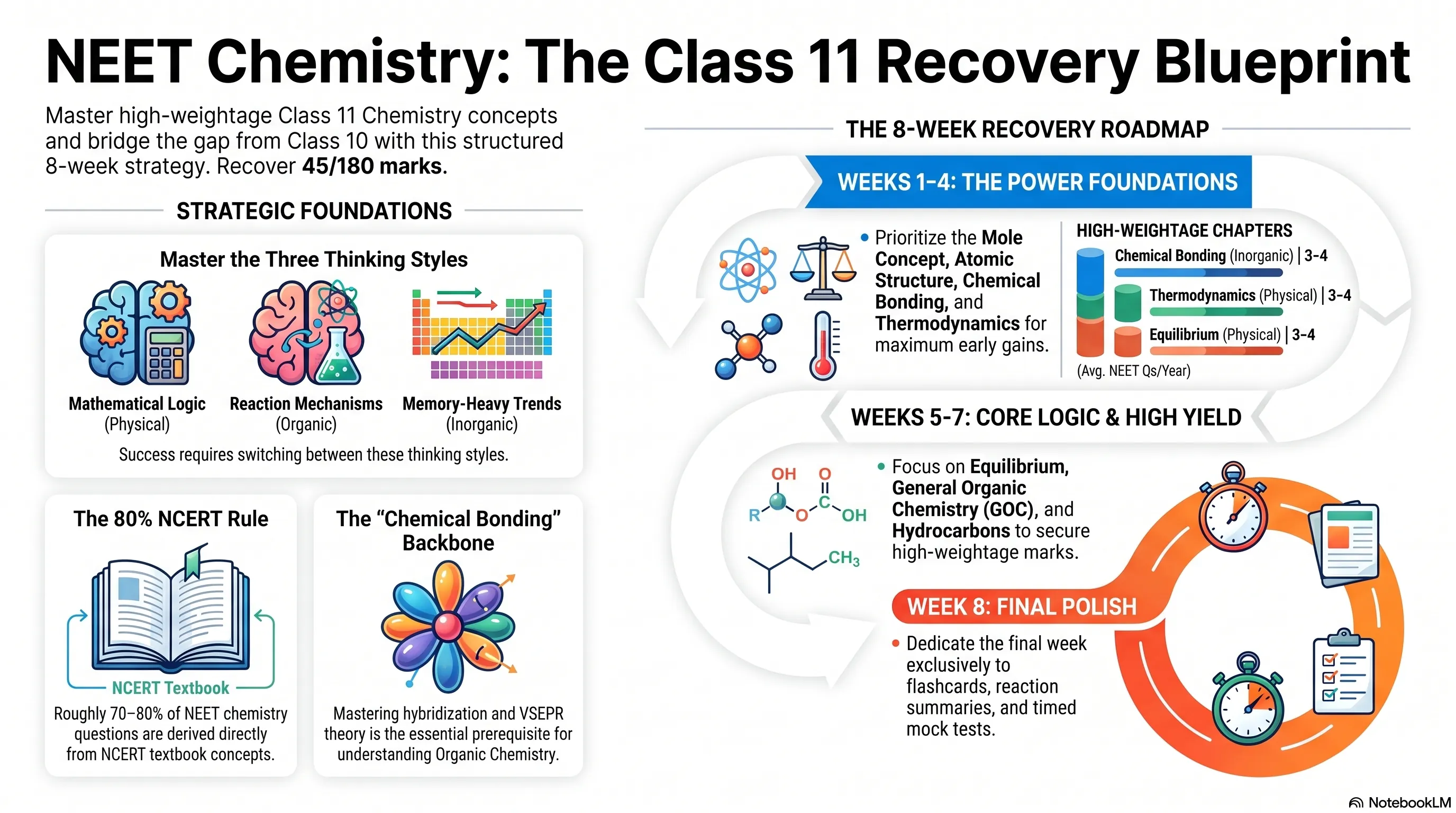
Table of Contents

eSaral › NEET › Why Is Class 11 Chemistry So Hard for NEET? Honest Answers + Recovery Plan (2026)

The Honest Answer: Is Class 11 Chemistry Really That Hard?
Yes — and no. Class 11 chemistry is genuinely harder than what came before. But it is not unbeatable.
The subject is harder because it splits into three distinct branches that require three different thinking styles: Physical Chemistry (mathematical and logical), Organic Chemistry (pattern-based and mechanistic), and Inorganic Chemistry (memory-heavy). No other class 11 subject asks you to switch thinking modes this often inside a single paper.
What makes it feel *impossible* rather than *hard* is usually the pace. School moves fast. If you miss the logic in one chapter, the next chapter assumes you have it. The gap compounds quickly.
💡 Expert Tip by eSaral Academic Team: "Most students who call themselves 'bad at chemistry' are actually bad at one branch — usually Physical or Organic — not all three. First, diagnose which branch is the weak link. That single step cuts your recovery time in half."
According to NEET chemistry weightage data, class 11 chemistry contributes roughly 45 out of 180 chemistry marks in NEET UG. That is significant but also very fixable with targeted preparation.
Why So Many NEET Aspirants Struggle With It
This is not a you problem. It is a transition problem that almost every NEET aspirant hits.
The Jump from Class 10 Science Is Steep
In class 10, chemistry is mostly descriptive — you memorise definitions, reactions, and properties. Class 11 asks you to *understand why* reactions happen. That is a fundamental shift in how you must engage with the subject. Students who coasted on memorisation in class 10 hit this wall hardest.
Three Subjects Disguised as One
Physical, Organic, and Inorganic chemistry feel like three separate disciplines. You need mathematical rigour for thermodynamics and equilibrium, visual-spatial thinking for VSEPR and hybridisation, and disciplined memorisation for periodic properties and s-block elements. Expecting one study method to work for all three is where most students go wrong.
Coaching Pace vs. Absorption Speed
JEE ki taiyari aur NEET ki preparation dono mein yahi problem aati hai — coaching institutions cover class 11 chemistry in roughly 5–6 months, but most students need 8–9 months to truly absorb it. The mismatch creates a permanent feeling of being behind.
|
Why It Feels Hard |
Root Cause |
Fix |
|
Mole concept confusing |
Gap in mathematical foundation |
Re-do basic ratio/proportion problems first |
|
Organic mechanisms unclear |
Trying to memorise, not understand |
Focus on arrow-pushing logic |
|
Inorganic facts won't stick |
No context for memory hooks |
Use periodic trends as anchors |
|
Feeling generally lost |
Skipped foundational chapters |
Go back to Chemical Bonding first |
What Actually Matters in Class 11 Chemistry for NEET
Not every chapter deserves equal time. Here is what the data says.
High-Weightage Chapters You Cannot Skip
Reviewing past NEET question papers from 2019 to 2024 shows a consistent pattern. Certain chapters appear almost every year with 2–4 questions each.
|
Chapter |
Branch |
Avg. NEET Questions/Year |
|
Chemical Bonding & Molecular Structure |
Inorganic |
3–4 |
|
Thermodynamics |
Physical |
3–4 |
|
Equilibrium |
Physical |
3–4 |
|
Hydrocarbons |
Organic |
2–3 |
|
s-Block Elements |
Inorganic |
2–3 |
|
Some Basic Concepts (Mole Concept) |
Physical |
2–3 |
|
States of Matter |
Physical |
2 |
Which Chapters Can Be Treated as Lower Priority?
Environmental Chemistry and some portions of Hydrogen carry low NEET weightage historically. This does not mean skip them entirely — it means do not spend two weeks here when Equilibrium is not solid yet.
💡 Expert Tip by eSaral Academic Team: "Chemical Bonding is the backbone of Class 11 Inorganic Chemistry. Students who master hybridisation, VSEPR, and molecular orbital theory find Organic Chemistry easier to learn afterward — the concepts connect directly."
You can explore the full NEET syllabus to see the official chapter list and cross-reference it against your preparation.
How to Recover: An 8-Week Catch-Up Roadmap
This roadmap is for a student who feels behind in class 11 chemistry — whether you are currently in class 11, class 12, or a dropper. Adjust the timeline proportionally if you have more or less time.
Start here before Week 1: Spend one day taking a diagnostic. Attempt 25 mixed class 11 chemistry questions from a past NEET paper. Mark which chapters your errors cluster in. That cluster is your Week 1–2 priority.
Week 1–2 — Physical Chemistry Foundation
Cover Mole Concept, Atomic Structure, and States of Matter. Do not move forward until mole-based calculations feel automatic. Use NCERT examples first, then attempt at least 30 practice problems per chapter.
Week 3–4 — Chemical Bonding + Thermodynamics
These two chapters together carry the highest Physical + Inorganic marks in NEET. Master VSEPR, hybridisation, and bond polarity in Week 3. Cover laws of thermodynamics, enthalpy, and Hess's Law in Week 4.
Week 5 — Equilibrium
Chemical and ionic equilibrium. Focus on Le Chatelier's Principle and buffer problems — these appear almost every year in NEET UG.
Week 6 — Organic Chemistry Basics
General Organic Chemistry (GOC) is the gateway to all Organic chapters. Spend the full week here. If GOC is shaky, every Organic chapter after it will feel random.
Week 7 — Hydrocarbons + s-Block
Alkanes, alkenes, alkynes reactions, and s-block properties and uses. These are high-yield and very learnable in one week each.
Week 8 — Revision + Mock Tests
No new chapters. Revise all flashcards, reaction summaries, and formula sheets. Attempt two full NEET chemistry section mocks under timed conditions.
In eSaral's 2025 dropper batch, students who followed a structured 8-week class 11 chemistry revision showed an average improvement of 18–22 marks in chemistry mock scores within two months.
Common Mistakes Students Make When They Panic
Panic does not just feel bad — it actively leads to study decisions that waste time. Here are the five mistakes to avoid.
Switching Resources Constantly
When a topic is unclear, many students download three different PDFs, watch five YouTube videos, and buy a new book. This is the most common panic response — and it creates more confusion, not less. Pick one source per chapter and finish it.
Treating Inorganic Like a Cramming Subject From Day One
Inorganic Chemistry does require memorisation. But students who start with rote learning before understanding periodic trends forget everything within two weeks. Learn the logic of trends first — reactivity, ionic radius, electronegativity — then the facts stick naturally.
Ignoring NCERT Entirely
NEET aspirants often feel NCERT is "too basic." It is not. Roughly 70–80% of NEET chemistry questions are either directly from NCERT or based on NCERT concepts. The NEET exam pattern confirms that factual, concept-based questions dominate — and NCERT covers them precisely.
Skipping Chapters They Find Boring
Thermodynamics and Equilibrium are unpopular because they require sustained logical thinking. Students skip them and then discover that these two chapters alone can cost 6–8 marks in NEET. No chapter is optional if it appears 3+ times per year.
Not Attempting Questions Early Enough
Many students spend weeks reading and making notes before attempting a single question. This feels thorough, but it delays the feedback loop. Attempt questions chapter by chapter, in the same week you study it.
Frequently Asked Questions
Find answers to common questions.
Why do NEET aspirants struggle with Class 11 chemistry more than Class 12?
Class 11 chemistry introduces three entirely new branches — Physical, Organic, and Inorganic — simultaneously, while class 12 builds on concepts already introduced. The learning curve is steepest in class 11 because there is no prior framework to attach new ideas to. Class 12 chemistry feels more manageable because the foundation is already partially there.
Which Class 11 Chemistry chapters are most important for NEET?
The highest-priority chapters are Chemical Bonding, Thermodynamics, Equilibrium, Mole Concept, and Hydrocarbons. These five chapters collectively account for approximately 18–22 marks in NEET UG most years. You can verify this against NEET chemistry weightage data for year-wise trends.
How many marks does Class 11 Chemistry carry in NEET?
Out of the total 180 chemistry marks in NEET UG, class 11 chapters typically contribute around 40–50 marks depending on the year. This is roughly 22–28% of the total chemistry section — significant enough that neglecting it seriously damages your overall score.
Is NCERT enough for Class 11 chemistry in NEET?
NCERT is necessary but not fully sufficient. It covers the conceptual base required for 70–75% of NEET chemistry questions. You still need practice questions and previous year papers to develop speed and application skills. Start with NCERT, master it completely, then move to supplementary question banks.
How to recover if you are weak in Class 11 chemistry for NEET?
Follow a chapter-priority approach rather than trying to redo everything. Identify your weakest branch using a diagnostic test, then spend 2 weeks per branch in this order: Physical Chemistry foundation, then Chemical Bonding, then Organic basics. An 8-week structured plan is realistic for most students to close significant gaps.