Foundation Classes Tour to Bundi, Rajasthan: A Day of History, Learning & Discovery
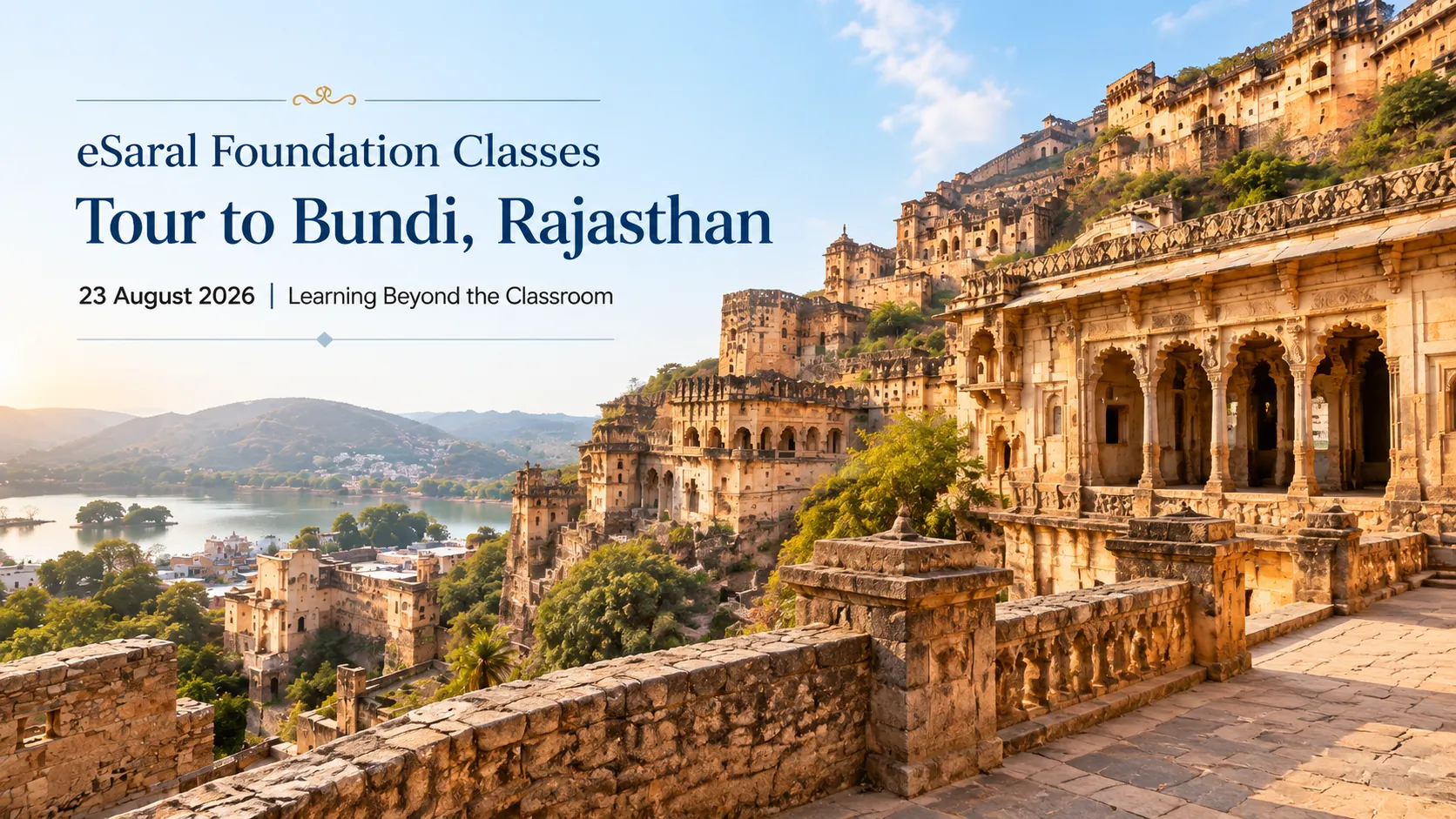
Table of Contents
- Event at a Glance
- A Day Beyond the Classroom
- Exploring the Heritage of Bundi
- Learning Through the Government Museum
- Phool Sagar and Chhatrashila
- More Than a Historical Visit
- Refreshments, Pictures & Shared Memories
- A Stop at the Highway Restaurant
- Why Educational Tours Matter for Students
- A Memorable Day of Learning

eSaral › eSaral Events › Foundation Classes Tour to Bundi, Rajasthan: A Day of History, Learning & Discovery
.webp)
Event at a Glance
| Details | Information |
|---|---|
| Date | 23 August 2026 |
| Location | Bundi, Rajasthan |
| Participants | eSaral Foundation Classes (8, 9 & 10), Mentors & Teachers |
| Duration | 9:00 AM – 6:00 PM |
| Mode of Travel | Bus |
Learning does not always happen inside a classroom. Sometimes, it begins when students step outside their familiar surroundings, observe the world around them, and experience history, architecture, culture, and nature firsthand. With this thought, eSaral organised a one-day educational tour to Bundi, Rajasthan, on 23 August 2026, bringing together students from the Foundation Classes (8, 9 and 10), along with their mentors and teachers.
The tour was planned as more than just a day away from regular classes. It gave students an opportunity to explore one of Rajasthan's historically rich cities, understand its heritage through direct observation, and learn how the subjects they study can connect with the real world. From forts and stepwells to museums, lakes, and historic structures, every stop offered something different to observe and think about.
A Day Beyond the Classroom
The journey began in the morning, with the group travelling by bus towards Bundi. The shared journey itself became an important part of the experience. Students spent time with their classmates, mentors, and teachers in a relaxed environment, creating opportunities for conversations and interactions beyond the regular classroom setting.
For students in Classes 8, 9 and 10, such experiences can be particularly valuable. At this stage, learning is not only about remembering facts but also about developing curiosity, asking questions, making observations, and understanding connections between different subjects. A historical site can bring Social Science to life, architectural structures can encourage mathematical and scientific observation, while museums can turn textbook information into something tangible and memorable.
Exploring the Heritage of Bundi
Bundi is known for its historic architecture, forts, stepwells, lakes, and cultural heritage. During the tour, students visited several important places across the city, including Bundi Fort, Taragarh Fort, Nawal Sagar, Chhatrashila, Phool Sagar, the Government Museum, and Rani Ji Ki Baori.
Each location offered a different perspective on Bundi's history and environment.
Bundi Fort and Taragarh Fort
The forts provided students with an opportunity to observe the scale and design of historical architecture up close. Instead of simply reading about forts and kingdoms in books, students could see the structures themselves and think about why they were built in particular locations, how they were designed, and how people may have lived and worked within such spaces.
A visit to a historic fort can also encourage students to think beyond dates and names. It can lead to questions about engineering, geography, defence, construction techniques, administration, and the everyday lives of people from earlier periods.
For young learners, this kind of observation-based experience can make historical knowledge more relatable and encourage them to look at the past with greater curiosity.
Nawal Sagar and the Relationship Between People and Water
The visit to Nawal Sagar added another dimension to the tour. Water has always played an important role in the development of settlements, particularly in regions such as Rajasthan where water management has historically been significant.
Seeing a water body in its actual geographical setting can help students understand ideas that may otherwise remain abstract in textbooks. It encourages them to think about how communities adapt to their environment, how natural resources influence settlements, and why water conservation has remained important across generations.
Rani Ji Ki Baori: Understanding Traditional Water Architecture
One of the notable stops on the tour was Rani Ji Ki Baori, Bundi's historic stepwell. Stepwells are an excellent example of how architecture, engineering, community needs, and environmental conditions can come together.
For students, observing a baori can open up questions that connect several areas of learning: How was water accessed? Why was the structure built underground? How did its design help people? What materials and construction methods might have been used?
Experiences like these can help students realise that knowledge is interconnected. History is not limited to historical dates, and science is not limited to laboratory experiments. Real-world structures often bring several subjects together.
Learning Through the Government Museum
The Government Museum was another important part of the day's exploration. Museums provide students with a direct connection to objects and artefacts associated with the past.
Seeing historical objects, artwork, and other exhibits in person can make students more attentive to details and encourage them to ask questions about how people lived, what they created, what they valued, and how societies changed over time.
The museum visit also gave students an opportunity to observe and learn at their own pace. Rather than receiving information only through a lecture, they could look closely at exhibits and form their own questions and interpretations.
The presence of turtles around the baori also added a natural and engaging element to the experience, giving students another reason to observe their surroundings closely.
Phool Sagar and Chhatrashila
The tour also included visits to Phool Sagar and Chhatrashila, adding to the variety of experiences throughout the day. Moving between historical structures, water bodies, museums, and other heritage locations allowed students to experience different aspects of Bundi rather than viewing its history from a single perspective.
Such variety can be especially useful for young learners because it encourages them to notice differences in architecture, surroundings, purpose, and design. It also gives them opportunities to discuss what they have seen with their classmates and teachers.
More Than a Historical Visit
While the destinations were an important part of the tour, the experience was equally about learning together.
Students had the opportunity to spend time with their mentors and teachers in an environment outside the classroom. Informal conversations, shared observations, group activities, and travelling together can strengthen the sense of community among students and educators.
For Foundation Classes, these experiences can contribute to skills that are difficult to develop through textbooks alone—such as observation, communication, curiosity, teamwork, and the confidence to ask questions.
A historical tour can also encourage students to think differently. When students see how people in the past solved practical problems, managed resources, constructed large structures, and adapted to their surroundings, they begin to understand that innovation and problem-solving are not new ideas. They have been part of human civilisation for centuries.
Refreshments, Pictures & Shared Memories
The day also included refreshments and plenty of opportunities for students to capture moments through photographs. Group pictures and informal moments with friends, teachers, and mentors became part of the memories created during the journey.
These moments may seem simple, but they contribute to the overall experience of an educational tour. Learning becomes more memorable when it is associated with experiences, people, conversations, and places.
A Stop at the Highway Restaurant
After a full day of exploration, the group also stopped at a highway restaurant for refreshments and a break during the journey. It provided students with time to relax, interact, and share their favourite moments from the day's experiences before continuing the journey.
By the end of the day, the tour had brought together history, architecture, geography, observation, interaction, and recreation in a single experience.
Why Educational Tours Matter for Students
For students in Classes 8, 9 and 10, educational tours can play an important role in making learning more experiential. A classroom provides the foundation of knowledge, but visiting real places can help students understand how that knowledge exists in the world around them.
A visit to a fort can make history feel tangible. A stepwell can demonstrate the relationship between architecture and water management. A museum can transform historical information into something students can see and examine. A natural setting can encourage observation and curiosity.
Most importantly, such experiences encourage students to look, question, connect, and think.
When students are given opportunities to explore beyond textbooks, they can begin developing a broader perspective on the subjects they study. They may return to the classroom with new questions, new observations, and a greater interest in understanding the world around them.
A Memorable Day of Learning
The eSaral Foundation Classes' Bundi Tour on 23 August 2026 was a day filled with exploration, interaction, history, and shared memories. From the forts and historic architecture to the museum, baori, water bodies, and conversations along the journey, every part of the day offered students an opportunity to experience learning in a different way.
The tour reminded us that education is not confined to books or classrooms. Sometimes, the best lessons begin with seeing something for yourself, asking a question, and discovering the answer through experience.
For the students, the Bundi tour was not simply a day trip—it was an opportunity to explore, observe, connect with history, and create memories with their classmates, mentors, and teachers.