How to make Notes For JEE Smart Notes Strategy of an AIR 41
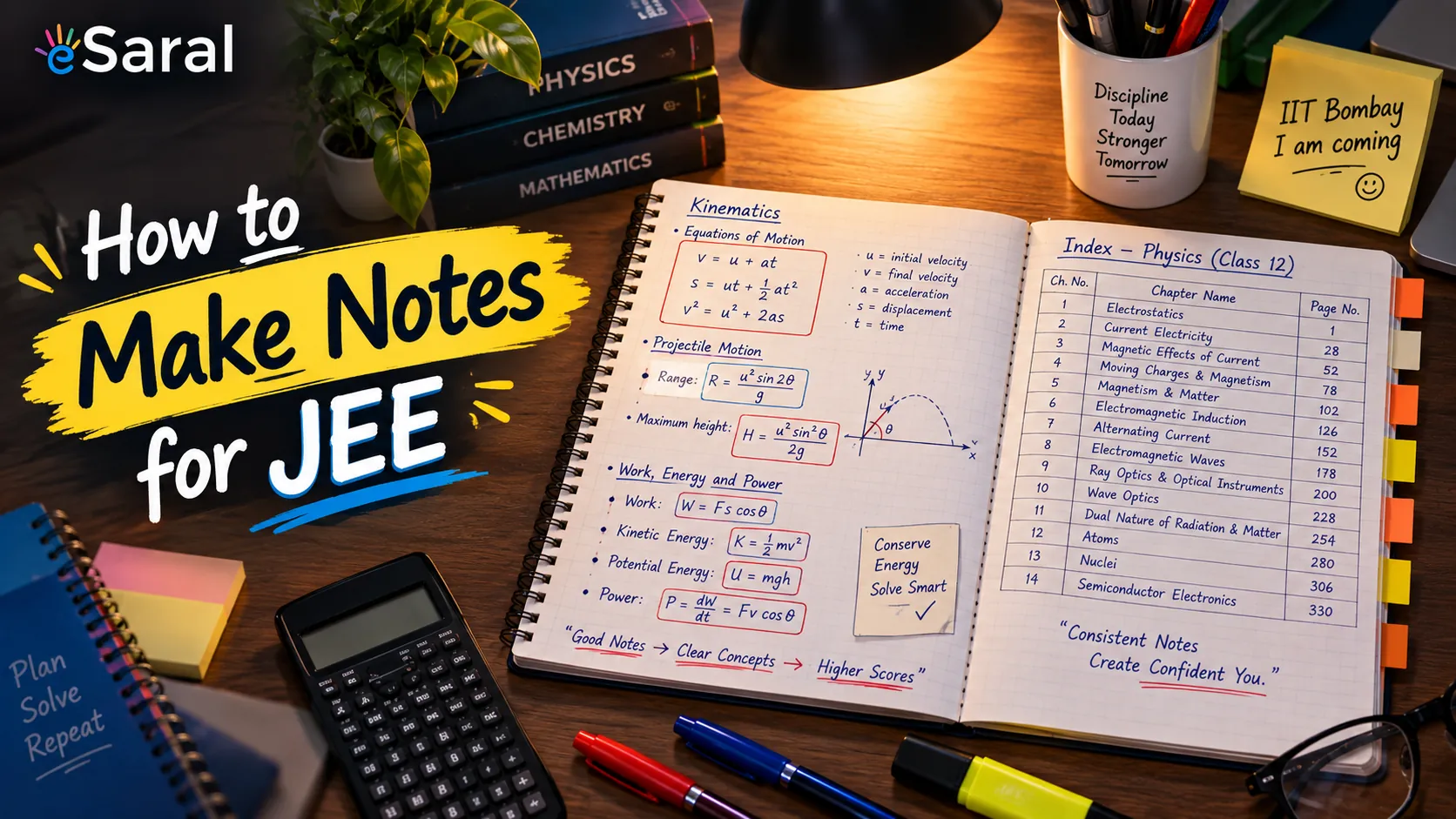
Table of Contents
- Quick Answer: How to Make Notes for JEE in 5 Steps
- Why Notes-Making Matters More Than You Think for JEE Preparation
- How to Make Notes for JEE: The 5-Step Topper Framework
- How to Make Short Notes for JEE: When and How to Compress
- Blank Copy vs Ruled Copy: Which Is Better for JEE Notes?
- 5 Common Mistakes to Avoid While Making JEE Notes
- How eSaral's Study Material Complements Your Own JEE Notes

eSaral › JEE › How to make Notes For JEE Smart Notes Strategy of an AIR 41

Every JEE aspirant makes notes. Very few make notes that actually get revised. Anyone can tell you "write neatly" or "use three pen colours" — but that's not what separates a topper's notebook from an average one. This guide breaks down exactly how to make notes for JEE using the same five-step method an AIR 41 rank holder used to revise two full years of Physics, Chemistry, and Mathematics syllabus in under a week before his exam.
If you're also wondering how to make short notes for JEE, or whether you even need a separate short-notes copy at all, this guide covers that too — with clear dos and don'ts for Physics, Maths, and Chemistry separately.
Quick Answer: How to Make Notes for JEE in 5 Steps
- Write everything first — don't shorten on day one; compress later, not the other way round.
- Build an index page at the start of every notebook, using odd page numbers only (1, 3, 5, 7…) to save time.
- Create your own shorthand for repeated terms (e.g., λ for wavelength, f for frequency).
- Note down "unsaid" points — the verbal tips and tricks a teacher mentions but doesn't write on the board.
- Add a one-line motivational goal on the first page of every notebook — it's the page you'll see most often.
Each of these is explained in detail below, exactly as used by IIT Bombay AIR-41 faculty and multiple Top-50 JEE rankers.
Why Notes-Making Matters More Than You Think for JEE Preparation
JEE and NEET preparation spans two academic years — Class 11 and Class 12 — across three subjects. By the time you reach your final months, you're not looking at one chapter's worth of material; you're managing 90–100 chapters' worth of theory, formulas, and tricks. Re-reading full modules or NCERT textbooks for revision at that stage simply isn't realistic.
This is exactly why your notes need to function as your personal theory textbook — the single resource you revise from repeatedly in the final months. Nearly every student in the Top 50 JEE rank bracket maintains detailed personal notes; the difference isn't whether they make notes, but how they structure them.
Whether you use a blank notebook or a ruled one doesn't matter much — one AIR-1 candidate used blank copies for diagram-heavy subjects like Organic Chemistry, while another used ruled copies for everything. Use whichever format your handwriting and thinking flow best in.
How to Make Notes for JEE: The 5-Step Topper Framework
This is the core method — the actual answer to how to make notes for JEE that toppers rely on, step by step.
Step 1: Write Everything Down First — Shorten Later, Never the Reverse
The single biggest mistake aspirants make is trying to write "short notes" from day one. Don't. Whatever your teacher explains in class — write it down in full. Definitions, derivations, examples — all of it.
Here's why this matters: you can always shorten a long, complete set of notes later during revision. But you cannot expand notes that were incomplete from the start — by the time you realise something is missing, you won't have time to go back and add it. A single missed concept can cost you 4 marks in JEE, and 4 marks is often the difference between one IIT and a completely different one.
Complete notes from Day 1 also become your biggest source of exam-time confidence — when you know you've captured everything your teacher taught, revising from your own notebook feels far more reliable than jumping between multiple sources.
Step 2: Master the Indexing Technique (Saves Hours During Revision)
This is arguably the most underrated notes-making hack for JEE aspirants. Just like a search engine indexes web pages, or a textbook has a table of contents, your notebooks need an index too.
Here's how to do it:
- Leave the first 1–2 pages of every notebook blank for an index.
- As you complete each chapter, write the chapter name and its starting page number in the index.
- Go a level deeper — list important sub-topics with their own page numbers too (e.g., "Kinematics – Page 59," "River-Boat Problems – Page 68").
- Stick a small label or chit on the spine or cover of each notebook listing the chapters it covers, so you don't have to flip through a stack of notebooks to find the right one.
The odd-page-number trick: Only write page numbers on odd pages (1, 3, 5, 7, 9…), never even ones. Since even-numbered pages always fall between two odd ones, you already know where they are — this alone cuts your numbering time in half.
| Notebook Section | What to Index | Example |
|---|---|---|
| Chapter start | Chapter name + page number | Kinematics — Page 59 |
| Important sub-topic | Sub-topic + page number | River-Boat Problems — Page 68 |
| Notebook cover | Sticky label with chapter list | "Ch. 1–4: Units, Vectors, Kinematics" |
When exam pressure builds and you need to revise a specific topic fast, this index lets you open straight to the exact page instead of flipping through an entire notebook — a habit that compounds into hours saved over a full JEE preparation cycle.
Step 3: Create Your Own Shorthand and Symbols
You don't need to write full words every time. Invent short forms that only need to make sense to you:
- Wavelength → λ
- Frequency → f
- Temperature → T
- Geometrical Optics → G. Optics or Opt.
- Current → Cur.
- Increasing/Decreasing → ↑ / ↓
This lets you keep pace with a fast-talking teacher without losing focus on definitions, and it naturally makes your notes shorter — which directly feeds into faster revision later.
Step 4: Capture "Unsaid" Notes — What the Teacher Says but Doesn't Write
Teachers often mention a useful trick, a mnemonic, or a deeper insight verbally, in between formal points, without writing it on the board. For example: "In a plane mirror, reflected rays always meet at the same point — that point is the image, not necessarily the object." These verbal asides are often exactly the kind of insight that clears a doubt permanently.
Use the blank space at the top or bottom of your notebook pages to jot these down in your own words — you don't need to copy the board exactly, but these "in-between-the-lines" comments deserve a permanent place in your notes.
Step 5: Add a Motivation Page
Since your notes copy is the notebook you'll open most often, use its first page for something that keeps you going — your target college, your target percentile, or a one-line personal challenge. One AIR-41 rank holder famously wrote "IIT Bombay, I am coming" on the very first page of his Class 11 Physics notebook — years before he actually got there.
How to Make Short Notes for JEE: When and How to Compress
A common doubt among aspirants is whether they should maintain a completely separate "short notes" notebook alongside their main notes. The honest answer: it depends on the subject and how much time you have left.
Physics and Maths vs Chemistry: Different Short Notes Strategy
| Subject | Should You Make Separate Short Notes? | Recommended Approach |
|---|---|---|
| Physics & Maths | Generally not needed | Mark formulas and key points inside your main notes with a box or star instead |
| Organic & Inorganic Chemistry | Yes, recommended | These subjects are memory-heavy, so a separate condensed notebook helps with quick recall |
| Physical Chemistry | Optional | Can be marked within main notes like Physics/Maths |
For Physics and Maths, instead of creating a whole new notebook, simply go back through your main notes with a different-coloured pen and box every formula. Star or highlight the important conceptual points. Over time, this marking process itself becomes your short notes — no separate copy needed. This is genuinely how to make short notes for JEE without doubling your workload: your main notes and short notes become the same notebook, just layered with marking.
The Real Secret Behind How to Make Notes for JEE That Actually Get Revised
The secret isn't a separate short-notes copy — it's disciplined marking. One rank holder marked his Physics notes down to a level where all 30 chapters of Physics were revisable in just 2 days, full Mathematics in 2 days, and full Chemistry (Organic, Inorganic, and Physical combined) in 3 days — meaning an entire two-year syllabus revised in about 7 days, purely through well-indexed, well-marked main notes.
Class 9–10 vs Class 11–12/Droppers: Should You Make Separate Short Notes?
- Class 9–10 students generally have more spare time, so building a separate short-notes booklet alongside your main notes is a reasonable use of that time.
- Class 11–12 students and droppers are usually short on time — homework, revision, and mock tests eat into your schedule. In this phase, avoid creating an entirely new short-notes copy from scratch. Instead, mark your existing main notes as described above.
If you'd rather skip building short notes entirely, eSaral's ready-made chapter-wise JEE Main revision notes are already structured in this exact condensed, formula-first format across Physics, Chemistry, and Maths — useful as a backup or cross-check alongside your own notebook.
Blank Copy vs Ruled Copy: Which Is Better for JEE Notes?
| Format | Best For | Why |
|---|---|---|
| Blank/plain notebook | Organic Chemistry, diagram-heavy chapters (Optics, Circuits) | More space to draw structures and diagrams freely |
| Ruled notebook | Physics, Maths, Inorganic Chemistry | Easier to keep derivations and numbered points aligned |
There's no universal right answer here — both formats have produced AIR-1 level notes. Pick whichever helps your brain process and recall information faster.
5 Common Mistakes to Avoid While Making JEE Notes
- Trying to write short notes from the very first class — this leads to missed concepts you can't recover later.
- Writing full words for every recurring term instead of building personal shorthand.
- Skipping the index page — leading to wasted time hunting for a topic during revision.
- Ignoring verbal tips and tricks a teacher shares but doesn't write on the board.
- Wasting page space — for example, building a side-column on every page for "extra points" when most pages don't need one; use top/bottom margins instead so you don't run out of pages mid-syllabus.
How eSaral's Study Material Complements Your Own JEE Notes
Your handwritten notes should always be your primary revision tool — but cross-checking them against structured, expert-made material can help you catch anything you missed. eSaral offers:
- Chapter-wise JEE Main Physics revision notes built by IIT Bombay faculty, following a formula-first, NTA-pattern-mapped structure.
- JEE Main Maths revision notes covering every chapter with concise, exam-ready formulas.
- JEE Advanced revision notes for aspirants preparing beyond JEE Main.
If you're in your final revision weeks and want a structured comeback plan around your notes and mock analysis, eSaral's JEE 2026 bounce-back strategy guide and JEE Advanced last-20-days preparation strategy walk through exactly how to combine notes revision with test-series practice in the final stretch.
Want expert-guided mentorship alongside your own notes-making system? Explore eSaral's JEE Main and Dropper courses taught by IIT Bombay faculty, including 5-layered doubt support and structured revision plans.
Frequently Asked Questions
Find answers to common questions.
Should I make notes in a blank notebook or a ruled one for JEE?
Both work equally well — it comes down to personal comfort. Blank notebooks suit diagram-heavy topics like Organic Chemistry and Optics, while ruled notebooks help keep numbered derivations and formulas aligned in Physics and Maths.
What is the best way to make short notes for JEE?
For Physics and Maths, don't create a separate short-notes book — mark formulas and key points inside your main notes using a different-coloured pen. For Organic and Inorganic Chemistry, a separate condensed short-notes copy works better since these subjects rely more on memorisation.
How to make notes for JEE Main and JEE Advanced effectively?
Write your notes in full during class first — don't shorten anything on day one. Then build an index page with odd-numbered page references, invent your own shorthand for recurring terms, and box every formula so revision becomes faster later. This is exactly how to make notes for JEE that toppers rely on across both Main and Advanced preparation.
How many notebooks do I need for JEE preparation?
There's no fixed number — most aspirants end up with several notebooks per subject by the end of two years (often more for subjects like Biology or Chemistry). What matters more than the count is that each notebook has its own index page, so managing multiple notebooks doesn't become chaotic during revision.
Should Class 11 and 12 students make separate short notes for JEE?
Class 9–10 students, who usually have more spare time, can maintain separate short notes alongside their main notes. However, Class 11, Class 12, and dropper students are generally short on time and should avoid building a new short-notes copy from scratch — marking the main notes is a faster, equally effective alternative.
What is indexing in JEE notes, and why is it important?
Indexing means listing chapter names, sub-topics, and their page numbers at the start of each notebook — similar to how a search engine indexes web pages. It lets you jump directly to any topic during revision instead of flipping through the entire notebook, saving significant time in the final months.
Is it necessary to write everything the teacher says, or just what's on the board?
Write both. Board content is usually captured by most students automatically, but teachers often share extra tips, tricks, or clarifications verbally without writing them down. These "unsaid" points, noted in the margins of your notebook, often turn out to be the exact insight that resolves a recurring doubt.
How can I revise my JEE notes faster before the exam?
Combine indexing (odd page numbers, chapter/topic references) with clear marking of formulas and must-revise points using a separate pen colour. Once your notes are properly indexed and marked, full-syllabus revision that once took weeks can be compressed into about 5–7 days, which is the ultimate goal of learning how to make notes for JEE the smart way.