Irodov Selected Questions for JEE Advanced: Full Guide
Table of Contents
- IRODOV Selected Questions For JEE Advanced
- What Is Irodov's Problems in General Physics?
- Is Irodov in the JEE Advanced Syllabus?
- How Many Hours Should You Give Irodov Per Week?
- Should Class 11 Students Attempt Irodov?
- Irodov vs HC Verma for JEE Advanced
- Which Irodov Chapters Can JEE Aspirants Skip?
- Irodov Selected Questions & Solutions for JEE Advanced

eSaral › JEE › Irodov's Selected Questions for JEE Advanced

Irodov selected questions for JEE Advanced are the numericals from Problems in General Physics by I.E. Irodov that overlap with the current JEE Advanced syllabus, mainly from Mechanics, Electrodynamics, Oscillations, Waves, and Optics. These questions are not meant to be solved chapter-by-chapter in full; only a filtered, topic-matched subset of Irodov questions for JEE builds real exam-day problem-solving speed.
IRODOV Selected Questions For JEE Advanced
PART 1 — MECHANICS & PROPERTIES OF MATTER
| Kinematics | 1.1 to 1.54, 1.58 |
| NLM | 1.59 to 1.108, 1.110 |
| Work Energy Power | 1.118 to 1.131, 1.133 to 1.142 |
| Centre of Mass, Momentum | 1.143 to 1.184 |
| Rotational Motion | 1.185 to 1.199, 1.234 to 1.266, 1.269 to 1.279 |
| Gravitation | 1.200 to 1.206, 1.209 to 1.233 |
| Properties of Matter | 1.290 to 1.299, 1.309 to 1.311 |
| Fluid Mechanics | 1.315 to 1.324, 1.326 to 1.330 |
| Viscosity | 1.331, 1.332, 1.336 to 1.339 |
| Surface Tension | 2.100 to 2.181 |
PART 2 — HEAT & THERMODYNAMICS
| Kinetic Theory of Gases | 2.62 to 2.79 |
| Sp. Heat Capacity, Laws of Thermodynamics | 2.1 to 2.20, 2.41, 2.43 to 2.56, 2.116 to 2.127, 2.149 |
| Thermal Conductivity | 2.247 to 2.251, 2.254 to 2.257 |
| Heat | 5.247, 5.249, 5.251 |
PART 3 — ELECTRICITY & MAGNETISM
| Electrostatics | 3.1, 3.2, 3.4 to 3.15, 3.19 to 3.42, 3.46 to 3.53 |
| Capacitance | 3.101 to 3.110, 3.112 to 3.142, 3.144, 3.145, 3.146 |
| Current Electricity | 3.147 to 3.152, 3.160, 3.163, 3.169, 3.170 to 3.209 |
| Magnetic Effect of Current | 3.219 to 3.230, 3.232 to 3.237, 3.242 to 3.255, 3.257 to 3.266, 3.269 to 3.271, 3.372, 3.373, 3.374, 3.378, 3.382 to 3.392 |
| EMI | 3.288 to 3.307, 3.311 to 3.318, 3.223, 3.324, 3.331, 3.334, 3.335 |
| A.C. | 4.121 to 4.125, 4.134, 4.135 to 4.147 |
PART 4 — OSCILLATIONS & WAVES
| SHM | 4.1 to 4.65, 4.95 to 4.100 |
| Mechanical Wave | 4.150 to 4.187, Except [157, 159(a), 181, 182, 184, 188] |
PART 5 — OPTICS & MODERN PHYSICS
| Optics | |
| Geometrical Optics | 5.13 to 5.42 |
| Wave Optics | 5.64 to 5.85(a) |
| Modern Physics | |
| Photon | 5.260 to 5268, 5.268, 5.270, 5.273 to 5.281, except [32, 33, 34(a), 38, 39, 71(c), 73(b), 78] |
PART 6 — ATOMIC & NUCLEAR PHYSICS
| Bohr's Model | 6.21 to 6.28, 6.30 to 6.43, 6.46 to 6.48 |
| X-ray | 6.133 to 6.142 |
| Nuclear Physics | 6.214 to 6.232, 6.232, 6.249 to 6.280, 6.289 |
What Is Irodov's Problems in General Physics?
Problems in General Physics by I.E. Irodov is a Russian physics problem book, originally written for engineering and science undergraduates in the USSR. It is not an Indian exam book, and it was never written with JEE Advanced in mind, which is exactly why students need a filtered list of Irodov selected questions for JEE Advanced rather than solving it cover to cover.
What made it popular among Indian physics students is the density of its problems. Each question typically forces you to combine two or three concepts, for example, rotational dynamics with energy conservation, or electromagnetic induction with circuit analysis rather than testing one formula in isolation.
💡 Expert Tip: Irodov is not a "learning" book. If you're still building your concept of torque or capacitors, go back to NCERT and HC Verma first. Irodov questions for JEE are a stress-test for concepts you already know, not a first introduction to them.
The book covers Mechanics, Thermodynamics, Electrodynamics, Oscillations and Waves, Optics, and Atomic-Nuclear Physics, but not every section is relevant to an Indian JEE aspirant, which is the single most important thing to understand before opening it.
Chapter-Wise Selected Irodov Questions for JEE Advanced
Instead of solving Irodov cover to cover, use this chapter-wise filter of Irodov selected questions for JEE Advanced to decide where your time is actually well spent.
| Irodov Chapter | JEE Advanced Relevance | Recommended Approach |
|---|---|---|
| Mechanics (Physical Fundamentals) | High | Solve all rotational dynamics and collision problems |
| Thermodynamics and Molecular Physics | Medium | Pick only problems matching NCERT-level kinetic theory |
| Electrodynamics | High | Solve all high JEE Advanced weightage |
| Oscillations and Waves | High | Solve all SHM and wave interference problems |
| Optics | High | Focus on interference and diffraction sets |
| Atomic and Nuclear Physics | Low | Skip advanced sections; solve only basic photoelectric and Bohr model problems |
Is Irodov in the JEE Advanced Syllabus?
No, Irodov questions are not in the JEE syllabus officially. The JEE Advanced syllabus is defined by the IITs each year, and Irodov's problems simply happen to overlap in difficulty and topic scope with several of its physics chapters. This is the most common confusion students have: assuming that because Irodov selected questions for JEE Advanced are widely recommended, the book itself is part of the prescribed syllabus. It isn't.
Which Irodov Topics Overlap With JEE Advanced?
The overlap between Irodov questions for JEE and the actual exam exists mainly in four areas:
- Mechanics: rotational dynamics, variable mass systems, collisions
- Electrodynamics: electric fields, magnetic fields, electromagnetic induction
- Oscillations and Waves: SHM, damped oscillations, wave interference
- Optics: wave optics, interference, diffraction
Which Irodov Topics Go Beyond JEE Advanced?
- Relativity: not tested in JEE Advanced at all
- Atomic and Nuclear Physics (advanced sections): Irodov goes deeper into quantum and nuclear topics than the JEE syllabus requires
- Thermodynamics (kinetic theory derivations): some sections exceed JEE's expected derivation depth
Solving these sections is not wrong, but it is time you could have spent on higher-yield Irodov selected questions for JEE Advanced closer to the exam.
How Many Hours Should You Give Irodov Per Week?
For a student already covering NCERT and mock tests, 3 to 5 hours a week dedicated to Irodov selected questions for JEE Advanced is enough. Anything beyond that starts eating into revision and test-series time without proportional benefit this close to JEE Advanced.
How We Selected These Irodov Questions
| Field | Selection |
|---|---|
| Mapping basis | JEE Advanced 2026 Physics syllabus |
| Reviewed by | eSaral Physics faculty |
| Last manually verified | August 2026 |
| Selection criteria | Syllabus overlap + concept relevance + difficulty |
How Many Hours Should You Give Irodov Per Week?
For a student already covering NCERT and mock tests, 3 to 5 hours a week dedicated to Irodov selected questions for JEE Advanced is enough. Anything beyond that starts eating into revision and test-series time without proportional benefit this close to JEE Advanced.
Read the complete guide below for a detailed, step-by-step breakdown of Irodov selected questions for JEE Advanced.
Every JEE dropper eventually hits the same wall. NCERT feels too easy, HC Verma feels manageable, and yet the actual JEE Advanced paper still feels like a different sport. That gap between "I understand the concept" and "I can solve a genuinely hard, multi-concept problem under pressure" is exactly what Irodov questions for JEE were adopted to close.
Why IIT Toppers Still Recommend Irodov
The honest reason Irodov questions for JEE keep coming up in JEE Advanced prep circles is that they train a specific skill: recognising which concept to apply when a problem doesn't tell you directly. JEE Advanced questions are deliberately written to disguise the underlying concept, and Irodov selected questions for JEE Advanced train exactly that instinct.
In eSaral's 2025 JEE Advanced batch, students who solved a filtered, topic-matched set of Irodov questions for JEE alongside their regular mock tests reported noticeably faster recognition of multi-concept questions in the actual exam the kind of question that usually eats 8 to 10 minutes if you're solving it cold.
💡 Expert Tip: Don't measure progress on Irodov selected questions for JEE Advanced by how many questions you've solved. Measure it by how many you solved without looking at the solution first. That ratio is your real Physics readiness score.
How to Solve Irodov Without Wasting Time
A structured approach to Irodov questions for JEE matters more than raw question count. Follow this sequence:
- Finish NCERT and one standard reference (HC Verma) for the topic first. Irodov assumes you already know the formulas.
- Pick only the chapters listed as "High" relevance in the Irodov selected questions for JEE Advanced table above.
- Attempt each problem for 15–20 minutes before checking the solution. If you can't get anywhere in that time, note the concept gap and move on.
- Maintain an error log; write down which concept the question actually tested versus what you assumed it tested.
- Revisit unsolved problems after two weeks, not immediately. Spaced repetition is what makes the difficulty stick.
- Stop Irodov entirely 6 weeks before JEE Advanced and shift fully to previous years' JEE Advanced question papers and full mock tests.
Should Class 11 Students Attempt Irodov?
Generally, no. Class 11 students should prioritise NCERT and HC Verma to build a strong base first. Irodov questions for JEE assume fluency across topics, which most Class 11 students haven't built yet. Attempting Irodov selected questions for JEE Advanced too early usually causes more frustration than learning.
Is Irodov Sufficient for JEE Advanced?
No, Irodov alone is not sufficient for JEE Advanced. Irodov selected questions for JEE Advanced work as a supplementary problem set for sharpening multi-concept, high-difficulty problem-solving, not as a standalone preparation resource. A student who solves only Irodov questions for JEE, without a strong NCERT and HC Verma foundation or previous years' paper practice, will still be underprepared for the actual exam.
Irodov works best as the final layer in a structured sequence: NCERT for concept foundation → HC Verma and DC Pandey for application and JEE Main-level practice → Irodov selected questions for JEE Advanced for multi-concept stress-testing → previous years' papers and full mock tests for exam-pattern familiarity. Skipping any of the earlier layers and jumping straight to Irodov usually leads to excessive solution-checking instead of independent problem-solving.
Is Irodov Necessary for JEE Advanced?
Irodov's "Problems in General Physics" is not mandatory for JEE Advanced, but it is highly recommended for students targeting a top 500 AIR who want to master multi-concept, high-difficulty physics problems. JEE Advanced physics questions are increasingly conceptual and application-heavy, and Irodov trains exactly this problem-solving muscle — applying two or three physics concepts together in a single question, the same pattern JEE Advanced examiners favor.
Bottom line: Irodov is necessary for score optimization at the top end (270+ marks range), not for basic qualification. Students scoring below 60% in HC Verma or DC Pandey should skip Irodov entirely and focus on strengthening fundamentals first.
Irodov vs HC Verma for JEE Advanced
HC Verma builds the conceptual foundation; Irodov tests whether that foundation can survive under pressure. This is the core difference between the two books, and it decides the order in which a JEE Advanced aspirant should attempt them.
| Parameter | HC Verma | Irodov |
|---|---|---|
| Purpose | Concept building | Concept application under difficulty |
| Difficulty Level | Foundation to Advanced | Advanced to Olympiad-level |
| Syllabus Alignment | Fully JEE-aligned | Partially beyond JEE syllabus |
| Best Used For | First-pass learning + practice | Final-stage problem-solving speed and depth |
| Recommended Stage | Class 11–12, first attempt | After HC Verma + syllabus completion |
| Question Style | Single-concept, structured | Multi-concept, unstructured, research-style |
HC Verma should always come first — it mirrors the JEE Advanced syllabus and question difficulty far more closely. Irodov should be picked up only after a student is comfortable solving HC Verma's advanced-level exercises without external help. Jumping to Irodov too early is one of the most common mistakes JEE droppers make.
Which Irodov Chapters Can JEE Aspirants Skip?
Not every chapter in Irodov is worth a JEE Advanced aspirant's time — several sections fall outside the syllabus entirely and are safe to skip without any score impact.
Chapters and sections JEE Advanced students can skip:
- Physical Fundamentals of Mechanics (advanced sections): Topics like non-inertial reference frames with complex Coriolis force derivations go beyond JEE syllabus depth.
- Relativistic Mechanics: Special relativity problems in Irodov are far more rigorous than anything JEE Advanced tests — safely skippable.
- Thermodynamics and Molecular Physics (statistical mechanics portions): Advanced kinetic theory derivations exceed JEE syllabus scope.
- Atomic and Nuclear Physics (advanced quantum sections): Deep quantum mechanics problems (wave functions, Schrödinger-level treatment) are not part of JEE Advanced.
- Optics (wave optics research-level problems): A few extremely niche interference/diffraction problems go beyond standard JEE difficulty.
Chapters worth prioritizing instead: Electrodynamics, Electromagnetic Induction, Mechanics (rotational dynamics, oscillations), and standard Optics — these align closely with the JEE Advanced pattern and give the highest return on solving time.
How Many Irodov Questions Are Enough?
For JEE Advanced preparation, solving 150 to 200 well-chosen Irodov questions is enough — quality and chapter-relevance matter far more than attempting the book cover to cover. Irodov has over 1,800 problems in total, and attempting all of them is neither necessary nor time-efficient for a JEE aspirant.
A practical target breakdown:
- Mechanics: 40–50 selected problems
- Electrodynamics: 40–50 selected problems
- Thermodynamics: 20–25 selected problems
- Optics: 20–25 selected problems
- Oscillations and Waves: 20–25 selected problems
Students should pick problems from JEE-relevant chapters only, skipping sections flagged as beyond the syllabus. Attempting random or unfiltered chapters wastes revision hours that are better spent on previous years' JEE Advanced papers and mock tests.
When Should You Stop Solving Irodov Before JEE Advanced?
Students should stop solving new Irodov problems at least 45 to 60 days before JEE Advanced and shift entirely to previous years' papers, full-length mock tests, and revision. Irodov is a concept-strengthening tool, not an exam-simulation tool — continuing it too close to the exam disrupts speed, accuracy, and familiarity with the exam pattern.
Signs it's time to stop:
- Full syllabus revision has not yet started and time is running short
- Mock test scores are not improving despite consistent effort
- Less than two months remain before JEE Advanced
- Confidence in standard JEE-level questions is still shaky
In the final phase, the priority shifts from problem difficulty to speed, accuracy, and time management — exactly what JEE Advanced previous-year papers and full mock tests train, and something Irodov, by design, does not.
Irodov Selected Questions & Solutions for JEE Advanced
Irodov Questions for Newton's Laws of Motion
Irodov Problem 1.71 – Pulley Inside an Accelerating Elevator
Question
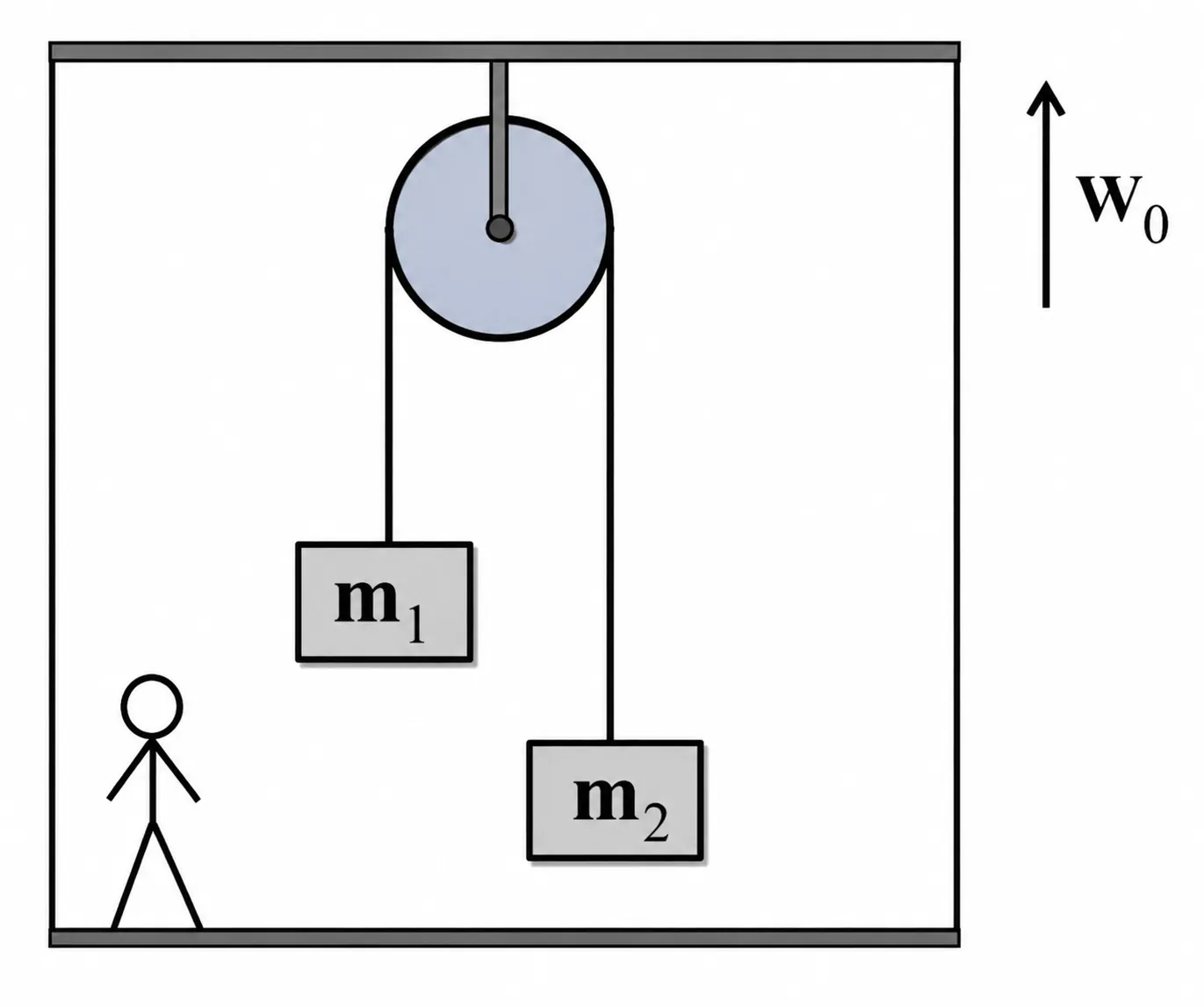
A light pulley is fixed to the ceiling of an elevator. A massless string passes over the pulley, with masses $m_1$ and $m_2$ attached to its two ends. The elevator starts accelerating vertically upward with acceleration $w_0$.
Neglect the mass of the pulley and string and assume that there is no friction.
Find:
- The acceleration of mass $m_1$ relative to the elevator and relative to the elevator shaft.
- The force exerted by the pulley on the ceiling of the elevator.
Solution
Saransh Gupta Sir first points out the most important issue in this problem: the frame of reference.
If we solve the problem with respect to the elevator, the elevator is a non-inertial frame because it is accelerating upward with acceleration $w_0$. Therefore, a pseudo force acts downward on each mass.
So, instead of $g$, the effective gravitational acceleration inside the elevator becomes
$g_{\text{eff}}=g+w_0$.
This gives a quick way to visualize the problem: it is simply an Atwood machine operating under an effective gravity $g+w_0$.
Assume $m_1>m_2$, so that $m_1$ moves downward and $m_2$ moves upward relative to the elevator with acceleration $a$.
For $m_1$,
$m_1(g+w_0)-T=m_1a$.
For $m_2$,
$T-m_2(g+w_0)=m_2a$.
Adding the equations eliminates the tension:
$(m_1-m_2)(g+w_0)=(m_1+m_2)a$.
Hence,
$a=\dfrac{m_1-m_2}{m_1+m_2}(g+w_0)$.
Therefore, the acceleration of $m_1$ relative to the elevator is
$\boxed{a_{1,\text{lift}}=\dfrac{m_1-m_2}{m_1+m_2}(g+w_0)}$
directed downward when $m_1>m_2$.
This is one of the key ideas highlighted in the video: in the accelerating lift frame, simply replace $g$ by $g_{\text{eff}}=g+w_0$ in the familiar Atwood-machine result.
Acceleration Relative to the Elevator Shaft
Now we have to be careful. The acceleration obtained above is relative to the elevator, not relative to the ground or elevator shaft.
Saransh Sir uses the relative-acceleration relation:
$\vec a_{1,\text{ground}}=\vec a_{1,\text{lift}}+\vec a_{\text{lift,ground}}$.
The lift accelerates upward with $w_0$, whereas $m_1$ accelerates downward relative to the lift.
Taking downward as positive,
$a_{1,\text{shaft}}=a-w_0$.
Thus,
$a_{1,\text{shaft}}=\dfrac{m_1-m_2}{m_1+m_2}(g+w_0)-w_0$.
Therefore,
$\boxed{a_{1,\text{shaft}}=\dfrac{(m_1-m_2)g-2m_2w_0}{m_1+m_2}}$
where the sign tells us the actual direction. A positive value corresponds to downward acceleration according to the chosen sign convention. Saransh Sir specifically stresses that the two masses may have equal and opposite accelerations in the lift frame, but this need not remain true in the ground frame.
Tension and Force on the Ceiling
Using either mass equation,
$T=\dfrac{2m_1m_2}{m_1+m_2}(g+w_0)$.
The pulley is pulled downward by two segments of the string, each with tension $T$. Therefore, the magnitude of the force exerted by the pulley on the elevator ceiling is
$F=2T$.
Hence,
$\boxed{F=\dfrac{4m_1m_2}{m_1+m_2}(g+w_0)}$.
The force exerted by the pulley on the ceiling is vertically downward.
Saransh Sir’s Answer Check
An important habit discussed in the video is checking the limiting case.
Put $w_0=0$. The elevator is no longer accelerating, so the answer must reduce to the ordinary Atwood-machine result:
$a=\dfrac{m_1-m_2}{m_1+m_2}g$.
Since it does, the expression passes the basic consistency check.
Irodov Problem 1.73 – Movable Pulley System with Three Masses
Question
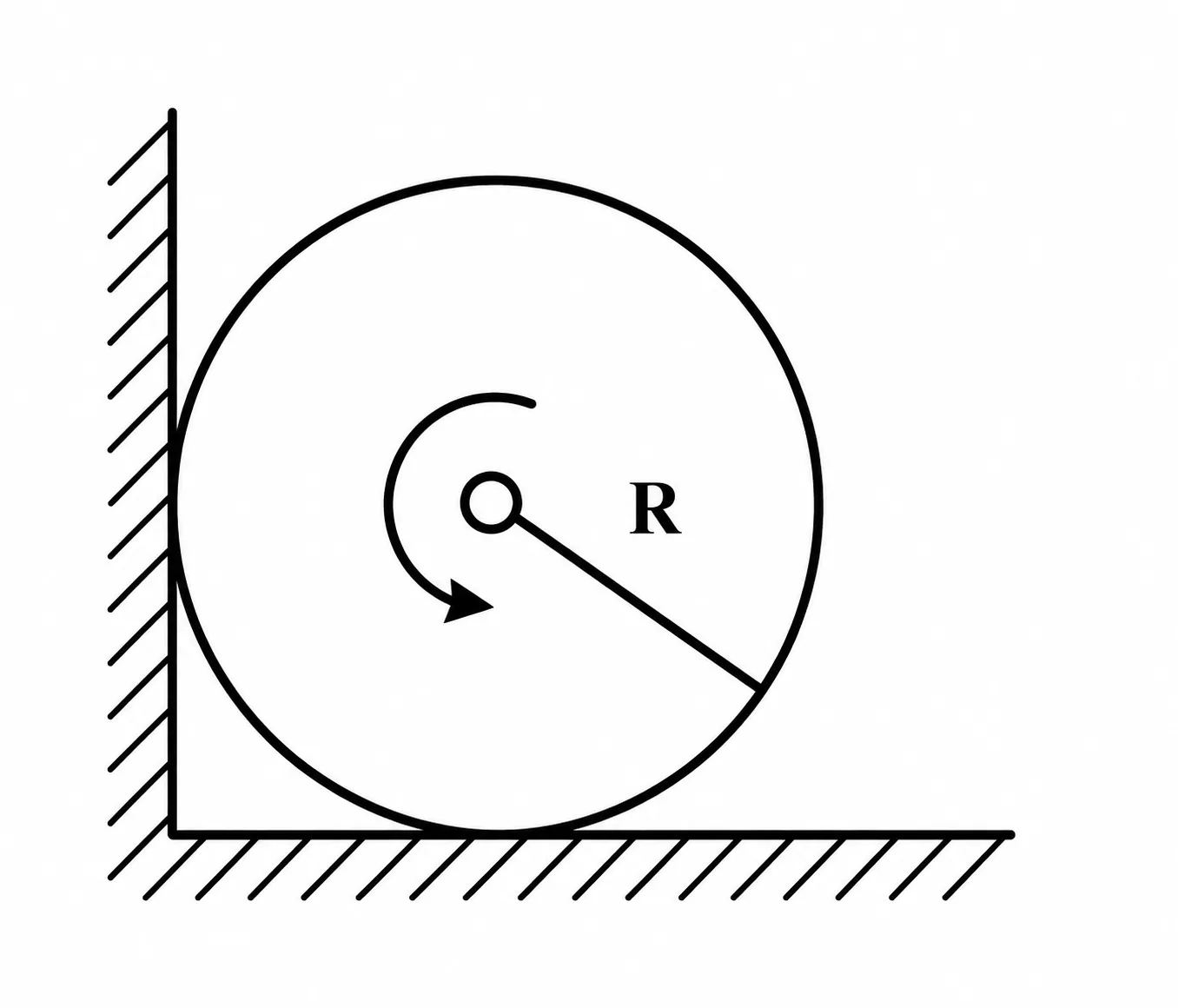
In the pulley arrangement shown in the figure, the three bodies have masses $m_0$, $m_1$, and $m_2$. The pulleys and strings are massless and friction is absent.
Find the acceleration of mass $m_1$ and examine the possible directions of its motion.
Solution
Saransh Gupta Sir begins this problem with an important warning: do not directly assume that $m_1$ and $m_2$ have equal and opposite accelerations.
That familiar constraint works when the pulley is fixed. Here, the pulley itself can move, so the constraint relation must account for its acceleration.
Let the acceleration of the movable pulley be $a_0$. Take downward as positive for $m_1$ and $m_2$.
Let $T$ be the tension in the string carrying $m_1$ and $m_2$, and let $T_0$ be the tension in the string connected to $m_0$.
For mass $m_1$,
$m_1g-T=m_1a_1$.
For mass $m_2$,
$m_2g-T=m_2a_2$.
Because the movable pulley is massless, the net force on it must be zero. Therefore,
$T_0=2T$.
For mass $m_0$,
$T_0=m_0a_0$.
The key step is now the string constraint.
Because the total length of the lower string remains constant,
$a_1+a_2=2a_0$.
This is the relation that replaces the incorrect assumption $a_1=a_2$. Saransh Sir emphasizes using the pulley constraint directly instead of unnecessarily introducing relative accelerations that make the algebra more complicated.
From $T_0=2T$ and $T_0=m_0a_0$,
$T=\dfrac{m_0a_0}{2}$.
Solving the equations together with
$a_1+a_2=2a_0$
gives the acceleration of $m_1$:
$\boxed{a_1=\dfrac{4m_1m_2+m_0(m_1-m_2)}{4m_1m_2+m_0(m_1+m_2)}g}$.
Possible Cases
The denominator is always positive, so the direction of $m_1$ is determined by
$4m_1m_2+m_0(m_1-m_2)$.
If this quantity is positive, $m_1$ accelerates downward.
If
$4m_1m_2+m_0(m_1-m_2)=0$,
then $m_1$ has zero acceleration.
If the quantity is negative, the actual acceleration of $m_1$ is upward.
This is why Saransh Sir advises not to decide beforehand which mass must move upward or downward. Assume a direction, write the equations consistently, and let the sign of the final answer determine the actual motion.
Irodov Problem 1.81 – Block Sliding on a Movable Prism
Question
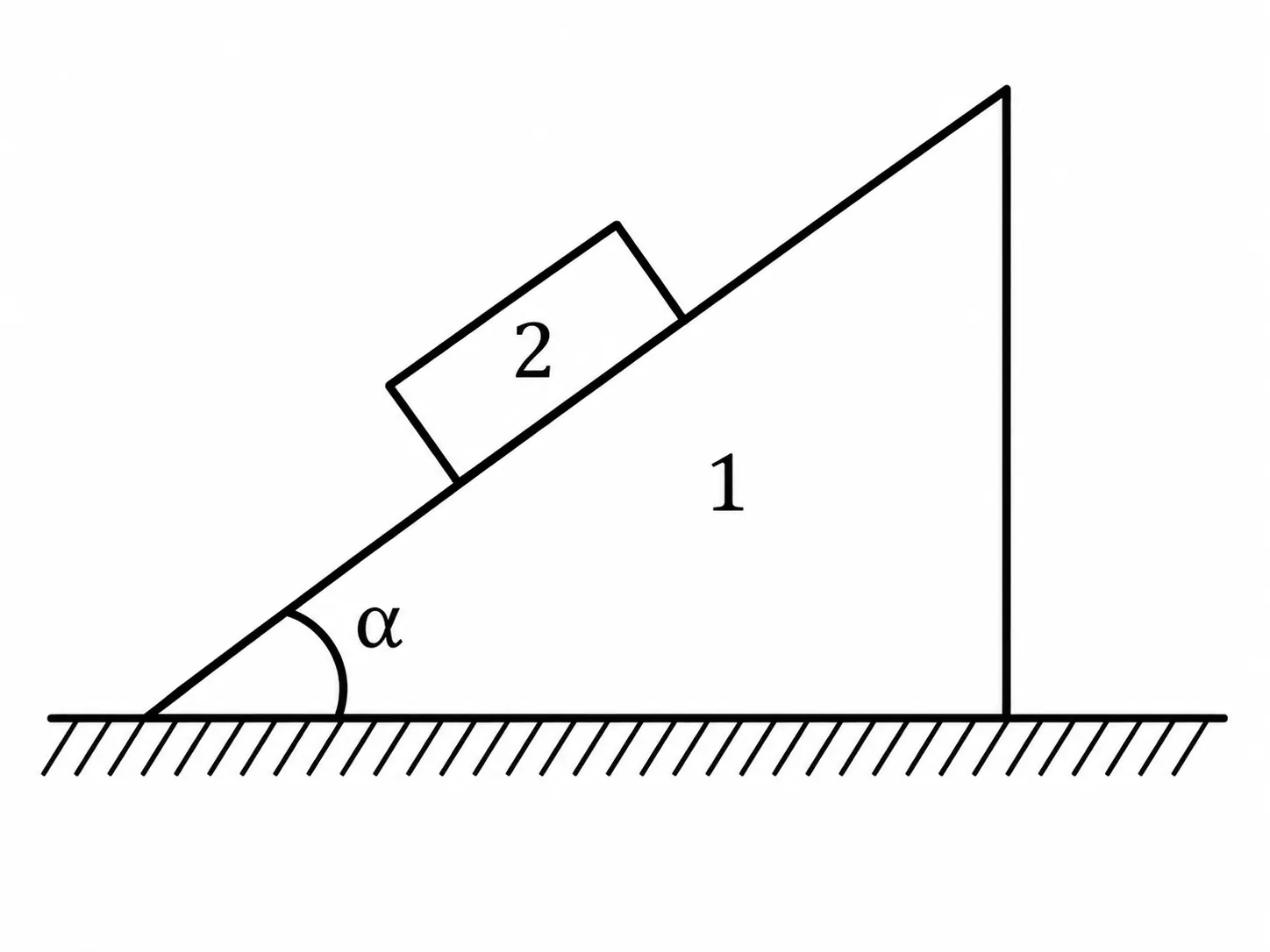
A prism of mass $m_1$ and angle $\alpha$ is placed on a smooth horizontal surface. A block of mass $m_2$ is placed on its smooth inclined face.
Neglect all friction and find the horizontal acceleration of the prism.
Solution
Saransh Gupta Sir uses this problem to highlight a common mistake in wedge problems.
If the block slides along the inclined surface, its acceleration is along the incline only relative to the wedge. Its acceleration relative to the ground is not simply along the incline because the wedge itself is accelerating horizontally.
Let the horizontal acceleration of the prism be $a$, and let the normal reaction between the block and prism be $N$.
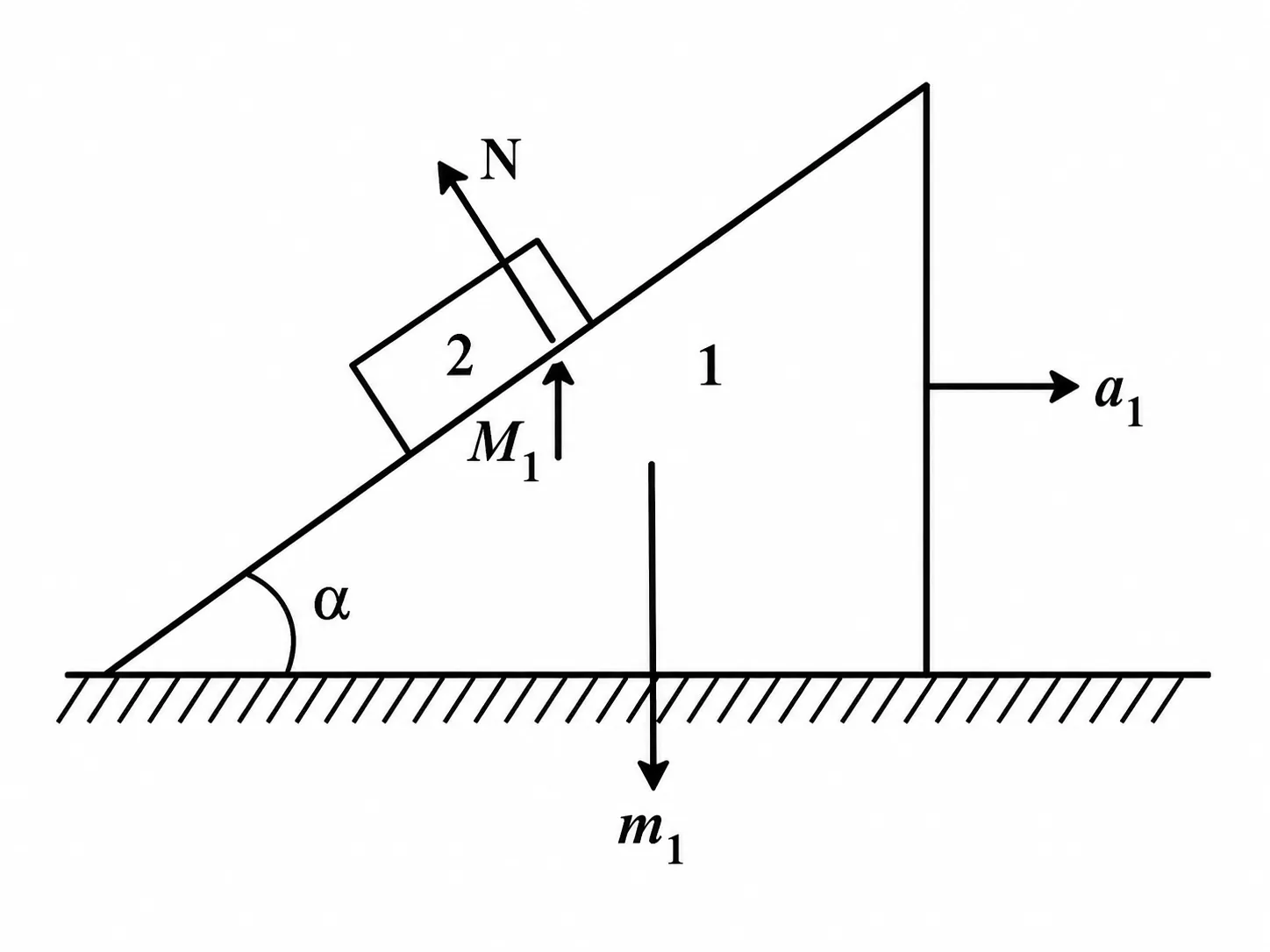
Step 1: Equation for the Prism
The only horizontal force accelerating the prism is the horizontal component of the normal reaction.
The normal makes an angle $\alpha$ with the vertical.
Therefore,
$N\sin\alpha=m_1a$.
So,
$N=\dfrac{m_1a}{\sin\alpha}$.
Saransh Sir gives a useful visualization for remembering this angle: imagine gradually reducing the wedge angle to zero. When $\alpha=0$, the surface becomes horizontal and the normal becomes perfectly vertical. Therefore, the angle between the normal and vertical must also be $\alpha$.
Step 2: Avoid Introducing Unnecessary Acceleration Variables
One possible method is to give the block separate horizontal and vertical accelerations and then write multiple equations.
Saransh Sir deliberately avoids this because it introduces extra variables.
Instead, consider the block’s acceleration relative to the wedge. That relative acceleration lies completely along the inclined surface.
Therefore, if Newton’s second law is projected perpendicular to the inclined surface, the relative acceleration disappears from the equation.
This is the key simplification of the solution.
In the direction perpendicular to and into the inclined surface, the gravitational component is
$m_2g\cos\alpha$.
The normal reaction acts in the opposite direction.
The prism acceleration $a$ has a component perpendicular to the incline equal to
$a\sin\alpha$.
Therefore,
$m_2g\cos\alpha-N=m_2a\sin\alpha$.
Thus,
$N=m_2(g\cos\alpha-a\sin\alpha)$.
Step 3: Substitute the Normal Reaction
Using
$N\sin\alpha=m_1a$,
we get
$m_2(g\cos\alpha-a\sin\alpha)\sin\alpha=m_1a$.
Expanding,
$m_2g\sin\alpha\cos\alpha-m_2a\sin^2\alpha=m_1a$.
Therefore,
$m_2g\sin\alpha\cos\alpha=a(m_1+m_2\sin^2\alpha)$.
Hence, the acceleration of the prism is
$\boxed{a=\dfrac{m_2g\sin\alpha\cos\alpha}{m_1+m_2\sin^2\alpha}}$.
Equivalently,
$\boxed{a=\dfrac{g\sin\alpha\cos\alpha}{\dfrac{m_1}{m_2}+\sin^2\alpha}}$.
This is the final result for Irodov Problem 1.81.
Key Learning from Saransh Sir’s Approach
The important point is not merely the final formula. The elegant part is choosing a direction for Newton’s second law in which the unwanted relative acceleration has no component.
Instead of introducing separate $x$ and $y$ accelerations for the block, the solution uses the fact that its acceleration relative to the wedge is parallel to the incline and therefore disappears when projected perpendicular to it. This reduces the problem directly to two equations in the two unknowns $N$ and $a$.
Question
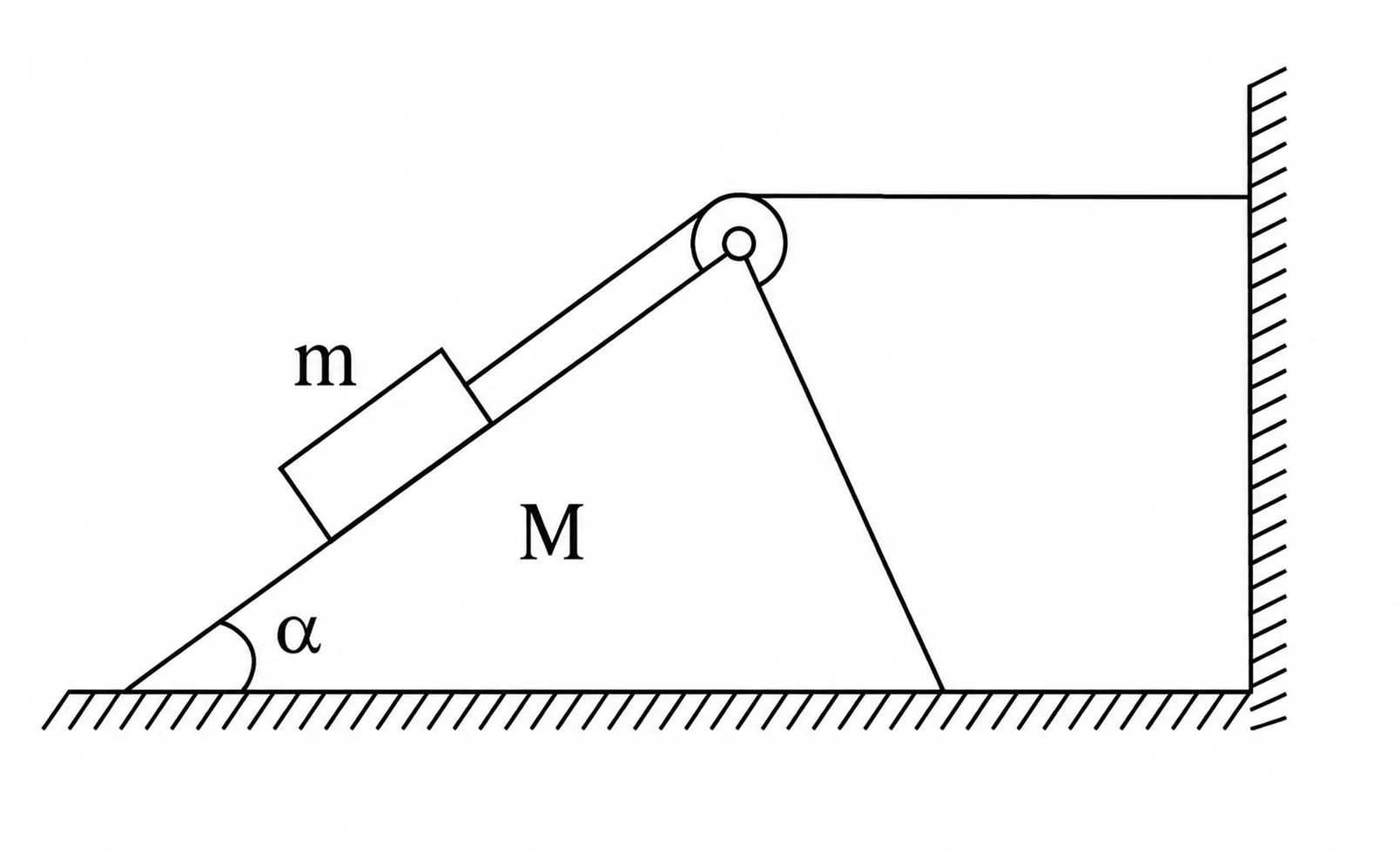
In the arrangement shown in the figure, the mass $m$ of the bar (block), the mass $M$ of the wedge, and the wedge angle $\alpha$ are known. The masses of the pulley and the thread are negligible. Friction is absent.
Find the acceleration of the wedge MM.
Solution
Let the acceleration of the wedge $M$ towards the right be $A$.
Since one end of the string is fixed to the wall, when the wedge and pulley move towards the right by a distance $x$, the horizontal part of the string decreases by $x$.
Therefore, the inclined part of the string must increase by the same amount $x$.
Hence, the acceleration of the block relative to the wedge, down the inclined plane, is
$ a_{\text{rel}}=A $
Now consider the motion of the block in the frame of the accelerating wedge.
Since the wedge accelerates towards the right with acceleration $A$, a pseudo force $mA$ acts on the block towards the left.
Taking the direction down the inclined plane as positive, the forces along the inclined plane are:
- Component of gravity down the plane: $mg\sin\alpha$
- Component of pseudo force down the plane: $mA\cos\alpha$
- Tension $T$ acts up the plane
Therefore,
$ mg\sin\alpha+mA\cos\alpha-T=mA $
Hence,
$ T=mg\sin\alpha-mA(1-\cos\alpha) \qquad ...(1) $
Now consider the forces perpendicular to the inclined plane.
There is no acceleration of the block relative to the wedge in the normal direction. Therefore,
$ N+mA\sin\alpha-mg\cos\alpha=0 $
Thus,
$ N=mg\cos\alpha-mA\sin\alpha \qquad ...(2) $
Now consider the horizontal motion of the wedge.
The horizontal component of the force due to the normal reaction is
$ N\sin\alpha $
The pulley is acted upon by two tensions. The horizontal string exerts a force $T$ towards the right, while the inclined string has a horizontal component $T\cos\alpha$ towards the left.
Therefore, the net horizontal force on the pulley is
$ T-T\cos\alpha=T(1-\cos\alpha) $
Hence, for the wedge,
$ MA=N\sin\alpha+T(1-\cos\alpha) $
Using equations $(1)$ and $(2)$,
$MA=(mg\cos\alpha-mA\sin\alpha)\sin\alpha+mg\sin\alpha-mA(1-\cos\alpha)$
Expanding,
$ MA=mg\sin\alpha\cos\alpha-mA\sin^2\alpha+mg\sin\alpha(1-\cos\alpha)-mA(1-\cos\alpha)^2 $
Combining the gravitational terms,
$ mg\sin\alpha\cos\alpha+mg\sin\alpha(1-\cos\alpha)=mg\sin\alpha $
Also,
$ \sin^2\alpha+(1-\cos\alpha)^2 $
$ =\sin^2\alpha+1-2\cos\alpha+\cos^2\alpha $
$ =2(1-\cos\alpha) $
Therefore,
$ MA=mg\sin\alpha-2mA(1-\cos\alpha) $
Hence,
$ A[M+2m(1-\cos\alpha)]=mg\sin\alpha $
Therefore, the acceleration of the wedge is
$ \boxed{A=\frac{mg\sin\alpha}{M+2m(1-\cos\alpha)}} $
The wedge accelerates towards the right.
Irodov Problems on Friction
Irodov Problem 1.61 – Two Blocks on a Rough Inclined Plane
Question
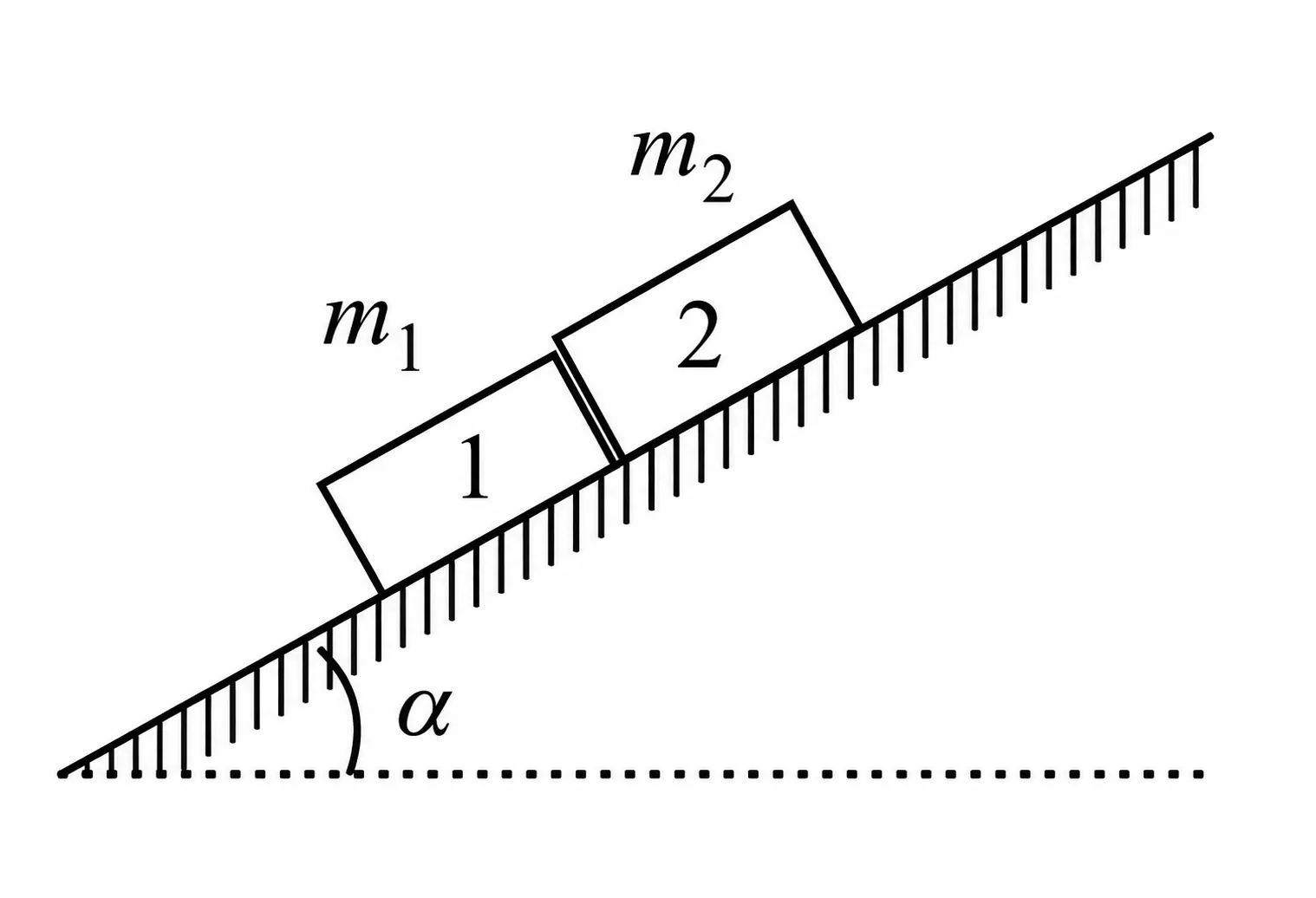
Two touching blocks $1$ and $2$ of masses $m_1$ and $m_2$ are placed on an inclined plane making an angle $\alpha$ with the horizontal.
The coefficients of friction between the inclined plane and the two blocks are $k_1$ and $k_2$, respectively, where $k_1>k_2$.
Find:
(a) the force of interaction between the blocks while they are moving;
(b) the minimum value of $\alpha$ at which the blocks start sliding down the plane.
Solution
The first thing to understand is why there is a force of interaction between the two blocks.
Since $k_1>k_2$, if the blocks were allowed to slide independently, block $1$ would experience greater friction and hence would have a smaller acceleration down the inclined plane.
Block $2$, which has the smaller coefficient of friction, tends to accelerate faster.
But the two blocks are touching each other. Therefore, block $2$ pushes block $1$, and both move together with the same acceleration $a$.
Let the force of interaction between the blocks be $N$.
For block $1$, along the inclined plane,
$m_1g\sin\alpha+N-k_1m_1g\cos\alpha=m_1a$
For block $2$,
$m_2g\sin\alpha-N-k_2m_2g\cos\alpha=m_2a$
Both blocks have the same acceleration because they remain in contact while moving.
Adding the two equations,
$(m_1+m_2)g\sin\alpha-(k_1m_1+k_2m_2)g\cos\alpha=(m_1+m_2)a$
Therefore,
$a=g\sin\alpha-\dfrac{k_1m_1+k_2m_2}{m_1+m_2}g\cos\alpha$
Now substitute this value of $a$ in either of the individual equations.
Using the equation for block $1$,
$N=m_1a-m_1g\sin\alpha+k_1m_1g\cos\alpha$
Substituting $a$ and simplifying,
$\boxed{N=\dfrac{m_1m_2}{m_1+m_2}(k_1-k_2)g\cos\alpha}$
Therefore, the force of interaction between the blocks is
$\boxed{N=\dfrac{m_1m_2(k_1-k_2)g\cos\alpha}{m_1+m_2}}$
Minimum Angle for Sliding
Now we have to find the minimum value of $\alpha$ at which the blocks just begin to slide.
At the limiting condition, the blocks are just about to start moving, so
$a=0$
Using the combined equation,
$(m_1+m_2)g\sin\alpha=(k_1m_1+k_2m_2)g\cos\alpha$
Therefore,
$(m_1+m_2)\tan\alpha=k_1m_1+k_2m_2$
Hence,
$\boxed{\tan\alpha_{\min}=\dfrac{k_1m_1+k_2m_2}{m_1+m_2}}$
or
$\boxed{\alpha_{\min}=\tan^{-1}\left(\dfrac{k_1m_1+k_2m_2}{m_1+m_2}\right)}$
The important learning from this question is that although the two blocks have different coefficients of friction, they have the same acceleration while they remain in contact.
Irodov Problem 1.62 – Time of Ascent and Descent on a Rough Incline
Question
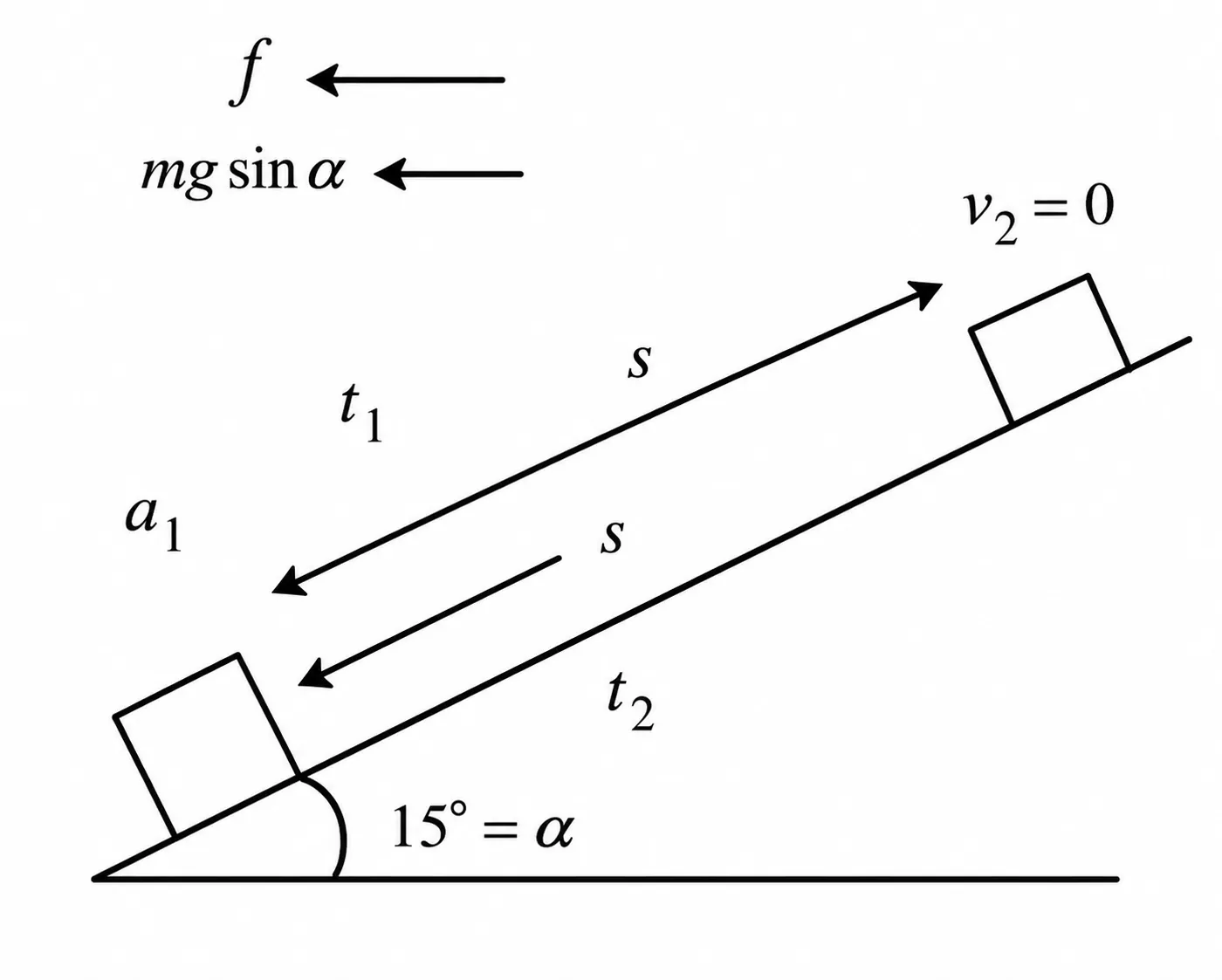
A small body is projected upward along an inclined plane making an angle $\alpha=15^\circ$ with the horizontal.
The time taken by the body to move upward is $\eta=2$ times less than the time taken by it to slide back down.
Find the coefficient of friction $\mu$ between the body and the inclined plane.
Solution
This problem gives a result which may initially look opposite to our intuition.
Normally, we may feel that going upward should take more time and coming downward should take less time.
But friction changes the situation.
Suppose the body is projected upward with velocity $u$.
Let the time of ascent be $t_1$ and the time of descent be $t_2$.
According to the question,
$t_2=2t_1$
Let the acceleration magnitude while moving upward be $a_1$.
During upward motion, both the component of gravity and friction act down the inclined plane.
Therefore,
$ma_1=mg\sin\alpha+\mu mg\cos\alpha$
Hence,
$a_1=g(\sin\alpha+\mu\cos\alpha)$
Now consider the downward journey.
During downward motion, gravity acts down the plane but friction acts upward.
Therefore,
$ma_2=mg\sin\alpha-\mu mg\cos\alpha$
Hence,
$a_2=g(\sin\alpha-\mu\cos\alpha)$
Thus,
$a_1>a_2$
This immediately explains why the upward journey can take less time.
During upward motion, gravity and friction both oppose the motion, so the body loses its velocity very rapidly.
During downward motion, friction opposes gravity, so the acceleration is smaller and the body takes more time to travel the same distance.
Let the distance travelled along the plane be $s$.
At the highest point, the velocity becomes zero.
For the upward journey,
$s=\dfrac{1}{2}a_1t_1^2$
For the downward journey, the body starts from rest from the highest point, so
$s=\dfrac{1}{2}a_2t_2^2$
Since the distance is the same,
$a_1t_1^2=a_2t_2^2$
Using $t_2=2t_1$,
$a_1=4a_2$
Therefore,
$g(\sin\alpha+\mu\cos\alpha)=4g(\sin\alpha-\mu\cos\alpha)$
Cancelling $g$,
$\sin\alpha+\mu\cos\alpha=4\sin\alpha-4\mu\cos\alpha$
Hence,
$5\mu\cos\alpha=3\sin\alpha$
Therefore,
$\mu=\dfrac{3}{5}\tan\alpha$
For $\alpha=15^\circ$,
$\boxed{\mu=\dfrac{3}{5}\tan15^\circ}$
Numerically,
$\boxed{\mu\approx0.161}$
The key idea is that the acceleration during ascent is larger than during descent because during ascent both friction and the component of gravity oppose the motion.
Irodov Problem 1.74 – Ball Sliding Along a Thread
Question
In the arrangement shown in the figure, a rod of mass $M$ and a ball of mass $m$ are connected through a light thread passing over a frictionless pulley, where $M>m$.
The ball has a hole through which the thread can slide with friction.
Initially, the ball is opposite the lower end of the rod. After the system is released, both bodies move with constant accelerations.
After a time $t$, the ball reaches a position opposite the upper end of the rod.
If the length of the rod is $l$, find the friction force between the ball and the thread.
Solution
The first and most important observation is that there is no normal string constraint between the rod and the ball.
The ball is not tied to the thread.
It has a hole through which the thread can slide.
Therefore, it is not necessary that if the rod moves downward with some acceleration, the ball must move upward with the same acceleration.
Their accelerations can be different.
Let the rod of mass $M$ accelerate downward with acceleration $a_1$.
Let the ball of mass $m$ have acceleration $a_2$ upward.
Let the tension in the thread be $T$.
Why is Tension Equal to Friction?
This is the beautiful concept in this problem.
The thread develops tension only because friction acts between the ball and the thread.
Consider a very small portion of the thread lying inside the hole of the ball.
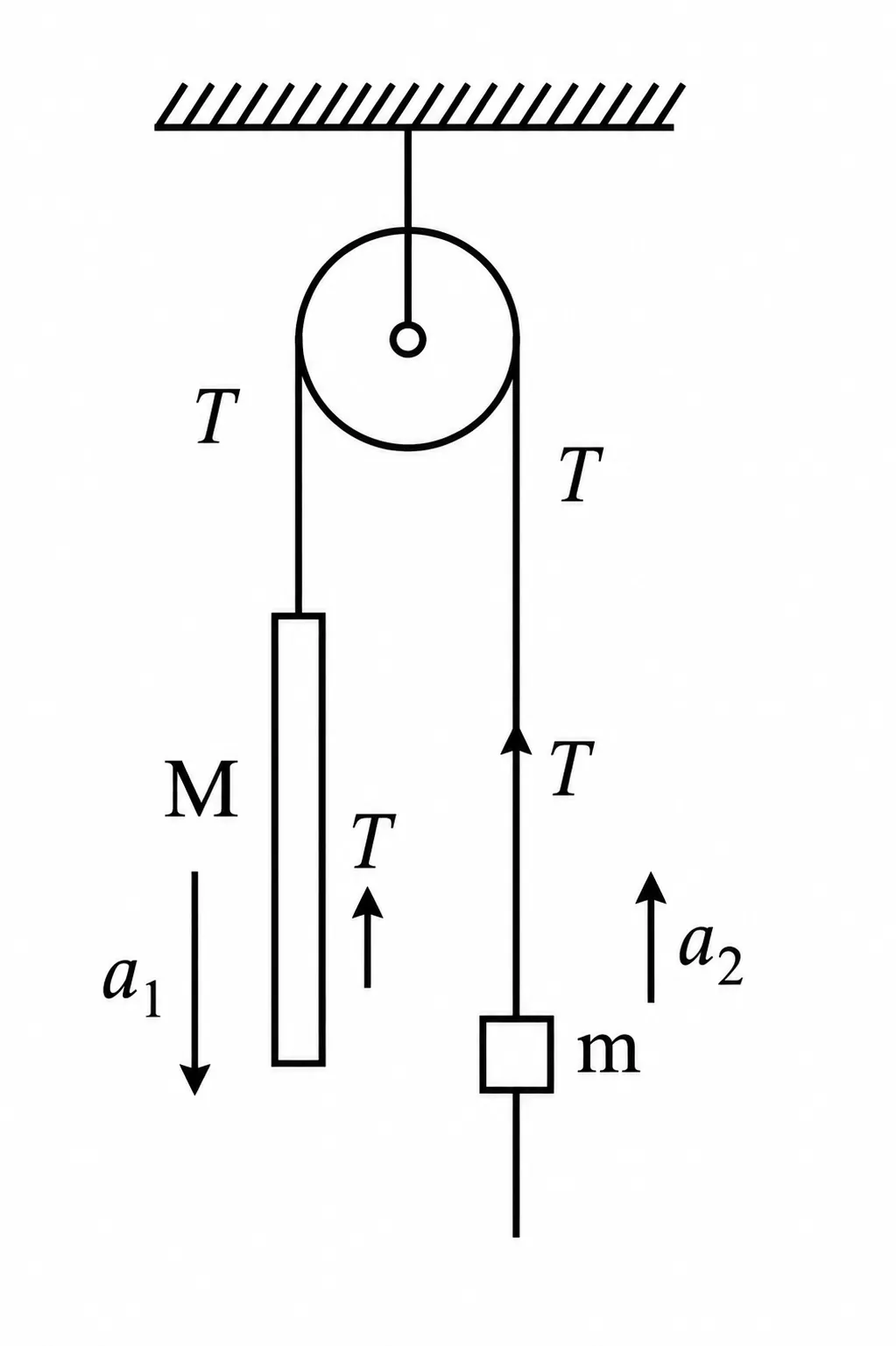
The small portion of thread is massless.
Tension $T$ acts on it in one direction and friction $f$ acts in the opposite direction.
Therefore,
$T-f=0$
Hence,
$\boxed{T=f}$
So the friction force between the ball and the thread is equal to the tension in the thread.
Equation for the Rod
For the rod of mass $M$,
$Mg-T=Ma_1$
Therefore,
$a_1=g-\dfrac{T}{M}$
Equation for the Ball
For the ball,
$T-mg=ma_2$
Therefore,
$a_2=\dfrac{T}{m}-g$
Relative Motion
Initially, the ball is opposite the lower end of the rod.
After time $t$, it is opposite the upper end.
Therefore, relative to the rod, the ball has travelled a distance $l$.
Since the rod accelerates downward while the ball accelerates upward, their relative acceleration is
$a_{\text{rel}}=a_1+a_2$
Both start from rest, so
$l=\dfrac{1}{2}(a_1+a_2)t^2$
Therefore,
$a_1+a_2=\dfrac{2l}{t^2}$
Now,
$a_1+a_2=g-\dfrac{T}{M}+\dfrac{T}{m}-g$
Hence,
$a_1+a_2=T\left(\dfrac{1}{m}-\dfrac{1}{M}\right)$
Therefore,
$\dfrac{2l}{t^2}=T\dfrac{M-m}{mM}$
Thus,
$T=\dfrac{2lmM}{(M-m)t^2}$
Since $T=f$,
$\boxed{f=\dfrac{2lmM}{(M-m)t^2}}$
This is the required friction force.
The main concepts to learn from this problem are:
The ball is not tied to the string, so there is no ordinary string constraint between the rod and the ball.
The tension in the thread is produced because of friction between the ball and the thread.
The required displacement condition is most easily written using relative motion.
Irodov Problem 1.79 – Minimum Acceleration of a Bar
Question
In the arrangement shown in the figure, bodies $1$ and $2$ have equal masses $m$.
The coefficient of friction between each body and bar $A$ is $k$.
The masses of the pulley and strings are negligible and there is no friction in the pulley.
Find the minimum horizontal acceleration $a$ with which bar $A$ must be moved so that both bodies remain stationary relative to the bar.
Solution
This is a minimum-acceleration problem, so the most important step is to determine the tendency of motion and hence the direction of friction.
We want both bodies to remain stationary relative to bar $A$.
Therefore, it is convenient to analyse the system in the accelerating frame of the bar.
Suppose bar $A$ is accelerating horizontally towards the right with acceleration $a$.
In the frame of the bar, each body experiences a pseudo force $ma$ towards the left.
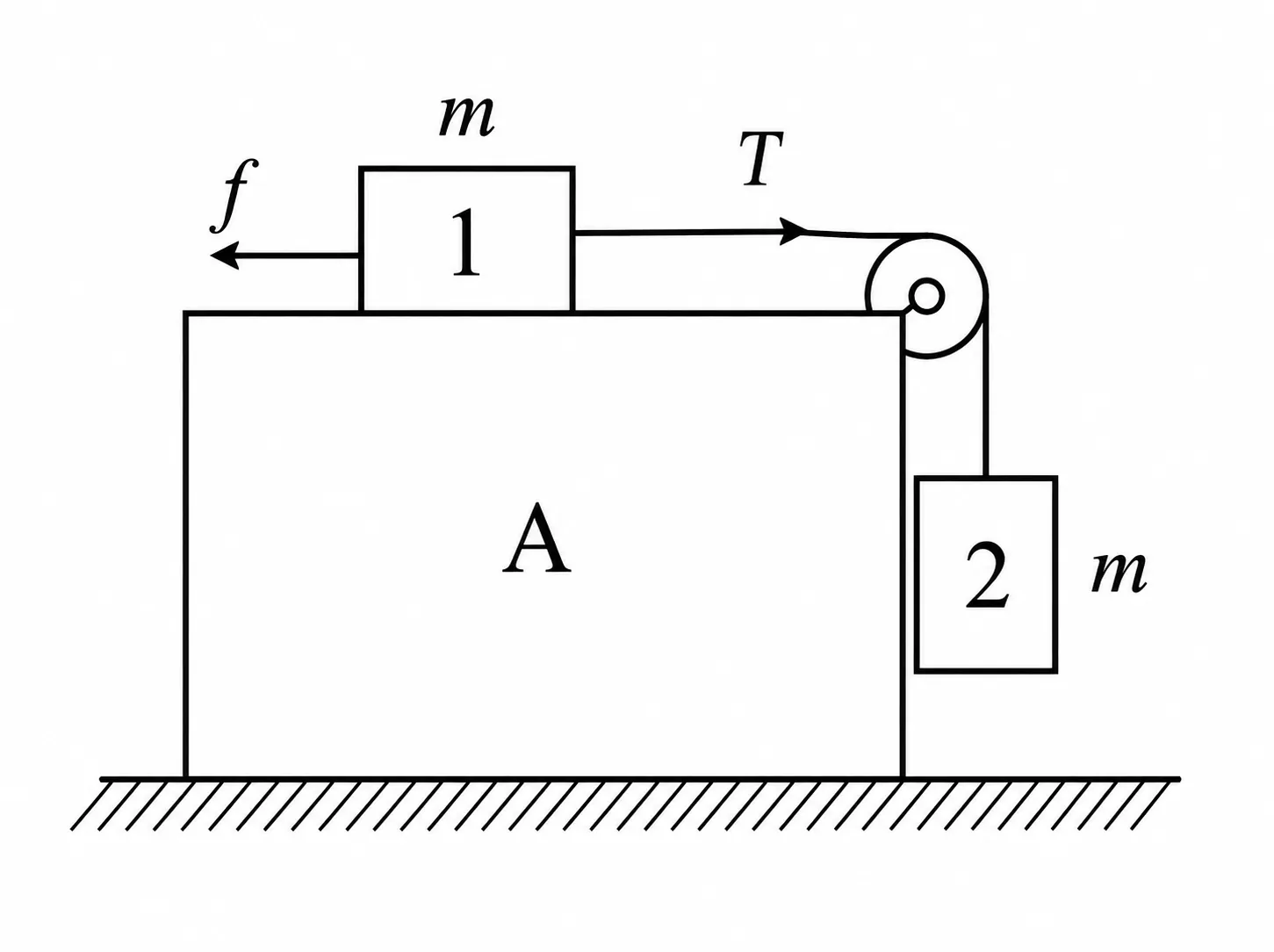
Friction on Body 1
For the minimum acceleration condition, body $1$ has a tendency to move towards the right relative to the bar.
Therefore, friction on body $1$ acts towards the left.
Let this friction be $f_1$.
The tension $T$ acts towards the right.
The pseudo force $ma$ acts towards the left.
Since the body is stationary relative to the bar,
$T-f_1-ma=0$
Therefore,
$f_1=T-ma$
For body $1$, in the vertical direction,
$N_1=mg$
Forces on Body 2
Body $2$ has a tendency to slide downward.
Therefore, friction $f_2$ acts upward.
Horizontally, the normal force must balance the pseudo force.
Hence,
$N_2=ma$
Vertically, body $2$ is stationary relative to the bar.
Therefore,
$T+f_2=mg$
Hence,
$f_2=mg-T$
Now add the two friction forces required to maintain equilibrium:
$f_1+f_2=(T-ma)+(mg-T)$
Therefore,
$f_1+f_2=m(g-a)$
At the minimum acceleration condition, the available friction reaches its limiting requirement.
The maximum total available friction is
$kN_1+kN_2$
Therefore,
$f_1+f_2=k(N_1+N_2)$
Using $N_1=mg$ and $N_2=ma$,
$m(g-a)=k(mg+ma)$
Cancelling $m$,
$g-a=k(g+a)$
Therefore,
$g-a=kg+ka$
Hence,
$g(1-k)=a(1+k)$
Thus, the minimum acceleration is
$\boxed{a_{\min}=g\dfrac{1-k}{1+k}}$
Important Point About “Minimum”
The direction of friction is decided by the tendency of relative motion.
For the minimum acceleration, body $1$ tends to move forward relative to the bar, so friction on it acts backward.
Body $2$ tends to slide downward, so friction on it acts upward.
If the question asked for the maximum possible acceleration instead, these tendencies could reverse, and the directions of friction would have to be reconsidered.
Therefore,
$\boxed{a_{\min}=\dfrac{g(1-k)}{1+k}}$
is obtained only after correctly identifying the limiting condition and the directions of friction.
Frequently Asked Questions
Find answers to common questions.
Is Irodov sufficient for JEE Advanced?
How many Irodov questions should I solve before JEE Advanced?
There's no fixed number — focus on the "High relevance" chapters listed in this guide rather than a target count. Solving 150–200 well-chosen problems across Mechanics, Electrodynamics, and Optics is a realistic, useful range.
Is Irodov harder than JEE Advanced?
In some sections, yes — particularly Relativity and advanced Atomic Physics, which aren't part of the JEE Advanced syllabus at all. In the overlapping chapters, the difficulty level is comparable to or slightly above JEE Advanced's toughest questions.
Which Irodov chapters should I skip for JEE Advanced?
Skip Relativity entirely and skip the advanced sections of Atomic and Nuclear Physics. These go beyond what JEE Advanced tests and are better replaced with previous years' paper practice.
Does solving Irodov actually improve JEE Advanced rank?
It can, indirectly — by improving speed and accuracy on multi-concept questions, which are a significant part of JEE Advanced's marks-vs-rank curve. It's not a substitute for mock tests and previous years' papers, though — it's a supplement.