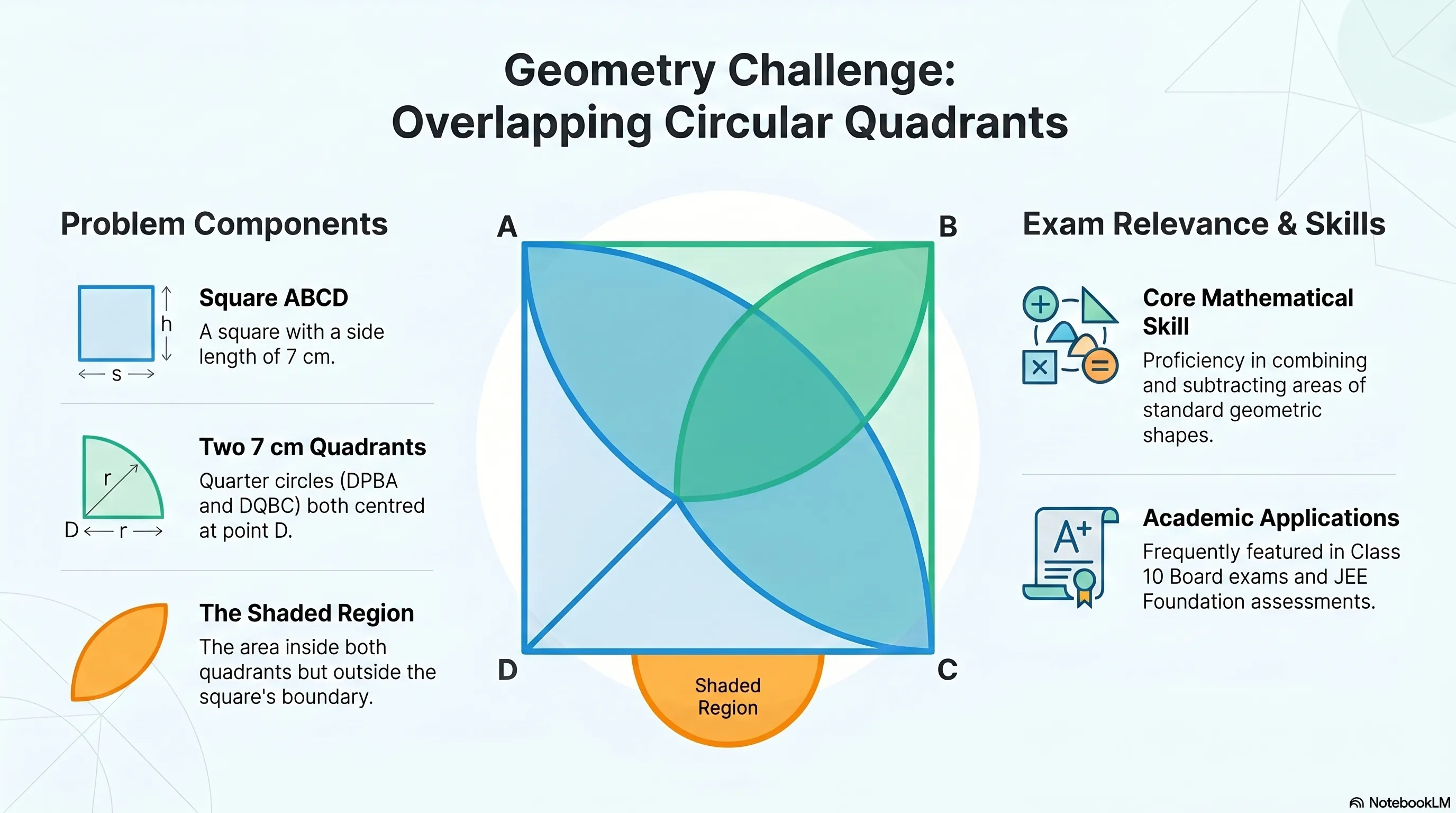
In the given figure, ABCD is a square of side 7 cm, DPBA and DQBC are quadrants of circles each of the radius 7 cm.
This Class 10 Areas Related to Circles problem finds the shaded region by adding the areas of two quadrants of radius 7 cm and subtracting the area of the square, giving a final shaded area of 28 cm².


What Does This Problem Ask?
This is a standard Class 10 NCERT problem from Chapter 12 — Areas Related to Circles. You are given:
- A square ABCD with side 7 cm
- Quadrant DPBA — a quarter circle of radius 7 cm centred at D, passing through points P, B, and A
- Quadrant DQBC — a quarter circle of radius 7 cm centred at D, passing through points Q, B, and C
The shaded region is the area inside both quadrants but outside the square — essentially the two circular arcs bulging beyond the boundary of the square, minus the overlapping square itself.
This type of problem tests your ability to combine and subtract areas of standard geometric shapes — a skill that appears repeatedly in board exams and JEE Foundation assessments.
In the given figure, ABCD is a square of side 7 cm, DPBA and DQBC are quadrants of circles each of the radius 7 cm. Find the area of shaded region.
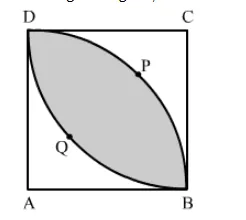
Area of the shaded portion = (Area of quadrant DPBA + Area of quadrant DQBC) − Area of Square ABCD
$=\left[\frac{1}{4} \pi(7)^{2}+\frac{1}{4} \pi(7)^{2}\right]-(7)^{2}$
$=\frac{1}{2} \times \frac{22}{7}(7)^{2}-49$
$=28 \mathrm{~cm}^{2}$
Hence, the area of the shaded portion is 28 cm2.
Frequently Asked Questions
Find answers to common questions.
What is the area of the shaded region when ABCD is a square of side 7 cm and DPBA and DQBC are quadrants of radius 7 cm?
The area of the shaded region is 28 cm². It is calculated by adding the areas of both quadrants (each = ¼ × 22/7 × 49 = 38.5 cm²) to get 77 cm², then subtracting the area of the square (49 cm²). The result is 77 − 49 = 28 cm².
What formula is used to find the area of a quadrant of a circle?
The area of a quadrant is ¼ × π × r², where r is the radius of the circle. A quadrant is one-fourth of a full circle. For r = 7 cm and π = 22/7, the area of each quadrant = ¼ × 22/7 × 49 = 38.5 cm². This formula appears directly in NCERT Class 10 Chapter 12.
Why is the area of the square subtracted in this problem?
The square ABCD is subtracted because both quadrants overlap exactly over the square region. If you add the two quadrant areas without subtracting, the square area is counted twice. Subtracting the square once (49 cm²) corrects this double-counting. This is the inclusion-exclusion principle applied to geometric areas.
What is the value of π used in this NCERT problem?
NCERT Class 10 problems involving a radius that is a multiple of 7 (such as 7 cm, 14 cm, or 21 cm) use π = 22/7. This makes the arithmetic clean and avoids decimals. When the radius is not a multiple of 7, π = 3.14 is typically used. Always check which value the problem specifies or implies.
Is this problem from NCERT Class 10 Chapter 12?
Yes. This problem is from NCERT Class 10 Maths Chapter 12 — Areas Related to Circles, specifically from the exercise on combinations of plane figures. The chapter is part of the Class 10 board exam syllabus and carries significant weightage. It also forms the foundation for integration-based area problems in Class 12 Maths.