Table 13.1 biology class 11 solutions
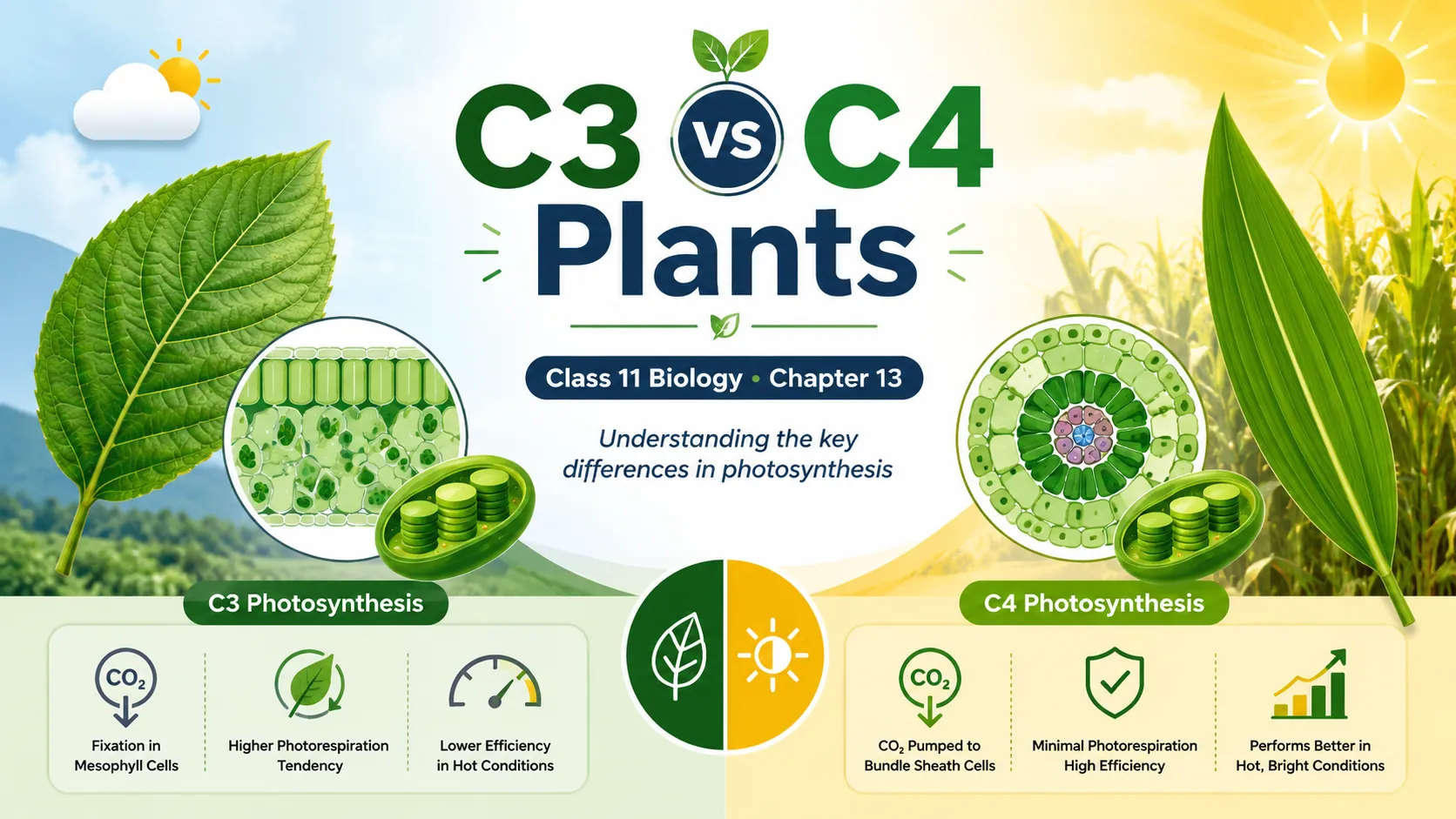
Table of Contents

eSaral › Class 11 › Table 13.1 biology class 11 solutions

What Is the Complete Difference Between C3 and C4 Plants (Table 13.1 Answer)?
| Feature | C3 Plants | C4 Plants |
|---|---|---|
| Pathway name | C3 pathway / Calvin cycle only | C4 pathway / Hatch-Slack pathway |
| Bundle sheath chloroplasts | Absent | Present (Kranz anatomy) |
| Primary CO₂ acceptor | RuBP (5-carbon compound) | PEP (3-carbon compound) |
| First stable product | 3-PGA (3-carbon compound) | OAA, oxaloacetic acid (4-carbon compound) |
| Carboxylating enzyme | RuBisCO only | PEPCase (mesophyll) + RuBisCO (bundle sheath) |
| Number of carboxylation sites | One (mesophyll cells only) | Two (mesophyll + bundle sheath cells) |
| CO₂ fixation cycles | Calvin cycle only | Hatch-Slack cycle + Calvin cycle |
| Photorespiration | Significant, lowers yield | Minimal to absent |
| Optimum temperature | 10–25°C | 30–45°C |
| Water use efficiency | Lower | Higher |
| Leaf anatomy | Normal, no Kranz anatomy | Kranz anatomy (ring of bundle sheath cells) |
| Photosynthetic efficiency in high light/heat | Lower | Higher |
| Example plants | Rice, wheat, oats, spinach, most trees | Maize, sugarcane, sorghum, pearl millet |
Why Do C3 Plants Fix CO₂ Only Once, in the Mesophyll Cells?
C3 plants lack a CO₂-concentrating mechanism. Their only carboxylating enzyme, RuBisCO, is present solely in mesophyll cell chloroplasts, where it directly combines atmospheric CO₂ with RuBP to form two molecules of 3-PGA. Since RuBisCO has almost equal affinity for CO₂ and O₂, whenever CO₂ levels drop (such as when stomata partially close in heat), RuBisCO starts binding O₂ instead — triggering photorespiration and reducing net photosynthetic output. This is the core biochemical reason C3 plants are less efficient in hot, dry environments.
Why Do C4 Plants Fix CO₂ Twice — Once in Mesophyll, Once in Bundle Sheath Cells?
C4 plants evolved a two-step CO₂ fixation system specifically to keep RuBisCO surrounded by a high concentration of CO₂ at all times, so it rarely binds O₂:
- Step 1 (Mesophyll cells): CO₂ combines with PEP using the enzyme PEPcase, forming a 4-carbon compound, oxaloacetic acid (OAA). PEPcase has no affinity for O₂, so this step is unaffected by high temperature or low CO₂.
- Transport: OAA is converted to malate and transported to nearby bundle sheath cells through plasmodesmata.
- Step 2 (Bundle sheath cells): Malate breaks down, releasing CO₂ at high local concentration right next to RuBisCO, which then runs the normal Calvin cycle to produce sugar.
This "CO₂ pump" is why C4 plants rarely photorespire and remain efficient even under intense sunlight and heat.
What Is Kranz Anatomy and How Does It Enable the C4 Pathway?
Kranz anatomy (German for "wreath") is the distinctive leaf structure found only in C4 plants. Bundle sheath cells — large cells containing chloroplasts — form a tight ring around each vascular bundle, surrounded in turn by a ring of mesophyll cells. This physical arrangement:
- Keeps the two carboxylation sites (mesophyll and bundle sheath) close together for efficient CO₂/malate transport
- Isolates RuBisCO inside bundle sheath cells, away from atmospheric O₂ exposure
- Allows CO₂ concentration around RuBisCO to be several times higher than atmospheric levels, suppressing photorespiration almost entirely
C3 plants lack this specialised anatomy — their bundle sheath cells, if present, do not contain chloroplasts.
Which Plants Are C3 and Which Are C4? (With Examples)
| Category | Examples |
|---|---|
| C3 plants | Rice, wheat, oats, barley, spinach, potato, most trees and shrubs |
| C4 plants | Maize (corn), sugarcane, sorghum, pearl millet (bajra), Amaranthus |
Why it matters for exams: NEET frequently asks students to identify whether a named crop is C3 or C4 based on this list, so memorising a handful of common examples from each group is high-yield revision.
Why Are C4 Plants More Efficient Than C3 Plants in Hot Climates?
C4 plants outperform C3 plants under high temperature and high light intensity for three connected reasons:
- Their CO₂-concentrating mechanism keeps RuBisCO saturated with CO₂, virtually eliminating photorespiration.
- PEPcase (used in the first fixation step) has a much higher affinity for CO₂ than RuBisCO and no competing affinity for O₂.
- Because they don't need stomata open as wide or as long to gather sufficient CO₂, C4 plants lose less water through transpiration — giving them a natural advantage in hot, dry, tropical regions.
This is exactly why crops like sugarcane and maize, cultivated in high-temperature regions, are C4 plants, while temperate-climate staples like wheat remain C3. Once this reasoning is clear, test recall speed with eSaral's NEET Test Series, which includes topic-wise Photosynthesis mock sections.
How Is Table 13.1 Usually Asked in CBSE Board Exams and NEET?
Table 13.1 is tested in a few recurring formats that aspirants should specifically practise:
- Direct tabular/list question: "Differentiate between C3 and C4 plants" (2–3 marks, board exam)
- Assertion-Reason: Statements combining Kranz anatomy, PEPcase, or photorespiration, testing whether students understand the reasoning, not just the terms
- Identify-the-pathway question: Given a diagram or plant name, identify whether it follows the C3 or C4 pathway
- Application-based NEET MCQ: Testing why C4 plants show minimal photorespiration or higher water-use efficiency
Cross-check your prep against the full NEET Syllabus to see how Photosynthesis fits alongside other high-weightage Botany chapters.
What Are Some NEET-Level Practice Questions Based on Table 13.1?
Q. Why does PEPcase not contribute to photorespiration the way RuBisCO does? PEPcase is specific to CO₂ and has no affinity for O₂, unlike RuBisCO, which can bind both — so PEPcase-driven fixation never leads to the wasteful oxygenation reaction that causes photorespiration.
Q. Why is 3-PGA the first stable product in C3 plants but OAA in C4 plants? In C3 plants, CO₂ combines with the 5-carbon RuBP to directly form two 3-carbon 3-PGA molecules. In C4 plants, CO₂ combines with the 3-carbon PEP to form the 4-carbon OAA — a different acceptor molecule, hence a different first product.
Q. Would a C4 plant survive in cool, low-light conditions as efficiently as a C3 plant? No — the C4 pathway requires extra ATP to regenerate PEP, making it energetically costlier. In cool, moderate-light conditions where photorespiration is naturally low, C3 plants are actually more energy-efficient than C4 plants.
For more application-based questions in this exact style, work through NEET Previous Year Question Papers year by year.
Why Is This Topic High-Weightage for NEET Biology Aspirants?
The C3–C4 comparison sits at the intersection of plant anatomy, enzyme biochemistry, and photosynthetic efficiency — three examiner-favourite angles rolled into a single table. Because NEET frequently rewords the same underlying concept (Kranz anatomy, PEPcase specificity, photorespiration suppression) into new question formats each year, understanding why each difference exists — not just memorising the table — is what protects marks on unfamiliar question phrasing. Practice how this exact topic has been asked before with NEET Chapterwise PYQ.
Where Can I Read the Full Chapter 13 NCERT Solutions?
This page expands specifically on Table 13.1. For the complete chapter — light reaction, dark reaction, chemiosmotic hypothesis, photorespiration, and factors affecting the rate of photosynthesis — read the full chapter breakdown here: NCERT Class 11 Biology Chapter 13 Photosynthesis in Higher Plants
Struggling to remember biochemistry tables like this one under exam pressure? eSaral's NEET Biology course breaks down every high-weightage NCERT table into quick-revision visuals and topic tests, taught by Kota's top faculty. Explore NEET Biology Courses on eSaral →
Frequently Asked Questions
Find answers to common questions.