CBSE Class 10 Revision Notes 2025-26 - PDF Download
Class 10
"Board exams aa gaye, aur notes ka kya karna hai?"
If this question is running in your mind right now, then sit down and read this blog like your Class 10 result depends on it — because it actually does.
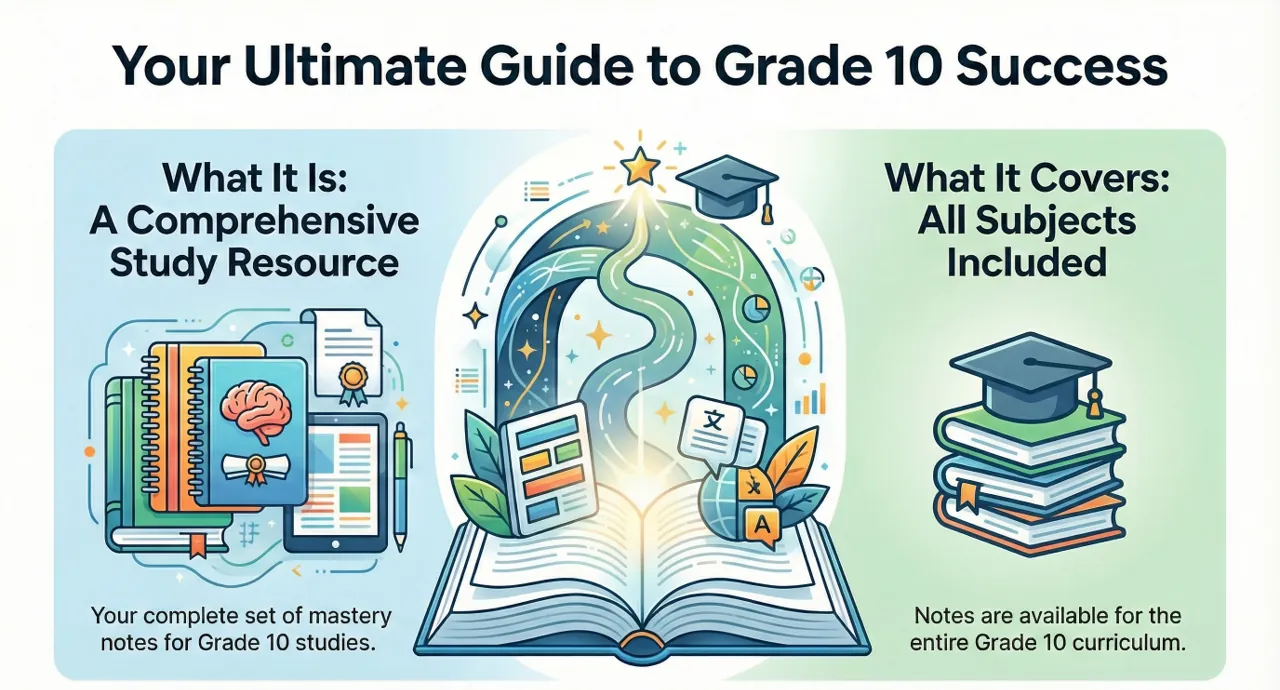
CBSE Class 10 board exams are not just another test. They decide your stream, your confidence, your future direction. And the difference between students who score 90+ and those who struggle? The right revision notes.
These Class 10 revision notes are not just random PDFs floating on the internet. They are your secret weapon for those final 2-3 months when every mark matters. Think about it: when you're sitting in that exam hall, your mind should instantly recall formulas, dates, diagrams — not waste time trying to remember what chapter had what concept.
Class 10 notes work because they strip away the noise. No 500-page textbooks. No confusing explanations. Just pure, concentrated knowledge that goes straight into your brain and stays there.
Download All Class 10 Revision Notes PDFs
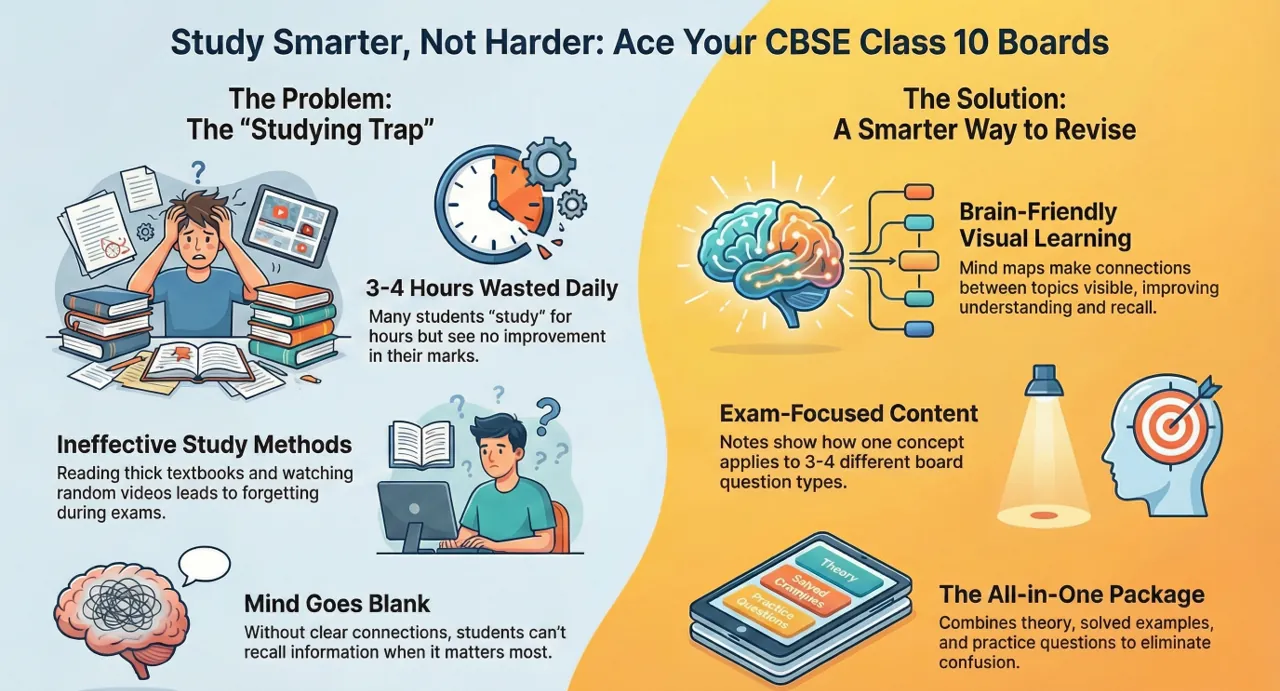
Here's the reality: Most students waste 3-4 hours daily "studying" but see no improvement in marks. They read thick textbooks, watch random videos, make colorful notes — but when exam time comes, their mind goes blank.
The CBSE Class 10 revision notes for 2025-26 solve this exact problem. They don't just give you information. They give you rank-boosting information organized exactly how your brain needs it.
|
S. No |
CBSE Class 10 Revision Notes |
|
|
1 |
||
|
2 |
||
|
3 |
||
|
4 |
CBSE Class 10 Hindi Notes |
|
|
5 |
||
Why these CBSE Class 10 subject notes work:
Your brain needs visual connections. Mind maps designed specifically for the latest board exam pattern make those connections visible. When you see how Real Numbers connects to Polynomials, or how Life Processes links with Control and Coordination — that's when understanding clicks.
Take mathematics. Every composite number can be expressed as a product of prime factors in a unique way. Sounds simple? But this one concept appears in 3-4 different question types in your board exam. These notes show you exactly how.
Bottom line: These revision notes combine theory + solved examples + practice questions into one powerful package. No time waste. No confusion. Just results.
Your Class 10 board result is written nowhere. It depends on how smart your preparation is in these final months.
What You Get: Complete Subject Coverage
Your download includes notes for all CBSE board subjects: Mathematics, Science, Social Science, English, and Hindi. Not random chapters. Not incomplete coverage. Everything you need to score 90+ in every subject.
| Each subject follows the same winning formula: |
|
1. High-priority topics first |
|
2. NCERT alignment with board exam focus |
| 3. Quick revision format that actually sticks |
Why PDFs Work Better Than Everything Else
Three reasons these revision notes outperform coaching material, YouTube videos, and expensive guide books:
Accessibility: Download once, access forever. No internet needed during late-night revision. No buffering when you're cramming the day before exam.
Cost-effective: Zero cost, maximum impact. While other students spend ₹5,000-10,000 on different guide books for different subjects, you get everything in one place.
Comprehensive coverage: All major Class 10 subjects organized under one system. No jumping between 10 different resources.
Subject-wise Breakdown: What Actually Matters
Science Notes: Cover all seven units with surgical precision. Life Processes, Control and Coordination, How Do Organisms Reproduce, Electricity, Magnetic Effects — these chapters alone give you 40-50 marks in your board exam. The notes focus on these high-weightage chapters first.
Mathematics Notes: Designed specifically for students targeting PCM stream or engineering. Real Numbers, Polynomials, Pair of Linear Equations, Quadratic Equations, Trigonometry, Probability — each chapter includes step-by-step derivations and solved examples that actually appear in exams.
Social Science Notes: Nationalism in India and Power Sharing carry massive weightage every year. The notes include important maps and diagrams that students often ignore but examiners love to test.
The Strategic Advantage
These class 10 notes follow a simple principle: "High ROI topics first, everything else later."
While other students waste time on low-priority chapters, these notes guide you to mark-generating content. The same content that helped 1000+ students jump from 70s to 90s in their final 2 months.
Every concept includes detailed explanations + illustrative examples + solved questions. This combination builds both understanding and exam confidence.
Your Class 10 Decision Point
Class 10 results determine your stream choice. Science stream? Commerce? Arts? Your board marks decide everything.
Most students treat Class 10 casually. Then panic in Class 11 when they realize their foundation is weak.
Smart students do this: They use these revision notes to build unshakeable conceptual clarity. They focus on understanding over memorization. They target 90+ in every subject, not just "passing marks."
The difference between average students and toppers? Toppers use the right study material at the right time.
Your revision starts now. Your target is clear. Your resources are ready.
Subject-wise Class 10 Revision Notes Overview
"Bhai, which subject should I focus on first?"
Stop jumping randomly between subjects. Class 10 notes are designed with a clear strategy: cover high-impact chapters first, then fill gaps.
Here's the reality: Not all chapters carry equal weightage in your board exam. Some give you 15-20 marks easily. Others? Maybe 2-3 marks after hours of study.
Smart students know this difference. Average students waste time equally on everything.
Maths, Science, SST, English, Hindi – What's Covered
Mathematics: These notes focus on scoring chapters that decide your rank. If you're targeting PCM stream or engineering later, these chapters are non-negotiable:
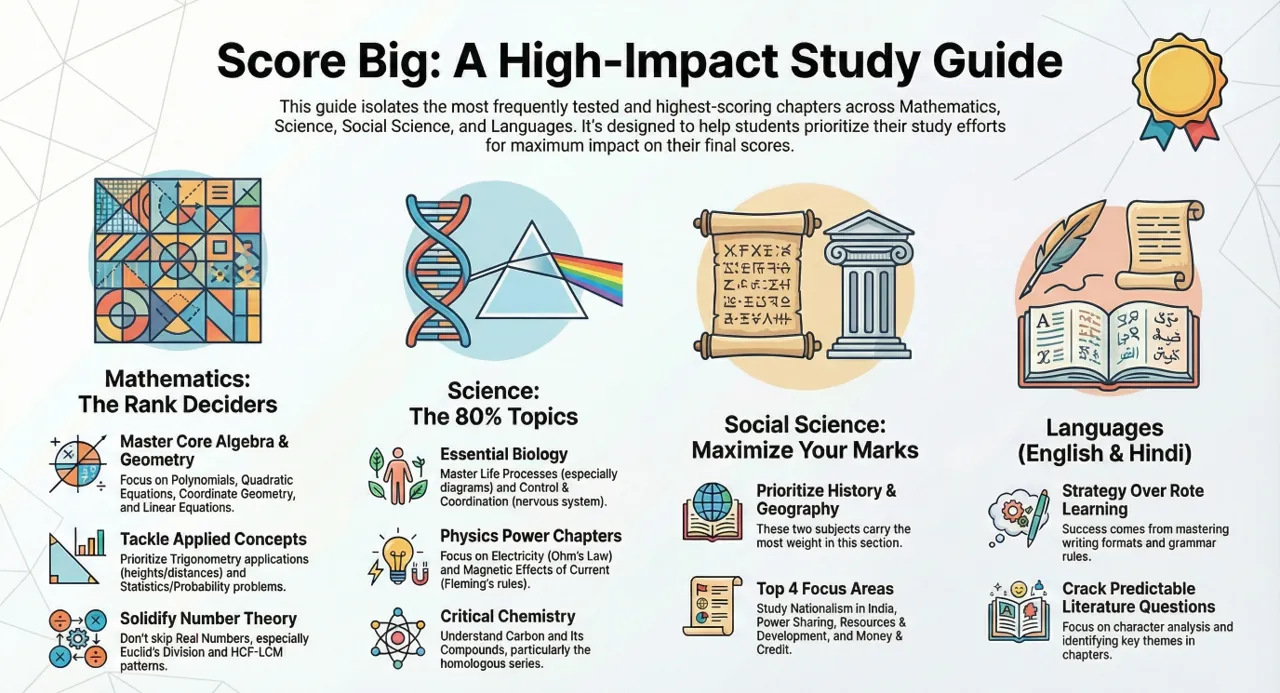
· Real Numbers (Euclid's Division + HCF-LCM patterns)
· Polynomials (Relationship between zeros and coefficients)
· Quadratic Equations (Discriminant + Nature of roots)
· Trigonometry and its applications (Height-Distance problems)
· Statistics and Probability (Mean, Median, Mode calculations)
· Coordinate Geometry + Pair of Linear Equations
Science: Seven units, but not equal importance. These notes focus on chapters that appear in 80% of board papers:
· Life Processes (Nutrition + Respiration diagrams)
· Electricity (Ohm's Law + Power calculations)
· Magnetic Effects of Current (Fleming's rules)
· Carbon and Its Compounds (Homologous series)
· Control and Coordination (Nervous system + Hormones)
:Social Science Four subjects, but History + Geography carry maximum marks. Priority chapters:
· Nationalism in India (Gandhi's movements + Dates)
· Power Sharing (Types + Examples)
· Resources and Development (Soil types + Conservation)
· Money and Credit (Banking + Formal/Informal credit)
English + Hindi: Focus on writing formats, grammar rules, and chapter summaries. Literature questions are predictable if you know character analysis and theme identification.
How to Use These Notes for Quick Revision
Your textbooks are for learning. These notes are for winning.
Phase 1: Foundation Building (First 2 weeks) Create a study plan targeting weak subjects first. Don't start with your strongest subject — that's wasted time.
Phase 2: Active Practice (Next 4 weeks) Read a chapter from textbook, then test yourself using these notes. If you can explain a concept without looking, you've learned it. If not, repeat.
Phase 3: Rapid Revision (Final 2 weeks) Use notes for speed revision. One subject per day. No deep study now — just reinforcement.
The Group Study Method: Use these notes during group discussions. When someone asks a question, refer to the notes for instant answers. This builds confidence and identifies knowledge gaps.
The Highlighting Strategy: Mark difficult concepts during regular classes. When exam time comes, focus only on highlighted sections.
Golden Rule for Mathematics: Reading notes won't help in Math. Solve the example problems first. Then use notes to quickly recall formulas and methods.
Golden Rule for Science: Diagrams decide your marks. Draw from memory, then check with notes.
These Class 10 revision notes work because they're built for results, not just information. Every page is designed to save you time while increasing your score.
Use them smartly, and your board result will show the difference.
Class 10 Maths Notes – Chapter-wise Breakdown
Mathematics is where board exam ranks are made or broken. One silly mistake in algebra costs you 4 marks. One forgotten formula in trigonometry drops your percentage by 3-4 points.
The chapter-wise class 10 notes for mathematics don't just explain concepts — they show you exactly which topics carry maximum weightage and how to avoid the common traps that destroy students every year.
Here's your strategic breakdown:
Real Numbers
Why this chapter decides your math confidence:
Real numbers might look simple, but it's the foundation for everything else. Mess this up, and polynomials become confusing. Quadratic equations feel impossible.
The notes focus on Euclid's Division Lemma — the tool that solves 90% of HCF-LCM problems in 30 seconds instead of 5 minutes. Prime factorization methods become automatic when you understand the pattern.
The game-changer: The fundamental theorem of arithmetic. Every composite number can be expressed as a product of primes in a unique way. This one line appears in 3-4 different question formats in your board exam. Master this, get those free marks.
Polynomials
The connection most students miss:
Polynomials build directly on Real Numbers. If your algebra basics are shaky, this chapter becomes a nightmare.
Your class 10 notes break down polynomial types: constant, linear, quadratic, cubic. But the real insight? The relationship between zeros and coefficients. This concept appears in both direct questions and inside bigger problems.
Graphical representations aren't just pretty pictures — they help you visualize why certain polynomials behave certain ways. When you see the graph, the algebra makes sense.
Pair of Linear Equations
Four methods. One smart choice.
Your notes cover graphical, substitution, elimination, and cross-multiplication methods. But experienced students know: elimination method solves 80% of problems fastest.
The general form (a₁x + b₁y + c₁ = 0; a₂x + b₂y + c₂ = 0) looks scary. The notes show you the shortcut pattern that makes these equations feel like basic arithmetic.
Critical insight: Understanding when equations have unique solutions, infinite solutions, or no solutions. This appears in application problems where students panic because they don't recognize the pattern.
Quadratic Equations
The chapter that separates average from excellent:
Standard form ax² + bx + c = 0 (where a≠0) is just the beginning. The magic happens with the discriminant: D = b²-4ac.
· D = 0: real and equal roots
· D > 0: real and distinct roots
· D < 0: imaginary roots
Factorization vs. Quadratic Formula: Most students learn both but don't know when to use which. Notes show you the 5-second decision rule that saves time and prevents errors.
Trigonometry and Applications
From theory to real-world application:
Basic trigonometric ratios are easy. The challenge comes in heights and distances problems where students freeze because they can't visualize the setup
Your notes don't just list sin, cos, tan values. They show you the step-by-step thinking process for real-life trigonometry problems. When you can see the triangle in the word problem, solving becomes mechanical.
Statistics and Probability
Where calculation speed matters most:
Three methods for calculating mean: direct, assumed mean, step-deviation. Each has its place. Notes show you which method works fastest for which type of data.
Probability problems trip students because they overthink. The notes teach you to identify whether it's theoretical or experimental probability in the first 10 seconds of reading the question.
Strategy note: Each chapter builds on previous knowledge. Real Numbers → Polynomials → Linear Equations → Quadratic Equations. Miss one connection, struggle with everything after.
These notes don't just teach math. They teach you how to think mathematically — the pattern recognition that turns difficult problems into familiar routines.
Your board exam math score isn't about intelligence. It's about recognizing patterns faster than time runs out.
Class 10 Science Notes – Key Concepts and Diagrams
Science without diagrams is like trying to explain colors to someone who's never seen them.
Your brain processes visual information 60,000 times faster than text. That's not motivation — that's neuroscience. And when it comes to Class 10 Science board exams, diagrams are not optional. They are game-changers.
These Class 10 notes don't just throw random pictures at you. Every diagram is designed to solve one problem: How do you remember complex processes under exam pressure?
Life Processes Class 10 Notes
Life Processes = 6-8 marks guaranteed in every board paper.
The notes break down four critical functions: nutrition, respiration, transportation, and excretion. But here's what most students miss — the connections between these processes.
Your notes show:
· How photosynthesis in plants connects to cellular respiration
· Why the human digestive system has specific enzyme locations
· How blood circulation supports ALL life processes
The heart diagram isn't just about memorizing chamber names. It's about understanding why blood flows this way, how oxygen reaches every cell, what happens when this system fails.
When you see the step-by-step breakdown of respiration in different organisms, you're not just learning facts. You're understanding the logic behind biological design.
Control and Coordination Class 10 Notes
This chapter separates average students from toppers.
Neurons are the functional units of the nervous system. But knowing this won't get you marks. Understanding how myelinated neurons transmit impulses faster than non-myelinated ones — that's what gets you the 3-mark questions.
Your revision notes detail neuron structure: dendrites, cyton/soma, and axons through clear illustrations that make sense. No more confusion about signal direction.
Plant hormones — the game-changer section:
· Auxin → tissue growth
· Cytokinin → cell division, delays aging
· Gibberellins → stem growth, seed germination
· Abscisic acid → growth inhibition, promotes dormancy
· Ethylene → fruit ripening
These aren't just definitions to mug up. The notes show you which hormone does what, when, and why. Plus diagrams of phototropism, geotropism, and thigmotropism that actually make plant movements visible.
How Do Organisms Reproduce Class 10 Notes
Reproduction = guaranteed 4-6 marks every year.
The notes cover both sexual and asexual reproduction with one key difference: they show you the WHY behind each method.
Asexual reproduction types: binary fission, budding, vegetative propagation. Each method comes with clear diagrams showing exactly how organisms multiply.
Sexual reproduction gets detailed treatment with labeled male and female reproductive systems. The fertilization processes and embryonic development stages aren't just memorization — they're understanding how life begins and develops.
Electricity and Magnetic Effects
Most students fear this chapter. These notes make it simple.
Current-carrying conductor = magnetic field. The Right Hand Thumb Rule becomes easy: thumb points in current direction, fingers curl in magnetic field direction.
Fleming's Left Hand Rule diagrams show you exactly how to determine force direction on current-carrying conductors. No more guess work.
Electric motor diagrams demonstrate electrical energy converting to mechanical energy — the principle behind every fan, washing machine, and electric car you see.
Electromagnetic induction principles show how changing magnetic fields generate electric currents. This is how power plants work, how transformers function, how your phone charger operates.
Carbon and Its Compounds
Carbon = the basis of all organic chemistry you'll study in Class 11 and 12.
The notes explain carbon's versatility through covalent bonding diagrams. Electron sharing between atoms becomes visible through dot structures.
Hydrocarbons made simple:
· Saturated (alkanes) = single bonds only
· Unsaturated (alkenes, alkynes) = double or triple bonds
Diamond vs graphite comparison through crystal structure diagrams answers the eternal question: "How can the same element be so different?"
· Diamond's 3D network = hardness
· Graphite's layered structure = lubrication
Homologous series and functional groups determine compound properties. The notes show you patterns, not just individual examples.
Bottom line: These diagrams aren't decoration. They are your visual memory bank for board exams. When you can't remember a process, the diagram in your mind becomes your lifeline.
Class 10 Social Science Notes – History, Civics, Geography 📚
Social Science is not just about memorizing dates and names. It's about understanding how our nation was built and how our democracy works.
These Class 10 Social Science notes cover the three pillars that decide your board exam success: History, Civics, and Geography. More importantly, they focus on the chapters that carry maximum weightage in your board exams.
Nationalism in India Class 10 Notes
Why this chapter matters: Nationalism in India gives you 6-8 marks in every board exam. Miss this chapter, and you're losing guaranteed marks.
These notes trace the growth of modern nationalism through the anti-colonial movement. Here's what you need to master:
Mahatma Gandhi's return to India (1915) changed everything. After his experience in South Africa, Gandhi introduced Satyagraha as a method of agitation for truth . This wasn't just philosophy — it was strategy.
Gandhi's early experiments:
· Champaran (1917) — peasants against indigo planters
· Kheda (1918) — farmers against heavy land revenue
· Ahmedabad (1918) — mill workers against poor working conditions
The Rowlatt Act (1919) allowed detention of political prisoners without trial for two years. This sparked massive protests.
Jallianwala Bagh massacre (April 13, 1919) — General Dyer opened fire on peaceful civilians. This event turned the entire nation against British rule.
Non-Cooperation-Khilafat Movement (January 1921) saw students, teachers, and lawyers boycotting government institutions. The movement spread like wildfire because it connected Hindu-Muslim unity against a common enemy.
Salt March (1930) — Gandhi's 240-mile march to Dandi marked the beginning of Civil Disobedience Movement. One simple act of making salt challenged the entire British tax system.
Power Sharing Class 10 Notes
Power sharing is your gateway to understanding how democracy actually works. This chapter from Democratic Politics-II consistently appears in board exams.
Core concept: Power sharing prevents conflict between different groups and ensures stability in political systems.
Why it works:
· Reduces the possibility of conflict between social groups
· Creates a sense of participation among all citizens
· Ensures better outcomes through consultation and deliberation
These notes break down power-sharing mechanisms with real-world examples from Belgium, Sri Lanka, and India — exactly what your board exam questions will ask.
Class 10 History Chapter 1 Notes
"The Rise of Nationalism in Europe" — this chapter sets the foundation for understanding nationalism.
The story begins with Frédéric Sorrieu's vision through his series of four prints in 1848, imagining a world of democratic and social republics.
Game changers:
· French Revolution of 1789 introduced 'la patrie' (the fatherland) and 'le citoyen' (the citizen)
· Napoleon destroyed democracy but spread revolutionary ideas through the Napoleonic Code of 1804
· Liberalism (from Latin 'liber' meaning free) influenced nationalist thought across Europe
Key events your exam will test:
· Treaty of Vienna (1815)
· Revolution of 1848
· Unification of Germany and Italy
· Britain's development as a nation-state
Important Maps and Diagrams — Your Secret Weapon
Map work = easy marks if you practice correctly.
History map items:
· Congress sessions: Nagpur (1920), Calcutta (1920), Madras (1927)
· Nationalist movement centers: Champaran (Bihar), Kheda (Gujarat), Ahmedabad (Gujarat), Amritsar (Punjab), Dandi (Gujarat)
Geography map items:
· Major dams: Salal, Bhakra Nangal, Tehri
· Crop production leaders: West Bengal (rice), Uttar Pradesh (wheat)
· Major producer states: jute, cotton, rubber, sugarcane, tea, coffee
Pro tip: Use color-coding for different types of locations. Make the map visually distinct — your brain will remember colors faster than black dots.
Practice map work for 15 minutes daily. These are guaranteed marks that most students ignore until the last minute.
Your Social Science score depends on how well you connect historical events with their impact on modern India. These notes give you that connection.
How to Use Mind Maps, Videos, and Sample Papers
Your notes are ready. Your chapters are covered. But here's the thing: toppers don't just read notes — they use smart tools that multiply their revision efficiency.
Mind maps, videos, and sample papers are not "extra" resources. They are essential weapons in your Class 10 arsenal that can push your marks from 75% to 90%+.
Benefits of Mind Maps for Quick Recall
Think of mind maps as visual shortcuts for your brain. When you're sitting in that exam hall with 3 hours on the clock, you don't have time to dig through 200 pages of notes. You need instant recall.
Mind maps work because they mirror how your brain actually stores information.
Here's what mind maps do for your Class 10 notes:
· Enhanced memory retention – The visual format helps you recall information faster during exams
· Color-coding benefits – Using different colors associates specific hues with facts, aiding retention
· Reduced overwhelm – Fitting an entire topic on one page makes revision less intimidating
· Visual hierarchy – Relationships between concepts become instantly visible
Pro tip: Draw everything you remember about a topic in black pen first, then add missing information in another color to spot your weak areas. This technique alone can save you 2-3 hours per chapter during final revision.
Where to Find Free Revision Videos
Videos are your backup when reading gets boring or concepts feel stuck. CBSE provides official revision videos that explain concepts in simple yet effective ways. These videos are updated regularly to match your current syllabus.
But here's the smart way to use videos: Don't just watch passively.
Create mind maps while watching to stay focused and prevent your brain from drifting. This double-action approach — visual + auditory + kinesthetic — locks information into your memory faster.
Practicing with Sample Papers and PYQs
Sample papers reveal the examiner's mind. They show you exactly what questions appear most frequently and how marks are distributed across chapters.
PYQs (Previous Year Questions) are pure gold for Class 10 students. They give you clear understanding of exam patterns and frequently tested topics.
Your sample paper strategy:
· Solve at least 5-10 years of previous papers under timed conditions
· Analyze frequently asked questions to identify high-priority topics
· Use the detailed marking schemes to understand how examiners award marks
Sample papers do three critical things: familiarize you with question formats, improve your time management, and identify knowledge gaps. Most importantly, they build confidence by simulating real exam conditions.
Golden rule: Only start sample papers after completing subject-wise revision. This approach tests your preparation, sharpens time management, and builds pre-exam confidence.
Remember: The difference between average students and toppers is not intelligence. It's strategy + smart tools + consistent practice.
Your Class 10 Success Story Starts Now
Class 10 is not just another exam. It's your launch pad to the next chapter of your academic life.
You now have everything you need: chapter-wise notes that cut through the noise, mind maps that make complex topics click, sample papers that train your exam brain. The tools are ready. The strategy is clear.
What happens next is up to you.
These revision notes don't just give you information — they give you confidence. When you walk into that board exam hall, you won't be guessing. You'll know the answer to that Real Numbers question. You'll remember the diagram for Life Processes. You'll solve that quadratic equation in under 2 minutes.
Your Class 10 result is not written in the stars. It's written in your daily choices.
Choice to pick up these notes instead of scrolling Instagram.
Choice to solve that sample paper instead of procrastinating.
Choice to revise with mind maps instead of reading aimlessly.
Students who score 90+ in boards are not magically smarter. They just make smarter preparation choices. They use resources that work. They don't waste time on random materials.
You have 2-3 months left. That's more than enough time to completely change your result.
Your Class 11th stream depends on this. Your confidence for the next 2 years depends on this. Your belief in your own capability depends on this.
So download these notes. Print them. Use them. Make them your daily companions.
Your future self will thank you for the effort you put in today.
All the best, beta. Go show these board exams what you're made of. 💪🔥
Key Takeaways
Master your CBSE Class 10 board exams with these essential revision strategies and resources:
• Download comprehensive PDF notes covering all subjects (Math, Science, SST, English, Hindi) for free offline access and structured learning
• Use mind maps and visual tools to enhance memory retention through color-coding and visual connections between concepts
• Practice with sample papers and PYQs under timed conditions to familiarize yourself with exam patterns and improve time management
• Focus on chapter-wise breakdown in Math (Real Numbers, Polynomials, Quadratic Equations) and Science (Life Processes, Electricity, Carbon Compounds)
• Combine multiple study methods including revision notes, videos, and active recall techniques for deeper conceptual understanding
These revision notes transform complex syllabus content into manageable segments, helping you build confidence and achieve target scores. The key is consistent practice with structured materials rather than rote memorization, ensuring you develop genuine understanding of concepts that will serve you well in board examinations and future academic pursuits.
Related Study Materials Links for Class 10
|
S. No |
Related Study Materials Links for Class 10 |
|
1. |
|
|
2. |
|
|
3. |
|
|
4. |
FAQs
Q1. What subjects do the CBSE Class 10 revision notes cover?
The revision notes cover all major subjects for CBSE Class 10, including Mathematics, Science, Social Science, English, and Hindi. Each subject's notes are organized to provide in-depth insights into the syllabus.
Q2. How can I effectively use mind maps for revision?
Mind maps are visual tools that help simplify complex topics. They enhance memory retention, reduce overwhelm, and show relationships between concepts. Create your own mind maps using different colors to associate specific hues with facts, aiding in quicker recall during exams.
Q3. Where can I find sample papers and previous year questions (PYQs) for practice?
CBSE provides official sample papers and PYQs that are regularly updated to align with the latest syllabus. It's recommended to solve at least 5-10 years of previous papers under timed conditions to familiarize yourself with exam patterns and frequently tested topics.
Q4. What are some key topics covered in Class 10 Science notes?
Class 10 Science notes cover important topics like Life Processes, Control and Coordination, How Do Organisms Reproduce, Electricity and Magnetic Effects, and Carbon and Its Compounds. These notes include detailed explanations and diagrams to help understand complex concepts.
Q5. How can I make the most of these revision notes for exam preparation?
To maximize the effectiveness of these notes, create a structured study plan allocating time for each subject. Focus on challenging areas first, practice active recall, cross-reference with textbooks when needed, and use the notes for group study discussions. Combine these notes with mind maps, videos, and sample paper practice for comprehensive preparation.