CBSE Class 10 Maths Revision Notes 2025-26
Class 10
"Sir, boards mein maths mein achhe marks chahiye... but syllabus itna vast hai!"
If this worry is running in your mind right now, then sit down with your notebook and read this carefully – because these Class 10 maths notes are exactly what you need to turn that fear into confidence.
Your Class 10 boards are not just another exam. They decide your stream, your future, your next two years. And maths? Well, maths can either make you or break you in these boards.
The updated CBSE Class 10 Mathematics syllabus covers everything from basic algebra to complex trigonometry. The problem? Most students get lost in this ocean of formulas, theorems, and concepts. They study hard but still feel unprepared.
But what if you had notes that actually work?
These Class 10 maths notes are built chapter-by-chapter – no jumping around, no confusion. When you're sitting with just 15 days left for your exam, you don't want to flip through heavy textbooks. You want crisp, clear notes that give you exactly what the paper will test.
What makes these notes different?
Simple. They're written by people who understand that you don't have time for fancy language or unnecessary theory. You need:
· Formula sheets that you can revise in 10 minutes
· Shortcut tricks that save you precious exam time
· Solved examples that show you the exact way to write answers
· Memory aids that help you remember even the trickiest concepts
The entire CBSE syllabus is here – Algebra, Geometry, Trigonometry, Statistics. Everything. No topic left behind, no surprises on exam day.
Your Class 10 maths result is not written in stone.
With the right notes, the right strategy, and consistent practice, you can score the marks that open doors to the stream you want. These notes? They're your weapon for that battle.
Beta, this is not just about passing. This is about scoring marks that make your family proud and give you the confidence to take on anything. 💪
Here is the Chapterwise link for Class 10 Maths Revision Notes:
|
CBSE Class 10 Maths Revision Notes Chapter Wise |
|
The Smart Student's Guide to Class 10 Maths Syllabus Strategy
Here's the reality: CBSE Class 10 Maths paper has 100 marks. 80 marks theory + 20 marks internal assessment.
But here's what most students don't know – all marks are not created equal.
The CBSE board has done something clever. They've distributed these 80 theory marks across units in a specific pattern. And if you understand this pattern, you can study smarter, not harder.
The 25-15-12 Rule: Your Winning Strategy
This is the exact marks breakdown that decides your rank:
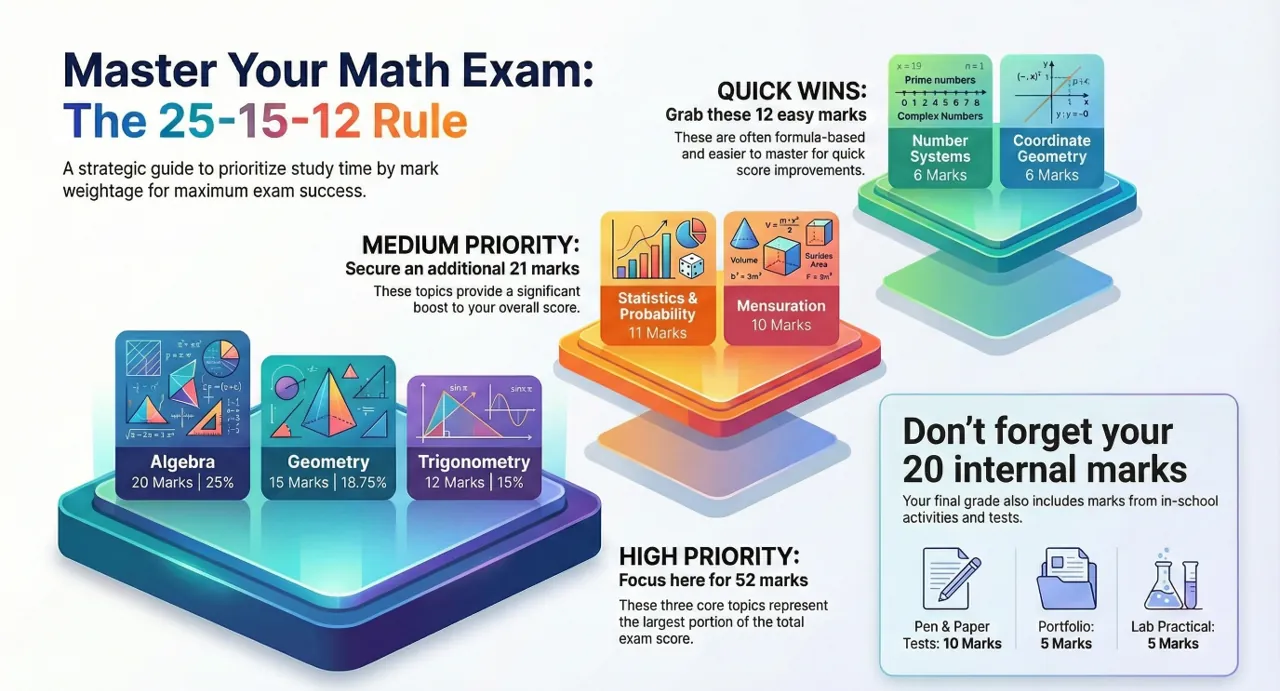
High Priority (52 marks total):
· Algebra: 20 marks (25%) – The biggest chunk
· Geometry: 15 marks (18.75%) – Second largest
· Trigonometry: 12 marks (15%) – Consistent scorer
Medium Priority (21 marks total):
· Statistics & Probability: 11 marks (13.75%)
· Mensuration: 10 marks (12.5%)
Quick Wins (12 marks total):
· Number Systems: 6 marks (7.5%) – Easy if you know basics
· Coordinate Geometry: 6 marks (7.5%) – Formula-based
The internal 20 marks breakdown:
· Pen Paper Tests: 10 marks (5+5)
· Portfolio: 5 marks
· Lab Practical: 5 marks
Where to Invest Your Time (Chapter-by-Chapter War Plan)
| Unit Name | Unit Marks | Chapter Name | Chapter Marks | Key Insights & Focus Areas |
| Algebra | 20 | Linear Equations in Two Variables | 6 | Expect the highest volume of questions here. |
| Quadratic Equations | 6 | Formula-heavy; high accuracy is possible if you know the formulas. | ||
| Polynomials | 4 | Quick scoring area if your fundamentals are clear. | ||
| Arithmetic Progressions | 4 | Generally a student-favorite; easy to grasp. | ||
| Geometry | 15 | Triangles | 8 | Focus on Similarity, Congruence, and Pythagoras Theorem. |
| Circles | 7 | Master tangent properties and core theorems. | ||
| Trigonometry | 12 | Introduction to Trigonometry | 8 | Heavy focus on Ratios and Identities. |
| Heights and Distances | 4 | Real-world application problems (Angles of elevation/depression). | ||
| TOTAL | 47 | Passing/Distinction Strategy |
💡 Strategic Takeaways
-
Algebra is your anchor: Scoring full marks in the 20-mark Algebra section is the safest way to ensure a passing grade and build towards a distinction.
-
Geometry Weightage: "Triangles" and "Circles" carry massive weight (15 marks together). These require visualizing figures and memorizing theorems.
-
Trigonometry Split: Don't ignore the "Introduction" chapter; it carries double the weight of the "Heights and Distances" applications.
The High ROI Chapters (Maximum Marks, Minimum Effort)
Smart students focus here first:
Real Numbers (6 marks): Pure formula work. Euclid's division lemma, HCF, LCM problems. Full marks possible with 3-4 days of focused practice.
Arithmetic Progressions (4 marks): Simple formulas. nth term = a + (n-1)d. Sum = n/2[2a + (n-1)d]. Students regularly score 4/4 here.
Statistics and Probability (11 marks): Mean, median, mode calculations + dice/card problems. Scoring chapter if you practice the standard question types.
Coordinate Geometry (6 marks): Distance formula, section formula, area of triangle. All formula-based. High accuracy potential.
Surface Areas and Volumes (7 marks within Mensuration): Combinations of shapes. Practice 10-15 problems = exam confidence.
Question Pattern Reality Check
Your 80 marks come from:
| Question Type | Total Marks | Strategy & Requirements |
| MCQs | 20 | High Accuracy: These are quick to solve but risky; a wrong answer usually gets 0 marks. |
| Short Answer | 28 | Methodology: Show your work. Requires 2–3 logical steps and the correct method. |
| Long Answer | 32 | Step-Marking: These carry the highest individual weight. Write full solutions; every step counts towards the final score. |
| TOTAL | 80 |
🧠 Scoring Strategy
-
Secure the Base (MCQs): 20 marks is 25% of the paper. Speed is good, but accuracy is paramount here.
-
The "Passing" Zone (Long Answers): Even if you don't get the final answer right in a Long Answer question, writing the correct formula and first few steps can still earn you partial marks.
The strategy?
MCQs give you momentum. Short answers build your score. Long answers decide your grade.
Focus sequence: Algebra first. Geometry second. Trigonometry third.
This gives you 47 marks from just three units. Add the easy 6 from Real Numbers. You're already at 53 marks – which means you're in the safe zone for boards.
The remaining marks? Polish them later. But nail these 53 first.
Chapter-wise Breakdown: Your Complete Battle Plan
Most students make one big mistake: they treat all chapters equally. Wrong approach. Some chapters are gold mines, others are time traps. Let's fix your strategy right now.
Here's the truth about Class 10 maths – 14 chapters, but only 6-7 will decide your final score. Master the right ones, and you're set. Waste time on low-priority topics, and you'll regret it in the exam hall.
Real Numbers to Probability: The Smart Way to Study
Real Numbers – your foundation chapter. Master Euclid's Division Lemma and the Fundamental Theorem of Arithmetic first. These aren't just theoretical concepts; they're the building blocks for everything that follows.
Polynomials – focus on zeros and coefficients relationship. Factorization techniques are exam favorites. Don't memorize blindly; understand the logic.
Linear Equations in Two Variables – four methods to solve, but in exams? Elimination and substitution methods win 90% of the time. Master these two, practice the other two.
Quadratic Equations – discriminant (b²-4ac) is your weapon. This single concept can fetch you 4-6 marks easily.
Arithmetic Progressions – simple formulas, guaranteed questions. nth term and sum formulas are your bread and butter.
Triangles – similarity and Pythagoras theorem dominate this chapter. Draw diagrams accurately; half your marks depend on correct figures.
Coordinate Geometry – distance and section formulas are repeated every year. Learn them once, use them forever.
Trigonometry chapters – ratios in the first chapter, applications in heights and distances. This is where most students either score big or lose badly.
Circles – tangent properties are the core. Questions are predictable here.
Areas Related to Circles and Surface Areas and Volumes – pure formula-based chapters. Perfect these, and you get easy marks.
Statistics and Probability – mean, median, mode for grouped data, plus basic probability. These chapters reward consistent practice.
Formula Arsenal: Your 5-Minute Power Pack
Stop making long formula sheets. These are the only formulas you need to remember:
Quadratic formula: x = [-b ± √(b²-4ac)]/2a
AP formulas: nth term = a + (n-1)d, Sum = n/2[2a + (n-1)d]
Distance formula: d = √[(x₂-x₁)² + (y₂-y₁)²]
Basic trig ratios: sin θ = P/H, cos θ = B/H, tan θ = P/B
Circle basics: Area = πr², Circumference = 2πr
Sphere formulas: Surface area = 4πr², Volume = 4/3πr³
Probability: P(E) = Favorable outcomes / Total outcomes
Key theorems you cannot ignore: Pythagoras theorem, basic proportionality theorem, Euclid's division lemma. Plus, the fundamental theorem of arithmetic – every composite number breaks down uniquely into prime factors.
Deadly Mistakes That Kill Your Marks
Here's what trips up even smart students:
Real Numbers: Confusing rational vs irrational numbers. Write your steps clearly.
Algebra: Writing 3(2x²-6) = 6x²-6 instead of 6x²-18. Distribution errors are mark killers.
Powers: Writing (3x)² = 3x² instead of 9x². Parentheses matter.
Trigonometry: Using sin(x+y) = sinx + siny. This is wrong. Learn the correct compound angle formulas.
Quadratic equations: Dividing by x without checking if x = 0. You'll miss solutions.
Trig values: Writing cos85° = sin5°. Learn complementary angle relationships properly.
Geometry: Mixing up similar triangles with congruent triangles. They're different concepts.
Negative numbers: Writing -2² = -4 instead of (-2)² = 4. Bracket placement changes everything.
CPCT misuse: Using CPCT for similar triangles. Only works for congruent triangles.
Poor diagrams: Not drawing accurate figures. Your diagram is half your solution.
Bottom line: These chapters aren't mysteries. They follow patterns. Master the patterns, avoid the traps, and Class 10 maths becomes your strongest subject.
Why These Notes Are Perfect for Class 10 Students
Most students waste months struggling with thick textbooks that confuse more than they clarify. You sit with a 500-page book, read for hours, but still can't solve basic problems in the exam.
The problem is simple: textbooks are written for teachers, not for students who need to score fast.
Built for Your Brain, Not for Show
These notes work because they speak your language. No fancy mathematical jargon that makes your head spin. No unnecessarily long explanations for simple concepts.
Every topic is broken down into bite-sized pieces that your brain can actually digest. When you read about quadratic equations, you don't get lost in theoretical discussions. You get the formula, the method, and the exact steps to solve any question.
Visual learners? These notes have your back. Diagrams, graphs, and step-by-step illustrations show you exactly what's happening. No more staring at text and wondering "What does this even mean?"
100% Exam-Focused Content
Here's what makes the difference: these notes follow the NCERT curriculum completely. Every formula, every concept, every trick is exactly what CBSE tests in your boards.
You won't study anything extra. You won't miss anything important.
The notes cover the complete syllabus – from Algebra basics to Statistics calculations. But unlike your textbook, they focus only on what actually appears in exams. Smart preparation, not hard preparation.
Study Anywhere, Anytime
These class 10 maths notes pdf in English medium work on your phone, tablet, laptop – whatever you have. No more carrying heavy books to coaching or to your friend's house.
Last-minute revision? Open the PDF, find your weak chapter, revise formulas in 15 minutes. This is exactly what toppers do before walking into the exam hall.
School Tests + Board Exams = One Strategy
The beauty of these notes? They prepare you for everything at once.
Your monthly school test needs quick concept recall. Your board exam needs detailed step-by-step solutions and proper presentation. These notes train you for both.
Practice exercises with varying difficulty levels mean you can handle easy questions quickly and tackle tough problems confidently. Your study schedule becomes cleaner, your revision becomes faster.
These notes don't just help you pass Class 10. They build the mathematical thinking you'll need for Class 11, Class 12, and beyond. Smart work today = easier future.
Every concept is summarized in the clearest possible way. Because when you're under exam pressure, you need clarity, not confusion.
How to Plan Your Revision Using These Notes
"Sir, notes toh mil gaye, but revision plan kaise banayun? Time itna kam hai..."
Listen, success in maths doesn't come from studying 12 hours a day and burning yourself out. It comes from smart planning and consistent execution. A proper revision strategy using your .class 10 maths notes is what separates students who panic before exams from those who walk in with confidence
Create a weekly revision timetable
Your first step? Stop random studying.
Most students open their books and start wherever they feel like. Result? Chaos. Wasted time. Incomplete coverage.
Instead, allocate specific time slots for each chapter based on its weightage and your comfort level. The high-weightage topics like Algebra (25%), Geometry (18.75%), and Trigonometry (15%) deserve maximum attention. But here's the key – don't ignore the smaller chapters completely. Even Number Systems (7.5%) can give you easy marks if revised properly.
Here's your 9-week battle plan:
Weeks 1-2: Foundation Building Phase
· Focus only on understanding core concepts from your notes
· Don't rush into problem-solving yet
Weeks 3-4: Daily Practice Phase
· 30-40 basic questions every day
· Build your calculation speed
Weeks 5-6: Advanced Problem Solving
· Take on the tougher questions
· Focus on application-based problems
Weeks 7-8: Mock Test Phase
· Regular full-length tests
· Time yourself strictly
Week 9: Final Polish
· Formula revision only
· Light practice, no new topics
Use notes for daily 30-minute recap
The 30-minute power rule works like magic.
Every evening, before you sleep, spend exactly 30 minutes with your notes. Not 25, not 45 – exactly 30 minutes. Why this works? Your brain processes information better in short, focused bursts rather than marathon sessions.
During these sessions:
· Revise formulas from the day's study
· Go through shortcuts and tricks
· Check if you remember the key theorems
This daily practice turns difficult concepts into second nature. When you sit in the exam, formulas will flow automatically from your pen.
Combine with mock tests and sample papers
Notes alone won't get you 90+. You need test practice.
Once you've covered concepts from your notes, start taking timed mock tests. This is where you discover your real preparation level. The exam hall is not the place to realize you're slow at calculations or weak in a particular chapter.
After every test, spend 1 hour analyzing mistakes. Keep a separate "Mistakes Notebook" – write down every wrong answer with the correct solution. This notebook becomes your most valuable asset in the last 15 days.
Regular mock testing does something amazing – it removes exam fear and builds your confidence. You start thinking: "I've solved similar papers 20 times already. This is just another practice session."
Track your progress chapter-wise
Data doesn't lie. Your feelings do.
You might feel you're good at Algebra, but if you're consistently losing 3-4 marks in Quadratic Equations, that's a red flag. Track everything – which chapters eat up your marks, where you make silly mistakes, which topics slow you down.
Keep a simple test tracker with columns for: Date, Total Marks, Time Taken, Chapter-wise Performance, and Mistakes Made. After 4-5 tests, patterns will emerge. Maybe you always mess up coordinate geometry formulas. Maybe you're too slow in trigonometry calculations.
This tracking system is your GPS for exam success. It tells you exactly where to spend extra time and which areas need urgent attention.
Remember, beta, your Class 10 result is not about luck. It's about having the right strategy and executing it with discipline. These notes give you the content. Your revision plan gives you the direction.
Now stop overthinking and start planning. Your future self will thank you for the effort you put in today. 💪
Free Resources and Where to Download
"Sir, notes kharidne ke paise nahi hain... kya free mein achhe notes mil sakte hain?"
Absolutely. Quality .class 10 maths notes don't always come with a price tag. Smart students know where to look
Maths Notes for Class 10 PDF Free Download
Free Class 10 maths notes PDFs are everywhere – but finding the right ones? That's the real challenge. The good ones are prepared by expert faculty who actually understand what students need. These PDFs focus on the critical aspects of each chapter, making them perfect for last-minute revisions.
What to look for in free notes:
· Clear explanations without unnecessary jargon
· Formula sheets that you can print and stick on your wall
· Solved examples that show you the exact steps
· Chapter-wise organization – no jumping around
Chapter-Wise PDFs: Real Numbers to Probability
Start with Chapter 1 (Real Numbers) – it covers Euclid's Division Lemma and Fundamental Theorem of Arithmetic. From there, you can find PDFs for all 14 chapters, from Polynomials to Probability.
Pro tip: Download chapter-wise instead of one giant file. Easier to manage, faster to open on your phone.
CBSE Class 10 Maths Notes PDF Links
Direct downloads are available from various educational platforms. These serve as your primary study material when textbooks feel too heavy or complicated.
Beyond Free Notes: RD Sharma, RS Aggarwal
If you want to go deeper, RD Sharma solutions cover all 16 chapters and seriously improve your problem-solving skills. RS Aggarwal gives you detailed explanations for chapters like Real Numbers, Polynomials, and Trigonometric Ratios.
The reality check: Free is good, but consistency is better. Pick one set of notes, stick with them, and master them completely rather than collecting 20 different PDFs and using none properly.
Your goal is not to hoard resources. Your goal is to use what you have and score well.
Your Maths Success Story Starts Now
You've made it this far. You've seen the strategy, you understand the weightage, you know which chapters matter most. Now comes the real part – execution.
Your Class 10 maths result is not decided by how smart you are.
It's decided by how consistently you use these notes, how seriously you follow the revision plan, and how badly you want those marks that will change your future.
Every year, thousands of students sit with the same syllabus, the same chapters, the same formulas. But only some of them score 95+, 98+, even 100/100 in maths. What's the difference?
The difference is in the notes they use and the strategy they follow.
These Class 10 maths notes? They're not just PDFs on your phone. They're your roadmap to the stream you want, the college you dream of, the confidence you need.
Some students will continue struggling with heavy textbooks, jumping between topics, panicking before exams. But not you. You now have:
· Clear, chapter-wise notes that cut through the confusion
· Smart revision strategies that save time and boost retention
· Free resources that give you everything without spending money
· A plan that actually works
The next few months will decide your next few years.
Will you be the student who looks back and says, "I wish I had studied smarter"? Or will you be the one who scores those marks that make everyone ask, "How did you do it?"
The choice is yours. The notes are ready. The strategy is clear.
Beta, your maths success story starts today. Go write a result that makes this effort worth it. 💪🔥
Key Takeaways
These comprehensive CBSE Class 10 Maths revision notes provide strategic guidance for mastering mathematics and achieving exam success through structured preparation.
• Focus on high-weightage chapters: Algebra (25%), Geometry (18.75%), and Trigonometry (15%) deserve maximum attention for optimal score improvement.
• Create a 9-week strategic study plan: Progress from understanding concepts to practicing complex problems, then mock tests, ending with formula revision.
• Use daily 30-minute recap sessions: Short, focused revision with notes strengthens retention better than marathon study sessions.
• Track progress chapter-wise: Maintain a mistakes notebook and test tracker to identify weak areas and monitor continuous improvement.
• Leverage free PDF resources: Access comprehensive notes covering all 14 chapters, emphasizing critical concepts perfect for last-minute revision.
These notes transform complex mathematical concepts into digestible portions while providing formula-based shortcuts, solved examples, and exam-specific strategies. Success in Class 10 Mathematics comes from consistent practice, strategic preparation using proper weightage distribution, and systematic revision rather than unfocused studying.
FAQs
Q1. How is the CBSE Class 10 Maths syllabus structured?
The syllabus is divided into units with specific weightage: Algebra (25%), Geometry (18.75%), Trigonometry (15%), Statistics & Probability (13.75%), Mensuration (12.5%), Number Systems (7.5%), and Coordinate Geometry (7.5%). The total marks are 100, with 80 for theory and 20 for internal assessment.
Q2. Which chapters should I focus on the most for my Class 10 Maths exam?
Prioritize chapters based on their weightage. Algebra carries the highest marks (20), followed by Geometry (15) and Trigonometry (12). Within Algebra, pay special attention to Polynomials, Linear Equations, Quadratic Equations, and Arithmetic Progressions.
Q3. How can I effectively use the Class 10 Maths revision notes?
Create a weekly revision timetable, allocating time for each chapter based on its weightage. Use the notes for daily 30-minute recap sessions to reinforce concepts. Combine note revision with mock tests and sample papers for comprehensive preparation.
Q4. Are there any free resources available for Class 10 Maths revision?
Yes, there are numerous free resources available. You can find chapter-wise PDF notes for all 14 chapters of CBSE Class 10 Maths online. These free notes offer concise explanations of key concepts and are excellent for last-minute revision.
Q5. How can I track my progress while preparing for the Class 10 Maths exam?
Maintain a test tracker to log dates, marks obtained, time taken, and topics where you lost marks. Identify chapters where you consistently lose marks and devote additional practice time to these weak areas. This data-driven approach ensures continuous improvement in your mathematical skills.