Chemical Formula of Ammonia
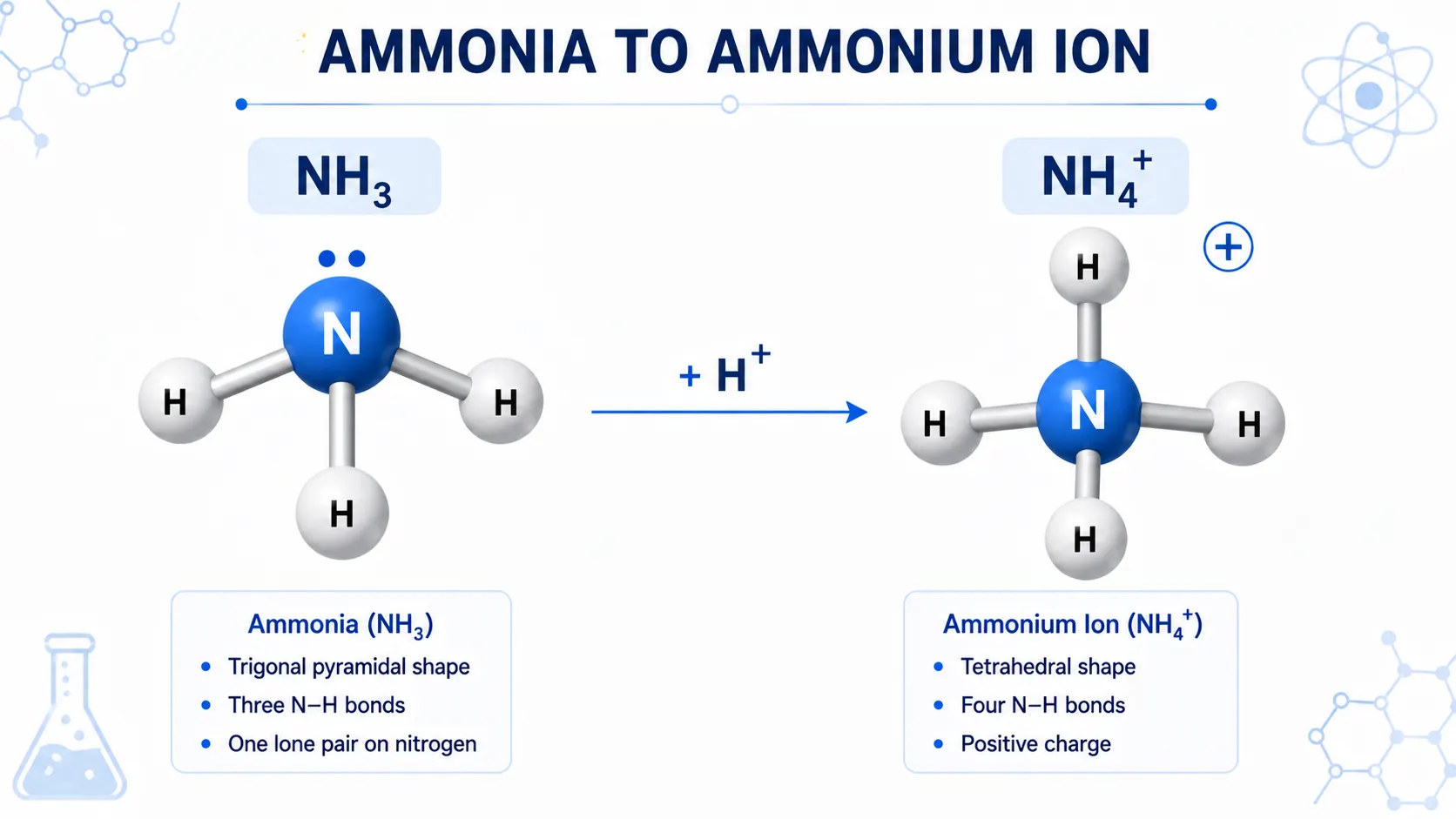
Table of Contents

eSaral › Class 11 Chemistry › Chemical Formula of Ammonia

The ammonia molecular formula, the answer is $\ce{NH3}$ — but students frequently confuse this with the ammonium formula, $\ce{NH4+}$, which is a completely different chemical species (a positively charged ion, not a neutral molecule). This page, from the p-Block Elements (Group 15) chapter, covers the chemical formula of ammonia along with its structure, preparation, properties, and its exact difference from the ammonium ion.
Ammonia – Chemical Formula, Preparation & Properties (p-Block)
Ammonia is one of the most industrially and academically important compounds of Group 15 (the Nitrogen family) in the p-Block Elements chapter. The chemical formula of ammonia is:
$\ce{NH3}$
This means one molecule of ammonia is made up of one nitrogen atom covalently bonded to three hydrogen atoms. Ammonia is a colourless gas with a characteristic pungent (sharp, irritating) odour and is highly soluble in water, where it forms a weakly basic solution.
| Property | Detail |
|---|---|
| Chemical formula | $\ce{NH3}$ |
| Molar mass | 17.03 g/mol |
| Physical state | Colourless gas |
| Odour | Pungent |
| Melting point | 198.4 K |
| Boiling point | 239.7 K |
| Solubility | Highly soluble in water |
| Nature of aqueous solution | Weakly basic |
What Is the Molecular Formula of Ammonia?
The ammonia molecular formula, $\ce{NH3}$, is also its empirical formula — since 1 nitrogen and 3 hydrogen atoms are already in their simplest whole-number ratio. Unlike glucose or many organic compounds, ammonia's molecular and empirical formulas are identical.
Structure of the Ammonia Molecule
In the $\ce{NH3}$ molecule, nitrogen is $\ce{sp3}$ hybridised. Three of the four $\ce{sp3}$ hybrid orbitals form $\ce{N-H}$ sigma bonds with hydrogen atoms, while the fourth orbital holds a lone pair of electrons. This lone pair is responsible for:
- Ammonia's trigonal pyramidal shape (not perfectly tetrahedral, because the lone pair occupies more space than a bond pair).
- A bond angle of approximately 107°, slightly less than the ideal tetrahedral angle of 109.5°.
- Ammonia's ability to act as a Lewis base, donating its lone pair to form the ammonium ion or coordinate bonds in complexes.
Once the trigonal pyramidal shape and bond angle are clear, test recall speed with eSaral's JEE Test Series, which includes dedicated p-Block Elements mock sections.
What Is the Ammonium Formula? (Ammonia vs Ammonium)
A very common point of confusion in exams is between ammonia and the ammonium ion. While the chemical formula of ammonia is the neutral molecule $\ce{NH3}$, when ammonia's lone pair accepts a proton ($\ce{H+}$), it forms the ammonium ion, and the ammonium formula is:
$\ce{NH4+}$
Ammonia vs Ammonium — Key Differences
| Basis | Ammonia | Ammonium |
|---|---|---|
| Formula | $\ce{NH3}$ | $\ce{NH4+}$ |
| Charge | Neutral molecule | Positively charged cation |
| Shape | Trigonal pyramidal | Tetrahedral |
| Hybridisation of N | $\ce{sp3}$ (with 1 lone pair) | $\ce{sp3}$ (no lone pair, all 4 used in bonding) |
| Formed by | Direct combination of $\ce{N2}$ and $\ce{H2}$ | Ammonia accepting a proton ($\ce{H+}$) |
| Example compound | Liquid ammonia (refrigerant) | Ammonium chloride, $\ce{NH4Cl}$ |
This distinction — ammonia molecular formula $\ce{NH3}$ versus ammonium formula $\ce{NH4+}$ — is one of the most frequently tested one-mark concepts in board exams and a common assertion-reason question in NEET/JEE. Practice how this exact distinction is tested with JEE Main Chapterwise PYQ.
Preparation of Ammonia (Haber Process)
The industrial preparation of ammonia, once chemical formula of ammonia is understood, follows the Haber process — the direct combination of dinitrogen and dihydrogen gases under specific conditions:
$\ce{N2 + 3H2 -> 2NH3}$
Conditions for Maximum Yield of Ammonia (Haber Process)
| Condition | Optimum Value | Reason |
|---|---|---|
| Temperature | About 700 K | Reaction is exothermic; moderate temperature balances rate and yield |
| Pressure | 200 atm | High pressure favours the side with fewer gas moles (product side) |
| Catalyst | Finely divided iron with Mo as promoter | Increases the rate of reaction |
In the laboratory, ammonia is prepared by heating an ammonium salt (such as $\ce{NH4Cl}$) with a base like slaked lime:
$\ce{2NH4Cl + Ca(OH)2 -> CaCl2 + 2H2O + 2NH3}$
Haber process conditions — temperature, pressure, and catalyst — are among the most repeated numerical and reasoning questions in JEE Advanced Chapterwise PYQ, so memorising the exact values above is high-yield.
Chemical Properties of Ammonia
The reactivity of ammonia stems directly from the lone pair present on nitrogen in its $\ce{NH3}$ structure:
- Basic nature: Ammonia's aqueous solution turns red litmus blue due to the formation of $\ce{OH-}$ ions: $\ce{NH3 + H2O <=> NH4+ + OH-}$
- Formation of ammonium salts: Ammonia reacts with acids to form ammonium salts, e.g., $\ce{NH3 + HCl -> NH4Cl}$ (this reaction is used as a qualitative test for ammonia gas, producing dense white fumes).
- Complex formation: Ammonia acts as a ligand, donating its lone pair to form coordination complexes such as $\ce{[Cu(NH3)4]^2+}$.
- Combustion: In the presence of a catalyst, ammonia is oxidised to nitric oxide, a key step in the industrial manufacture of nitric acid.
Test how these properties are asked in NEET with NEET Chapterwise PYQ, since ammonia's basic nature and complex formation appear regularly in inorganic chemistry sections.
Uses of Ammonia
- Manufacture of nitrogenous fertilisers such as ammonium nitrate, ammonium sulphate, and urea.
- Production of nitric acid ($\ce{HNO3}$) via catalytic oxidation.
- Used as a refrigerant in its liquid form.
- Used in the manufacture of synthetic fibres and household cleaning agents.
Explore More on eSaral (Related p-Block Elements & Class 12 Chemistry Resources)
- Master the complete chapter this topic belongs to: p-Block Elements: Nitrogen Family Notes for IIT JEE & NEET →
- Solve exercise-based questions on this exact chapter: NCERT Solutions for Class 12 Chemistry Chapter 7 The p-Block Elements →
- Continue with the next Group in p-Block: P Block Class 12 Notes – Halogen Family →
- Get the latest 2026–27 chapter-wise revision notes: CBSE Class 12 Chemistry Revision Notes PDF 2026–27 →
- Download the complete syllabus reference: NCERT Class 12 Chemistry Book – Free PDF →
Mixing up ammonia and ammonium under exam pressure, or struggling with Haber process yield conditions? eSaral's Class 12 Chemistry course, taught by IIT Bombay faculty, breaks down every p-Block Elements reaction and structure with clear diagrams and a 5-layer doubt-solving system so concepts like the ammonia molecular formula stick permanently. Start your free eSaral Class 12 Chemistry demo class today →
Frequently Asked Questions
Find answers to common questions.