Motion in a Plane – Vectors & 2D Motion (Class 11 Physics)
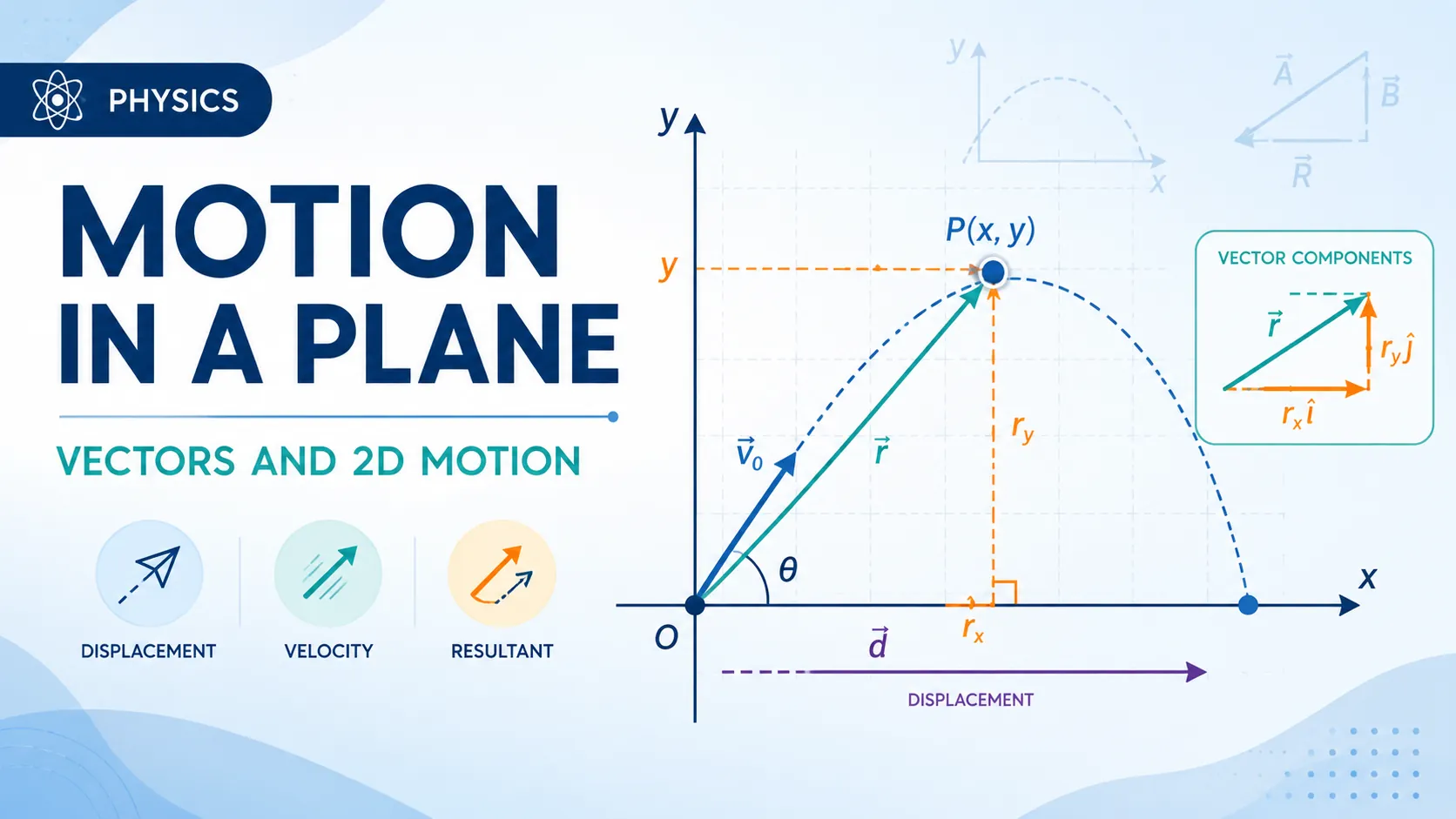
Table of Contents
- What Is the Connection Between Vectors and Two-Dimensional Motion?
- What Is a Vector, and How Is It Different From a Scalar?
- What Are the Rules for Vector Addition Used in Two-Dimensional Motion?
- What Are the Equations of Motion in Two Dimensions?
- How Are Vectors Used to Solve Projectile Motion Problems?
- Key projectile motion formulas derived from resolving the initial velocity vector:
- How Do Vectors Explain Uniform Circular Motion?
- What Is Relative Velocity in Two Dimensions?
- Why Are Vectors and Two-Dimensional Motion Important for JEE and NEET?
- Common Mistakes Students Make With Vectors and Two Dimensional Motion

eSaral › Class 11 Physics › Motion in a Plane – Vectors & 2D Motion (Class 11 Physics)

What Is the Connection Between Vectors and Two-Dimensional Motion?
Vectors and two-dimensional motion are inseparable in Class 11 Physics because motion in a plane cannot be described using single numbers alone — direction matters as much as magnitude. When an object moves in two dimensions (along both the x-axis and y-axis simultaneously), its position, velocity, and acceleration must all be treated as vectors and analysed component-wise. This page builds vector concepts from the ground up and applies them directly to two real motion scenarios every Class 11 student must master: projectile motion and uniform circular motion.
What Is a Vector, and How Is It Different From a Scalar?
A scalar quantity has only magnitude — examples include mass, distance, speed, time, and energy. A vector quantity has both magnitude and direction — examples include displacement, velocity, acceleration, and force. This distinction is the starting point for understanding two-dimensional motion and vectors together, since every equation describing motion in a plane depends on treating quantities like velocity and displacement as vectors, not plain numbers.
How Do You Represent Position and Displacement as Vectors in Two Dimensions?
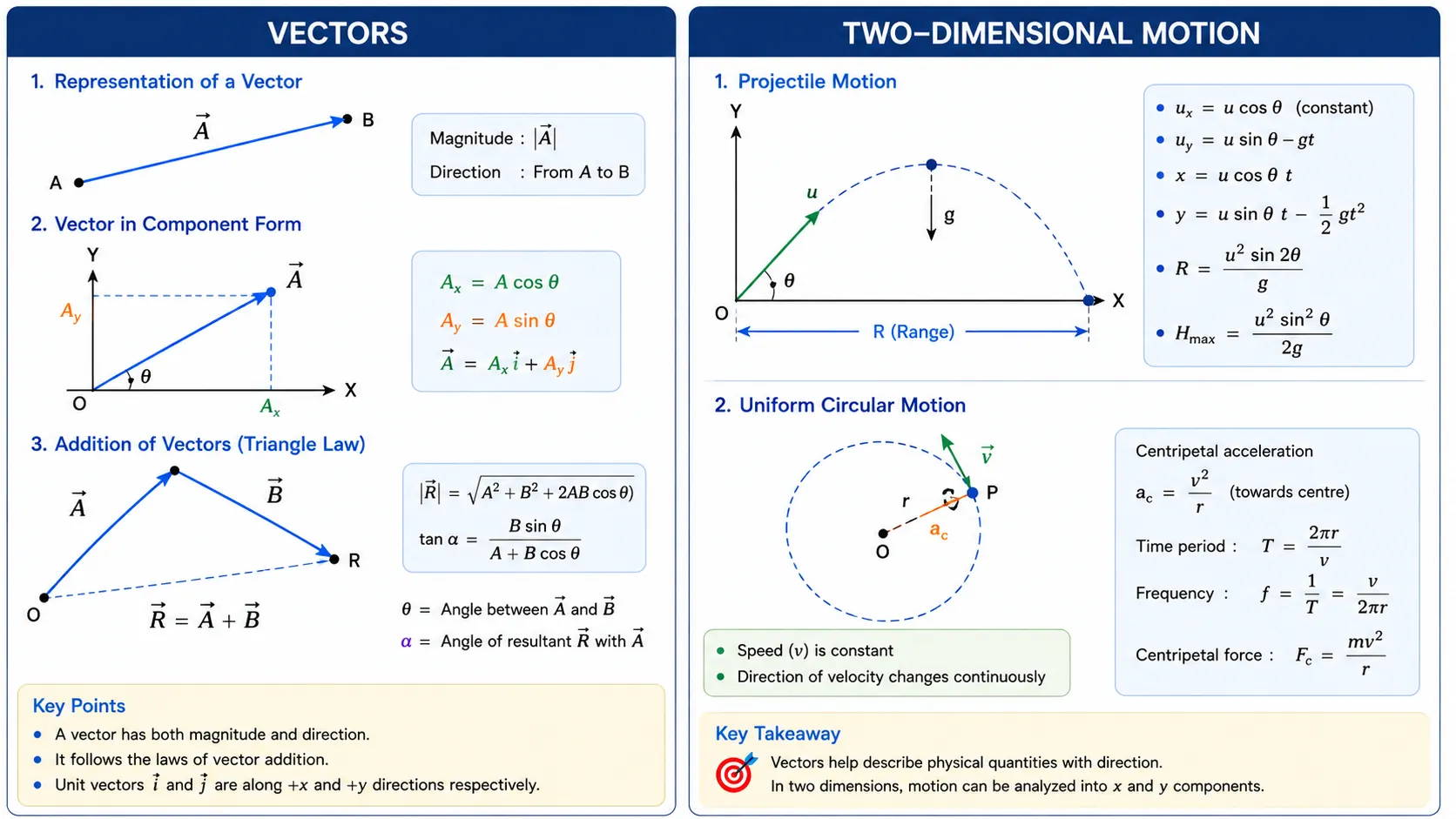
- Position vector (r) — describes the location of a point relative to the origin, written as r = xî + yĵ, where î and ĵ are unit vectors along the x and y axes.
- Displacement vector (Δr) — the change in position vector between two points, Δr = r₂ − r₁, representing both distance and direction of net movement.
Unlike scalar distance, displacement can be zero even if an object travels a long path, as long as it returns to its starting point — a distinction frequently tested in two-dimensional motion problems.
What Are the Rules for Vector Addition Used in Two-Dimensional Motion?
| Law | Description |
|---|---|
| Triangle Law | If two vectors are represented as two sides of a triangle taken in order, the resultant is the third side taken in reverse order: R = A + B |
| Parallelogram Law | If two vectors are represented as adjacent sides of a parallelogram from a common point, the resultant is the diagonal from that point |
| Resultant magnitude | R = √(A² + B² + 2AB cos θ), where θ is the angle between vectors A and B |
| Resultant direction | tan α = (B sin θ) / (A + B cos θ), where α is the angle the resultant makes with vector A |
How Do You Resolve a Vector Into Its Components?
Resolving a vector means breaking it into two perpendicular components, typically along the x and y axes. For a vector A making angle θ with the x-axis:
- x-component: Aₓ = A cos θ
- y-component: Aᵧ = A sin θ
This resolution is the key technique that converts every two-dimensional motion problem into two independent one-dimensional problems — one along the x-axis, one along the y-axis — solved separately and then combined.
What Are the Equations of Motion in Two Dimensions?
Using vector notation, the equations of motion extend naturally from one dimension to two:
| Quantity | Equation (Vector Form) |
|---|---|
| Velocity | v = v₀ + at |
| Position | r = r₀ + v₀t + ½at² |
| Velocity-position relation | v² = v₀² + 2a·(r − r₀) |
Because acceleration, velocity, and position are all vectors, each equation above can be split into separate x-component and y-component equations — this is exactly how projectile motion is solved.
How Are Vectors Used to Solve Projectile Motion Problems?
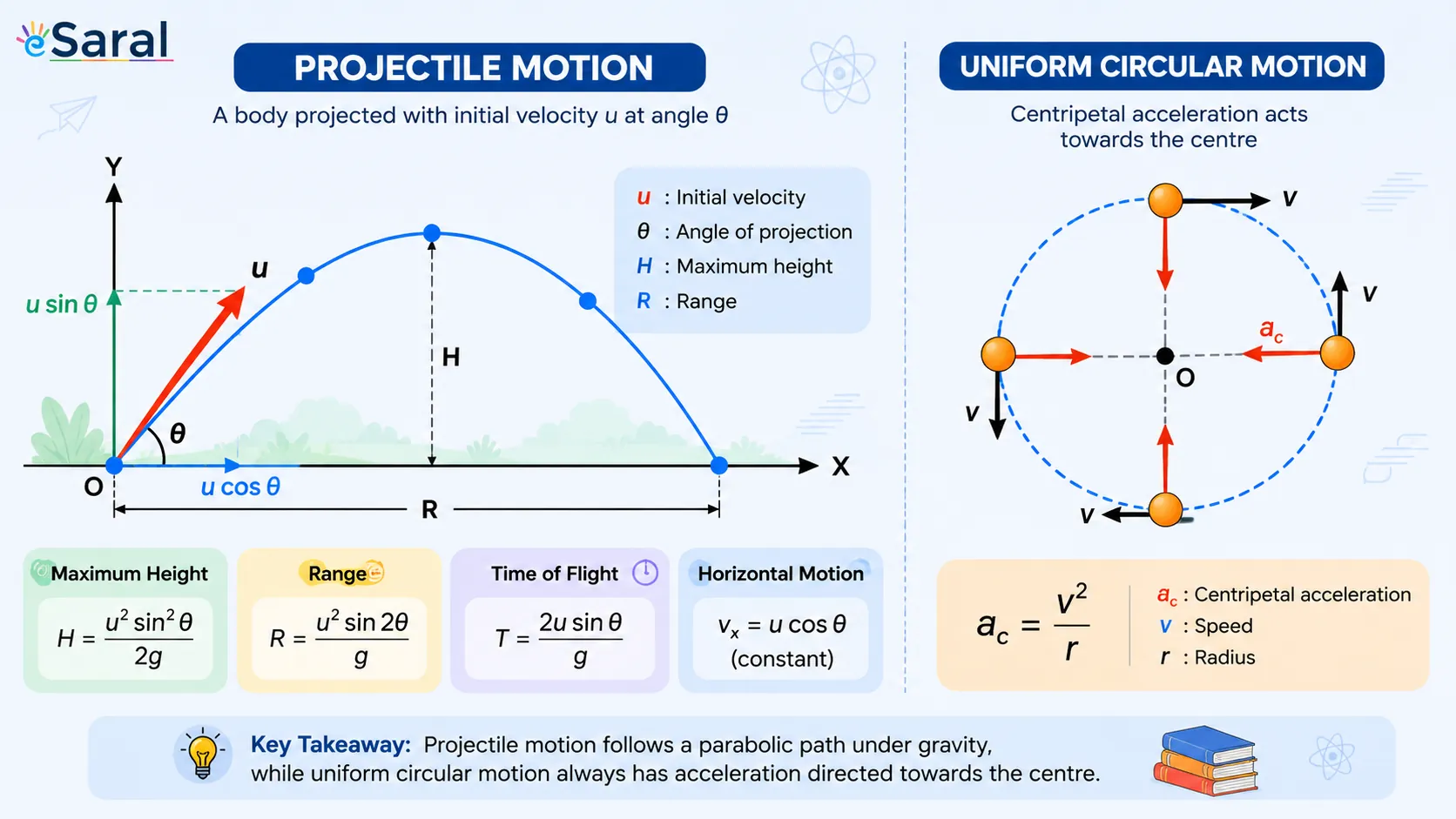
Projectile motion is the clearest real-world application of two-dimensional motion and vectors. When an object is launched with initial velocity u at angle θ to the horizontal:
- Horizontal component: uₓ = u cos θ (constant throughout, since no horizontal force acts)
- Vertical component: uᵧ = u sin θ (changes continuously due to gravity)
Practice how projectile motion is tested with JEE Main Chapterwise PYQ.
Key projectile motion formulas derived from resolving the initial velocity vector:
| Quantity | Formula |
|---|---|
| Time of flight | T = 2u sin θ / g |
| Maximum height | H = u² sin²θ / 2g |
| Horizontal range | R = u² sin 2θ / g |
| Trajectory equation | y = x tan θ − gx² / (2u² cos²θ) |
The trajectory equation, obtained by eliminating time from the horizontal and vertical displacement equations, shows that a projectile follows a parabolic path — a direct consequence of treating velocity as a vector with independent components.
How Do Vectors Explain Uniform Circular Motion?
In uniform circular motion, an object moves at constant speed along a circular path, but its velocity vector continuously changes direction — which means it is still accelerating, even though speed stays constant. This acceleration, called centripetal acceleration, always points toward the centre of the circle:
- Centripetal acceleration: a꜀ = v² / r
- Centripetal force: F꜀ = mv² / r
This is one of the clearest examples in Class 11 Physics of why vectors — not just magnitudes — are essential to fully describe two-dimensional motion. Centripetal acceleration questions are a recurring pattern in JEE Advanced Chapterwise PYQ, often combined with circular motion dynamics.
What Is Relative Velocity in Two Dimensions?
When two objects move simultaneously, their relative velocity is a vector quantity found by vector subtraction: v_AB = v_A − v_B, the velocity of object A as observed from object B. In two-dimensional problems (such as a boat crossing a river with current, or rain falling relative to a moving person), both velocity vectors must be resolved into components before subtraction — a classic application-based question type in CBSE and JEE Main.
Why Are Vectors and Two-Dimensional Motion Important for JEE and NEET?
Motion in a plane rarely appears as a standalone easy topic — it forms the base layer for later chapters like Laws of Motion, Work Energy and Power, and Rotational Motion, all of which use vector resolution repeatedly. In JEE Main, vector-based questions on projectile motion and circular motion appear almost every year, and weak vector fundamentals are one of the most common reasons students lose marks in seemingly unrelated later chapters. Test this exact pattern with JEE Main PYQ.
How Should Students Practice Vectors and Two-Dimensional Motion Problems?
- Master vector addition, subtraction, and resolution before attempting any 2D motion numerical — this is the single most common gap that causes errors later.
- Always split a two-dimensional motion problem into separate horizontal and vertical components before solving.
- Practice projectile motion problems with different launch angles to build intuition for how range, height, and time of flight change.
- Use relative velocity problems (river-boat, rain-man) to strengthen vector subtraction skills, since these frequently appear in board and competitive exams.
Once confident, test recall speed under timed conditions with eSaral's JEE Test Series, which includes a dedicated Motion in a Plane mock section.
Common Mistakes Students Make With Vectors and Two Dimensional Motion
Vectors and two-dimensional motion are one of the first chapters where students shift from single-axis thinking to component-wise analysis — and that shift is exactly where most errors creep in.
- Adding magnitudes directly instead of using the triangle or parallelogram law, especially when two vectors are not along the same line.
- Mixing horizontal and vertical components in projectile motion — using the wrong angle or forgetting that horizontal velocity stays constant while vertical velocity changes.
- Treating displacement as distance in two-dimensional paths, leading to incorrect answers in questions involving curved or circular motion.
- Forgetting that uniform circular motion is still accelerated motion, since only the direction of velocity changes, not its magnitude.
Fixing these errors early makes every later mechanics chapter — Laws of Motion, Work Energy and Power, Rotational Motion — significantly easier, since all of them build directly on the vector skills learned in vectors and two-dimensional motion.
Which Other eSaral Physics Resources Should Class 11 Students Check Next?
- NCERT Solutions Class 11 Physics Chapter 3 — Motion in a Plane
- Important Questions for Class 11 Physics Chapter 3 — Motion in a Plane
- Vector Physics Notes Class 11 — IIT JEE, NEET
- CBSE Class 11 Physics Revision Notes with Weightage
- Motion in Plane Class 11 One Shot Physics NCERT Short Notes
- NCERT Solutions for Class 11 Physics — All Chapters
- Practice Motion in a Plane questions from JEE Main previous years: JEE Main Chapterwise PYQ with Solutions →
Want to see every vector concept applied to solved JEE and NEET problems? eSaral's Class 11 Physics course covers vector algebra, projectile motion, and circular motion with concept videos by IIT Bombay faculty and chapter-wise practice tests. Explore Class 11 Physics Courses on eSaral →
Frequently Asked Questions
Find answers to common questions.
How do you resolve a vector into its x and y components?
What are the laws of vector addition?
What is the difference between a scalar and a vector quantity?
What is relative velocity in two-dimensional motion?
Why is uniform circular motion considered accelerated motion even though speed is constant?
What is the formula for time of flight, maximum height, and range in projectile motion?
Why are vectors important for topics beyond Motion in a Plane?
Why does a projectile follow a parabolic path?
Is Motion in a Plane an important chapter for JEE Main?
What is the difference between distance and displacement in two-dimensional motion?
How many marks does vectors and two-dimensional motion carry in CBSE Class 11 board exams?
Vectors and two-dimensional motion (Motion in a Plane) typically carries around 3–5 marks in CBSE Class 11 board exams, usually through one numerical on projectile motion or one conceptual question on vector addition or circular motion.
What topics are covered under vectors and two-dimensional motion in Class 11 Physics?
Vectors and two-dimensional motion covers vector addition and resolution, position and displacement vectors, equations of motion in two dimensions, projectile motion, uniform circular motion, and relative velocity — forming the base for later mechanics chapters.