Chemical Formula of Glucose
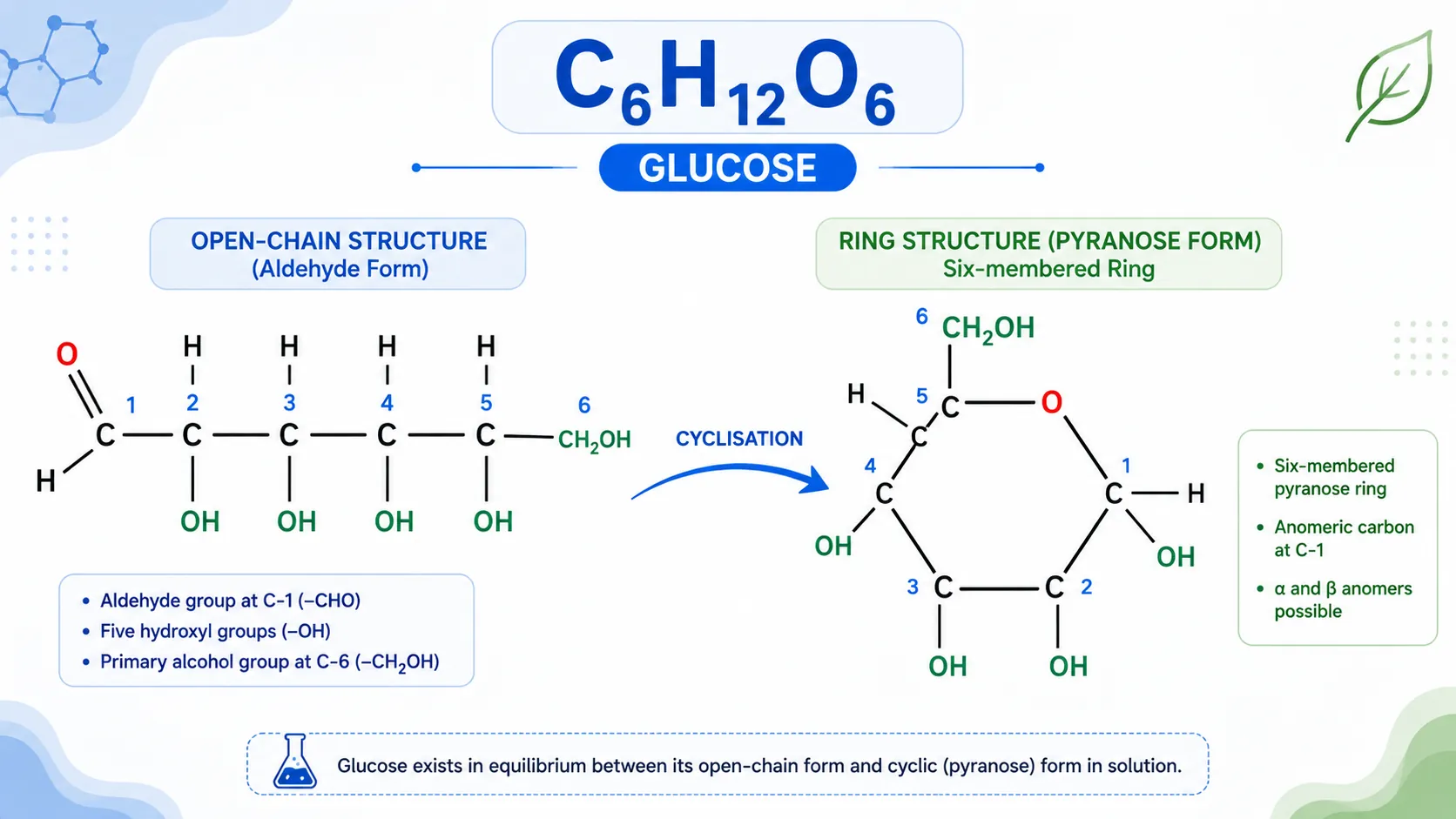
Table of Contents
- What Is the Chemical Formula of Glucose?
- Glucose Molecular Formula: $\ce{C6H12O6}$ Explained
- Empirical Formula of Glucose
- Structural Formula of Glucose (Open-Chain Form)
- Cyclic Structure of Glucose (Pyranose Form)
- Difference Between Glucose Molecule Formula and Fructose Formula
- Where Does Glucose Fit in the Biomolecules Chapter?

eSaral › Class 11 Chemistry › Chemical Formula of Glucose

The formula of glucose, the direct answer is $\ce{C6H12O6}$ — but this same glucose molecule formula is also shared by fructose and galactose, which is exactly why board exams and NEET/JEE ask you to go beyond just the molecular formula. This page, from the Biomolecules chapter, breaks down the chemical formula of glucose at every level — molecular, empirical, structural, and cyclic — so you understand it completely, not just memorise it.
What Is the Chemical Formula of Glucose?
Glucose is a naturally occurring monosaccharide (simple sugar) and the most abundant carbohydrate found in living organisms. The chemical formula of glucose is:
$\ce{C6H12O6}$
This glucose chemical formula tells you that every glucose molecule is built from 6 carbon atoms, 12 hydrogen atoms, and 6 oxygen atoms, bonded together in a specific arrangement. Glucose belongs to the class of compounds called aldohexoses, because it has six carbon atoms (hexose) and an aldehyde functional group (aldo-).
Glucose Molecular Formula: $\ce{C6H12O6}$ Explained
The glucose molecular formula, $\ce{C6H12O6}$, represents the actual number of atoms present in one molecule of glucose — not just their simplest ratio. This distinguishes the molecular formula from the empirical formula (explained below).
| Property | Detail |
|---|---|
| Molecular formula | $\ce{C6H12O6}$ |
| Molar mass | 180.16 g/mol |
| Type of carbohydrate | Monosaccharide (aldohexose) |
| Functional groups present | 1 aldehyde ($\ce{-CHO}$) + 5 hydroxyl ($\ce{-OH}$) |
| IUPAC-style name | D-(+)-Glucose |
| Common natural sources | Fruits, honey, grapes, blood (blood sugar) |
Empirical Formula of Glucose
The empirical formula shows the simplest whole-number ratio of atoms in a compound, unlike the molecular formula which shows the actual count. For glucose:
- Molecular formula: $\ce{C6H12O6}$
- Simplest ratio of C : H : O = 1 : 2 : 1
- Empirical formula of glucose: $\ce{CH2O}$
This is also why carbohydrates as a class were historically named "hydrates of carbon" — the general empirical formula $\ce{Cn(H2O)n}$ matches glucose exactly when n = 6, i.e., $\ce{C6(H2O)6}$ simplifies to $\ce{C6H12O6}$.
Once this molecular-vs-empirical distinction is clear, test your recall with eSaral's NEET Test Series, which includes dedicated Biomolecules mock sections
Structural Formula of Glucose (Open-Chain Form)
While $\ce{C6H12O6}$ is the chemical formula of glucose, it doesn't show how the atoms are connected. The open-chain structural formula of glucose is written as:
$\ce{CH2OH-CHOH-CHOH-CHOH-CHOH-CHO}$
Reading this structure from C-1 to C-6:
- C-1: Aldehyde group ($\ce{-CHO}$) — this is why glucose is classified as an aldose and gives positive tests with Tollens' and Fehling's reagents.
- C-2 to C-5: Each carbon carries one hydroxyl group ($\ce{-OH}$), making glucose a pentahydroxy aldehyde.
- C-6: A terminal $\ce{-CH2OH}$ (primary alcohol) group.
This open-chain form explains why the glucose molecule formula, though written simply as $\ce{C6H12O6}$, actually represents a highly reactive polyhydroxy aldehyde.
Cyclic Structure of Glucose (Pyranose Form)
In reality, glucose exists predominantly not in the open-chain form but as a six-membered ring, formed when the $\ce{-OH}$ group on C-5 attacks the aldehyde carbon (C-1) intramolecularly. This ring structure is called the pyranose form, and it explains two experimentally observed puzzles about glucose that the plain open-chain chemical formula of glucose cannot:
- Glucose does not give the characteristic color reaction of aldehydes with Schiff's reagent.
- Glucose exists in two distinct crystalline forms with different optical rotations.This distinction between anomers is a recurring pattern in JEE Main Chapterwise PYQ as well, especially in stereochemistry-linked questions.
Alpha (α) and Beta (β) Glucose
When the ring closes, C-1 becomes a new chiral centre called the anomeric carbon, producing two cyclic isomers:
| Form | Position of –OH on C-1 | Specific Rotation |
|---|---|---|
| α-D-Glucose | Below the plane of the ring | +112° |
| β-D-Glucose | Above the plane of the ring | +18.7° |
Both α and β glucose share the exact same molecular formula, $\ce{C6H12O6}$ — they are anomers, differing only in the spatial arrangement at C-1.
Difference Between Glucose Molecule Formula and Fructose Formula
A very common confusion (and a favourite exam trap) is that glucose and fructose share an identical molecular formula, $\ce{C6H12O6}$, despite being structurally different sugars:
| Basis | Glucose | Fructose |
|---|---|---|
| Molecular formula | $\ce{C6H12O6}$ | $\ce{C6H12O6}$ |
| Type | Aldohexose (aldehyde group) | Ketohexose (ketone group) |
| Functional group at C-1/C-2 | $\ce{-CHO}$ at C-1 | $\ce{C=O}$ (ketone) at C-2 |
| Ring form | Pyranose (6-membered) | Furanose (5-membered) |
| Relationship | — | Functional isomer (isomeric with glucose) |
Because both compounds satisfy the same chemical formula, $\ce{C6H12O6}$, glucose and fructose are classic examples of structural (functional) isomers — a concept frequently tested alongside the glucose formula itself. Practice how this exact confusion is tested with NEET Chapterwise PYQ.
Molecular Formula of Common Hexose Monosaccharides
| Monosaccharide | Molecular Formula | Type |
|---|---|---|
| Glucose | $\ce{C6H12O6}$ | Aldohexose |
| Fructose | $\ce{C6H12O6}$ | Ketohexose |
| Galactose | $\ce{C6H12O6}$ | Aldohexose |
Where Does Glucose Fit in the Biomolecules Chapter?
In the Biomolecules chapter of Class 12 Chemistry, glucose is studied as the most important monosaccharide under the broader topic of carbohydrates. Carbohydrates are classified based on their behaviour on hydrolysis:
- Monosaccharides — cannot be hydrolysed further; glucose, fructose, and galactose belong here.
- Oligosaccharides — give 2–10 monosaccharide units on hydrolysis (e.g., sucrose gives glucose + fructose).
- Polysaccharides — give many monosaccharide units on hydrolysis (e.g., starch, cellulose, glycogen — all built from repeating glucose units).
Understanding the chemical formula of glucose deeply — not just as $\ce{C6H12O6}$, but as a pentahydroxy aldehyde that exists in equilibrium between open-chain and cyclic forms — is the foundation for understanding glycosidic bonds, reducing sugars, and polysaccharide structure later in the same chapter. Check the NEET Syllabus to see how much weight Biomolecules carries within the overall NEET Chemistry section.
Explore More on eSaral (Related Biomolecules & Class 12 Chemistry Resources)
- Master the complete chapter this topic belongs to: Chemistry Class 12 Biomolecules Notes for IIT JEE & NEET →
- Solve exercise-based questions on this exact chapter: NCERT Solutions for Class 12 Chemistry Chapter 14 Biomolecules →
- Quick visual revision before exams: Mind Map for Biomolecules – Class 12, JEE & NEET →
- Practice previous year NEET questions from this chapter: Biomolecules NEET Previous Year Questions & Solutions →
- Get the latest 2026–27 chapter-wise revision notes: CBSE Class 12 Chemistry Revision Notes PDF 2026–27 →
- Download the complete syllabus reference: NCERT Class 12 Chemistry Book – Free PDF
- Practice Biomolecules-based NEET previous year questions: NEET Chapterwise PYQ with Solutions →
Struggling to connect the glucose formula with the rest of the Biomolecules chapter — glycosidic bonds, reducing sugars, and polysaccharides? eSaral's Class 12 Chemistry course, taught by IIT Bombay faculty, breaks every Biomolecules concept into structured, exam-ready tables and diagrams, with a 5-layer doubt-solving system to clear doubts the same day. Start your free eSaral Class 12 Chemistry demo class today →
Frequently Asked Questions
Find answers to common questions.