JEE Main 2026 Question Paper, Answer Key & Solutions (Session 1 & Session 2)
JEE Mains & Advanced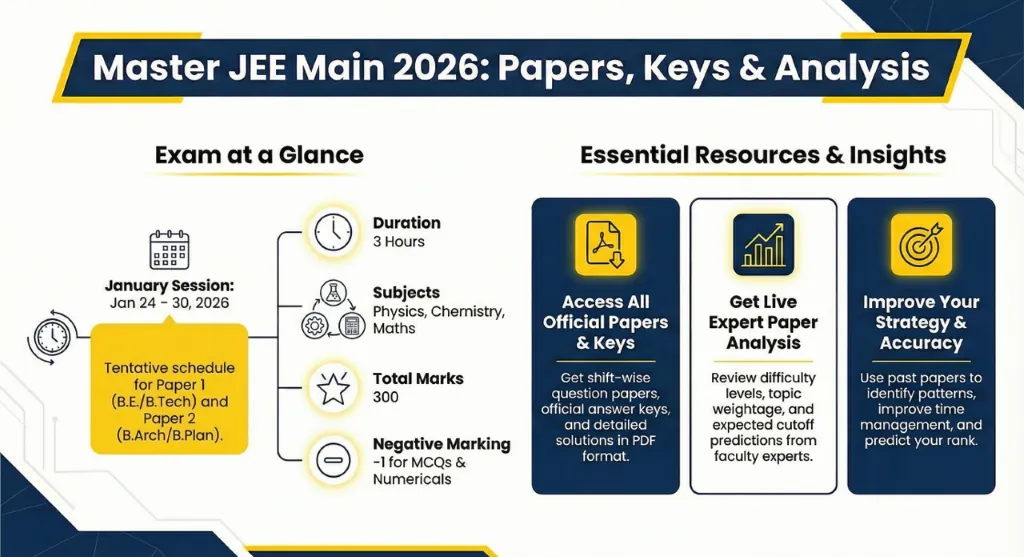

1st Attempt बर्बाद?
Get 99%ile in April Attempt & IIT Bombay
Thank You! eSaral Academic Expert will reach out to you.
The National Testing Agency has scheduled JEE Mains 2026 session1 exams from January 24 to 30. Students preparing for JEE need detailed question papers with solutions to excel. Your preparation strategy should focus on understanding previous exam patterns and question types. If you want to estimate your expected percentile, you can check it based on your expected marks using our JEE Main Marks vs Percentile analysis.
Students can also check the JEE Main 2026 Answer Key to verify their responses and calculate their expected score.
Paper 1 follows a consistent examination structure with morning and afternoon slots on January 21, 22,23,24, 28, and 29. The exam pattern's familiarity will help you master the duration, marking scheme, and total marks. The JEE BTech paper consists of 25 questions each from Physics, Chemistry, and Mathematics sections. Students can score a maximum of 300 marks in JEE Mains 2025, with each section contributing 100 marks. The scoring system awards 4 marks for correct answers and deducts 1 mark for incorrect ones.
The National Testing Agency (NTA) will conduct JEE Main 2026 Session 1 (January attempt) in multiple shifts. On this page, students will find complete information related to:
-
JEE Main 2026 January exam dates
-
Shift-wise question papers & answer keys
-
Live paper analysis
-
Updated exam pattern
-
Marking scheme
-
Previous year question papers (PYQs)
JEE Main 2026 Session 1 – Shift-wise PDFs
The JEE Main 2026 question papers follow the NCERT syllabus as per standard practice. Here's exactly how to get every single paper you need.
Session 1: January Attempt Papers
Both morning (9:00 AM - 12:00 PM) and evening shifts (3:00 PM - 6:00 PM) available for download post-exam. All three subjects covered with subject-wise solutions provided separately.
| Exam Date | Shift | Download | Complete Analysis |
|---|---|---|---|
| Jan 21, 2026 | Shift 1 | PDF Download | Detailed Analysis |
| Jan 21 2026 | Shift 2 | PDF Download | Detailed Analysis |
| For bounce back -> Click here - |
|||
| Jan 22, 2026 | Shift 1 | PDF Download | Detailed Analysis |
| Jan 22, 2026 | Shift 2 | PDF Download | Detailed Analysis |
| Jan 23, 2026 | Shift 1 | PDF Download | Detailed Analysis |
| Jan 23, 2026 | Shift 2 | PDF Download | Detailed Analysis |
| Jan 24, 2026 | Shift 1 | PDF Download | Detailed Analysis |
| Jan 24, 2026 | Shift 2 | PDF Download | Detailed Analysis |
| Jan 28, 2026 | Shift 1 | PDF Download | Detailed Analysis |
| Jan 28, 2026 | Shift 2 | PDF Download | Detailed Analysis Coming Soon 👉 All Shift Comparison |
📌 All PDFs will include detailed answer keys and solutions.
📄JEE Main 2026 Question Papers with Answer Key – Paper 1
After each exam shift, JEE Main 2026 question papers and answer keys will be released. These papers help students understand:
-
Difficulty level
-
Topic-wise weightage
-
Shift-wise variation
-
Expected cutoff trends
📊JEE Main 2026 Live Paper Analysis (Session 1)
Our expert faculty will conduct shift-wise live paper analysis after every exam.
Daily Analysis Schedule
| Exam Date | Shift 1 | Shift 2 |
|---|---|---|
| Jan 21 | Join Session | Join Session |
| Jan 22 | Join Session | Join Session |
| Jan 23 | Join Session | Join Session |
| Jan 24 | Join Session | Join Session |
| Jan 28 | Join Session | Join Session |

📚JEE Main Previous Year Question Papers (With Solutions)
Practicing PYQs is the most powerful strategy for JEE Main.
🔗 Recommended resources:
👉 For trend-based preparation, also explore:
JEE Main marks vs percentile analysis
🔗 https://www.esaral.com/jee-mains-marks-vs-percentile/
📅JEE Main 2026 Exam Dates – January Session (Tentative)
As per the expected NTA schedule and past year trends, JEE Main 2026 Session 1 is likely to be conducted in the last week of January 2026.
| Paper | Expected Dates | Shifts |
|---|---|---|
| Paper 1 (B.E./B.Tech.) | January 21 to 24, 28 – 2026 | Morning & Afternoon |
| Paper 2A (B.Arch) | January 29, 2026 | Afternoon |
| Paper 2B (B.Planning) | January 29, 2026 | Afternoon |
🕘 Morning Shift: 9:00 AM – 12:00 PM
🕒 Afternoon Shift: 3:00 PM – 6:00 PM
📌 Final dates will be confirmed through the official NTA notification.
📐JEE Main 2026 Exam Pattern (Expected – Based on NTA Guidelines)
NTA is expected to follow the same exam pattern as previous years.
JEE Main Paper Pattern – B.E./B.Tech
| Particular | Details |
|---|---|
| Exam Mode | Computer-Based Test |
| Duration | 3 Hours |
| Sections | Physics, Chemistry, Mathematics |
| Questions per Subject | 25 (20 MCQs + 5 Numerical) |
| Total Questions | 75 |
| Total Marks | 300 |
| Response Type | Marks |
|---|---|
| Correct Answer | +4 |
| Wrong Answer | −1 |
| Unattempted | 0 |
🧮 Subject-wise Marks Distribution
| Subject | Section A | Section B | Total Marks |
|---|---|---|---|
| Mathematics | 20 | 5 | 100 |
| Physics | 20 | 5 | 100 |
| Chemistry | 20 | 5 | 100 |
| Total | 60 | 15 | 300 |
📥How to Download JEE Main 2026 Question Paper & Answer Key
-
Scroll to the Shift-wise PDF table
-
Select your exam date & shift
-
Click on “PDF Download”
-
Get question paper + detailed solution
🎯Why Solving JEE Main 2026 Papers Is Important
-
Understand actual exam difficulty
-
Identify repeated concepts
-
Improve time management
-
Predict rank & percentile range
👉 To convert your score into rank, use:
🔗 JEE Main Percentile to Rank Tool
https://www.esaral.com/jee-mains-percentile-to-rank/
👉 For counseling clarity, analyze:
🔗 JoSAA Opening & Closing Ranks
https://www.esaral.com/jossa-opening-and-closing-rank/
JEE Main 2026 Answer Key (Official & Unofficial)
Your JEE Main exam papers are complete, and checking answer keys is the next vital step in your exam experience. The National Testing Agency (NTA) releases official answer keys for January and April sessions. These keys let you assess your performance before the results come out.
NTA Official Answer Key Release Date
JEE Main 2026's official answer key follows a set timeline. The Session 1 (January) provisional answer key should arrive in the first week of February 2026, right after all January exams end. The Session 2 (April) provisional answer key will come out in the second week of April 2026.
The answer key goes through these stages:
- Provisional Answer Key - Released first for student review
- Challenge Window - 2-3 days to raise objections (₹200 non-refundable fee per question)
- Final Answer Key - Published after reviewing all challenges
The final answer key for January session arrives by the third week of February 2026. April session's final answer key becomes available by the fourth week of April 2026. These dates help you plan better for upcoming exams.
Unofficial Answer Keys by Coaching Institutes
Coaching institutions release memory-based unofficial answer keys right after each exam shift. These solutions appear within hours of the exam's end and are a great way to get quick feedback while official versions are pending.
Memory-based answer keys help you:
- Get immediate post-exam assessment
- Make better decisions about second session attempts
- See your expected performance quickly
Note that unofficial keys might have errors since students' memories form their basis rather than actual question papers. These keys work well for quick feedback, but wait for NTA's official versions to be sure.
How to Use the Answer Key for Score Estimation
JEE Main's marking scheme stays simple: +4 marks for correct answers and -1 mark for incorrect responses (in MCQs). Numerical value questions usually have no negative marking, but check current year's guidelines to be certain.
Your estimated score calculation needs these steps:
- Download your response sheet and answer key from NTA's website
- Match your answers with the key for each subject
- Add up correct and incorrect attempts
- Use this formula: Total Score = (Number of Correct Answers × 4) - (Number of Incorrect Answers × 1)
This method gives you a reliable score estimate before official results arrive. To cite an instance, 45 correct and 15 incorrect answers would give you (45 × 4) - (15 × 1) = 180 - 15 = 165 out of 300.
A score around 180 out of 300 shows excellent performance, usually landing above the 99th percentile. This score often opens doors to prominent institutions and makes you eligible for JEE Advanced.
The answer key helps you look beyond total scores. Subject-wise analysis reveals your strong and weak areas, which becomes valuable if you plan to take the second session.
Your response sheet shows your exact option choices, removing any doubt about your answers. This full picture helps you learn from mistakes and perform better next time.
The provisional answer key might change based on valid challenges, so your final score could be different from your calculation. All the same, this estimation gives you a good idea of your performance well before the official announcement.
JEE Main 2026 Exam Analysis (Session 1 & 2)
Your JEE Main 2026 performance depends on how well you understand the exam's complexity levels and patterns. The analysis of previous years' trends will help you create a better preparation strategy for both January and April sessions.
Overall Difficulty Level
The most important aspect of JEE Main 2026 preparation is knowing what to expect. Experts have predicted a moderate difficulty level based on past patterns. This means you need balanced preparation across subjects to tackle challenging but manageable questions.
The last several years (2021-2025) show JEE Main has managed to keep a moderate difficulty level. The 2021 paper had balanced NCERT-based questions at a moderate level. The 2022 paper proved tougher, and Physics gave students a hard time. Papers in 2023 and 2024 returned to moderate levels, though 2025 showed some changes with Session 2 becoming tougher than 2024.
Students should note that January papers are usually more available than April session papers. This creates an advantage if you plan to take both attempts since your first attempt gives you real exam experience with potentially easier questions.
Subject-wise Analysis: Physics, Chemistry, Maths
Physics: The paper will likely be moderate in difficulty with more numerical and application-based problems. Questions will test your conceptual understanding rather than simple formula application. Modern Physics remains the most important component (4-5 questions, about 18% of the section). Heat & Thermodynamics follows with 3-4 questions (12%), and Electrostatics & Current Electricity gets similar coverage (3-4 questions, 12%).
Chemistry: This subject gives you the best chance to score well, with an easy to moderate difficulty level. NCERT forms the foundation for most questions, especially in Organic and Inorganic Chemistry. General Organic Chemistry and Hydrocarbons each get 2-3 questions (8% weightage). Chemical Bonding & Molecular Structure appears in 3-4 questions (12%), while p-Block Elements cover 3 questions (10%).
Mathematics: Math proves to be the toughest section for many students and will likely stay moderate to tough. Questions need strong calculation skills and smart time management. Integral Calculus leads with 3-4 questions (12%), followed by Coordinate Geometry with 3 questions (10%), and Matrices & Determinants taking 2-3 questions (8%).
Student Reactions and Feedback
Previous years' student feedback offers valuable lessons for 2026 aspirants. Mathematics consistently takes the most time to complete. Students in January 2025 called the Math section "lengthy calculation based" but found Chemistry straightforward with direct NCERT questions.
Physics challenged students conceptually but stayed manageable with proper preparation. A student from January 29, 2025, shared, "Physics was the easiest followed by Chemistry which was moderate in difficulty".
Students across different shifts share similar experiences: Chemistry offers the best scoring opportunity due to its NCERT focus. Math needs careful time management, while Physics tests concepts fairly but thoroughly.
A score around 180 out of 300 stands out as excellent, usually landing you in the 99th percentile or higher. This score level opens doors to prestigious institutions like NITs and IIITs, while making you eligible for JEE Advanced.
JEE Main 2026 Exam Pattern Overview
A full understanding of the JEE Main 2026 exam pattern will help you prepare better. The exam has different formats for engineering, architecture, and planning aspirants, each with its own requirements and evaluation methods.
Paper 1 vs Paper 2 Structure
Paper 1 (B.E./B.Tech) is different from Paper 2 (B.Arch/B.Planning) in both content and evaluation. Paper 1 tests Physics, Chemistry, and Mathematics through a Computer-Based Test (CBT) mode. This format evaluates your understanding of core science concepts and problem-solving skills.
Paper 2 comes in two variations:
- Paper 2A (B.Arch): Mathematics and Aptitude sections in CBT format plus a Drawing Test on paper
- Paper 2B (B.Planning): Mathematics, Aptitude, and Planning-based sections all in CBT format
Regular candidates get 3 hours to complete any paper, while PwD candidates receive 4 hours. Students taking both Paper 2A and 2B get 3 hours 30 minutes (4 hours 10 minutes for PwD candidates).
Marking Scheme and Negative Marking
The marking pattern stays the same for all papers:
- Correct answer: +4 marks
- Incorrect answer: -1 mark (negative marking)
- Unattempted question: 0 marks
This scheme applies to both MCQs and Numerical Value Questions. The latest NTA update confirms negative marking even for numerical-type questions. Random guessing should be avoided to protect your score.
Paper 2A's Drawing Test works differently - you can score up to 100 marks without negative marking. Your accuracy matters a lot since wrong answers reduce your total score.
Number of Questions and Sections
Paper 1 (B.E./B.Tech) has 90 questions worth 300 marks, but you only need to attempt 75. Each subject includes:
- Section A: 20 Multiple Choice Questions (MCQs)
- Section B: 10 Numerical Value Questions (attempt any 5)
Physics, Chemistry, and Mathematics each have 25 questions and carry 100 marks each.
Paper 2A (B.Arch) has 77 questions worth 400 marks:
- Mathematics: 25 questions (20 MCQs + 5 Numerical Value Questions) - 100 marks
- Aptitude Test: 50 MCQs - 200 marks
- Drawing Test: 2 questions - 100 marks (50 marks each)
Paper 2B (B.Planning) contains 100 questions worth 400 marks:
- Mathematics: 25 questions (20 MCQs + 5 Numerical Value Questions) - 100 marks
- Aptitude Test: 50 MCQs - 200 marks
- Planning-Based Questions: 25 MCQs - 100 marks
This exam structure helps you plan your preparation time for each section. Paper 1's flexibility to choose 5 out of 10 numerical questions lets you pick your strongest areas. Smart question selection can help maximize your score while managing time well during the exam.
Subject-wise Marks Distribution in JEE Main 2026
Your roadmap to targeted JEE Main 2026 preparation starts with understanding how marks are distributed across subjects. This knowledge will help you plan your study time and create strategies that maximize your score.
Mathematics: Section A & B
Mathematics plays a vital role in JEE Main Paper 1 with 100 marks out of 300. The paper has 25 questions split into two parts:
- Section A: 20 Multiple Choice Questions (MCQs) where you pick one correct option from four choices
- Section B: 5 Numerical Value Questions that need exact numerical answers using the on-screen keyboard
The numerical value section demands precision since answers are usually rounded to the nearest integer. The marking scheme gives you +4 marks for each right answer and deducts 1 mark for wrong answers in MCQs. The latest guidelines state that numerical value questions also carry negative marking.
Physics: Section A & B
Physics follows a similar structure to Mathematics and carries 100 marks with 25 questions. The paper divides into:
- Section A: 20 MCQs that test your concept understanding and application skills
- Section B: 5 Numerical Value Questions requiring accurate calculations
Right answers in both sections earn 4 marks, while wrong ones lose 1 mark. Questions left blank get zero marks without any penalty. Physics questions test your understanding of core concepts and problem-solving abilities.
Chemistry: Section A & B
Chemistry matches the other subjects with 100 marks spread across 25 questions. The format stays consistent with:
- Section A: 20 MCQs covering organic, inorganic, and physical chemistry concepts
- Section B: 5 Numerical Value Questions focused on calculations and exact values
All three subjects share this pattern, bringing Paper 1 (B.E./B.Tech) total to 300 marks for 75 questions. Paper 2A (B.Arch) and Paper 2B (B.Planning) differ with 400 marks each.
The marking scheme stays the same for all subjects (+4 for correct, -1 for incorrect). Your strategy should focus on accuracy rather than attempting every question. Building strong concept foundations in all subjects will help you score well in both MCQ and numerical sections.
How to Calculate Your Score Using the Answer Key
Your JEE Main 2026 score calculation will help you make better decisions about future attempts and college choices. A precise estimate of your performance comes from a step-by-step approach after you download the answer key.
Marking Scheme Recap
The JEE Main marking pattern is the foundation of accurate score calculation. The marking scheme for JEE Main 2026 stays the same in all sections:
- Correct Answer: +4 marks awarded
- Incorrect Answer (MCQs): -1 mark deducted
- Unattempted Question: 0 marks (no positive or negative effect)
Numerical value questions give you +4 marks for correct answers and typically don't have negative marking for wrong ones. All the same, you should check the current year's official guidelines since marking rules might change.
Paper 1 (B.E./B.Tech) has a total score of 300 marks. Mathematics, Physics, and Chemistry each carry 100 marks.
Formula for Score Calculation
Match your answers with the official answer key and use this simple formula to find your expected score:
Total Score = (Number of Correct Answers × 4) − (Number of Incorrect Answers × 1)
To cite an instance, see this sample calculation:
- Mathematics: 18 correct, 6 incorrect, 1 unattempted = (18 × 4) − (6 × 1) = 72 − 6 = 66 marks
- Physics: 20 correct, 3 incorrect, 2 unattempted = (20 × 4) − (3 × 1) = 80 − 3 = 77 marks
- Chemistry: 19 correct, 5 incorrect, 1 unattempted = (19 × 4) − (5 × 1) = 76 − 5 = 71 marks
Your total estimated score would be 66 + 77 + 71 = 214 out of 300.
The quickest way is to calculate across subjects:
- Total correct answers across subjects: 57
- Total incorrect answers across subjects: 14
- Total score = (57 × 4) - (14 × 1) = 228 - 14 = 214 marks
Common Mistakes to Avoid
Small calculation errors can throw off your score predictions. Here are mistakes you should avoid when using the answer key:
-
Forgetting Negative Marking: Students often multiply correct answers by 4 but forget to subtract marks for wrong answers.
-
Mixing Up Section A and B: Students sometimes get confused about the structure, though both sections follow identical marking schemes with mandatory questions.
-
Not Accounting for All Subjects: Good marks in one subject can't make up for low scores in others when calculating percentile.
-
Including Unattempted Questions as Incorrect: You don't lose marks for blank answers. Wrong options are the only ones that count against you.
-
Confusing Percentile with Percentage: A 99 percentile score means you did better than 99% of test-takers, not that you scored 99% marks.
Your calculations need a systematic approach to accurately show your expected JEE Main 2026 performance.
How to Download JEE Main 2026 Question Paper & Solutions
The JEE Main 2026 question papers are available through official channels. These resources will help you grasp the exam pattern and practice more effectively.
Step-by-Step Download Guide
Here's how to get the JEE Main 2026 question papers and solutions:
- Visit the official JEE Main website (jeemain.nta.nic.in)
- Find the "Downloads" or "Question Papers" section on the homepage
- Click on the link labeled "JEE Main 2026 Question Paper"
- Enter your application number and date of birth to log in
- Select the relevant session (January/April)
- Download both question papers and response sheets to review everything
Note that these files might not stay available on the portal indefinitely, so save them right away.
Accessing PDFs by Session
The paper's download process is straightforward:
- Log in and find the session date dropdown menu
- Pick your examination date (January 22-30 or April dates)
- Select either Morning Shift (9:00 AM-12:00 PM) or Evening Shift (3:00 PM-6:00 PM)
- Get your PDF file
Questions vary between shifts, but the overall pattern stays the same.
Tips for Offline Access
Smart storage matters:
- Set up folders to organize papers by date and session
- Keep both questions and solutions handy for practice
- Reduce PDF resolution if storage space runs low
- Print vital sections when you need to make notes
Conclusion
JEE Main 2026 question papers, answer keys, and solutions are a great way to get ready for your exam. Regular practice with these resources helps you learn about the exam pattern, question types, and difficulty levels across sessions.
Subject analysis from past papers shows that Mathematics needs the most time and practice. Chemistry tends to be the highest scoring section. These patterns help you create better strategies for each subject.
The marking scheme plays a crucial role in the exam. You get 4 marks for each correct answer but lose 1 mark for wrong ones. This makes picking the right questions key to getting a high score.
Practice papers from both January and April sessions give you a full picture of different question types. Solutions explain the right methods and help you spot areas where you need more work.
Learning to calculate scores with answer keys lets you predict your performance before results come out. This skill becomes useful when you take both sessions because you can improve your approach between attempts.
Success in JEE Main comes from solid preparation, knowing exam patterns, and smart test-taking. Question papers and detailed solutions give you the tools to face JEE Main 2026 with confidence and secure a spot in your preferred engineering college.
Key Takeaways
Master your JEE Main 2026 preparation with these essential insights from comprehensive question paper analysis and exam strategies.
• Download shift-wise papers systematically - Access all January (22-30) and April session papers with solutions to understand evolving difficulty patterns across different examination dates.
• Mathematics demands maximum time allocation - Consistently reported as the most challenging section requiring lengthy calculations, while Chemistry remains the most scoring with NCERT-based questions.
• Master the marking formula early - Calculate scores using (Correct × 4) - (Incorrect × 1) to make strategic decisions during exams and avoid costly guessing mistakes.
• Practice with official answer keys for accuracy - Use NTA's provisional keys (released within days) and final keys (after challenge period) for precise performance evaluation before results.
• Target 180+ marks for top percentiles - Scores around 180/300 typically correspond to 99+ percentile, qualifying for prestigious NITs, IIITs, and JEE Advanced eligibility.
Understanding these patterns and utilizing authentic resources strategically positions you for success in both January and April attempts, helping you secure admission to your dream engineering institution.
FAQs
Q1. What is the marking scheme for JEE Main 2026?
For each correct answer, you will be awarded 4 marks. However, for every incorrect response in Multiple Choice Questions (MCQs), 1 mark will be deducted. Unattempted questions will not be penalized.
Q2. How can I estimate my score using the answer key?
To calculate your estimated score, use the formula: Total Score = (Number of Correct Answers × 4) - (Number of Incorrect Answers × 1). This will give you a reliable prediction of your performance before the official results are announced.
Q3. Which section is typically considered the most challenging in JEE Main?
Based on previous years' trends, the Mathematics section is often regarded as the most time-consuming and challenging, requiring strong problem-solving skills and efficient time management.
Q4. What is the overall difficulty level expected for JEE Main 2026?
The overall difficulty level of JEE Main 2026 is projected to be moderate, consistent with the trend observed in recent years. However, the exam will still be challenging and require balanced preparation across all subjects.
Q5. How can I access the JEE Main 2026 question papers and solutions?
You can download the JEE Main 2026 question papers and solutions from the official NTA JEE Main website. After logging in with your application number and date of birth, navigate to the "Downloads" or "Question Papers" section to access the resources for both January and April sessions