Class 12 Mind Maps for Physics, Chemistry, Maths and Biology: Revise Every Chapter Faster
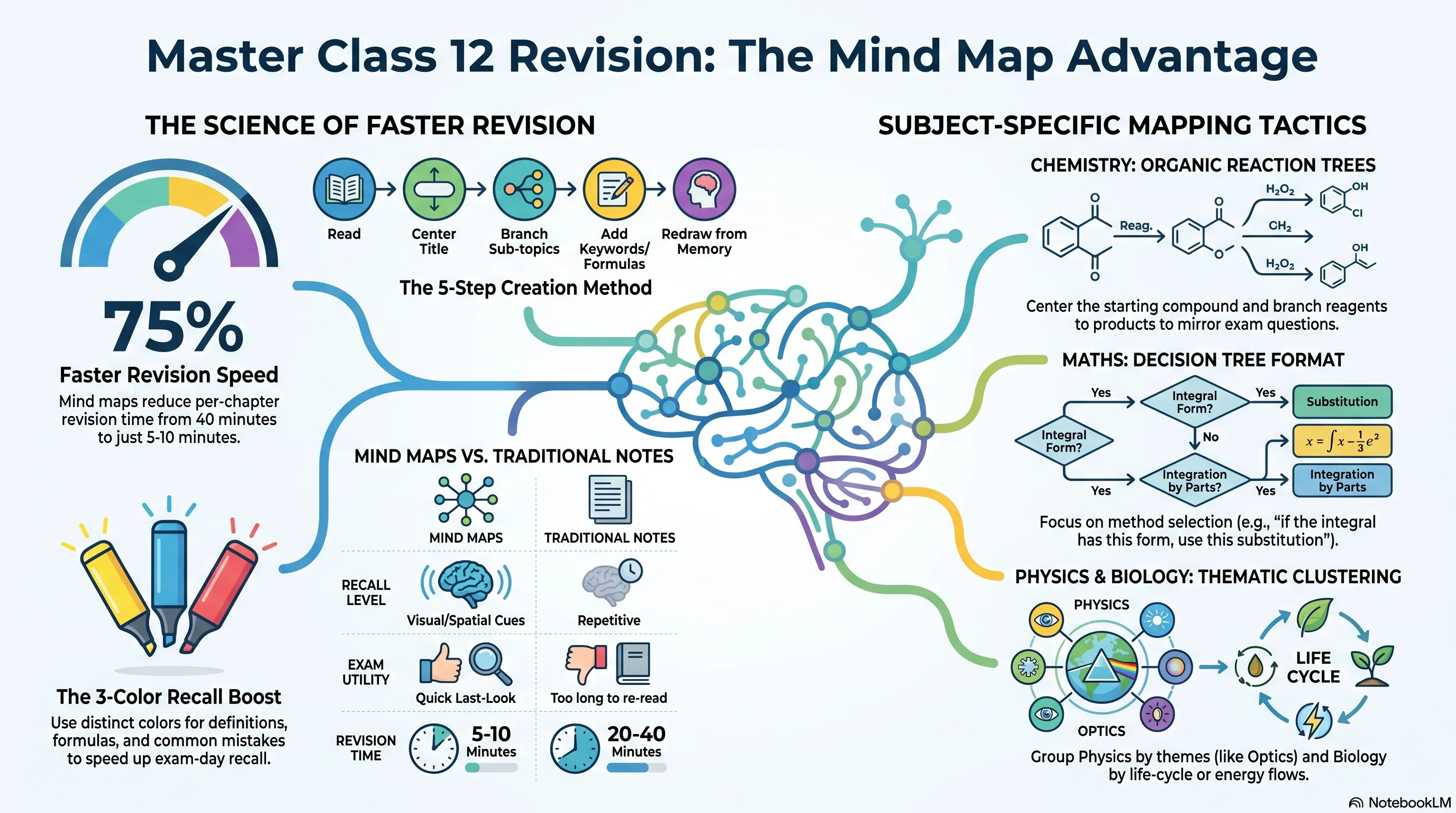
Table of Contents
- Why Mind Maps Work Better Than Regular Notes
- Class 12 Physics Mind Maps: Chapter-Wise Breakdown
- Class 12 Chemistry Mind Maps: Organic, Inorganic and Physical
- Class 12 Maths Mind Maps: Calculus, Algebra and Vectors
- Class 12 Biology Mind Maps: Genetics, Ecology and Reproduction
- How to Make Your Own Mind Map in 5 Steps
- Mind Maps vs Traditional Notes: A Quick Comparison

eSaral › NEET › JEE› Class 12 Mind Maps for Physics, Chemistry, Maths and Biology: Revise Every Chapter Faster

Why Mind Maps Work Better Than Regular Notes
A mind map works because it mirrors how the brain naturally organises information — as a hub with connected branches, not a straight line of text. When you look at a linear page of notes, you have to read every line to find what you need. A mind map lets your eyes jump straight to the branch you're revising.
How Is a Mind Map Different From a Flowchart?
A mind map radiates outward from one central idea to many related branches, while a flowchart follows a fixed sequence of steps in one direction. Mind maps suit concept-heavy subjects like Biology and Chemistry, while flowcharts suit process-heavy topics like a numerical solving method.
💡 Expert Tip: Draw your mind map in three colours — one colour for definitions, one for formulas, and one for exceptions or common mistakes. This colour-coding alone speeds up recall by a noticeable margin during a timed exam.
For subject-specific groundwork before you start mapping, it helps to revisit the original text through detailed NCERT Solutions for Class 12, since a mind map should compress what you already understand, not replace understanding.
Class 12 Physics Mind Maps: Chapter-Wise Breakdown
Class 12 Physics has 15 chapters, but they cluster into a few large themes: Electrostatics and Current Electricity, Magnetism, Optics, and Modern Physics. Mapping by cluster instead of by chapter number saves time because formulas repeat across related chapters.
| Chapter | Download |
|---|---|
| Units and Dimensions | Download PDF |
| Errors and Measurement | Download PDF |
| Vectors | Download PDF |
| Kinematics 1D | Download PDF |
| Kinematics 2D | Download PDF |
| Newton's Laws of Motion (NLM) | Download PDF |
| Friction | Download PDF |
| Circular Motion | Download PDF |
| Work, Power and Energy (WPE) | Download PDF |
| Centre of Mass (COM) | Download PDF |
| Rotational Motion | Download PDF |
| Gravitation | Download PDF |
| Elasticity | Download PDF |
| Fluid Mechanics – Viscosity and Surface Tension | Download PDF |
| Thermal Expansion | Download PDF |
| Calorimetry | Download PDF |
| Kinetic Theory of Gases (KTG) | Download PDF |
| Thermodynamics | Download PDF |
| Heat Transfer | Download PDF |
| Simple Harmonic Motion (SHM) | Download PDF |
| Wave on String | Download PDF |
| Sound Wave (Full Chapter Revision) | Download PDF |
| Electrostatics | Download PDF |
| Capacitor | Download PDF |
| Current Electricity (CE) | Download PDF |
| Magnetic Effects of Current (MEC) | Download PDF |
| Magnetism and Matter | Download PDF |
| Electromagnetic Induction (EMI) | Download PDF |
| Alternating Current (AC) | Download PDF |
| Electromagnetic Waves (EMW) | Download PDF |
| Ray Optics | Download PDF |
| Wave Optics | Download PDF |
| Atomic Structure | Download PDF |
| Dual Nature of Radiation and Matter | Download PDF |
| Radioactivity | Download PDF |
| Semiconductor Devices | Download PDF |
| Nuclear Physics | Download PDF |
| X-Rays | Download PDF |
Class 12 Chemistry Mind Maps: Organic, Inorganic and Physical
Chemistry mind maps work differently across its three branches, so treat each separately rather than forcing one format on all of them.
| Chapter | Download |
|---|---|
| Mole Concept | ⬇ Download PDF |
| Atomic Structure | Download PDF |
| Chemical Bonding | ⬇ Download PDF |
| States of Matter | ⬇ Download PDF |
| Liquid Solution | ⬇ Download PDF |
| Solid State | ⬇ Download PDF |
| Thermodynamics | ⬇ Download PDF |
| Thermochemistry | ⬇ Download PDF |
| Chemical Equilibrium | ⬇ Download PDF |
| Ionic Equilibrium | ⬇ Download PDF |
| Redox Reactions | ⬇ Download PDF |
| Electrochemistry (Part 1) | ⬇ Download PDF |
| Electrochemistry (Revision) | ⬇ Download PDF |
| Chemical Kinetics (CK) | ⬇ Download PDF |
| Surface Chemistry | ⬇ Download PDF |
| Periodic Table | ⬇ Download PDF |
| s-Block Elements | ⬇ Download PDF |
| P-Block Elements (Group 13–14) | ⬇ Download PDF |
| P-Block Elements (Group 15–18) | ⬇ Download PDF |
| Hydrogen | ⬇ Download PDF |
| D-Block Elements | ⬇ Download PDF |
| Coordination Compounds | ⬇ Download PDF |
| Metallurgy | ⬇ Download PDF |
| Salt Analysis | ⬇ Download PDF |
| IUPAC Nomenclature | ⬇ Download PDF |
| General Organic Chemistry (GOC) | ⬇ Download PDF |
| Isomerism | ⬇ Download PDF |
| Optical Isomerism | ⬇ Download PDF |
| Purification of Organic Compounds | ⬇ Download PDF |
| Hydrocarbons | ⬇ Download PDF |
| Haloalkanes and Haloarenes | ⬇ Download PDF |
| Alcohol, Phenol and Ether | ⬇ Download PDF |
| Carbonyl Compounds | ⬇ Download PDF |
| Carboxylic Acid | ⬇ Download PDF |
| Environmental Chemistry | ⬇ Download PDF |
| Oxidation | Download PDF |
| Biomolecules (BM) | Download PDF |
How Do You Map Organic Chemistry Reactions?
Organic Chemistry mind maps should be structured as reaction trees, with the starting compound at the centre and each reagent branching to a different product. This mirrors how questions are actually asked — "identify the product" — far better than a list format does.
- Physical Chemistry: map formula-heavy chapters (Electrochemistry, Chemical Kinetics, Solutions) around one central equation with branches for each variable and its unit.
- Inorganic Chemistry: map trend-based chapters (p-Block, d and f Block, Coordination Compounds) around periodic trends — branches for oxidation states, colour, and magnetic behaviour.
- Organic Chemistry: map reaction-heavy chapters (Aldehydes and Ketones, Amines, Biomolecules) as reagent-to-product trees.
💡 Expert Tip: For Coordination Compounds, draw one mind map per hybridisation type (sp3d2, d2sp3) instead of per chapter section. Students who group by hybridisation answer isomerism questions faster in both Boards and JEE Advanced.
Use the NCERT Solutions for Class 12 Chemistry to verify every reaction mechanism before it goes on your map, since an error copied onto a mind map gets reinforced every time you revise it.
Class 12 Maths Mind Maps: Calculus, Algebra and Vectors
Maths mind maps are less about definitions and more about method selection — which formula or technique to use for which type of question.
| Chapter | Download |
|---|---|
| Sets | ⬇ Download PDF |
| Relations | ⬇ Download PDF |
| Functions | ⬇ Download PDF |
| Complex Numbers (CN) | ⬇ Download PDF |
| Quadratic Equations (QE) | ⬇ Download PDF |
| Matrices | ⬇ Download PDF |
| Determinants | ⬇ Download PDF |
| Permutation and Combination | ⬇ Download PDF |
| Binomial Theorem (BT) | ⬇ Download PDF |
| Sequence and Series (SS) | ⬇ Download PDF |
| Logarithm | ⬇ Download PDF |
| Modulus Function (MOD) | ⬇ Download PDF |
| Limits | ⬇ Download PDF |
| Continuity | ⬇ Download PDF |
| Differentiation | ⬇ Download PDF |
| Application of Derivatives (AOD) | ⬇ Download PDF |
| Indefinite Integration | ⬇ Download PDF |
| Definite Integration (DINT) | ⬇ Download PDF |
| Area Under the Curve | ⬇ Download PDF |
| Differential Equations | ⬇ Download PDF |
| Point | ⬇ Download PDF |
| Straight Line | ⬇ Download PDF |
| Circle (CR) | ⬇ Download PDF |
| Parabola | ⬇ Download PDF |
| Ellipse | ⬇ Download PDF |
| Hyperbola | ⬇ Download PDF |
| Vectors (Chapter 3D/RFS) | ⬇ Download PDF |
| Compound Angle | ⬇ Download PDF |
| Trigonometric Equations (TE) | ⬇ Download PDF |
| Inverse Trigonometric Functions (ITF) | ⬇ Download PDF |
| Solution of Triangle (SOT) | ⬇ Download PDF |
| Statistics | ⬇ Download PDF |
| Probability | ⬇ Download PDF |
| 3D Geometry | ⬇ Download PDF |
Why Do Maths Mind Maps Need a Decision-Tree Format?
Maths mind maps work best as decision trees because the exam tests which method to apply, not just whether you remember the formula. A branch should read "if the integral has this form, use this substitution," not just list substitution rules on their own.
Continuous with Class 11 groundwork, keep your Class 12 Maths map linked back to the NCERT Solutions for Class 11 Maths for topics like Trigonometric Identities and Sets that resurface inside Calculus and Vectors.
Key clusters to map:
- Calculus — Continuity, Differentiability, Application of Derivatives, Integrals, Differential Equations
- Algebra & Matrices — Matrices, Determinants, and their use in solving linear equations
- Vectors and 3D Geometry — direction cosines, line and plane equations, shortest distance formulas
- Probability — Bayes' theorem and conditional probability, best mapped as a tree of "given this event, what changes"
Class 12 Biology Mind Maps: Genetics, Ecology and Reproduction
Biology is the most content-heavy of the four subjects for NEET aspirants, which makes it the subject where mind maps save the most time.
Which Biology Chapters Benefit Most From Mind Maps?
Reproduction, Genetics and Evolution, and Ecology benefit most from mind maps because they involve long sequences and classifications that are hard to recall as plain text. A single map of Mendelian inheritance patterns, for instance, replaces several pages of exceptions and ratios.
- Reproduction: map as a life-cycle flow — gametogenesis, fertilisation, embryonic development — with diagrams at each stage.
- Genetics and Evolution: map Mendelian ratios, linkage, and mutation types as branches off a central "inheritance pattern" node.
- Ecology: map ecosystem chapters around energy flow and nutrient cycles, since NEET frequently tests the direction of flow, not just definitions.
- Biotechnology: map principles and applications separately — one map for tools (restriction enzymes, vectors), one for uses (GM crops, gene therapy).
💡 Expert Tip: In eSaral's 2025 NEET batch, students who redrew their Ecology and Genetics mind maps from memory once a week scored noticeably higher on assertion-reason questions than those who only re-read the chapter.
Check the exact chapter weightage for your target exam against the NEET Syllabus before deciding which Biology mind maps to prioritise in the final weeks.
How to Make Your Own Mind Map in 5 Steps
You don't need a printed mind map for every chapter — building your own often helps you remember it better than studying someone else's.
- Read the chapter once fully from the NCERT textbook without taking notes, just to understand the flow.
- Write the chapter title in the centre of a blank page and circle it.
- Draw 4-6 main branches for the biggest sub-topics, using one line per branch.
- Add formulas, exceptions, and keywords as smaller branches off each main branch — use single words or short phrases, never full sentences.
- Review and redraw from memory two days later without looking at the original, then compare and fill gaps.
How Long Should a Mind Map Take to Make?
A single-chapter mind map should take 20-30 minutes to draw once you know the chapter, and under 5 minutes to review afterward. If it takes longer than 30 minutes, the chapter usually needs to be split into two separate maps.
Mind Maps vs Traditional Notes: A Quick Comparison
| Factor | Mind Maps | Traditional Linear Notes |
|---|---|---|
| Revision speed (per chapter) | 5-10 minutes | 20-40 minutes |
| Best for | Concept-heavy, classification-heavy chapters | Step-by-step derivations, long explanations |
| Memory recall | Higher, due to visual and spatial cues | Moderate, relies on repetition |
| Exam-day usefulness | High — quick last-look revision | Low — too long to re-read fully |
| Time to prepare | Moderate, needs prior understanding | Low, can be written while reading |
Neither format replaces the other completely. Most eSaral students keep detailed notes through the term and convert them into mind maps only in the final 30 days before an exam.
If you want structured revision built around exactly this kind of chapter-wise clarity, with doubt-solving support from IIT Bombay faculty, eSaral's JEE and NEET batches are worth exploring alongside eSaral, best coaching for JEE and NEET, for a complete preparation plan. Bookmark this page and revisit it each time you sit down to revise a new chapter — the five-step method above works for any subject, not just the four covered here.
Frequently Asked Questions
Find answers to common questions.
What are Class 12 mind maps used for?
Class 12 mind maps condense a full chapter's formulas, definitions, and concepts into one visual diagram for faster revision. They are especially useful in the final weeks before Boards, JEE Main, or NEET, when re-reading full chapters is no longer practical.
Are mind maps useful for JEE and NEET revision?
Yes, mind maps are useful for both JEE and NEET revision because they help students recall formulas and reaction sequences quickly under time pressure. They work best when paired with regular problem-solving, not as a replacement for practice.
How do I make a mind map for Class 12 Physics?
Start with the chapter title at the centre, then branch out into 4-6 sub-topics with their formulas, units, and applicable conditions. Add a solved numerical reference to each branch so the formula is tied to a real problem, not just memorised in isolation.
Which Class 12 Biology chapters need mind maps the most?
Reproduction, Genetics and Evolution, and Ecology benefit the most from mind maps because they involve long sequences and classifications. These chapters carry high weightage in NEET and are hard to recall accurately from plain text notes alone.
Can mind maps replace regular Class 12 notes completely?
No, mind maps work best alongside regular notes rather than replacing them entirely. Detailed notes build initial understanding through the term, while mind maps are most useful for quick revision in the final 30 days before an exam.
How many mind maps should I make for Class 12 Chemistry?
Most students need around 15-20 mind maps for Class 12 Chemistry, roughly one per major chapter cluster across Physical, Organic, and Inorganic sections. Reaction-heavy chapters like Aldehydes and Ketones may need two maps instead of one.